
What is a notification engine?
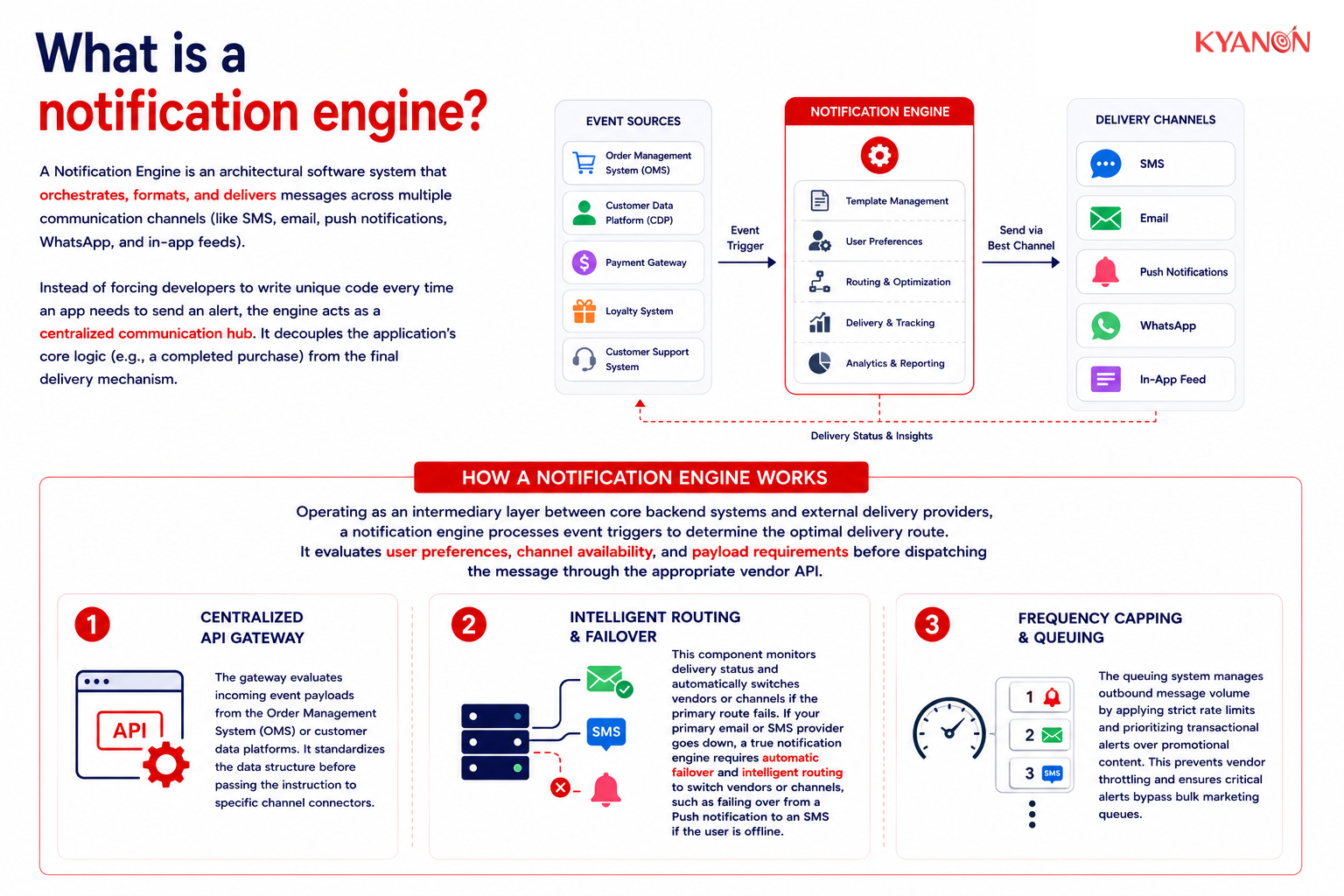
A notification engine is an architectural software system that orchestrates, formats, and delivers messages across multiple communication channels (like SMS, email, push notifications, WhatsApp, and in-app feeds). Instead of forcing developers to write unique code every time an app needs to send an alert, the engine acts as a centralized communication hub. It decouples the application’s core logic (e.g., a completed purchase) from the final delivery mechanism.
How a notification engine works
Operating as an intermediary layer between core backend systems and external delivery providers, a notification engine processes event triggers to determine the optimal delivery route. It evaluates user preferences, channel availability, and payload requirements before dispatching the message through the appropriate vendor API.
Centralized API gateway
The gateway evaluates incoming event payloads from the Order Management System (OMS) or customer data platforms. It standardizes the data structure before passing the instruction to specific channel connectors.
Intelligent routing & failover
This component monitors delivery status and automatically switches vendors or channels if the primary route fails. If your primary email or SMS provider goes down, a true notification engine requires automatic failover and intelligent routing to switch vendors or channels, such as failing over from a Push notification to an SMS if the user is offline.
Frequency capping & queuing
The queuing system manages outbound message volume by applying strict rate limits and prioritizing transactional alerts over promotional content. This prevents vendor throttling and ensures critical alerts bypass bulk marketing queues.
Notification Engine vs Basic Email Service Provider (ESP)
Both systems deliver messages to users, but they differ structurally in channel scope, infrastructure placement, and transactional capabilities.
|
Dimension |
Notification Engine | Basic ESP |
| Channel support | Omnichannel (SMS, Push, Email, In-app) |
Single-channel (Email) |
|
Primary use case |
Transactional routing & OTPs | Outbound marketing campaigns |
| Failover capability | High (Cross-channel automated routing) |
Low (Retries on the same channel) |
|
Infrastructure placement |
Middleware / Backend API | Frontend / Marketer UI |
| Throughput priority | Latency-sensitive (Real-time) |
Batch processing (Scheduled) |
When to consider a notification engine
Evaluating a notification engine requires assessing your current API maintenance overhead and the business impact of delayed transactional messages.
Consider a Notification Engine if:
- Your engineering team spends excessive sprint capacity managing retry logic and maintaining separate API connections for Twilio, SendGrid, and Firebase.
- Your transactional alerts, such as one-time passwords (OTPs) or fraud warnings, experience latency due to being queued behind large marketing batch sends.
- You require strict cross-channel frequency capping to prevent user churn across disparate marketing platforms.
It may not be the right priority if:
- Your communication strategy relies strictly on a single channel for a small user base and does not involve time-critical transactional alerts.
Why a notification engine matters for enterprise E-commerce
A Notification Engine is critical for enterprise e-commerce because it protects core revenue, slashes customer support costs, and ensures operational compliance at scale.In enterprise retail, a single system outage or a delayed transaction message can cost millions in lost sales and brand damage.
A dedicated notification engine isolates your checkout process from network deliverability issues, ensuring the digital infrastructure handles traffic spikes seamlessly.
Common misconceptions
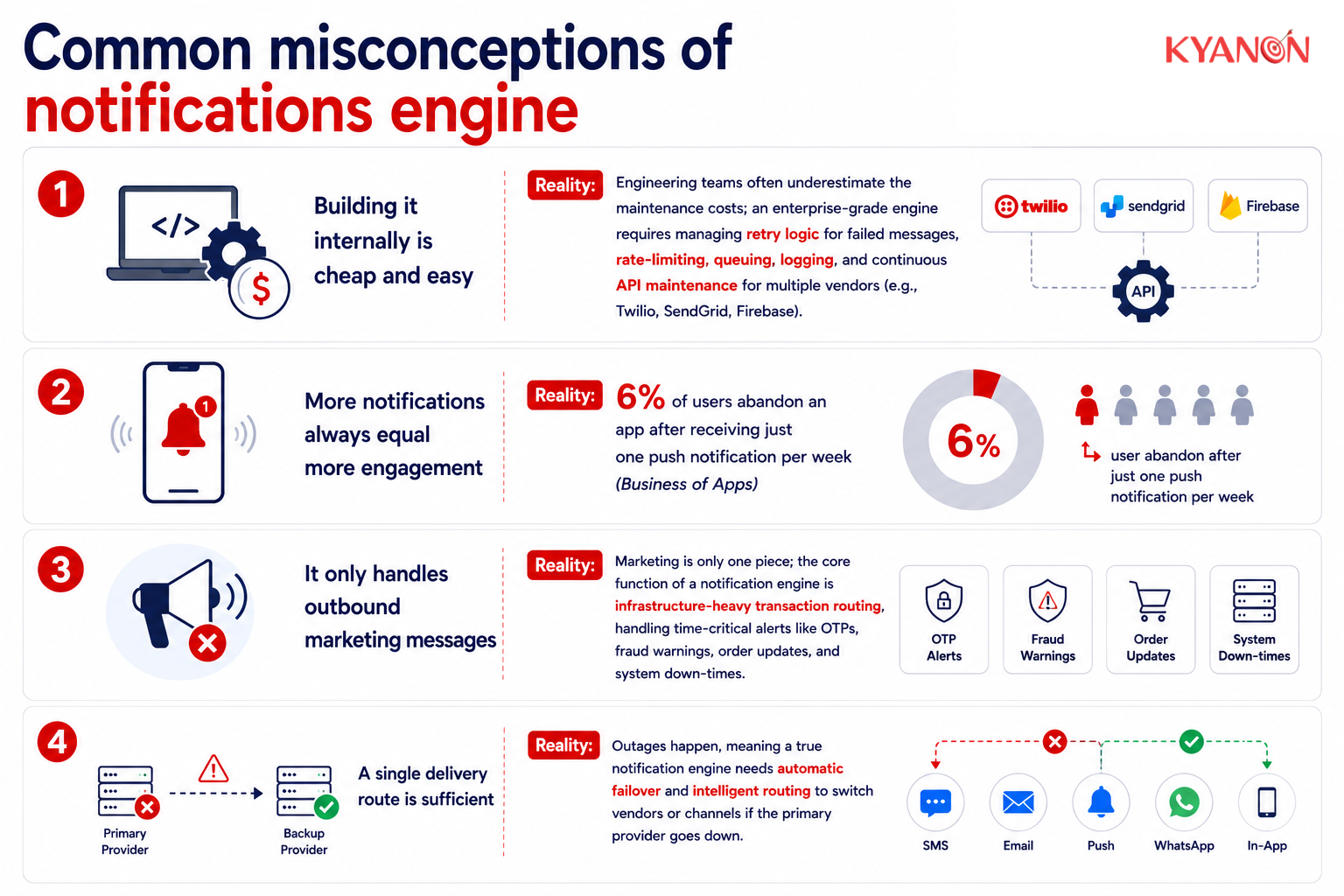
Building it internally is cheap and easy
Reality: Engineering teams often underestimate the maintenance costs; an enterprise-grade engine requires managing retry logic for failed messages, rate-limiting, queuing, logging, and continuous API maintenance for multiple vendors (e.g., Twilio, SendGrid, Firebase).
More notifications always equal more engagement
Reality: 6% of users abandon an app after receiving just one push notification per week (Business of Apps)
It only handles outbound marketing messages
Reality: Marketing is only one piece; the core function of a notification engine is infrastructure-heavy transaction routing, handling time-critical alerts like OTPs, fraud warnings, order updates, and system down-times.
A single delivery route is sufficient
Reality: Outages happen, meaning a true notification engine needs automatic failover and intelligent routing to switch vendors or channels if the primary provider goes down.
How Kyanon Digital applies notification engines
Kyanon Digital builds dedicated notification engines within broader Order Management System (OMS) and loyalty platform deliverables for enterprise clients across Southeast Asia and ANZ. Our architecture prioritizes intelligent routing and failover logic, ensuring customers receive time-critical transactional updates while strictly managing API overhead for internal engineering teams.
Explore our services:











 Create project brief with AI