

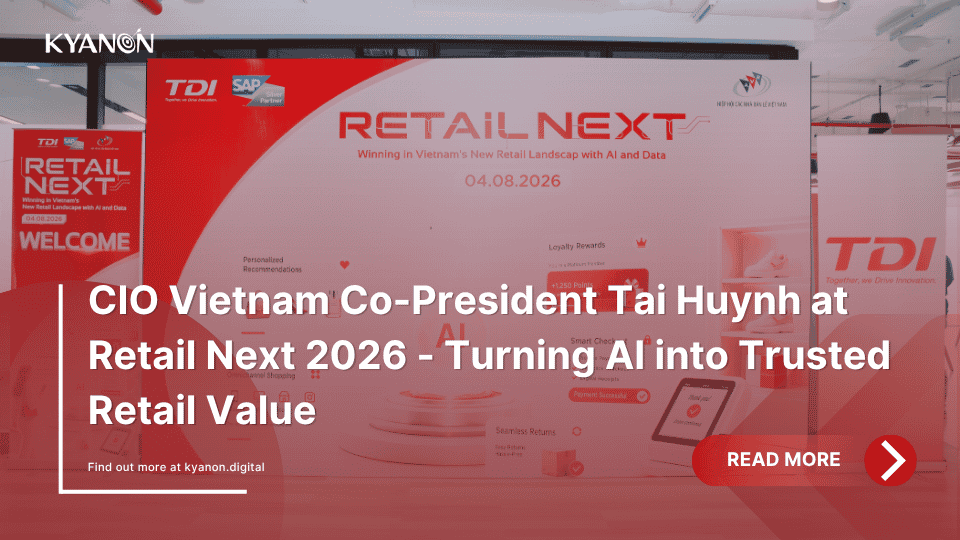
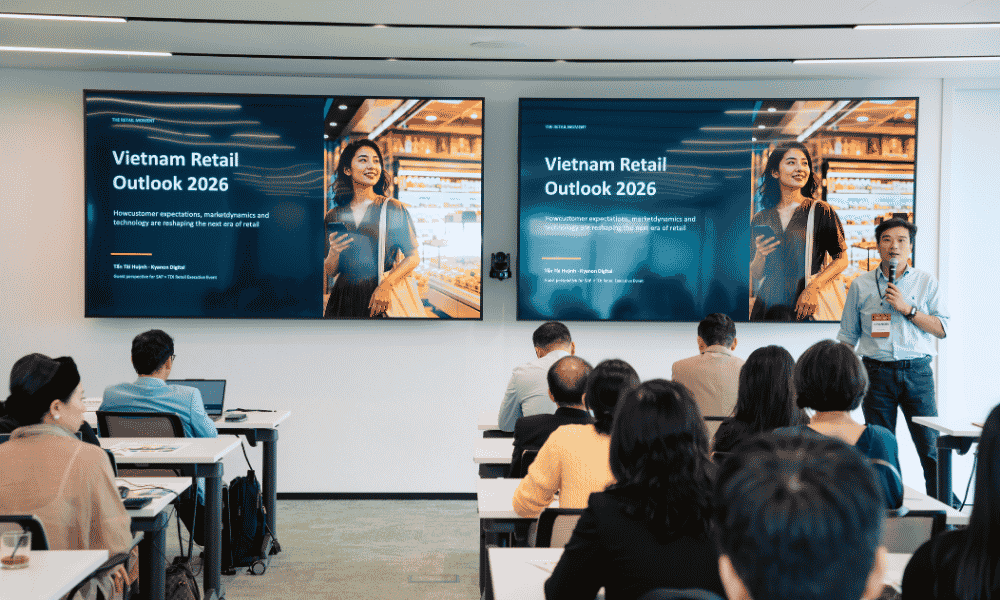
On 4 August in Ho Chi Minh City, Dr. Huỳnh Lê Tấn Tài (Tai Huynh), founder of Kyanon Digital and co-president of the CIO Vietnam Community, shared his perspective at the workshop Retail Next 2026 – Winning in Vietnam’s New Retail Landscape with AI and Data.
The event explored Vietnam’s evolving retail landscape and how AI, enterprise data, and Cloud ERP can support the next stage of growth. During the event, CIO Tai Huynh highlighted how technology can help retailers identify critical customer moments, connect customer experience with operations, improve decision-making with AI, and measure financial impact.
His presentation, The Retail Moment, focused on one central question: How quickly can a retailer turn a customer signal into an appropriate business response while the opportunity still matters?
The retail advantage is moving from reach to response
Retailers receive customer and operational signals every day: a product search, an abandoned cart, changing demand, a complaint, or an emerging inventory shortage.
The challenge is not simply collecting more signals. It is how quickly the organization can understand them, make a decision, and act consistently.
Digital commerce, mobile apps, loyalty, payments, and marketplaces remain important, but these capabilities are increasingly becoming baseline expectations. According to CIO Tai Huynh’s presentation, a more defensible advantage lies in shortening the distance between customer signals and business responses.
Customers see one brand, not separate systems
Customers expect one consistent promise covering products, prices, promotions, availability, delivery, returns, loyalty, and service.
Behind that promise, however, the journey may pass through commerce, loyalty, inventory, stores, fulfillment, payments, finance, and customer service systems.
Problems arise when these capabilities do not share the same context:
- An online promotion is unknown to store employees.
- A product appears available online but is out of stock at the store.
- A return is processed, but the refund or loyalty balance remains unchanged.
- Customer service cannot access an earlier interaction.
Customers do not describe these failures as integration gaps or data silos. They experience them as a brand failing to keep its promise.
When businesses cannot respond consistently, value leaks through lost sales, unnecessary discounts, manual work, fulfillment issues, inaccurate inventory, and declining customer trust. The presentation emphasized that the cost of standing still is not only an IT expense; it is commercial and operational leakage occurring every day.
Retail AI should improve real decisions
AI is increasingly involved in retail discovery, merchandising, personalization, customer service, demand planning, and next-best actions.
But the starting question should not be, “Which AI technology should we buy?”
In his follow-up interview with Tạp chí Thương Trường from the event, CIO Tai Huynh argued that retailers should first identify where customers experience friction and where the business is losing value.
AI can then support practical decisions such as:
- Which product or offer is most relevant?
- Is the product available where the customer needs it?
- Which customer or service case requires attention?
- When should AI hand an interaction to an employee?
- Where should inventory be allocated as demand changes?
The presentation reinforces the same principle: AI creates value when it improves a real decision, not simply when it produces more content or automation.
Retailers can measure the impact through response time, conversion, basket value, fulfillment reliability, retention, operating cost, margin, and inventory performance.

Personalization must create relevance, not noise
Following his presentation, CIO Tai Huynh spoke with Tạp chí Thương Trường about AI-powered personalization, privacy, and phygital customer experiences.
AI can combine purchase history, search behavior, previous campaign responses, interaction channels, timing, location, inventory availability, and business objectives to identify a more suitable next action.
That does not necessarily mean sending more discounts.
As he explained:
“Personalization should make customers feel understood, not monitored.”
— translated from his interview with Tạp chí Thương Trường.
The objective is to reduce irrelevant interactions and understand whether a customer needs an offer, advice, an alternative product, or simply faster service.

Customer trust must be designed into AI
Greater personalization also creates greater responsibility for customer data.
CIO Tai Huynh described privacy as something that needs to be considered from the beginning of an AI initiative:
“Privacy must be a design requirement from the outset.”
— translated from his interview with Tạp chí Thương Trường.
Retailers should therefore establish clear rules around what data they collect, why it is needed, who can access it, and how long it is retained.
The interview also highlights practical requirements including consent management, appropriate access controls, encryption or anonymization of sensitive data, traceability, and human supervision of high-impact AI decisions.
The underlying principle is straightforward: the deeper a business understands its customers, the greater its responsibility to protect and appropriately use their data.
Phygital means continuing the same customer journey
Phygital retail is more than adding QR codes, screens, or digital tools to physical stores.
CIO Tai Huynh described it as connecting online context with the physical experience so that customers do not have to restart their journey every time they change channels.
For example, a customer who researched a product online should be able to enter a store, confirm availability, receive relevant assistance, purchase or arrange fulfillment, and continue receiving loyalty and after-sales support within the same journey.
That requires connected information across customer profiles, products, pricing, promotions, inventory, orders, and service.
The physical store therefore becomes more than a transaction point. It can serve as a connected node for discovery, consultation, fulfillment, service, and customer relationships.
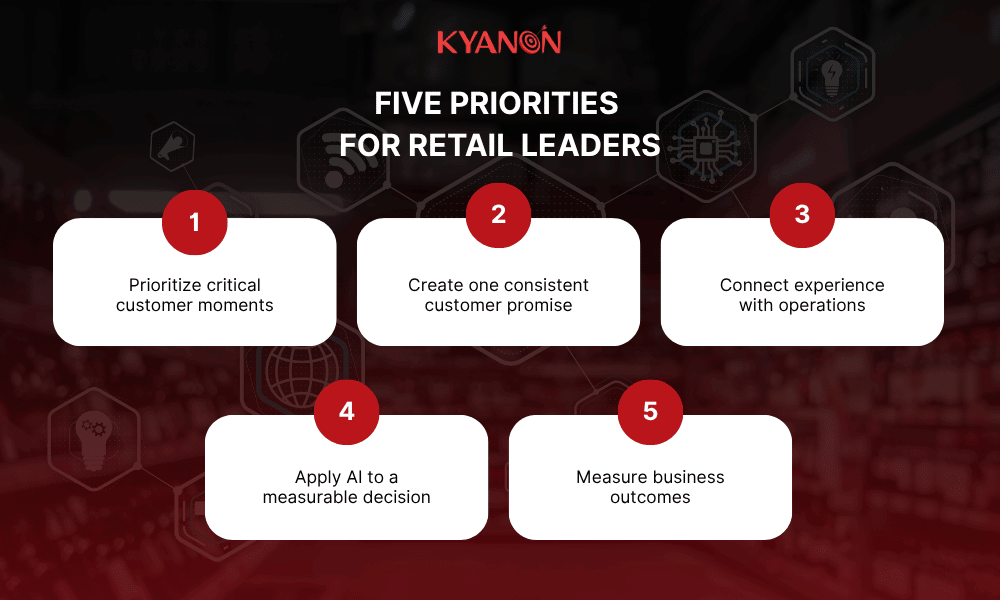
Five priorities for retail leaders
Retailers do not need to transform every journey at once. A focused starting point is to:
- Prioritize critical customer moments with high value, frequency, and friction.
- Create one consistent customer promise across product, price, availability, fulfillment, and service.
- Connect experience with operations rather than optimizing individual channels in isolation.
- Apply AI to a measurable decision with clear ownership, suitable data, and defined boundaries.
- Measure business outcomes through response time, promises kept, revenue, margin, cost, cash, and inventory impact.
Building a more responsive retail enterprise
The next stage of retail competition will not be defined simply by having more channels, campaigns, AI tools, or customer data. The advantage will come from how quickly retailers can turn customer signals into the right decisions and consistent business responses.
That requires more than a better customer-facing experience. Retailers need connected data and operations so that product, pricing, inventory, loyalty, fulfillment, and service can work around the same customer journey.
The business impact should also be clear: faster response times, more promises kept, lower operational leakage, and stronger outcomes across revenue, margin, cost, and inventory. These are the measures that turn AI and digital investment into sustainable retail value. This directly reflects the presentation’s emphasis on response time, promises kept, and financial impact.
For Kyanon Digital, this means helping retailers connect customer experience, commerce, data, AI, and operations around the moments that matter most, from customer signal to measurable business action.
Ready to turn retail moments into business results? Talk to Kyanon Digital.



















 Create project brief with AI