
What is microservices commerce?
Microservices commerce is an e-commerce architecture that separates capabilities such as product catalog, pricing, promotions, cart, checkout, payments, inventory, and order management into loosely coupled services that can be developed, deployed, operated, and scaled independently.
Each service is organized around a defined business capability and communicates with other services through APIs or asynchronous events rather than through one shared commerce codebase. AWS defines microservices as independent components aligned with business capabilities and connected through well-defined interfaces.
Microservices commerce describes the internal architecture of a commerce platform. It does not define the storefront design, customer channel, vendor model, or whether the platform is headless or composable.
How microservices commerce works
Microservices commerce works by assigning defined commerce responsibilities to autonomous services, allowing each capability to change and consume infrastructure without requiring the entire platform to be rebuilt, redeployed, or scaled.
The architecture is effective when service boundaries reflect real business domains rather than arbitrary technical layers. Microsoft’s Azure Architecture Center states that a microservice should implement one business capability within a bounded context and manage its own code and state.
Domain-aligned commerce services
Each service owns a specific commerce responsibility, such as calculating prices, maintaining carts, authorizing payments, checking inventory, or processing orders.
Service boundaries should follow business rules and ownership boundaries. For example, the pricing service may manage price lists, customer-specific pricing, tax inputs, and discount eligibility, while the inventory service manages available-to-sell quantities and reservation rules.
This separation limits the operational impact of a change. A team can modify promotion logic without rebuilding unrelated capabilities such as product search or order tracking.
APIs, events, and commerce orchestration
Microservices exchange information through synchronous APIs, asynchronous events, or a combination of both.
An API gateway or backend-for-frontend layer can route requests from web, mobile, marketplace, POS, and partner channels to the relevant services. Event-driven communication can distribute changes such as an order being confirmed, inventory being reserved, or a payment being declined without requiring every service to wait for a direct response.
The orchestration model must define what happens when part of a transaction fails. Checkout may involve pricing, inventory, payment, fraud, loyalty, delivery, and order services, so recovery rules and transaction states must be managed across service boundaries.
Independent deployment and runtime management
Each microservice can have its own release pipeline, runtime configuration, infrastructure capacity, and operational owner.
This independence allows a retailer to scale a high-demand service such as checkout or inventory availability without scaling the entire commerce platform. It also permits smaller releases and service-level rollbacks when a change creates an error. AWS identifies independent scaling, deployment, and service ownership as defining characteristics of microservices.
The trade-off is greater operational responsibility. CI/CD pipelines, API versioning, service discovery, access controls, distributed tracing, centralized logging, alerting, and infrastructure automation become part of the platform rather than optional support functions.

Microservices commerce vs. monolithic commerce
Microservices commerce distributes commerce capabilities across independently operated services, whereas monolithic commerce places multiple capabilities within one application, deployment unit, and, commonly, one shared data model.
A monolith is generally simpler to start and operate at a limited scale, while microservices provide more granular control over deployment, scaling, ownership, and technology selection as organizational and commerce complexity increases.
|
Dimension |
Microservices commerce |
Monolithic commerce |
|
Architecture |
Commerce capabilities are separated into loosely coupled services | Commerce capabilities are combined within one application |
| Deployment model | Services can be released independently |
Changes are normally released as one application deployment |
|
Scaling model |
Individual services can scale according to their workload | The entire application is commonly scaled together |
| Change isolation | A change can be limited to one defined capability |
A local change may affect several dependent modules |
|
Failure containment |
Failure can be isolated when dependencies and fallbacks are designed correctly | A failure may affect the entire application or several functions |
| Data ownership | Services usually manage their own state or data boundaries |
Modules commonly share a central database or tightly coupled data model |
|
Integration model |
APIs and events coordinate distributed services | Internal modules often communicate within the same process or codebase |
| Release frequency | Different teams can release at different cadences |
Teams usually coordinate around a shared release cycle |
|
Team structure |
Autonomous teams own defined business capabilities | Teams may share responsibility for the same application |
| Infrastructure cost | Capacity can be allocated by service, but platform overhead is higher |
Infrastructure is easier to manage initially but may be less granular |
|
Operational complexity |
Requires service governance, observability, automation, and distributed-system skills | Requires fewer distributed-system controls at the beginning |
| Technology flexibility | Services may use different technologies where justified |
The platform normally uses a more standardised technology stack |
|
Upfront delivery effort |
Higher architecture and platform-engineering investment | Faster initial setup for simple requirements |
| Long-term TCO | Can improve when independent change and scaling reduce platform constraints |
Can remain lower for simple operations but rise as coupling and customisation accumulate |
|
Best suited for |
Complex, high-volume, multi-market, or frequently changing commerce operations |
Smaller or more stable commerce operations with limited domain complexity |
Microservices commerce is not automatically superior to monolithic commerce. The appropriate choice depends on transaction volume, business-domain complexity, release frequency, integration requirements, team maturity, and the expected cost of operating a distributed platform.
When to consider microservices commerce
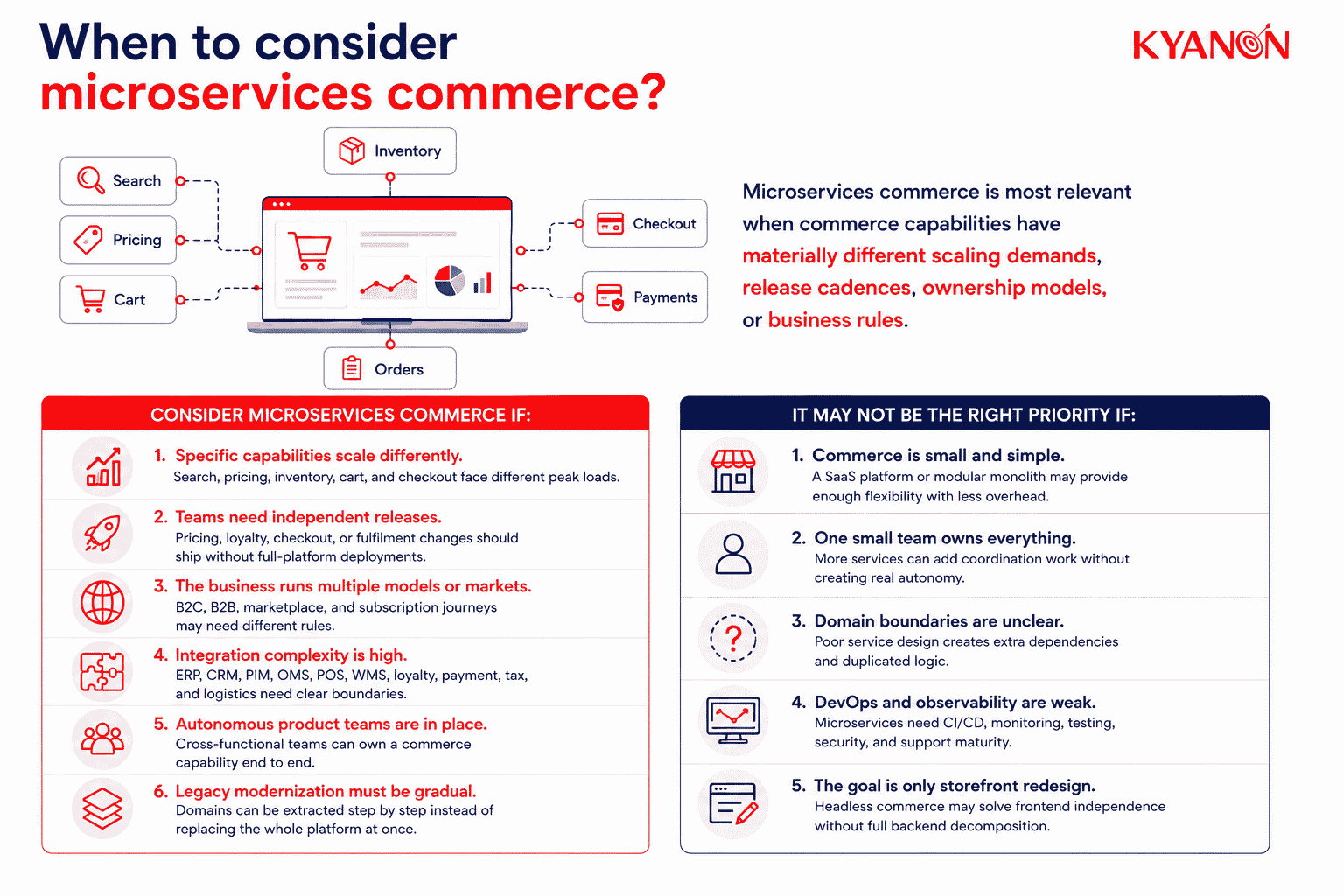
Microservices commerce is most relevant when commerce capabilities have materially different scaling demands, release cadences, ownership models, or business rules.
Consider microservices for commerce if:
- Peak traffic affects specific commerce capabilities differently. Search, pricing, promotion, inventory, cart, and checkout may experience different demand patterns during product launches, campaign periods, flash sales, or seasonal peaks.
- A shared release cycle is delaying commercial changes. Pricing, loyalty, checkout, or fulfillment teams may need to release independently rather than wait for a coordinated platform deployment.
- The business operates multiple brands, markets, or commerce models. B2C, B2B, marketplace, subscription, and store-assisted journeys may share selected services while applying different pricing, catalog, payment, or order rules.
- Commerce must connect with several enterprise systems. ERP, CRM, PIM, OMS, POS, WMS, loyalty, payment, tax, fraud, and logistics platforms may need clearly governed integration boundaries.
- The organization has autonomous product teams. Microservices are more effective when cross-functional teams can own a commerce capability from roadmap and development through production support.
- A legacy platform is preventing incremental modernization. Individual domains can be extracted progressively rather than requiring a single high-risk platform replacement.
It may not be the right priority if:
- The commerce operation has a small catalog, limited channels, and standard fulfillment requirements. A SaaS platform or modular monolith may provide sufficient flexibility with less operational overhead.
- One small engineering team owns the entire platform. Dividing the application into many services can add coordination work without creating meaningful team autonomy.
- Business-domain boundaries are unclear. Poorly defined services create excessive dependencies, duplicated logic, and frequent cross-service changes.
- The organization lacks automated deployment and observability. Microservices increase the number of runtime components that must be secured, monitored, tested, and supported.
- The primary goal is only to redesign the storefront. Headless commerce may address frontend independence without requiring full backend decomposition.
Why microservices commerce matters for enterprise retail
Microservices commerce matters for enterprise retail when commercial growth causes different capabilities, markets, and teams to change at different speeds.
Retailers frequently need to coordinate product data, pricing, promotion, inventory, payment, loyalty, orders, stores, fulfillment, and customer channels. Independent services can reduce the number of unrelated components affected when one of these domains changes, but the value depends on platform engineering and organizational ownership.
The Cloud Native Computing Foundation reported in 2026 that 98% of surveyed organizations had adopted cloud-native techniques, while 82% of container users ran Kubernetes in production, up from 66% in 2023. These findings do not measure microservices commerce specifically, but they show that the cloud-native infrastructure commonly used to operate distributed services has reached broad production adoption.
The same CNCF research found that organizational culture was the most frequently cited adoption challenge, selected by 47% of respondents, ahead of security and technical complexity. This supports the view that distributed architectures require changes in ownership, governance, and team coordination rather than only new infrastructure.
A commercetools customer case reports that Pet Valu combined a microservice-based architecture, CI/CD, Google Cloud, and observability to support incremental releases and rollbacks. The retailer reported releasing features two to three times faster and reducing time to market by 40% after the change. This is a vendor-published customer result rather than an industry-wide benchmark, but it illustrates how architecture, delivery practices, and team operating models can work together.
For enterprise retailers, the expected outcome should therefore be assessed through measurable platform and business indicators, including:
- Lead time for commerce changes
- Deployment frequency by business capability
- Change-failure and rollback rates
- Availability of checkout and order services
- Infrastructure cost by service or transaction
- Peak transaction throughput
- Time required to launch a new market or channel
- Conversion and order-completion performance
- Engineering effort spent on maintenance
- Total cost of ownership over the planned platform lifecycle
Common misconceptions
Microservices commerce does not remove architecture complexity; it exchanges centralised application coupling for distributed service, data, network, and operational coordination.
“Once we split the platform into microservices, scaling is automatic.”
Reality: Service separation only creates the option to scale components independently.
Poor service boundaries, shared databases, synchronous dependency chains, inefficient queries, or centralised bottlenecks can still limit the entire transaction. Scaling also requires capacity policies, performance testing, caching, queue management, and failure controls.
“Microservices eliminate complexity from the commerce platform.”
Reality: Microservices reduce some forms of code and deployment coupling but introduce distributed-system complexity.
The organization must manage network latency, partial failures, API contracts, asynchronous processing, data consistency, transaction recovery, service discovery, security, and end-to-end observability. Microsoft explicitly notes that a microservices system can be more complex overall even when each individual service is simpler.
“Best-of-breed services can be connected like plug-and-play components.”
Reality: Independent services and vendors do not remove integration engineering.
Teams must govern API versions, schemas, authentication, rate limits, error handling, data ownership, service-level objectives, and changes made by external providers. A commercial API reduces the need to build a capability from zero, but it does not remove orchestration or lifecycle management.
“Microservices commerce is always cheaper because we only scale what we use.”
Reality: Granular infrastructure allocation can reduce waste for uneven workloads, but the architecture creates additional platform costs.
These costs may include API gateways, message brokers, container orchestration, CI/CD, monitoring, distributed tracing, security tooling, test environments, cloud-network traffic, and specialist operating teams. TCO improves only when the value of independent scaling and delivery exceeds this overhead.
“Microservices are purely a technical architecture decision.”
Reality: Microservices also define how teams divide ownership and accountability.
A service requires decisions about roadmap ownership, data stewardship, production support, performance, security, and service-level objectives. AWS associates microservices with small teams that own individual services rather than with a central team managing every component.
“Every commerce capability should become its own microservice.”
Reality: Service count is not a measure of architectural maturity.
Splitting closely related logic into excessively small services increases network calls, deployment dependencies, troubleshooting effort, and coordination cost. A larger domain service or modular monolith may be more effective when capabilities change together and have the same ownership and scaling profile.
“Microservices commerce is the right target architecture for every retailer.”
Reality: Microservices are not a one-size-fits-all architecture.
Businesses with straightforward products, standard checkout, limited integrations, predictable demand, and one delivery team may obtain better time-to-market and TCO from a SaaS commerce platform or modular monolith. Architecture should follow operational complexity rather than company size or market terminology.
How Kyanon Digital applies microservices commerce
Kyanon Digital applies microservices commerce selectively by assessing business-domain boundaries, transaction patterns, integration dependencies, delivery ownership, security requirements, and total cost of ownership before defining the service architecture.
For enterprise commerce platforms, this can involve separating capabilities such as catalog, pricing, promotion, loyalty, inventory, checkout, payment, and order processing where independent change or scaling creates a measurable operating advantage. Kyanon Digital’s published commerce capabilities include headless architecture, API-first development, composable commerce, microservices integration, multi-frontend management, and connectivity with ERP, CRM, inventory, payment, logistics, and fulfillment systems.
The supporting delivery environment may include containerized services, Kubernetes, API gateways, event-driven integration, automated CI/CD, infrastructure as code, centralized monitoring, and distributed tracing. Kyanon Digital’s cloud engineering materials reference Docker, Kubernetes, Terraform, AWS CloudFormation, Jenkins, GitHub Actions, GitLab CI/CD, Prometheus, Grafana, and the ELK stack as technologies used across cloud and microservices delivery.
Kyanon Digital also evaluates monolithic, microservices, composable, cloud-native, and tiered architectures according to project requirements rather than treating microservices as the default for every implementation. Its application-development approach includes architecture selection, TCO assessment, secure API development, automated testing, performance monitoring, and post-launch evolution.
→ Explore Kyanon Digital’s omnichannel ecommerce development services.











 Create project brief with AI