



Retail inventory has become a strategic business issue, not simply an operational one. For retailers operating across physical stores, e-commerce channels, warehouses, and third-party marketplaces, knowing what is in stock, where it is, and when it will be needed can directly affect revenue, working capital, and customer loyalty.
The scale of the problem is significant. According to 2025 Fixing Inventory Distortion study of IHL Group, global retail inventory distortion costs approximately $1.7 trillion annually, including $1.2 trillion from out-of-stocks and $572 billion from overstocks.
At the same time, retailers are under pressure to make inventory decisions faster and more accurately. According to the Deloitte 2025 Retail Industry Outlook found that one-third of retail executives planned significant investments in capabilities such as accurate real-time inventory visibility, a single view of customers across channels, and multiple fulfillment options.
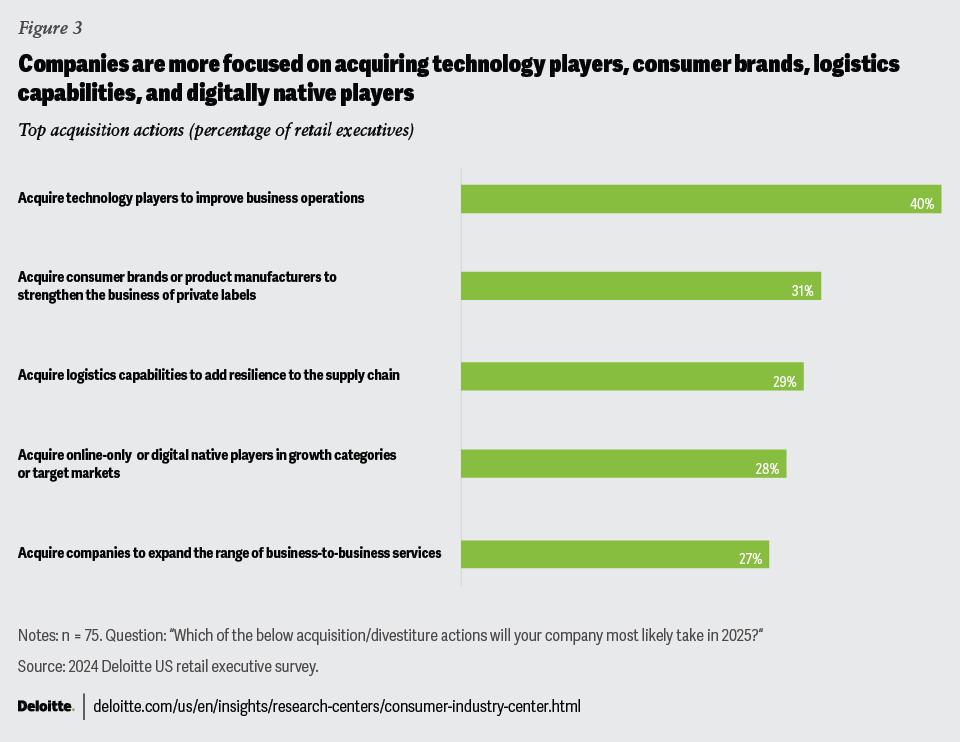
Companies are more focused on acquiring technology players to improve business operations (Source: Deloitte)
This is where modern retail inventory tracking software becomes strategically important. Instead of simply recording stock counts, today’s systems can connect POS, e-commerce, ERP, warehouse, fulfillment, and supply-chain data to create a real-time view of inventory. With AI, predictive analytics, RFID, and automation layered on top, retailers can move from reacting to stock problems to anticipating and preventing them.
Key takeaway
- Global inventory distortion costs retailers approximately $1.7 trillion annually, according to IHL Group’s 2025 research.
- Real-time inventory visibility is becoming a strategic priority as retailers expand omnichannel fulfillment and increasingly complex store networks.
- Retail stock management software can help prevent stockouts through real-time inventory synchronization, demand forecasting, reorder alerts, and intelligent replenishment.
- Digital inventory controls can reduce shrinkage and inventory discrepancies by creating better traceability across receiving, transfers, sales, returns, and fulfillment.
- RFID can deliver substantial operational benefits. McKinsey research found that RFID deployments can improve inventory accuracy by more than 25%, reduce inventory-related labor hours by 10–15%, and generate up to a 1.5% revenue uplift through reductions in shrinkage and theft.
- The next generation of inventory management will combine AI, RFID, IoT, computer vision, and predictive analytics to enable increasingly autonomous replenishment.
What is retail inventory tracking software?
Retail inventory management software provides real-time visibility into product availability and movement across stores, warehouses, and sales channels. By integrating inventory data with purchasing, fulfillment, customer service, and financial systems, it eliminates reliance on manual spreadsheets and fragmented point solutions that can lead to lost sales, cash-flow challenges, and inefficient operations. (Salesforce)
Unlike a basic stock-counting application, a modern retail inventory platform can connect data from multiple operational systems, including:
- Point-of-sale (POS) systems
- E-commerce platforms
- ERP systems
- Warehouse management systems (WMS)
- Order management systems (OMS)
- Supplier and procurement systems
- RFID and barcode scanners
- Stores and distribution centers
- Marketplaces and third-party fulfillment providers
The objective is to establish a single, reliable view of inventory.
For example, when a customer purchases an item in-store, the system can immediately update the available quantity. If the same SKU is also listed online, the e-commerce channel can reflect the updated availability. If inventory falls below a defined threshold, the system can alert the replenishment team or trigger an automated replenishment workflow.
This is particularly important for omnichannel retailers. Deloitte identifies real-time inventory visibility as one of the capabilities retailers are prioritizing as they work to make omnichannel operations more efficient and profitable.
In practice, a retail stock management system therefore becomes part of a broader digital operating model, not simply another application used by store employees.
Common inventory challenges retailers face
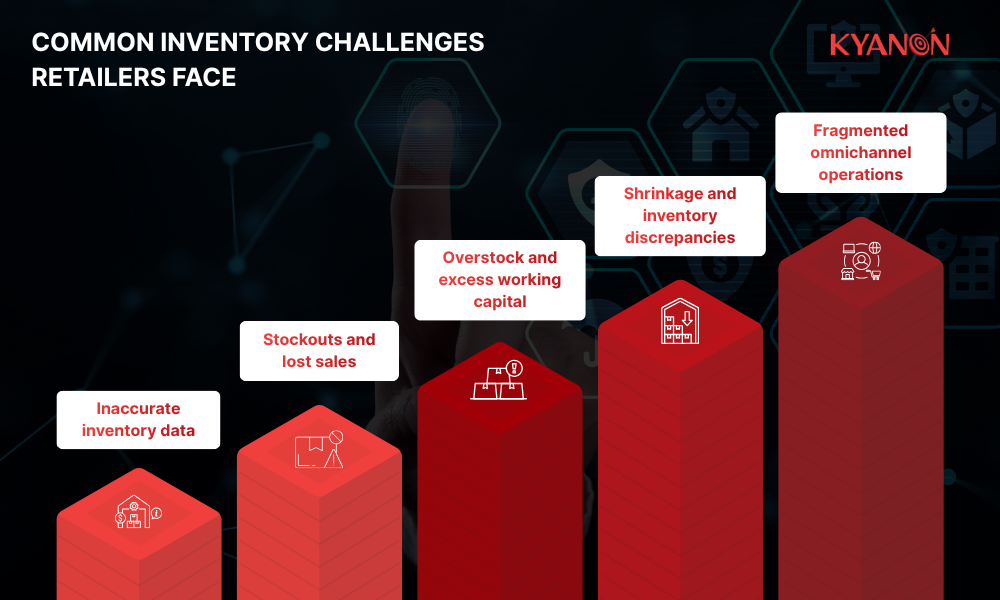
Inventory problems rarely originate from a single process. They are usually the result of disconnected systems, inaccurate data, unpredictable demand, and inconsistent operational processes.
Inaccurate inventory data
A product may appear available in the system even though it has already been sold, misplaced, damaged, or allocated to another order.
This creates what retailers often experience as inventory distortion: the digital inventory position does not accurately represent physical reality. The 2025 retail planning research from Deloitte identifies lack of inventory visibility, siloed and inconsistent data, inaccurate stock levels, and insufficient real-time inventory monitoring and traceability as key challenges facing retailers.
Stockouts and lost sales
When a high-demand product is unavailable, the retailer risks losing the immediate transaction and potentially the customer’s future business. The scale is substantial. IHL’s 2026 Inventory Distortion Study says out-of-stocks represent 65.6% of the $1.7 trillion global inventory-distortion cost. It also identifies $690.9 billion from empty shelves alone.
More importantly, today’s consumers increasingly expect retailers to provide reliable availability information before they visit a store. Product availability remains an important factor in retailer choice. McKinsey consumer research found that products being in stock was among the reasons consumers gave for switching retailers, highlighting how inventory availability can influence where customers choose to shop.
Overstock and excess working capital
The opposite problem can be just as damaging. Holding too much inventory ties up working capital, increases storage costs, creates markdown pressure, and raises the risk of obsolete or expired products.
Shrinkage and inventory discrepancies
Shrinkage can result from theft, administrative errors, damaged goods, incorrect receiving, vendor discrepancies, or process failures. Without detailed transaction records, identifying the source of a discrepancy can be difficult.
Fragmented omnichannel operations
A retailer may have one inventory number in its POS, another in its ERP, another in its e-commerce platform, and yet another in its warehouse.
When these systems are not synchronized, retailers cannot confidently answer basic questions:
- How much inventory is actually available?
- Where is it located?
- Which store should fulfill the order?
- When should replenishment happen?
- Can the product be promised to an online customer?
The result is operational complexity, higher fulfillment costs, and avoidable customer frustration.
How retail inventory tracking software prevents stockouts
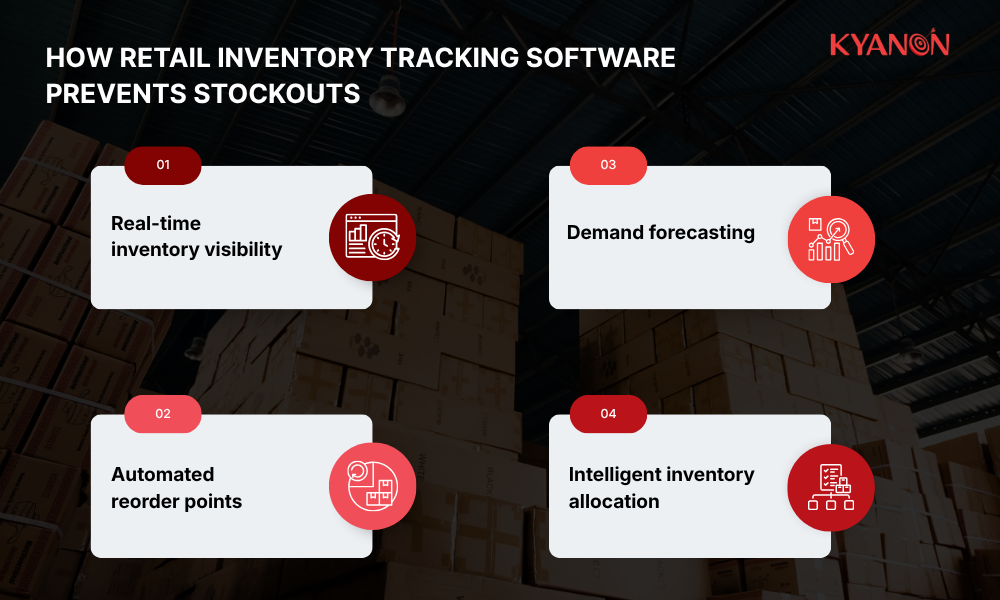
The first major business case for inventory tracking is straightforward: put the right product in the right place at the right time.
Real-time inventory visibility
A modern retail inventory tracking software solution continuously synchronizes inventory movements across stores, warehouses, fulfillment centers, and digital channels. This enables retailers to see:
- Available-to-promise inventory
- On-hand inventory
- Reserved inventory
- In-transit inventory
- Damaged or unavailable inventory
- Inventory by store or warehouse
- Historical sales velocity
This visibility creates the foundation for better replenishment decisions.
Automated reorder points
Instead of relying on employees to manually check stock levels, retailers can define reorder points based on demand, lead times, safety stock, and service-level requirements. When inventory reaches the predefined threshold, the system can generate an alert or, in more advanced environments, initiate an automated replenishment workflow.
Demand forecasting
Historical sales data alone is often insufficient in a volatile retail environment. Advanced forecasting can incorporate factors such as:
- Seasonality
- Promotions
- Holidays
- Weather
- Local demand
- Product lifecycle
- Price changes
- Supplier lead times
- External market signals
McKinsey has highlighted the role of advanced forecasting in reducing both shrink and stockouts by improving inventory decisions. In one case, a leading Eastern European grocer used granular, hourly demand forecasts alongside shrink-control measures for ready-to-eat products, reducing shrink by 15% while improving product quality.
Intelligent inventory allocation
Inventory tracking becomes even more valuable when combined with an order management or fulfillment platform. Suppose Store A has no stock while Store B has excess inventory. Instead of allowing an online order to fail, an intelligent system can determine whether Store B, a distribution center, or another node should fulfill the order.
This converts inventory visibility into revenue protection. Better inventory visibility can translate directly into revenue. McKinsey documented a convenience retailer that unlocked more than $100 million in incremental sales by improving product availability through a combination of inventory-accuracy improvements, service-level optimization, purchase-order reconciliation, and an inventory health dashboard. The case demonstrates that inventory management is not simply about controlling stock, it can become a direct lever for revenue growth and working-capital productivity.
How inventory tracking software reduces inventory loss
Preventing stockouts protects revenue. Improving inventory control protects margin.
Create a traceable inventory history
Every movement, from receiving and put-away to transfers, returns, adjustments, and sales can be recorded digitally.
This creates a traceable history that makes it easier to identify:
- Where discrepancies occurred
- Which locations have unusually high shrinkage
- Whether receiving quantities match purchase orders
- Whether transfers were completed correctly
- Whether returns were properly processed
- Which SKUs have abnormal inventory movements
Improve inventory accuracy through RFID
RFID can significantly improve the accuracy and speed of inventory counting. McKinsey research found that modern RFID deployments can deliver:
- More than 25% improvement in inventory accuracy through better item-level visibility.
- 1–3.5% increase in full-price sell-through, associated with improved inventory management and fewer stockouts.
- 10–15% reduction in inventory-related labor hours, reducing the time required for manual counting and inventory management.
The actual business case varies by retail category, product economics, and implementation model.
McKinsey highlights lululemon as a real-world example of RFID-enabled inventory management. The retailer uses RFID tags across its network of nearly 500 stores, achieving 98% inventory accuracy and a reported payback period of one year or less. The improved product-location visibility also supports omnichannel fulfillment by helping lululemon access inventory across both stores and distribution centers.
The lesson is important: inventory tracking technology creates the greatest value when it is connected to actual operating processes such as replenishment, fulfillment, and customer service.
For food, beverage, beauty, pharmaceutical, and other time-sensitive products, inventory tracking can also incorporate expiration dates, batches, and product age.
Walmart is also expanding RFID into fresh-food categories. In 2025, Walmart and Avery Dennison announced an RFID-enabled solution for bakery, meat, and deli departments. The technology allows associates to track inventory faster and more accurately, access digital use-by dates, improve product rotation, and make smarter markdown decisions, helping reduce unsold food and waste.
Essential features to look for
Not every inventory application delivers the same level of operational value. Retailers should evaluate the capabilities they need based on their scale, business model, and existing technology landscape.
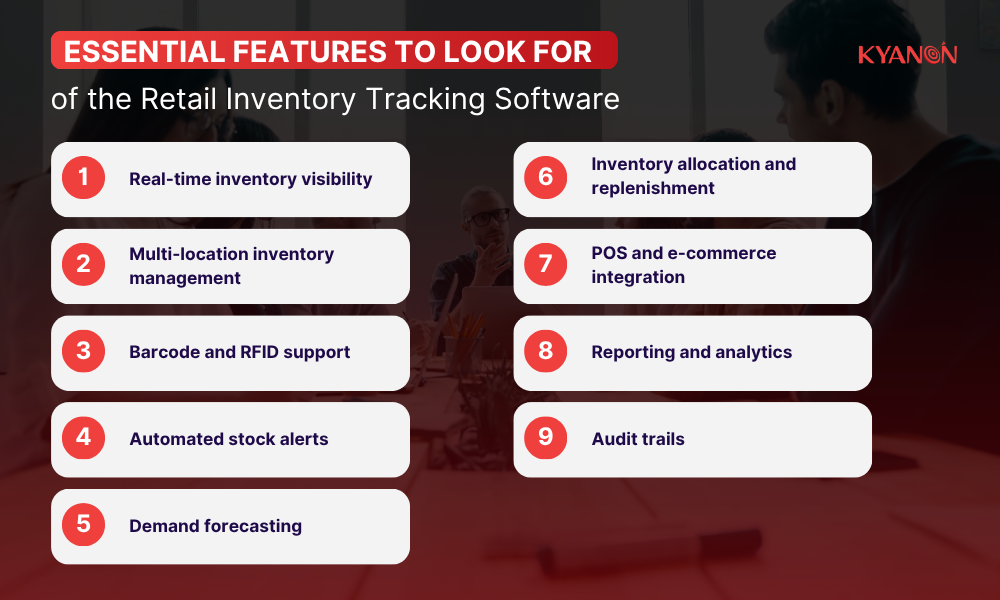
- Real-time inventory visibility: The system should provide a consolidated view of inventory across stores, warehouses, e-commerce, and other fulfillment nodes.
- Multi-location inventory management: Retailers with multiple locations should be able to track inventory by: Store, warehouse, distribution center, region, channel, fulfillment node
- Barcode and RFID support: Barcode scanning remains essential for many retail environments, while RFID can provide higher-speed inventory counting and item-level visibility where the business case supports it.
- Automated stock alerts: The system should identify low-stock, excess-stock, and unusual inventory conditions automatically.
- Demand forecasting: Forecasting capabilities can help retailers move beyond static reorder thresholds toward dynamic inventory planning.
- Inventory allocation and replenishment: The software should support decisions about where inventory should be positioned and when it should be replenished.
- POS and e-commerce integration: Integration is critical. Inventory data should flow reliably between the retail stock management system, POS, e-commerce platform, ERP, OMS, and warehouse systems.
- Reporting and analytics: Leadership teams need more than raw stock counts. They need dashboards that expose: Inventory turnover, stockout rates, sell-through, shrinkage, excess inventory, inventory aging, fill rates, forecast accuracy, working-capital impact
- Audit trails: Every adjustment and inventory movement should be traceable for operational control and compliance.
Benefits beyond stock control
The business value of inventory tracking extends beyond knowing how many products are on a shelf.
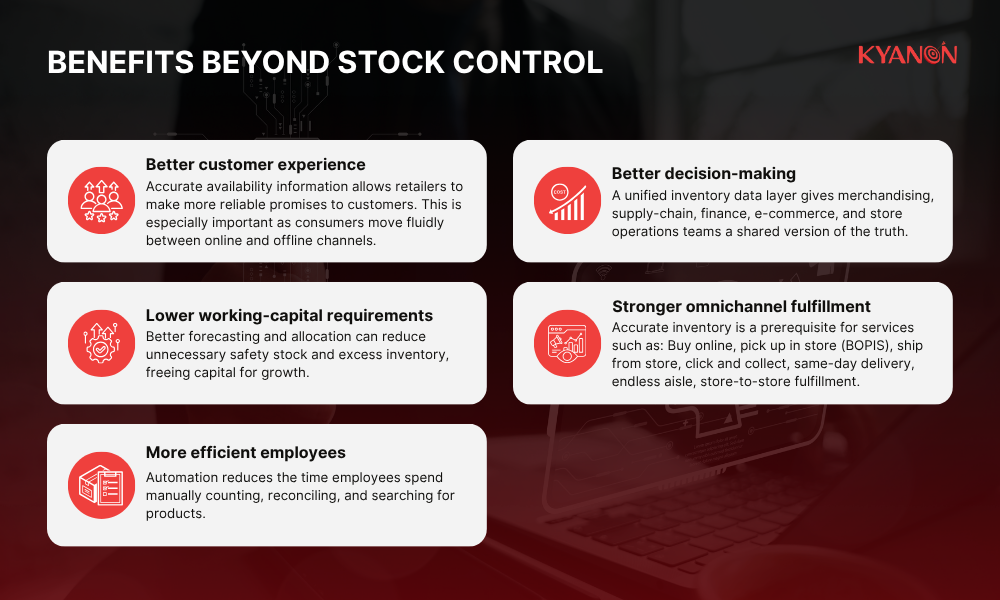
- Better customer experience: Accurate availability information allows retailers to make more reliable promises to customers. This is especially important as consumers move fluidly between online and offline channels.
- Lower working-capital requirements: Better forecasting and allocation can reduce unnecessary safety stock and excess inventory, freeing capital for growth.
- More efficient employees: Automation reduces the time employees spend manually counting, reconciling, and searching for products. McKinsey’s RFID research indicates that RFID deployments can reduce inventory-related labor hours by approximately 10–15%, helping retailers reduce the time and effort required for manual inventory counting and management.
- Better decision-making: A unified inventory data layer gives merchandising, supply-chain, finance, e-commerce, and store operations teams a shared version of the truth.
- Stronger omnichannel fulfillment: Accurate inventory is a prerequisite for services such as: Buy online, pick up in store (BOPIS), ship from store, click and collect, same-day delivery, endless aisle, store-to-store fulfillment
The value therefore extends beyond inventory control into the broader omnichannel operating model.
Best practices for successful implementation
Technology alone does not solve inventory problems. Retailers need to align systems, data, processes, and people.
Establish the baseline
Before implementing new technology, measure current performance:
- Inventory accuracy
- Stockout rate
- Shrinkage
- Inventory turnover
- Forecast accuracy
- Fill rate
- Carrying costs
This establishes a baseline against which ROI can be measured.
Clean and standardize inventory data
SKU duplication, inconsistent product descriptions, incorrect units of measure, and inaccurate supplier information can undermine even sophisticated technology.
Integrate rather than create another silo
The goal should not be to add another isolated application.
A modern retail inventory control software solution should integrate with the existing technology ecosystem wherever possible.
Start with high-value use cases
Rather than attempting a network-wide transformation immediately, retailers can begin with specific problems such as:
- High-stockout categories
- High-shrink stores
- Perishable inventory
- High-value SKUs
- Omnichannel fulfillment
- Poorly performing distribution nodes
Train frontline teams
Store employees remain critical to inventory accuracy. Receiving, transfer, return, scanning, and adjustment procedures need to be standardized and supported by training.
Build continuous improvement into the operating model
Inventory optimization should not end when the software goes live. Retailers should continuously evaluate performance, adjust forecasting models, refine replenishment rules, and identify new automation opportunities.
Measuring success
A successful inventory technology investment should be measured in business outcomes—not simply system adoption.
Key KPIs include:
|
KPI |
What it measures | Business impact |
| Inventory accuracy | Difference between system records and physical inventory |
Reduces stock discrepancies and improves inventory visibility |
|
Stockout rate |
Frequency of products being unavailable when needed | Protects sales and customer loyalty |
| Inventory turnover | How efficiently inventory is sold and replenished |
Improves working-capital efficiency |
|
Shrinkage rate |
Inventory lost through theft, damage, or operational errors | Protects profit margins |
| Sell-through rate | Percentage of available inventory sold within a given period |
Improves merchandising and assortment decisions |
|
Order fill rate |
Percentage of customer demand fulfilled from available inventory | Improves fulfillment performance and customer service |
| Forecast accuracy | Difference between forecasted and actual demand |
Enables more precise replenishment and purchasing |
|
Carrying cost |
Cost associated with storing and maintaining inventory | Reduces unnecessary capital tied up in stock |
| Inventory-related labor hours | Time employees spend counting, reconciling, and managing inventory |
Measures productivity gains and automation benefits |
The most useful approach is to connect operational KPIs to financial outcomes.
Choosing the right retail inventory tracking software
The right solution depends on the complexity of your retail operation.
|
Criteria |
What to consider | Why it matters |
| Business size | Choose capabilities appropriate to your operation, from basic inventory and POS integration for small retailers to distributed inventory visibility, advanced forecasting, RFID, OMS integration, and AI-driven optimization for enterprises. |
Ensures the solution matches your current operational complexity without overpaying for unnecessary capabilities. |
|
Number of locations |
Prioritize centralized inventory visibility and location-level inventory tracking and allocation for multi-store operations. | Enables better stock balancing, replenishment, and fulfillment across locations. |
| Industry-specific requirements | Evaluate features based on your retail category:
– Grocery & FMCG: expiry, batch, and freshness tracking; – Fashion: size/color variants and RFID; – Electronics: serial-number tracking; – Pharmacy: batch and expiration management; – Furniture: large-item logistics and warehouse visibility. |
Ensures the software addresses category-specific inventory challenges and compliance requirements. |
|
Ease of use |
Look for intuitive interfaces that store associates and warehouse employees can use with minimal training. | Improves adoption, reduces operational errors, and accelerates ROI. |
| Scalability | Assess whether the platform can support future growth in stores, SKUs, transaction volumes, sales channels, and geographic markets. |
Prevents costly system replacement as the business expands. |
|
Integration capabilities |
Check API and integration capabilities with POS, ERP, e-commerce, OMS, WMS, CRM, payment platforms, supplier systems, and data/analytics platforms. | Creates a connected technology ecosystem and eliminates fragmented inventory data. |
| Pricing model | Consider the total cost of ownership (TCO), including licenses, implementation, integrations, infrastructure, maintenance, customization, and upgrades. |
Provides a more accurate view of long-term investment and ROI. |
|
Customer support |
Evaluate implementation support, technical assistance, training, service-level agreements (SLAs), and ongoing maintenance. | Ensures faster issue resolution and minimizes disruption to mission-critical inventory operations. |
| Security & compliance | Assess data security, access controls, audit trails, regulatory requirements, data protection, and the security architecture of integrated systems. |
Protects sensitive business data and helps maintain regulatory and operational com |
Partnering with Kyanon Digital for a retail tailored solution
Kyanon Digital helps retailers move beyond fragmented technology toward connected, scalable digital operations.
Rather than forcing every retailer into a one-size-fits-all platform, Kyanon Digital can help assess the existing technology landscape and design a solution around specific business requirements, from inventory visibility and system integration to supply-chain automation, analytics, and AI.
Potential areas of transformation include:
- Inventory visibility: Connect inventory data across stores, warehouses, and digital channels.
- System integration: Integrate POS, ERP, OMS, WMS, e-commerce, and other enterprise systems.
- Supply-chain automation: Automate replenishment, inventory allocation, and operational workflows.
- Data & analytics: Build a unified data foundation for inventory and supply-chain decision-making.
- AI-powered optimization: Apply predictive analytics and AI to demand forecasting, inventory planning, and operational decision support.
- Omnichannel enablement: Build the inventory and fulfillment capabilities required for BOPIS, ship-from-store, and other omnichannel models.
The objective is not simply to deploy another inventory application. It is to create an inventory operating model that is more visible, responsive, automated, and scalable. Ready to build a system tailored exactly to your business? Contact Kyanon Digital to discuss how we can engineer the right inventory platform for your needs.
Case study: Scaling Singapore Retail Operations with Intelligent Supply Chain Automation with Kyanon Digital
Client Overview
A leading Singapore-based retail enterprise operating across retail stores, eCommerce, and B2B wholesale channels. The business processed thousands of supplier invoices, delivery orders, and inventory transactions daily across regional supplier networks. Existing SAP/ERP systems were in place, but supplier document processing, reconciliation, and inventory synchronization remained highly manual and fragmented.
Challenges
- Fragmented inventory data across stores, eCommerce, and B2B channels.
- Manual processing of supplier invoices and delivery documents.
- Reconciliation bottlenecks caused by mismatches between goods receipts, invoices, and ERP records.
- Inventory synchronization issues created “ghost inventory”, resulting in simultaneous overstock and stockout situations.
- Manual processes limited operational scalability and slowed supply-chain decision-making.
Solutions
- Implemented an intelligent supply chain automation platform integrated with existing SAP, POS, and omnichannel systems.
- Deployed AI-powered document intelligence to automate supplier invoice and document data extraction.
- Implemented AI-powered multi-way reconciliation to automatically identify and reconcile discrepancies.
- Built an event-driven real-time inventory synchronization layer connecting supplier, store, eCommerce, and B2B systems.
- Created greater end-to-end visibility across inventory and supply-chain operations.
Impact
- 90% reduction in manual data-entry time.
- Supplier invoice processing reduced from days to under 30 minutes.
- Fully automated three-way reconciliation.
- Over 80% reduction in omnichannel inventory discrepancy incidents.
- Reduced ghost inventory and improved inventory accuracy.
- Enabled more efficient replenishment planning and improved working-capital management.
Explore the full case study here: Scaling Singapore Retail Operations with Intelligent Supply Chain Automation
Future trends in retail inventory tracking
The retail inventory software market is undergoing a major shift as companies seek more precise and efficient ways to manage their stock. Faced with complex supply chains and the need for real-time insights, retailers are embracing advanced tools to cut costs and improve the shopper experience. A major trend is the adoption of AI and machine learning, which help businesses forecast consumer behavior and maintain optimal inventory levels. At the same time, flexible cloud platforms are surging in popularity, allowing remote teams to collaborate and access data from anywhere.
Alongside these tech upgrades, a growing push for eco-friendly business practices is driving demand for software that minimizes waste. Ultimately, the future of this market will be defined by innovative solutions that blend cutting-edge technology with sustainability.
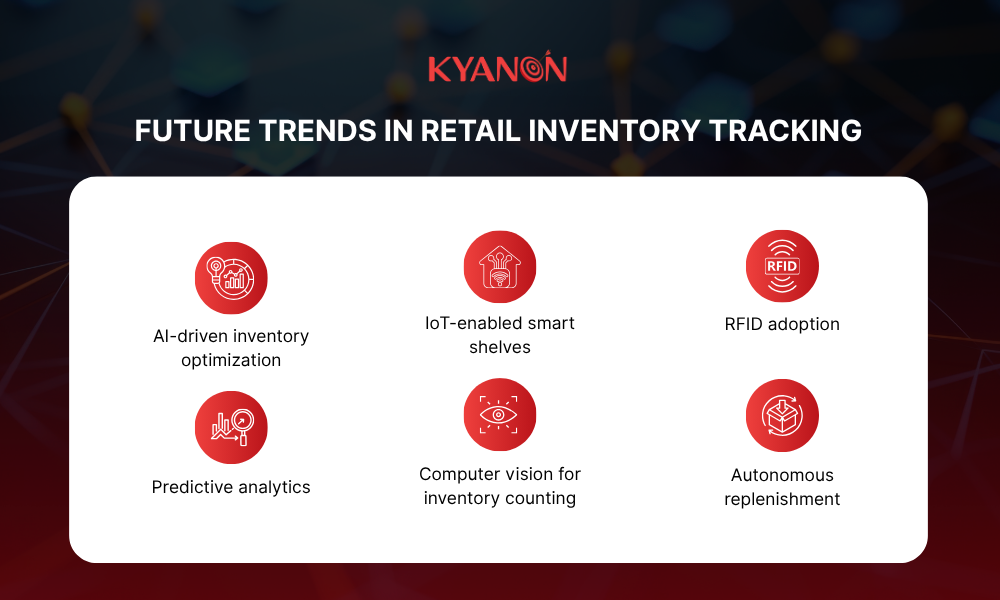
AI-driven inventory optimization
AI is increasingly being applied to demand forecasting, replenishment, pricing, assortment planning, and logistics. According to BCG’s 2025 retail research, AI adoption is expected to expand across key retail operations, including demand forecasting, inventory management, range planning, and logistics and route planning.
More recent BCG research published in 2026 shows that retail AI adoption is moving from experimentation toward scaled implementation, but progress remains uneven. BCG found that 45% of retailers are scaling AI’s impact, while 40% have barely begun. More than half of surveyed companies also do not formally measure AI ROI, highlighting the persistent challenge of turning successful AI pilots into measurable business value at scale.
IoT-enabled smart shelves
Connected shelves can use sensors to detect changes in product quantity and shelf availability, potentially triggering replenishment workflows automatically.
RFID adoption
RFID is becoming increasingly attractive as tag and reader economics improve. McKinsey reports that RFID tag costs have fallen dramatically over the past decade while read accuracy and range have improved, strengthening the business case for item-level inventory visibility.
Predictive analytics
Instead of asking: “How much inventory do we have?”, retailers can increasingly ask: “What inventory will we need, where will we need it, and when should we move it?”
This shift allows supply-chain teams to act before shortages or excess inventory occur.
Computer vision for inventory counting
Computer vision can monitor shelves, identify missing or misplaced products, and automate shelf audits. AWS highlights computer vision as a tool for real-time inventory monitoring and automated shelf auditing. By analyzing shelf images, computer vision can identify low-stock situations, stockouts, misplaced items, and expired products, helping retailers improve inventory accuracy and respond to shelf-level issues more quickly.
Autonomous replenishment
The ultimate evolution is a more autonomous inventory system: Sense → Predict → Decide → Replenish → Learn
For example, a system could detect declining shelf inventory, compare it against predicted demand and supplier lead time, determine the optimal replenishment quantity, and initiate the required workflow with minimal human intervention.
This does not mean eliminating human decision-making. Instead, it allows retail teams to focus on exceptions, strategy, supplier relationships, and customer experience.
Conclusion: Turn inventory visibility into a competitive advantage
For modern retailers, inventory accuracy is no longer simply an operational KPI. It influences revenue, working capital, fulfillment costs, customer satisfaction, and the ability to scale omnichannel commerce.
The evidence is compelling. Global inventory distortion represents a $1.7 trillion problem, while leading retailers are already using RFID, AI, advanced analytics, and connected systems to improve availability, reduce shrinkage, and make better use of inventory. The next step is not necessarily to replace every system in your technology stack.
It is to determine where inventory visibility breaks down, identify the highest-value opportunities, and connect the right data, technology, and processes around them.
If your retail business is struggling with stockouts, inventory discrepancies, fragmented systems, or inefficient replenishment, Kyanon Digital can help you assess the gaps and design a tailored digital solution around your existing environment. Talk to Kyanon Digital about your retail transformation.

















 Create project brief with AI