

Retail growth increasingly depends on the ability to coordinate orders, inventory, fulfillment, and customer experiences across every channel. Yet for many retailers, these operations still run across disconnected systems, eCommerce platforms, POS, ERP, WMS, marketplaces, stores, and third-party logistics providers.
The result is a familiar set of business problems: inaccurate inventory, fragmented order visibility, manual intervention, higher fulfillment costs, and inconsistent customer experiences.
Retail order management software addresses this challenge by creating a unified orchestration layer between sales channels, inventory locations, and fulfillment operations. Instead of treating every order as a separate transaction, retailers can manage the entire order lifecycle from a single operational view.
For business leaders, the objective is not simply to implement another retail technology platform. It is to make existing inventory more productive, reduce operational complexity, fulfill orders more profitably, and create a consistent customer experience across channels.
Key takeaways
- Unify orders and inventory across all sales channels through a single OMS.
- Optimize fulfillment and costs with real-time inventory visibility and intelligent order routing.
- Automate operations to reduce manual effort, errors, and processing complexity.
- Enable omnichannel fulfillment and deliver a consistent customer experience.
- Integrate the OMS with core enterprise systems to create a connected, scalable retail operation.
Further reading:
- Retail Supply Chain Digitalization: A Guide for Singapore Brands
- How to Choose a Retail Shop Management System
- AI-Driven Retail Analytics: From Data to Decisions
The business challenge: Retail operations are becoming more complex
Modern retailers rarely operate through a single sales channel. A customer might discover a product on social media, purchase it through an eCommerce site, pick it up at a store, and later return it to a different location.
Behind that seemingly simple journey are multiple systems and operational decisions. An order may need to move between:
- eCommerce or mobile commerce platforms
- Physical stores and POS systems
- Marketplaces
- ERP and merchandising systems
- Warehouses and distribution centers
- Third-party logistics providers
- Payment gateways
- Shipping carriers
- Customer service platforms
When these systems operate independently, retailers can end up with different versions of the truth.
The eCommerce platform may show an item as available while the store has already sold it. A warehouse may receive an order without knowing that a nearby store could fulfill it faster. Customer service teams may have limited visibility into the latest shipment or return status.
This creates a fundamental operational problem: The more channels a retailer adds, the harder it becomes to manage the order lifecycle consistently without a unified operating model. Gartner’s 2025 research identifies inventory visibility, order orchestration, and order visibility as core capabilities of modern distributed order management. By coordinating inventory and fulfillment across sales channels and locations, retailers can optimize order allocation based on service levels, availability, and cost.
That is where modern retail order management becomes strategically important.

What is retail order management software?
Retail order management software is a technology platform that centralizes and orchestrates the end-to-end order lifecycle across sales channels and fulfillment locations.
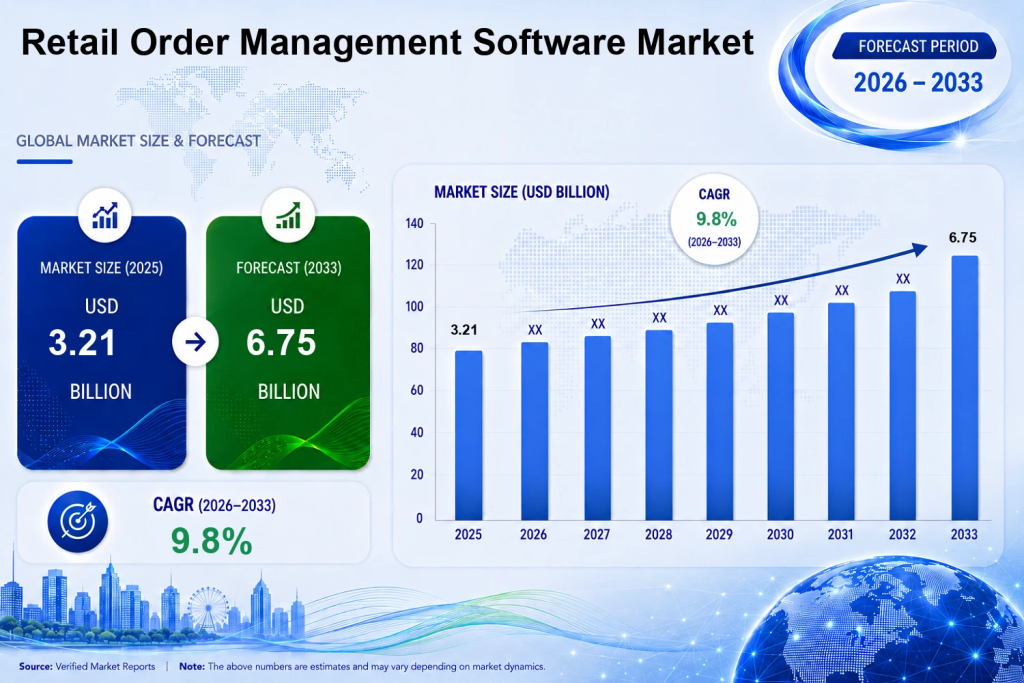
Retail order management software market revenue was valued at USD 3.21 Billion in 2025 and is estimated to reach USD 6.75 Billion by 2033 , growing at a CAGR of 9.8% from 2026-2033. (Verified market reports)
Instead of managing orders independently across individual channels, a retail order management system (OMS) serves as a centralized orchestration layer that connects the entire order lifecycle, from order capture and inventory allocation to fulfillment, delivery, and returns. This unified approach provides retailers with greater operational visibility, enables more consistent processes, and supports more efficient end-to-end order management.
In practical terms, an OMS can help a retailer:
- Consolidate orders from stores, eCommerce, marketplaces, and mobile channels
- Provide near real-time inventory visibility
- Reserve inventory to prevent conflicting orders
- Automatically route orders to the most appropriate fulfillment location
- Enable BOPIS, ship-from-store, curbside pickup, and home delivery
- Coordinate split shipments when necessary
- Track orders throughout the fulfillment lifecycle
- Manage cancellations, exchanges, and returns
- Provide operational analytics across channels
Leading enterprise platforms increasingly position order management as the orchestration layer connecting channels, inventory, and fulfillment. Leading enterprise platforms demonstrate this approach in practice. SAP Order Management connects sales channels, inventory, and fulfillment systems through a central orchestration hub, while Salesforce combines Order Management with Omnichannel Inventory to provide near-real-time inventory visibility and coordinate fulfillment across stores, distribution centers, and other fulfillment locations.
Why unified operations matter
For retailers, omnichannel transformation is no longer primarily a front-end challenge. Building an eCommerce website or mobile app is relatively straightforward compared with coordinating what happens after the customer clicks Buy.
The real complexity sits behind the transaction. McKinsey describes seamless omnichannel fulfillment as increasingly essential as customers expect retailers to provide products wherever and whenever they choose to shop. It also emphasizes that information must flow seamlessly across functions, channels, and systems to support both customer experience and management decision-making. A unified retail order management system creates a single operational view of orders and inventory.
Comparison between Unified vs. Fragmented Retail Order Management:
Area | Without Unified OMS | With Unified OMS |
| Order Management | Orders managed separately by each channel | Orders centralized across all channels |
Inventory | Fragmented and inconsistent visibility | Real-time visibility across locations |
| Fulfillment | Manual, channel-specific decisions | Automated, intelligent order routing |
Operations | High manual effort and process complexity | Standardized and automated workflows |
| Customer Experience | Inconsistent availability and fulfillment options | Consistent omnichannel experience |
Costs | Higher fulfillment and operational costs | Optimized fulfillment and resource utilization |
| Business Visibility | Siloed data and reporting | Unified view of orders and operations |
Scalability | Adding channels increases complexity | Easier expansion across channels and markets |
What does this mean for business leaders?
A unified operation can help answer critical questions in real time:
- Where is my inventory?
- Which inventory is actually available to promise?
- Where should this order be fulfilled from?
- Can this store fulfill online orders profitably?
- Which orders are at risk of missing their delivery promise?
- How much inventory is tied up in open orders?
- Where are fulfillment costs increasing?
- Which products are generating the highest return rates?
- Which stores or warehouses are operating below capacity?
Instead of managing individual systems, leadership teams gain visibility into the entire order-to-fulfillment network.
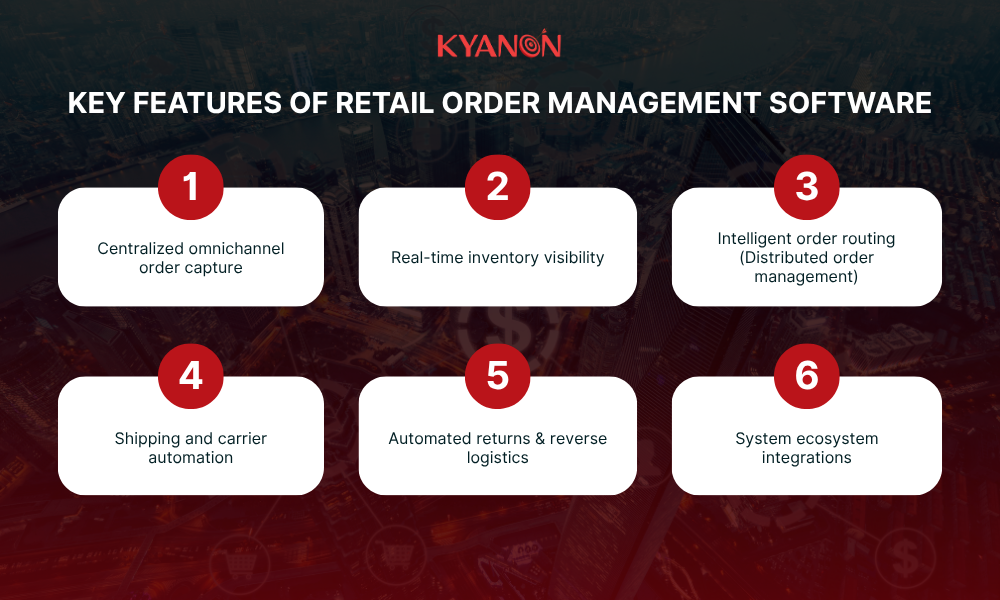
Key features of retail order management software
A modern retail order management system should do more than consolidate orders. Its core capabilities should help retailers improve operational control, optimize fulfillment decisions, and make better use of inventory across channels.
Centralized omnichannel order capture
A modern OMS serves as the single source of truth for all sales channels.
- Unified dashboard: Automatically aggregates transactions from brick-and-mortar Point of Sale (POS) terminals, e-commerce storefronts (e.g., Shopify), online marketplaces (e.g., Amazon), and social media.
- Fraud & payment screening: Automatically validates customer details and screens for fraudulent payment profiles before sending orders to the fulfillment queue.
- Multi-shipment management: Splitting a single customer order into separate shipments if items are coming from different fulfillment nodes.
Real-time inventory visibility
To prevent stock discrepancies, an OMS provides absolute visibility across the entire retail ecosystem.
- Cross-network synchronization: Tracks real-time stock levels across warehouses, physical stores, distribution centers, and third-party logistics (3PL) partners.
- Oversell prevention: Instantly updates global inventory availability numbers when an item is purchased on one platform, stopping stockouts and “phantom inventory” errors on others.
- Inventory allocation: Allocates specific batches of stock exclusively for high-priority sales channels, recurring subscriptions, or targeted regional marketing campaigns.
Intelligent order routing (Distributed order management)
Automating the decision-making process for fulfillment reduces delivery times and cuts logistics costs.
- Rule-based allocation: Automatically routes orders to the optimal fulfillment center based on pre-set parameters like proximity to the client, shipping fees, and carrier speed.
- Ship-From-Store (SFS): Treats physical storefronts as micro-fulfillment spaces, enabling store personnel to pick, pack, and mail e-commerce orders directly.
- BOPIS / Curbside Integration: Supports “Buy Online, Pick Up In Store” (BOPIS) by alerting local store employees to prep items for localized client pick-up.
Shipping and carrier automation
Connecting with logistics services streamlines the dispatch process.
- Rate shopping: Automatically evaluates real-time freight charges from multiple carriers to select the most economical shipping profile.
- Label generation: Instantly creates tracking barcodes, picking slips, and shipping labels directly through the main dashboard.
- Automated updates: Sends automated tracking alerts (via text or email) to keep customers updated on delivery stages.
Automated returns & reverse logistics
Managing post-purchase interactions is critical to preserving brand retention and loyalty.
- Omnichannel returns: Allows online purchasers to initiate returns seamlessly through self-service web portals or physically inside local storefronts.
- Disposition workflows: Guides store workers or warehouse teams on how to process incoming returns, whether to send them back to the active shelf, designate them for liquidation, or discard them.
- Instant financial settlement: Triggers automated consumer refunds or store credit vouchers the exact moment a returned shipment is validated.
System ecosystem integrations
An effective retail OMS connects with existing management infrastructure rather than isolating data silos.
- Enterprise Resource Planning (ERP): Aligns financial ledger sheets, procurement accounts, and master company datasets.
- Customer Relationship Management (CRM): Connects sales historical entries with buyer communication files for customized promotions.
- Warehouse Management Systems (WMS): Bridges the digital order log directly to warehouse bin locations and mobile scanner devices
Benefits of unifying retail operations
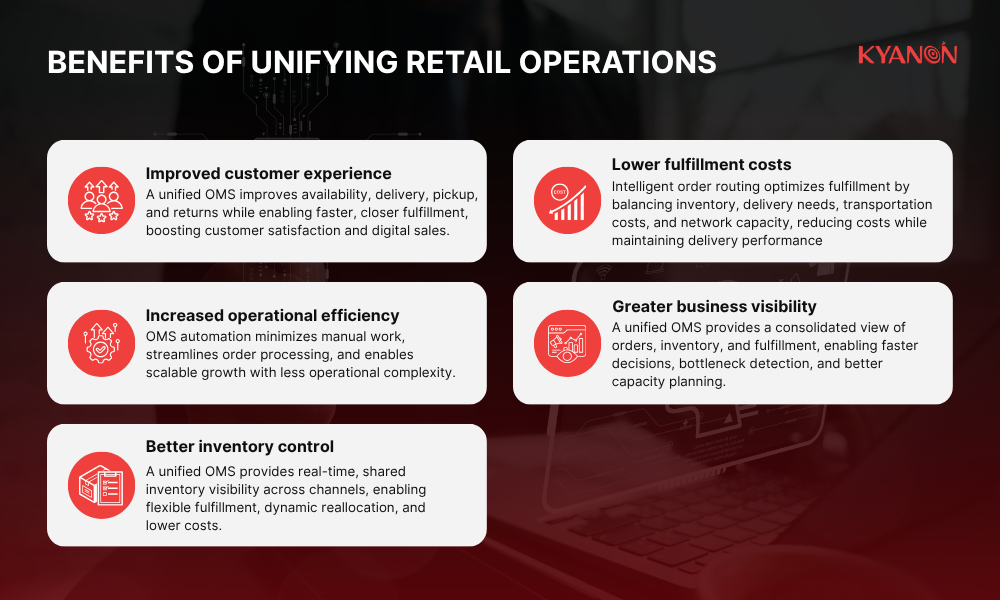
The business case for retail order management software extends beyond order visibility. By connecting inventory, orders, fulfillment, and customer touchpoints, retailers can improve service levels while controlling the cost and complexity of omnichannel operations.
Improved customer experience
A unified OMS gives customers more reliable information about product availability, delivery status, pickup options, and returns. It also enables retailers to fulfill orders from locations closer to the customer. Better fulfillment reliability and convenience can strengthen customer satisfaction while supporting digital sales growth.
Target provides a strong example of the value of integrating stores into an omnichannel fulfillment network. In fiscal 2025, 97.6% of Target’s merchandise sales were fulfilled through stores, including digitally originated orders handled through store shipping, Order Pickup, Drive Up, and Same-Day Delivery. The company also reported that two-thirds of its digital sales were fulfilled through same-day services. Target states that its store-based fulfillment model supports greater speed and cost efficiency.
Increased operational efficiency
OMS automation reduces the need for employees to manually reconcile orders, inventory, and fulfillment information across multiple systems. It also enables retailers to scale order processing during peak demand without proportionally increasing operational workload. Higher processing capacity and greater system resilience allow retailers to support business growth while reducing operational complexity.
Real-world example: Aditya Birla Fashion and Retail Limited (ABFRL)
With more than 3,000 retail stores, 40 warehouses, and a presence across 10 online marketplaces, ABFRL faced increasing complexity in managing orders and inventory across multiple channels. The retailer modernized its order management environment with IBM Sterling Order Management to improve inventory visibility, scalability, and omnichannel fulfillment.
The modernization tripled inventory-processing capacity from 2.5 million to more than 8 million records per day, while reducing deployment time by 75% and downtime by more than 80%. The solution also enabled dynamic auto-scaling, helping reduce infrastructure costs during periods of lower demand. IBM reports that OMS environment provisioning and upgrades now take hours rather than weeks, supporting faster brand integration and peak-season scalability. (IBM)
Better inventory control
A unified OMS allows retailers to treat inventory as a shared resource across channels rather than maintaining separate inventory pools. This makes it possible to identify available stock Fossil Group implemented IBM Order Management to establish centralized inventory visibility across channels. The company can now identify inventory available at nearby stores and support ship-from-store, BOPIS, BORIS, and home delivery. Its planning teams can also dynamically reallocate inventory when demand changes across channels.
McKinsey similarly identifies real-time inventory visibility and distributed order management as important capabilities for making inventory more accessible, improving service, increasing sales, and reducing costs.
Lower fulfillment costs
Intelligent order routing enables retailers to select fulfillment locations based not only on inventory availability but also on delivery requirements, transportation costs, and network capacity. More efficient sourcing and routing can reduce transportation expenses while maintaining delivery performance.
Another example is Advance Auto Parts, which reported a 12% reduction in transportation costs after implementing technology to improve delivery and order orchestration. The company also achieved a 98% on-time delivery rate.
Greater business visibility
A unified OMS gives retail leaders a consolidated view of orders, inventory, fulfillment, and customer activity. This allows management teams to identify operational bottlenecks, monitor service levels, and make faster decisions about inventory allocation and fulfillment capacity.
Fossil’s OMS implementation provided planners with a broader view of inventory across channels, allowing merchandising, planning, and eCommerce teams to identify demand changes and respond by reallocating stock.
Integrating with existing systems
A retail order management system should complement the existing technology landscape rather than replace every core business application. Its role is to orchestrate order and fulfillment processes while exchanging the right data with ERP, POS, WMS, CRM, commerce, payment, and logistics platforms.
For enterprise retailers, this integration layer is critical because order management depends on information from multiple systems. SAP, for example, describes its order management architecture as integrating existing order-capture, master-data, and fulfillment systems while consolidating order-related information in a central platform.
Core systems to integrate:
System | Role in OMS Integration | Business value |
| ERP | Synchronizes product, pricing, financial, and order data | Maintains financial and operational consistency |
POS | Shares store transactions and inventory updates | Extends store inventory into omnichannel fulfillment |
| WMS | Receives fulfillment instructions and returns execution status | Improves warehouse coordination and order accuracy |
CRM | Connects customer and order information | Gives service teams a complete customer view |
| eCommerce | Sends online orders and receives inventory and fulfillment updates | Enables consistent digital commerce operations |
Marketplaces | Consolidates orders from third-party sales channels | Reduces channel-specific processing |
| Payment Gateways | Supports payment authorization, capture, refund, and reconciliation | Reduces payment-related order exceptions |
Shipping & 3PL | Exchanges shipment, tracking, and delivery information | Improves delivery visibility and fulfillment coordination |
Explore the retail case study of Kyanon Digital: Transforming Retail Operations: Integrated Omnichannel Fulfillment & Transportation Management Solution
Choosing the right retail order management software
Selecting retail order management software should be treated as a strategic technology and operating-model decision, rather than a simple software purchase. The right platform should address current fulfillment challenges while providing the flexibility to support new channels, markets, products, and customer expectations.
Gartner notes that selecting a distributed order management system has become more complex as vendors expand their capabilities and customization options. Its guidance emphasizes aligning the technology choice with the retailer’s broader order-promising and fulfillment strategy.
When evaluating solutions, retailers should consider:
- Scalability for future growth
- Multi-channel integration capabilities
- Real-time inventory synchronization
- Flexible fulfillment options
- Automation features
- Reporting and analytics
- Cloud-based accessibility
- Ease of implementation
- Security and compliance
- Customer support and ongoing updates
The ideal solution should adapt to changing business needs while supporting expansion into new sales channels and markets.
A practical evaluation framework:
Evaluation area | Key business question |
| Operational fit | Does the OMS support our current order and fulfillment processes? |
Technology fit | Can it integrate with our existing architecture? |
| Scalability | Can it support future channels, markets, and order volumes? |
Financial value | Can the expected efficiency, inventory, and fulfillment benefits justify the investment? |
| Strategic fit | Can the platform support our long-term retail transformation roadmap? |
Ultimately, the right retail order management software should provide more than centralized order processing. It should establish a scalable orchestration layer that enables retailers to optimize fulfillment, improve inventory productivity, reduce operational complexity, and support profitable omnichannel growth.
Case study: Scaling Singapore retail operations with intelligent supply chain automation

Client Overview
A leading Singapore-based retail enterprise operating across retail stores, eCommerce, and B2B wholesale, with thousands of supplier invoices, delivery orders, and inventory transactions processed daily.
Challenges
- Manual supplier document processing and finance reconciliation
- Fragmented inventory data across retail, eCommerce, and B2B channels
- Three-way reconciliation bottlenecks between invoices, goods receipts, and ERP records
- Ghost inventory, stock discrepancies, and fulfillment gaps
- Limited real-time operational and financial visibility
Solutions
- AI-powered document intelligence to automate supplier invoice and document processing
- Automated reconciliation integrated with SAP to identify and resolve discrepancies
- Real-time inventory synchronization across SAP, POS, eCommerce, and B2B systems
- Event-driven integration architecture for scalable supplier and channel onboarding
- End-to-end audit traceability and compliance controls
Impact
- 90% reduction in manual data-entry time
- Invoice processing reduced from days to under 30 minutes
- 80%+ reduction in omnichannel inventory discrepancies
- Minimized ghost inventory and improved replenishment planning
- Faster supplier settlement and improved cash-flow visibility
- Scalable operations without additional headcount
Explore the full case study here: Scaling Singapore Retail Operations with Intelligent Supply Chain Automation
The future of retail order management
Retail order management is evolving beyond transaction processing toward intelligent, data-driven orchestration. AI, predictive analytics, and automation can help retailers improve demand forecasting, optimize inventory allocation, automate fulfillment decisions, and respond faster to changing customer demand.
A unified retail order management system provides the foundation for connecting sales channels, inventory, fulfillment, and customer experiences. For retailers, this can translate into greater operational efficiency, lower fulfillment costs, better inventory utilization, and more consistent omnichannel experiences.
Kyanon Digital helps retailers design and implement integrated order management ecosystems that connect eCommerce, OMS, ERP, POS, WMS, CRM, and logistics systems. Whether you are modernizing legacy systems, expanding omnichannel fulfillment, or building a new retail order management platform, Kyanon Digital can help you create a scalable architecture aligned with your business objectives.
Ready to unify your retail operations? Contact Kyanon Digital to build a retail order management solution tailored to your business and growth strategy.










 Create project brief with AI