
What is Net Promoter Score (NPS) integration?
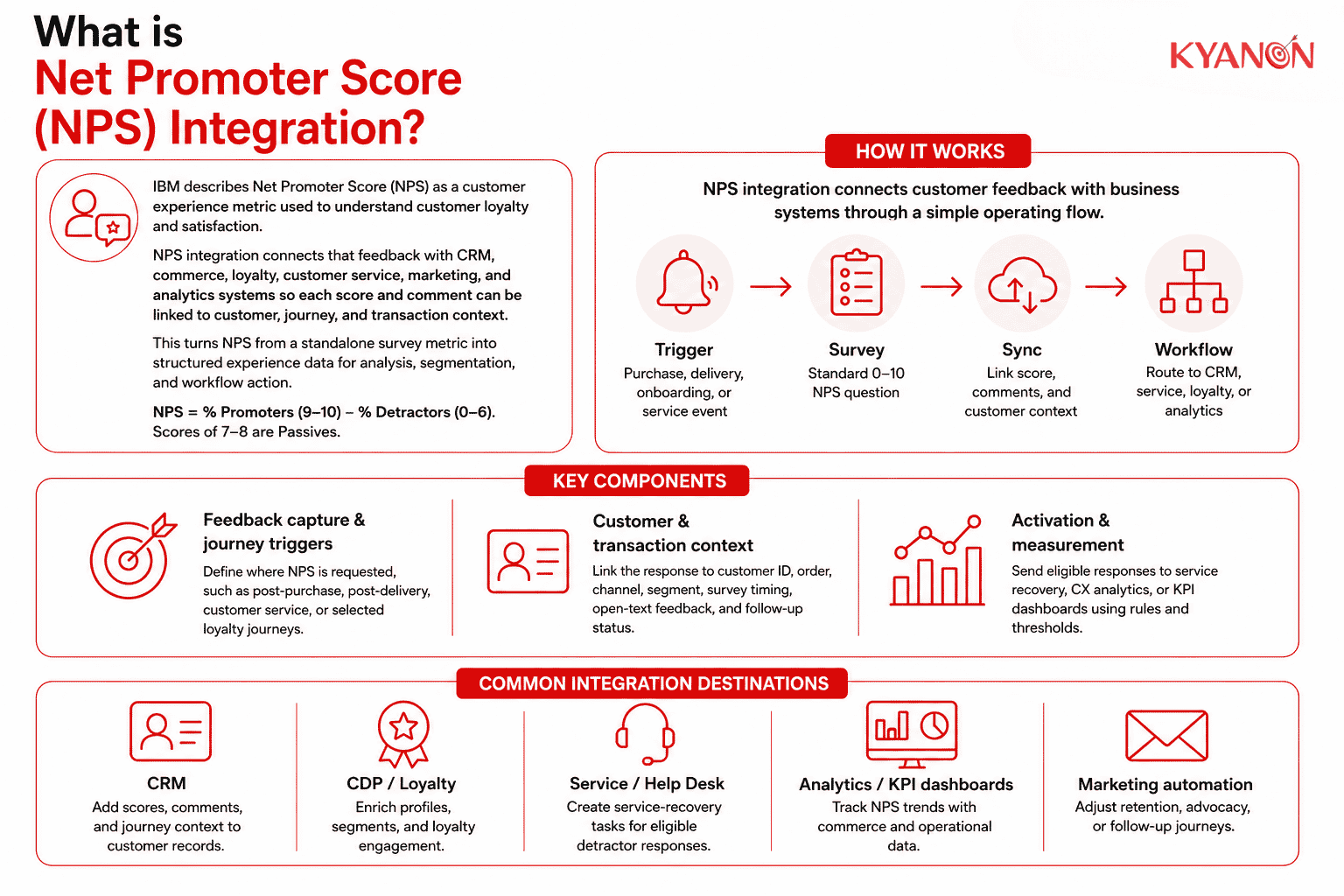
IBM describes Net Promoter Score (NPS) as a customer experience metric used to understand customer loyalty and satisfaction. Net Promoter Score (NPS) integration connects that feedback with CRM, commerce, loyalty, customer service, marketing, and analytics systems so scores and comments can be linked to customer context and used in business workflows.
Instead of keeping NPS inside a standalone survey platform, integration makes the feedback available alongside customer, transaction, journey, and operational data.
Under the standard NPS methodology, respondents scoring 9–10 are promoters, 7–8 are passives, and 0–6 are detractors. NPS equals the percentage of promoters minus the percentage of detractors.
How Net Promoter Score (NPS) integration works
NPS integration connects a customer feedback event to the systems that store customer context and execute follow-up actions, typically via APIs, webhooks, platform connectors, or scheduled data synchronization.
The operating flow can be simplified into four stages:
- Trigger: A defined customer event starts the feedback process, such as completing a purchase, receiving an order, finishing onboarding, or reaching a relationship milestone.
- Survey: The CX or survey platform presents the standard 0–10 recommendation question through the configured channel.
- Sync: The response is associated with identifiers and context such as customer ID, order, channel, journey stage, score category, and open-text feedback.
- Workflow: Business rules route the data to CRM, service, loyalty, marketing, analytics, or internal notification workflows based on the response and customer context.
IBM notes that organizations can collect NPS through channels including email, websites, SMS, post-call surveys, and in-person interactions and that some organizations send surveys following transactions such as purchases.
Feedback capture and journey triggers
The feedback trigger determines which customer experience the NPS response can reasonably be associated with.
For retail and eCommerce, organizations may capture feedback around purchase, delivery, customer service, or selected loyalty journeys. When transactional NPS is used, the survey timing and triggering event should be stored with the response so teams can distinguish journey-specific feedback from broader relationship feedback.
Customer and transaction context
An integrated NPS record is more actionable when the score is connected with the customer and operational conditions surrounding the response.
Relevant data can include:
- Customer ID
- NPS score and category
- Open-text feedback
- Order or delivery
- Sales channel
- Customer segment
- Loyalty status
- Survey timing
- Journey stage
- Follow-up status
Activation and measurement
NPS activation determines which system, team, or workflow should receive a customer signal after it has been captured and contextualized.
For example, an eligible detractor response may create a service-recovery task, while aggregated feedback may be routed into CX analytics or commerce KPI dashboards. Closed-loop CX systems can use predefined thresholds to determine which negative or neutral responses generate tickets or alerts.
The objective is not to automate every response, but to route the right feedback to the right decision or workflow.
Common types of NPS integrations
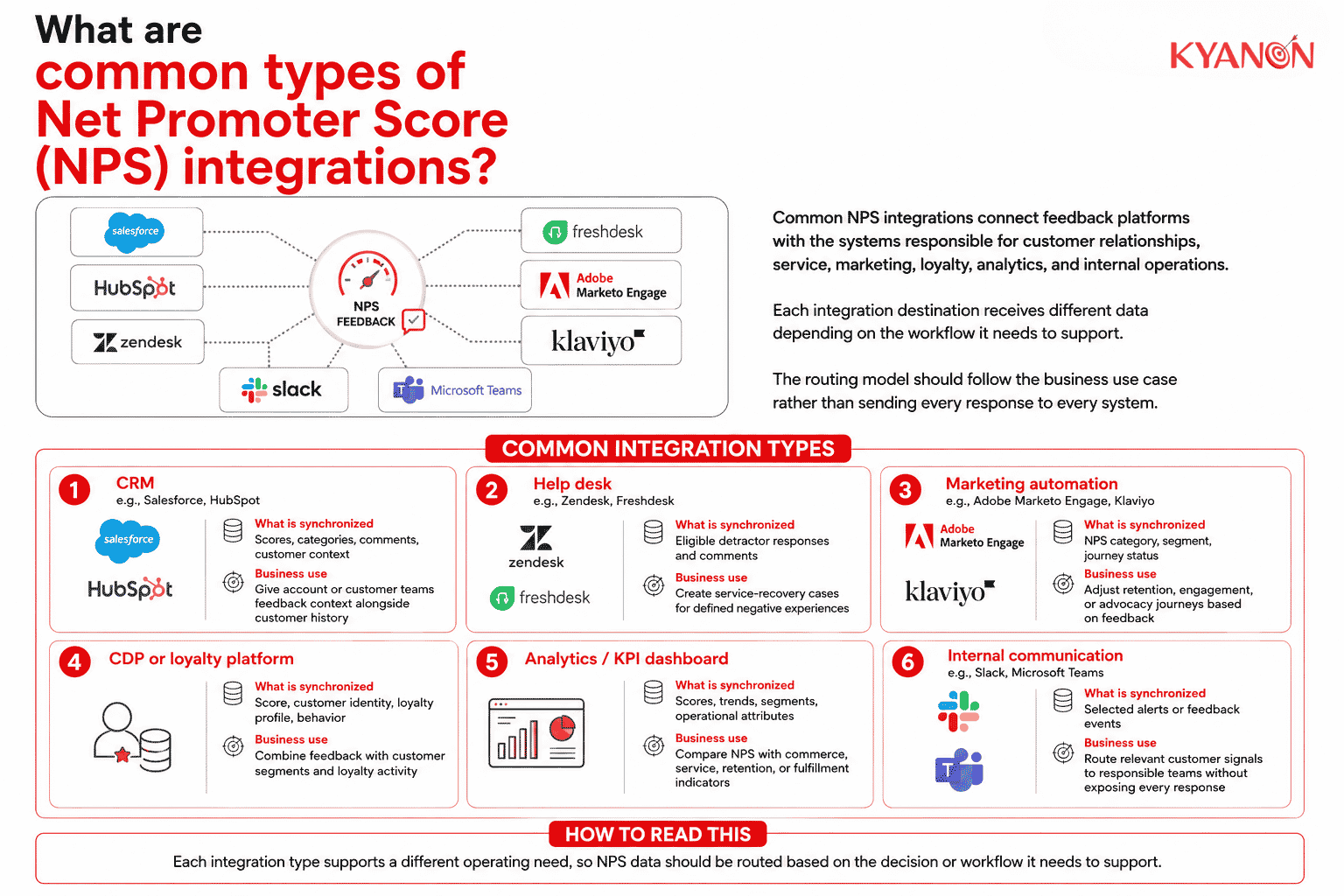
The most common NPS integrations connect feedback platforms with the systems responsible for customer relationships, service, marketing, loyalty, analytics, and internal operations.
| Target system | What is synchronized | Business use |
CRM — e.g., Salesforce, HubSpot | Scores, categories, comments, customer context | Give account or customer teams feedback context alongside customer history |
| Help desk — e.g., Zendesk, Freshdesk | Eligible detractor responses and comments | Create service-recovery cases for defined negative experiences |
Marketing automation — e.g., Marketo, Klaviyo | NPS category, segment, journey status | Adjust retention, engagement, or advocacy journeys based on feedback |
| CDP or loyalty platform | Score, customer identity, loyalty profile, behavior | Combine feedback with customer segments and loyalty activity |
Analytics / KPI dashboard | Scores, trends, segments, operational attributes | Compare NPS with commerce, service, retention, or fulfillment indicators |
| Internal communication — e.g., Slack, Teams | Selected alerts or feedback events | Route relevant customer signals to responsible teams without exposing every response |
These integrations serve different operating needs; an organization does not need to synchronize every NPS response with every connected platform.
Net Promoter Score (NPS) integration vs. Standalone NPS surveys
A standalone NPS survey measures recommendation intent, while NPS integration connects that feedback with customer, transaction, and operational data so the organization can determine where the signal originated and what should happen next.
Dimension | Net Promoter Score (NPS) integration | Standalone NPS survey |
Primary purpose | Connect feedback to business context and workflows | Collect and report NPS |
| Customer context | Linked to customer, segment, journey, or transaction | Often limited to survey attributes |
System coverage | CRM, CDP, loyalty, commerce, service, analytics | Mainly survey platform |
| Operational action | Can trigger defined workflows and follow-up | Usually requires manual action |
Analysis | Combines NPS with customer and operational variables | Primarily score and survey analysis |
| Ownership | Shared across CX, commerce, product, operations, and IT | Often CX or research-led |
Best fit | Organizations requiring closed-loop feedback | Basic measurement and benchmarking |
The standalone survey captures the signal; integration determines how that signal becomes part of the wider customer-data and operating environment.
When to consider Net Promoter Score (NPS) integration
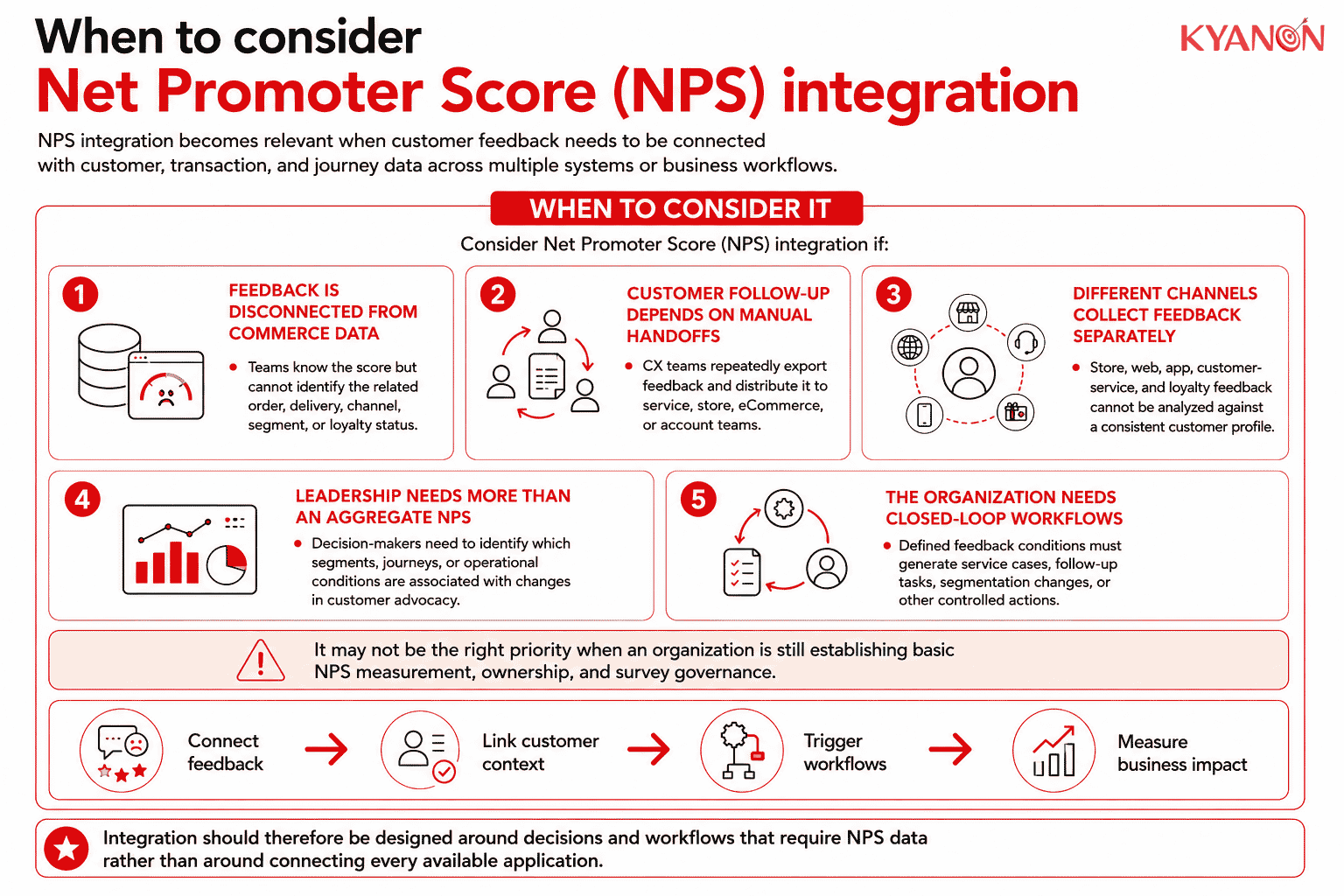
NPS integration becomes relevant when customer feedback needs to be connected with customer, transaction, and journey data across multiple systems or business workflows.
Consider Net Promoter Score (NPS) integration if:
- Feedback is disconnected from commerce data. Teams know the score but cannot identify the related order, delivery, channel, segment, or loyalty status.
- Customer follow-up depends on manual handoffs. CX teams repeatedly export feedback and distribute it to service, store, eCommerce, or account teams.
- Different channels collect feedback separately. Store, web, app, customer-service, and loyalty feedback cannot be analyzed against a consistent customer profile.
- Leadership needs more than an aggregate NPS. Decision-makers need to identify which segments, journeys, or operational conditions are associated with changes in customer advocacy.
- The organization needs closed-loop workflows. Defined feedback conditions must generate service cases, follow-up tasks, segmentation changes, or other controlled actions.
It may not be the right priority when an organization is still establishing basic NPS measurement, ownership, and survey governance.
Integration should therefore be designed around decisions and workflows that require NPS data rather than around connecting every available application.
Why Net Promoter Score (NPS) integration matters for retail and e-commerce
For retail and e-commerce, NPS integration connects customer sentiment with commerce events such as purchase, delivery, service, and loyalty interactions, making it easier to investigate where changes in customer advocacy originate.
For example, an aggregate decline in NPS reveals limited operational context on its own. When feedback is connected to order and journey data, teams can investigate whether lower scores are concentrated around specific fulfillment methods, customer segments, channels, or service conditions.
ACSI’s 2026 Retail and Consumer Shipping Study, based on 31,293 completed surveys, found that digital experience factors remained central to retail satisfaction: online retailers scored 88 for mobile-app quality, 87 for app reliability, and 86 for ease of checkout. The results show why feedback captured around digital commerce journeys should be connected with the underlying channel and transaction context.
For retailers, the value therefore comes from shortening the path between customer signal → business context → accountable action, rather than simply collecting more survey responses.
Common misconceptions
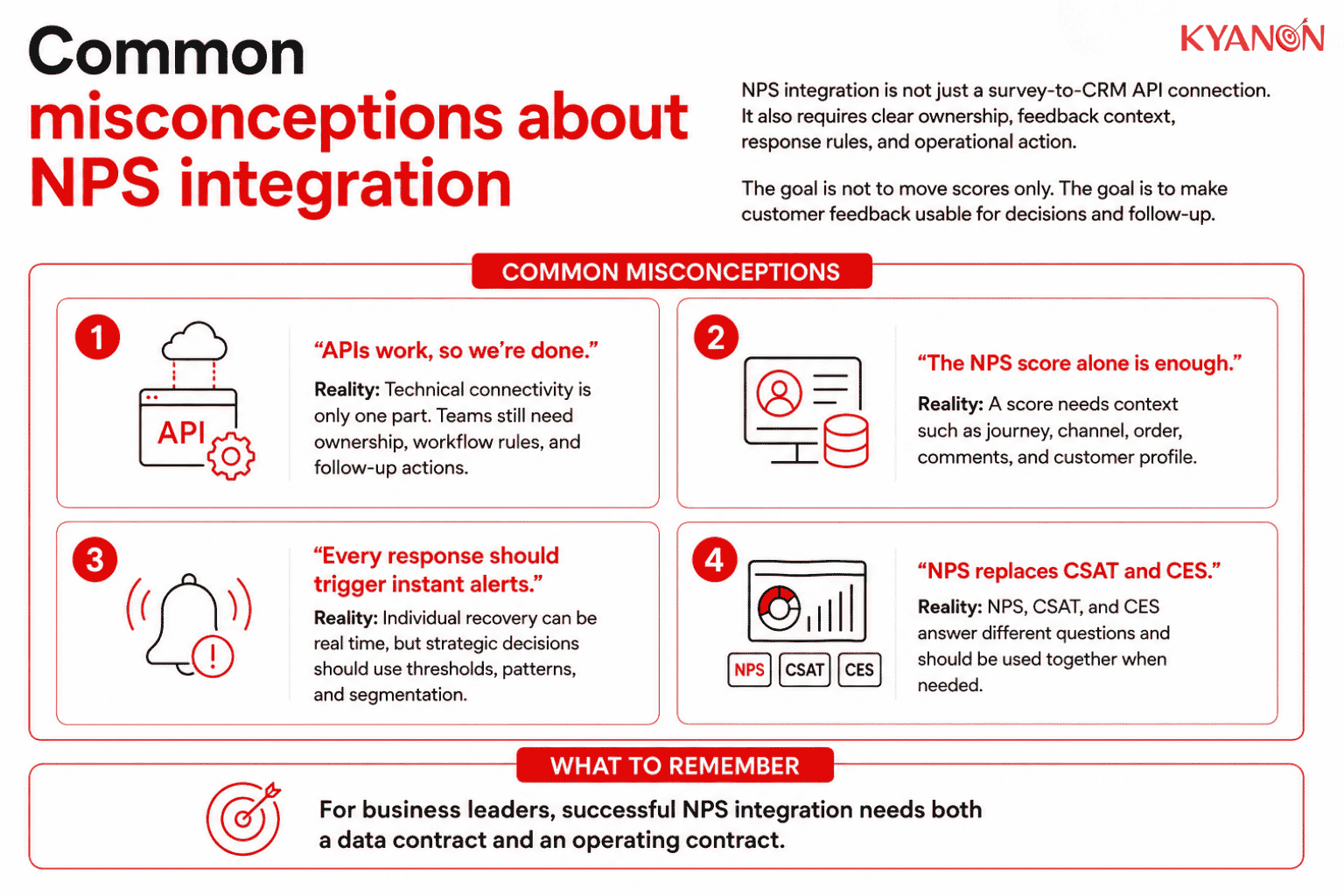
NPS integration is not simply an API connection between a survey platform and a CRM; it requires agreement on feedback context, data ownership, response rules, and how different teams will use the resulting customer signal. Mature NPS programs use feedback as part of an operating system for learning and action rather than stopping at score collection.
“This is an IT integration project. Once the APIs work, we’re done.”
Reality: Technical connectivity is only one part of the program. CX, eCommerce, product, service, and operational owners still need to define when feedback is collected, which customer context is required, who owns each type of response, and what actions should follow.
For a CTO or IT director, a successful integration therefore has both a data contract and an operating contract.
“If we push the NPS score into the CRM, we have everything we need.”
Reality: A value such as 9 identifies a promoter under the NPS methodology, but by itself it does not explain which journey, transaction, channel, product, or customer condition produced that response.
The integration should preserve enough contextual and qualitative information to make the score interpretable without turning the CRM into an uncontrolled data dump.
“Every NPS response should trigger an immediate alert everywhere.”
Reality: Real-time action is appropriate when a defined customer-level event requires intervention, but not every response should become an executive, product, or operational escalation.
Individual service recovery can be event-driven, while strategic decisions should normally rely on segmented patterns, thresholds, and repeated signals rather than one survey response.
“Once NPS is integrated, we can stop tracking CSAT and CES.”
Reality: NPS does not answer every customer-experience question. Relational NPS is commonly used to assess the broader customer relationship, while transactional metrics such as CSAT focus more directly on satisfaction with specific recent experiences.
NPS, CSAT, CES, behavioral data, and commercial measures such as retention or customer lifetime value should be treated as complementary signals when the business decisions require them.
How Kyanon Digital applies Net Promoter Score (NPS) integration
Kyanon Digital integrates NPS capture into retail customer journeys such as post-checkout and post-delivery flows, connecting feedback with loyalty, commerce, customer data, CX, and analytics capabilities rather than treating NPS as an isolated survey.
The implementation focus is on maintaining the business context around each feedback event and defining where that information should be used: customer profiles, segmentation, CX dashboards, customer-service workflows, loyalty journeys, or wider commerce analytics.
This aligns with Kyanon Digital’s connected commerce approach, which links customer-facing channels with customer data, loyalty, marketing automation, commerce analytics, CRM, order management, and other enterprise systems.
→ Explore Kyanon Digital’s Digital Commerce services for connected commerce, loyalty, customer data, analytics, and enterprise system integration.











 Create project brief with AI