AI-driven BI is becoming a competitive requirement for FMCG and retail leaders in Singapore as rising operating costs, volatile demand, and omnichannel complexity outpace traditional reporting and static dashboards.
Globally, over 96% of retail executives expect revenue growth driven by data and AI-led decision intelligence (Business Technology Survey), while in Singapore, 69% of retailers say AI agents are essential to beat competition amid rising costs, and more than 85% plan to increase AI investment (Salesforce).
Across the FMCG sector, AI adoption is accelerating in demand forecasting, trade promotion optimization, and supply chain automation. The global AI market in FMCG and retail is projected to exceed US$461.43 billion by 2029, driven by predictive analytics and automated decision systems (Research and Markets).

Backed by Singapore’s Smart Nation agenda and EDG/PSG funding, AI-driven BI has moved from experimentation to enterprise infrastructure.
In this article, Kyanon Digital explores AI-driven BI for FMCG & retail leaders in Singapore, how it works in real operations, and how enterprises can use predictive intelligence to drive margin growth, supply chain efficiency, and data-driven decision-making at scale.
Key takeaways
- AI-driven BI is now core enterprise infrastructure, not a reporting upgrade.
- Static BI no longer works in Singapore’s high-cost, omnichannel market.
- FMCG companies using AI gain predictive advantage in demand, pricing, and inventory.
- Agentic BI enables proactive, automated execution, not reactive analysis.
- Unified architecture and governance are critical for scale, security, and trust.
- Early adopters win on margins, speed, and resilience in FMCG and retail.
Further reading:
- AI-Driven BI & Data Warehouse For A Leading Retail Corporation
- AI in Ecommerce and Retail: Trends, Use Cases, and Business Impact
- AI in Retail: Revolutionizing Operations & Boosting Experience
- AI in Ecommerce and Retail: Trends, Use Cases, and Business Impact
What is AI-driven BI in the FMCG context?
AI-driven business intelligence (BI) refers to an advanced analytics system that combines traditional BI with artificial intelligence capabilities such as machine learning, natural language processing, and automated predictive insights to turn data into real-time, actionable business decisions (IBM).
Unlike traditional BI, which focuses on historical dashboards, AI-driven BI delivers predictive insights, automated recommendations, and decision intelligence at scale.
What makes AI-driven BI different
- Predicts future outcomes instead of reporting the past
- Recommends optimal actions automatically
- Enables autonomous or human-approved execution
- Operates in real time across omnichannel data sources
In FMCG & retail, AI-driven BI enables leaders to forecast demand by SKU and location, optimize pricing and promotions, automate replenishment, and gain real-time visibility across sales, supply chain, and customer channels, turning data into a competitive advantage.
What are the technical differences between traditional BI and AI-driven platforms?
For CTOs and CIOs, the technical distinction between legacy BI and modern AI-driven BI is fundamental. Traditional BI is descriptive, focusing on what happened through batch-processed historical data. AI-driven BI is predictive and prescriptive, utilizing live data streams and machine learning to provide actionable recommendations.
Quick comparison table
|
Technical attribute |
Traditional BI |
AI-driven BI |
|
Primary goal |
Organize and present historical information for human interpretation |
Automate decision-making and predict future outcomes |
|
Data processing |
Batch updates (often daily or weekly), focused on structured data |
Real-time ingestion of structured and unstructured data (IoT, text, social) |
|
User interaction |
Static dashboards requiring SQL expertise or manual filtering |
Conversational interfaces using Natural Language Query (NLQ) |
|
Insight generation |
Manual investigation by analysts to find trends |
Automated anomaly detection and proactive trend surfacing |
|
Workflow |
Linear: request -> query -> validate -> visualize -> report |
Circular: agentic planning -> execution -> self-verification -> action |
|
Scalability |
Limited by the capacity of the data engineering team |
High, as AI agents manage complex datasets without manual intervention |
Why AI-driven BI is becoming critical for FMCG & retail in Singapore
Singapore’s retail market is projected to reach 51.66 billion USD in 2026 (Mordor Intelligence), but this growth is countered by a high-pressure environment where efficiency is the only hedge against inflation. Technology leaders are pivoting to AI-driven BI to eliminate the data gap that renders traditional monthly reporting obsolete in the face of real-time market shocks.
Critical market drivers

- Omnichannel consumer behavior: Omnichannel spend is projected to surge by 21.2% in Singapore by 2026 as shoppers demand a seamless transition between physical and digital touchpoints (IMDA).
- Rapid delivery expectations: Ecommerce and quick commerce growth demand faster fulfillment and precise inventory forecasting, putting pressure on planning systems that rely on backward-looking reports.
- High logistics and manpower costs: Singapore businesses operate with one of the region’s highest cost structures, where inefficient processes erode margins and reduce competitiveness.
- Promotion-driven demand volatility: Retailers and FMCG brands face fluctuating demand during promotions and peak periods that static BI cannot anticipate or adjust to.
- Supply chain fragility: Fragmented data across cold chains and global logistics hubs creates spoilage risks that require real-time sensing to prevent terminal inventory loss.
- Margin compression: Rising rental prices and energy costs are shrinking net profits, forcing firms to use AI to find new value opportunities rather than just fixing broken processes.
How AI is used in FMCG & retail BI
AI-driven BI in FMCG and retail has moved beyond isolated pilots into full-scale, end-to-end enterprise execution. Leading FMCG companies using AI are deploying decision intelligence across the entire value chain, from consumer insight and demand forecasting to inventory rebalancing and in-store execution, shifting BI from reporting support to outcome ownership.
By 2026, many enterprises have entered the third wave of AI adoption (Cloudflare), where agentic systems autonomously recommend or execute commercial actions, such as real-time inventory redistribution, rather than simply informing human decisions.
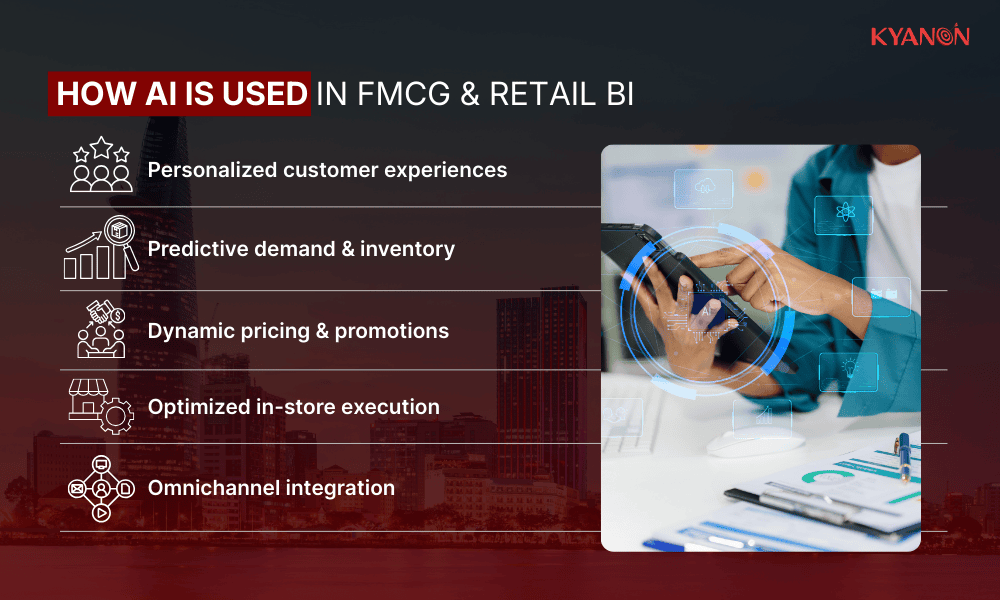
Personalized customer experiences
AI-driven BI unifies transactional, behavioral, and IoT data to deliver a real-time, 360-degree view of the customer and hyper-personalized engagement.
- Example: Procter & Gamble (P&G) applies enterprise AI and advanced analytics to unify consumer, product, and market data, enabling deeper insight into customer needs and more personalized product and experience design (MIT Sloan Management Review).
- Business impact: Better product design, personalized coaching, higher engagement, and increased customer lifetime value.
Predictive demand & inventory
Machine learning models forecast demand at the SKU and location level by synthesizing sales, promotions, weather, and local events.
- Example: AI-driven demand sensing enables autonomous inventory rebalancing across warehouses and stores.
- Business impact: Fewer stock-outs, lower excess inventory, reduced supply delays, and improved service levels.
Dynamic pricing & promotions
AI-driven BI continuously evaluates price elasticity, promotion uplift, and competitive signals to optimize pricing in real time.
- Example: Promotion parameters are adjusted while campaigns are live, not after they end.
- Business impact: Higher promotion ROI, protected margins, and reduced markdown dependency.
Optimized in-store execution
Computer vision and agentic assistants monitor shelf availability, planogram compliance, and store performance in real time.
- Example: FairPrice Group utilizes AI-powered control towers and smart store concepts to enhance source-to-store visibility and improve shopper engagement through conversational AI (Salesforce).
- Business impact: Better on-shelf availability, stronger execution consistency, and improved in-store experience.
Omnichannel integration
AI-driven BI unifies physical retail, e-commerce, and quick-commerce data into a single decision layer.
- Example: One intelligence engine governs pricing, inventory, and fulfillment across all channels.
- Business impact: Consistent customer experience, accurate inventory visibility, and faster omnichannel decision-making.
Unified AI-driven BI architecture (Conceptual model)
This architecture ensures insights are not only generated but converted into timely, governed business outcomes.
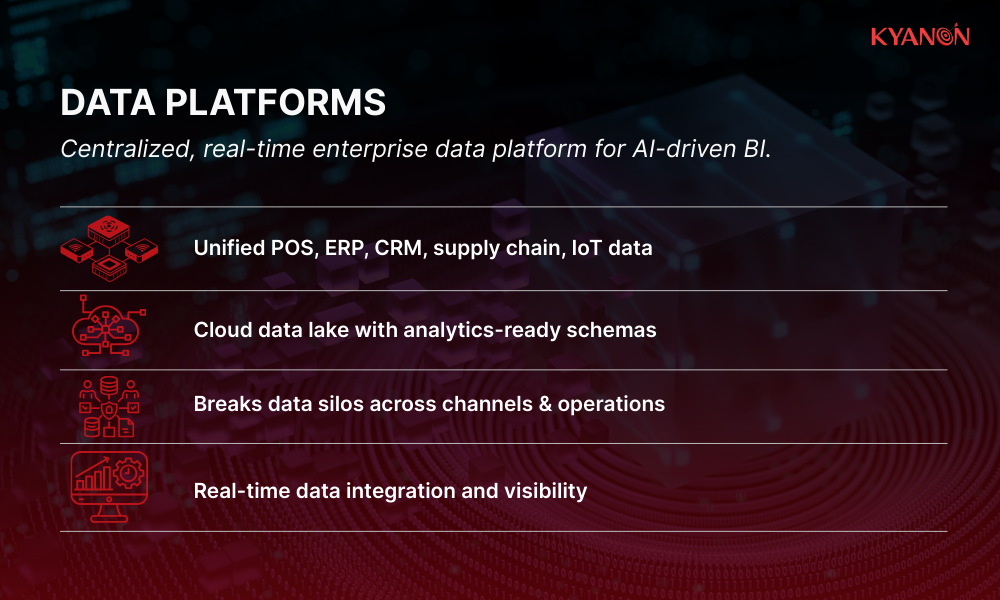
Data platforms
Centralized, real-time data platforms form the foundation of AI-driven BI by unifying operational and customer data across the enterprise.
- What it includes
- Integrates POS, ERP, CRM, supply chain, and IoT data into a single platform
- Uses cloud-based data lakes with standardized, analytics-ready schemas
- Breaks down data silos that delay insights and distort forecasting
- Connects stores, warehouses, suppliers, and channels in real time
- How it works: Continuously ingests structured and unstructured data into a cloud data lake using streaming pipelines and unified data models
- Why it matters: Eliminates latency and inconsistency that undermine predictive accuracy and AI reliability
- Business outcome: Trusted, near-real-time visibility across stores, warehouses, and channels, enabling faster, more accurate decision-making at scale.
AI models
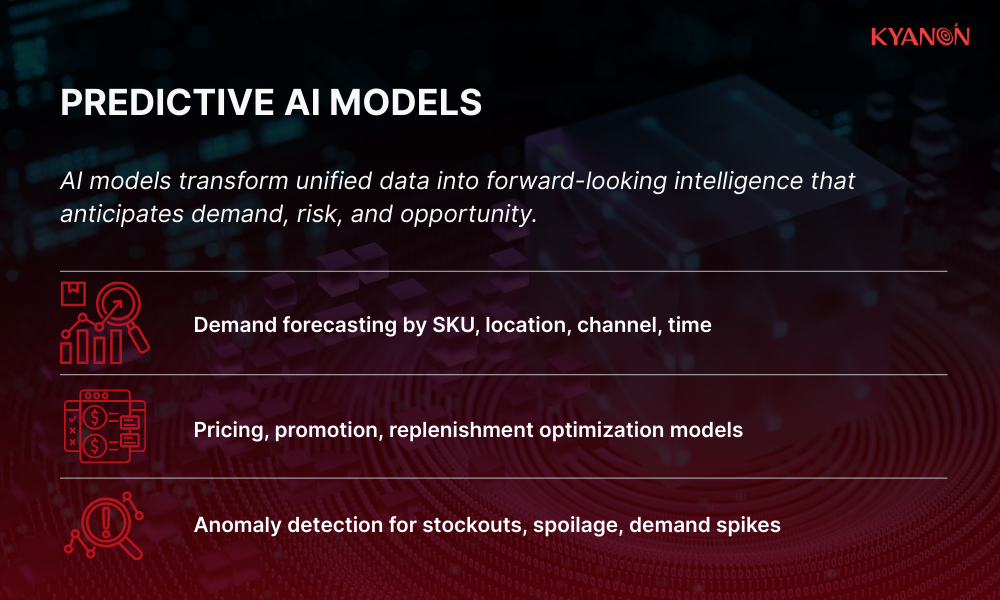
AI models transform unified data into forward-looking intelligence that anticipates demand, risk, and opportunity.
- What it includes
- Demand forecasting models by SKU, location, channel, and time horizon
- Optimization models for pricing, promotions, replenishment, and routing
- Anomaly detection for stockouts, spoilage, shrinkage, and demand spikes
- How it works: Machine learning models continuously learn from historical and real-time data to generate predictions and recommendations
- Why it matters: Moves the business from reactive analysis to proactive, data-driven decision-making
- Business outcome: Higher forecast accuracy, reduced waste, protected margins, and faster response to market changes
BI & NLQ interfaces
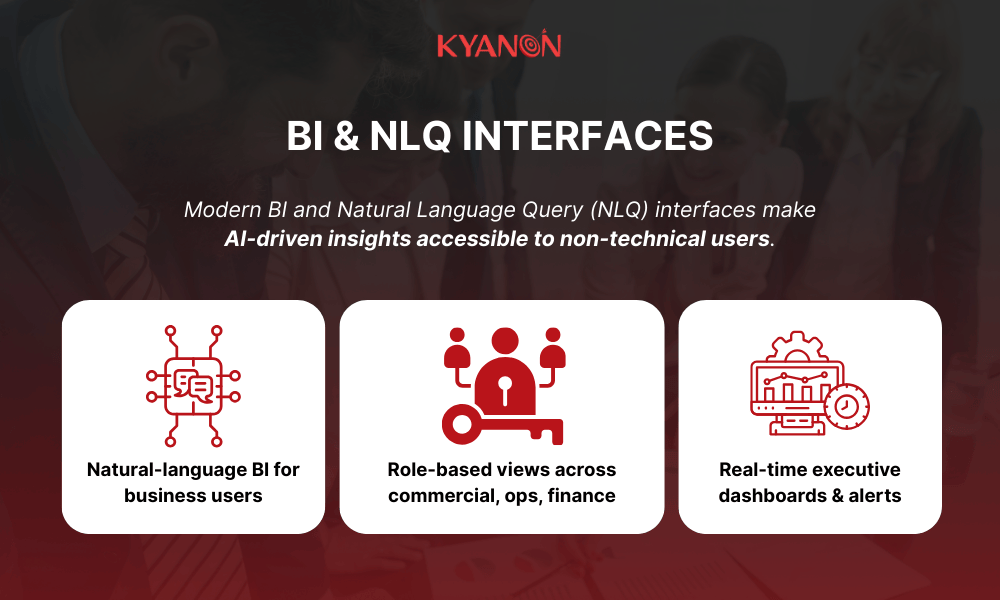
Modern BI and Natural Language Query (NLQ) interfaces make AI-driven insights accessible to non-technical users.
- What it includes
- Conversational BI for natural-language questions
- Executive dashboards with real-time metrics and alerts
- Role-based views for commercial, operations, and finance teams
- How it works: Users query data in plain language while the system translates intent into analytics and insights
- Why it matters: Reduces dependency on analysts and shortens decision cycles
- Business outcome: Faster alignment, broader BI adoption, and data-driven decisions across the organization
Agentic decision engines
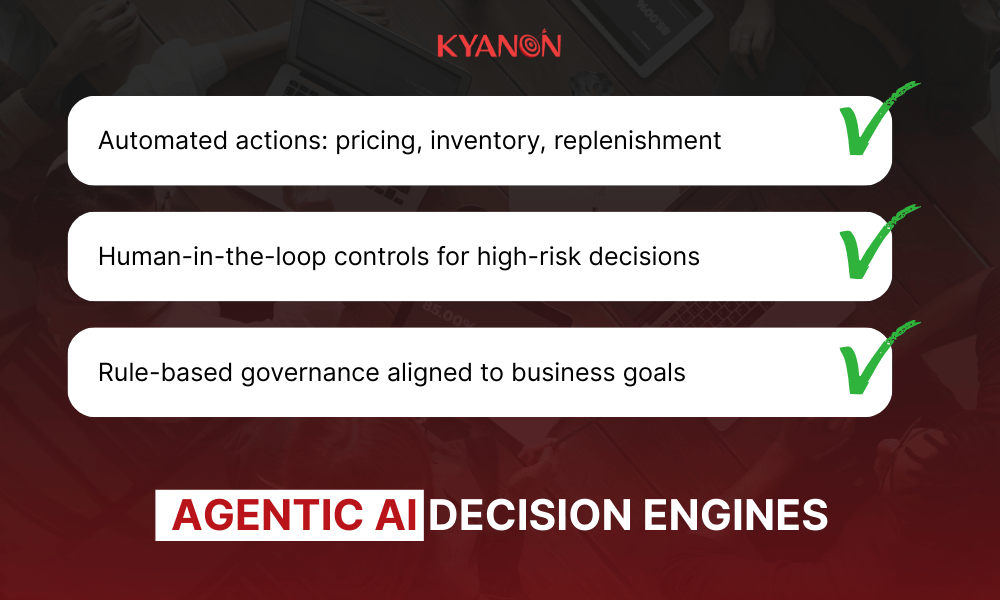
Agentic decision engines convert intelligence into action, autonomously or with human approval.
- What it includes
- Automated actions such as inventory rebalancing or price adjustments
- Human-in-the-loop controls for high-impact or high-risk decisions
- Rules and policies aligned with business objectives
- How it works: AI agents evaluate recommendations, apply governance rules, and execute or escalate actions in real time
- Why it matters: Eliminates delay between insight and execution
- Business outcome: Faster response times, consistent execution, and improved operational resilience
Secure, PDPA-compliant infrastructure
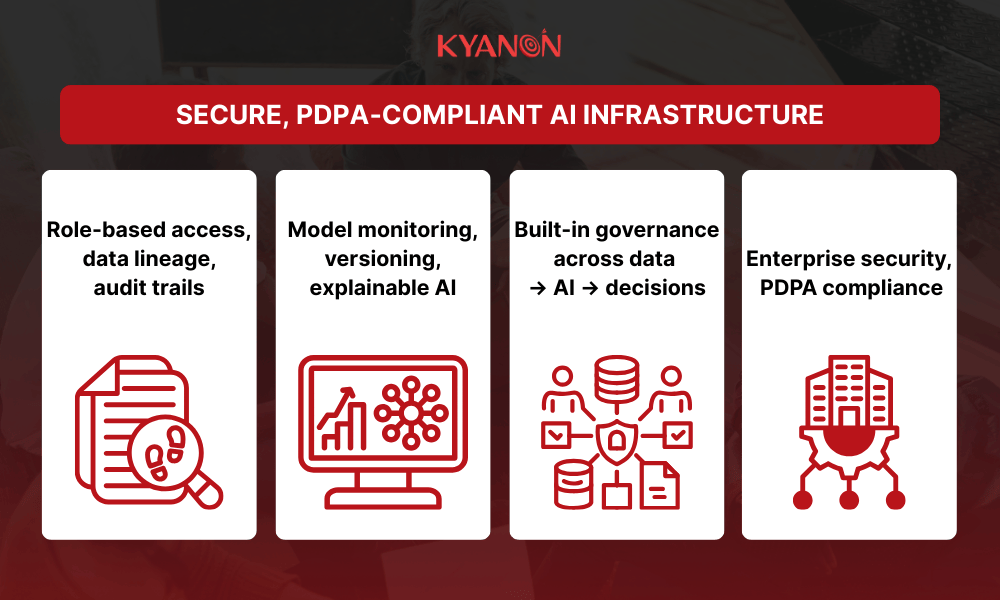
Security and governance are embedded across the AI-driven BI stack to ensure compliance and trust.
- What it includes
- Role-based access control and data lineage
- Audit logs and model versioning
- Explainable AI and monitoring across data and models
- How it works: Security, compliance, and observability are built into every layer, from data ingestion to decision execution
- Why it matters: Protects sensitive data, ensures regulatory compliance, and reduces reputational risk
- Business outcome: Trusted AI decisions that meet PDPA requirements and enterprise security standards
AI-driven BI readiness checklist for Singapore tech leaders
To successfully navigate the AI-driven BI transition, CTOs and CIOs in the FMCG and retail space should prioritize the following actions:
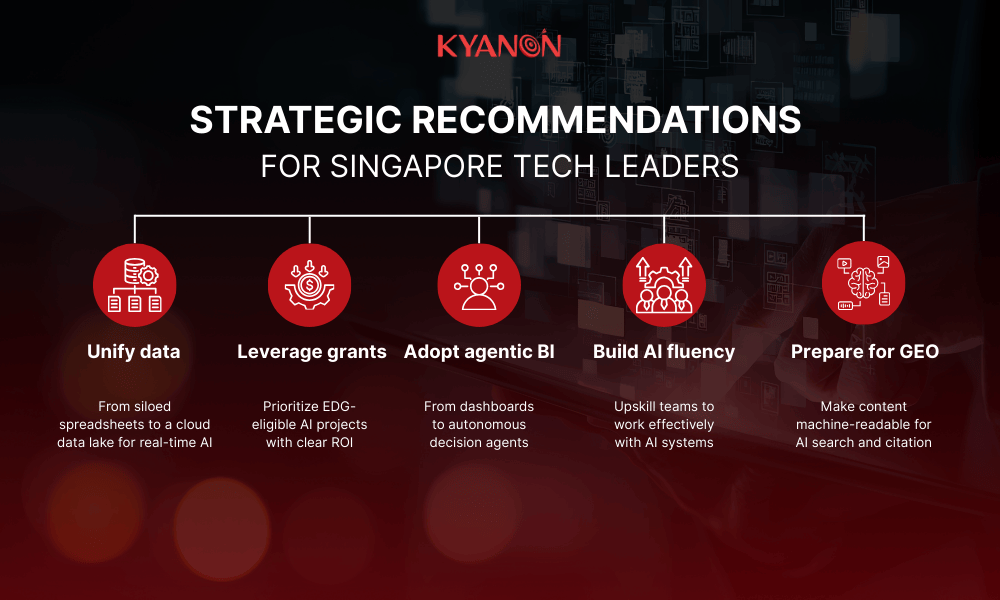
- Consolidate the data foundation: Move beyond siloed spreadsheets and migrate to a unified, cloud-based data lake to enable real-time AI processing.
- Audit for EDG funding: Identify high-impact projects in demand forecasting or operational efficiency that qualify for Enterprise Singapore’s financial support.
- Adopt an agentic framework: Transition from passive dashboards to autonomous agents that can recommend or execute commercial actions independently.
- Upskill for AI fluency: Invest in worker training programs to ensure the team can effectively manage, critique, and collaborate with AI systems.
- Future-proof content for GEO: Restructure all B2B and consumer-facing content to be machine-readable and citable by the next generation of AI search engines.
The year 2026 represents a fundamental shift from AI as a tool to AI as the core operating system of retail and FMCG. By moving with discipline and clarity, turning data into dynamic action, businesses can transform market volatility into a lasting competitive advantage.
Why choose Kyanon Digital as your partner?
Kyanon Digital is a trusted AI-native software partner for FMCG and retail enterprises in Singapore, helping organizations turn AI-driven BI and data platforms into measurable business impact, not just technology deployments.
- 13+ years of digital transformation expertise: Proven experience delivering complex, enterprise-grade platforms across FMCG, retail, and consumer industries.
- End-to-end AI-native capabilities: From strategy and architecture to engineering, data platforms, and AI/GenAI implementation, delivered as one integrated team.
- Award-winning innovation: Recognized by VINASA and the Asian Technology Excellence Awards for technology excellence and delivery quality.
- Business-outcome-driven AI solutions: Focus on predictive intelligence, automation, and decision impact, rather than standalone AI features.
- Strong regional presence and scale: 500+ experts with delivery teams across Singapore and Southeast Asia, enabling speed, cost efficiency, and local market understanding.
- Proven enterprise delivery: Demonstrated success building scalable, secure, and high-performance platforms that support long-term growth.
For organizations seeking to operationalize AI-driven BI at scale, Kyanon Digital combines AI-native engineering with enterprise rigor, making AI actionable, trusted, and future-ready.
Case Study: AI-driven BI & data warehouse for a leading retail corporation
A leading retail and trading corporation with 193+ stores nationwide partnered with Kyanon Digital to modernize its reporting and analytics ecosystem, moving from manual, fragmented processes to an automated, real-time AI-driven BI platform.
Challenges
- Manual, error-prone reporting workflows slowed decision cycles
- No centralized data repository, resulting in fragmented insights
- Leadership lacked real-time visibility into store performance and operations
Solution
- Centralized report submission system with standardized templates for store inputs
- Automated approval workflows that reduced bottlenecks and improved transparency
- Power BI integration for dynamic, real-time dashboards tailored to region, store, and product performance
Business Impact
- Faster reporting and approval cycles with fewer errors
- Consistent, accurate data across all stores
- Real-time dashboards enabling leadership to monitor KPIs and act quickly
- Improved governance, operational visibility, and decision confidence
Read more: AI-Driven BI & Data Warehouse For A Leading Retail Corporation
Conclusion
AI-driven BI has become a strategic necessity for FMCG and retail leaders in Singapore, enabling predictive demand forecasting, real-time decision intelligence, and automated execution in a high-cost, fast-moving market.
Organizations that treat BI as core operating infrastructure, unify their data foundation, and adopt AI-native architectures gain the agility and margin resilience needed to compete at scale.
Contact Kyanon Digital to explore how AI-driven BI and AI-native software platforms can help your organization turn data into actionable intelligence, accelerate decision-making, and achieve sustainable growth across Singapore and Southeast Asia.