


AI in ecommerce and retail helps businesses personalize shopping experiences, improve product discovery, forecast demand, optimize pricing and inventory, and automate operations. Major trends include hyper-personalization, agentic commerce, and predictive AI. These applications can improve commercial and operational performance when supported by reliable data, system integration, and clear business priorities.
For ecommerce and omnichannel retailers, the challenge is no longer simply adopting AI. It is identifying which applications can address low conversion rates, rising operating costs, inventory inefficiencies, and fragmented customer experiences.
Drawing on its experience in retail digital transformation, omnichannel commerce, and intelligent automation, Kyanon Digital examines the trends, practical use cases, and implementation decisions that can help retail leaders prioritize AI investments.
Key takeaways
- AI supports revenue and operational performance through personalized discovery, demand forecasting, and workflow automation.
- Start with the business bottleneck: low conversion, inefficient inventory, or repetitive operations should determine the first AI use case.
- Data integration, implementation costs, and governance are essential considerations before scaling AI across commerce channels.
- Kyanon Digital’s retail projects demonstrate the value of connecting intelligent automation with existing enterprise systems rather than deploying isolated solutions.
Further reading:
- Challenges of AI in Retail: How to Overcome Them
- Building AI-Driven Pricing Systems for Retail
- AI-Driven Retail Analytics: From Data to Decisions
The rise of AI in ecommerce and retail
AI is changing how consumers discover, evaluate, and purchase products, while helping retailers make more informed operational decisions.
According to the National Retail Federation and IBM’s 2026 consumer research, based on 18,000 consumers globally:
- 41% use AI assistants to research products.
- 33% use AI assistants to find product reviews.
- 31% use AI assistants to search for deals.
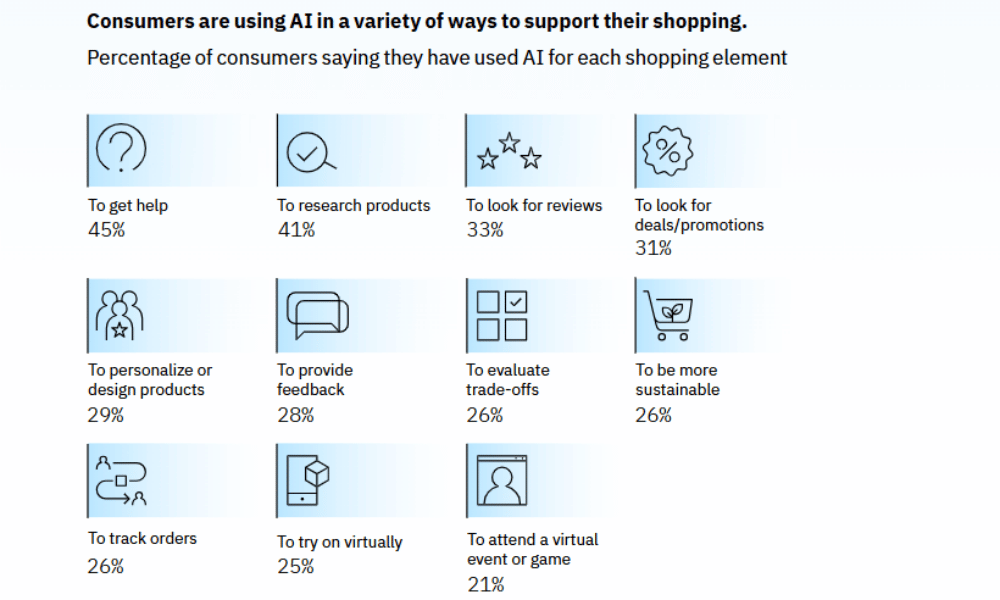
This shift means retailers must prepare for AI-assisted discovery beyond their own websites. Accurate product attributes, prices, availability, and fulfillment information increasingly matter to how customers evaluate products.

Why AI matters: Market trends and statistics
AI investment is increasingly tied to commercial performance, but adoption and operational readiness are not progressing at the same pace.
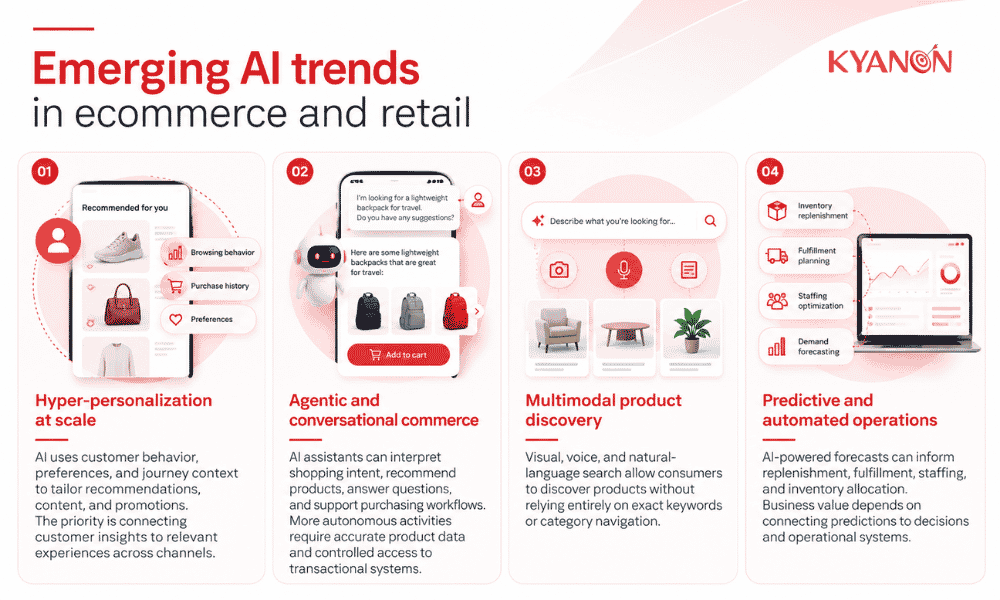
- Hyper-personalization at scale: AI uses customer behavior, preferences, and journey context to tailor recommendations, content, and promotions. The priority is connecting customer insights to relevant experiences across channels.
- Agentic and conversational commerce: AI assistants can interpret shopping intent, recommend products, answer questions, and support purchasing workflows. More autonomous activities require accurate product data and controlled access to transactional systems.
- Multimodal product discovery: Visual, voice, and natural-language search allow consumers to discover products without relying entirely on exact keywords or category navigation.
- Predictive and automated operations: AI-powered forecasts can inform replenishment, fulfillment, staffing, and inventory allocation. Business value depends on connecting predictions to decisions and operational systems.
What do the latest AI in ecommerce statistics reveal?
AI adoption is advancing, but enterprise readiness remains a significant challenge. Adobe‘s 2026 AI and Digital Trends in Retail and Consumer Goods research identifies three barriers to scaling agentic AI:
- 75% cite data integration and quality challenges.
- 72% cite an unclear business case.
- 68% cite talent and skills gaps.
These barriers explain why selecting an AI tool is not equivalent to preparing an organization for AI. A retailer might have a capable recommendation model but still struggle to activate it because ecommerce, POS, CRM, and loyalty systems maintain inconsistent customer or product records.
Kyanon Digital’s implementation perspective: retailers should assess the availability and reliability of the data required for a specific use case before investing in additional AI functionality. Otherwise, the project may automate incomplete or inconsistent decisions.
Core benefits of AI for ecommerce and retailers
AI in ecommerce creates value through revenue growth opportunities, operational efficiency, inventory optimization, and improved risk control. The business case should be measured against existing performance, rather than assuming AI adoption will automatically generate returns.
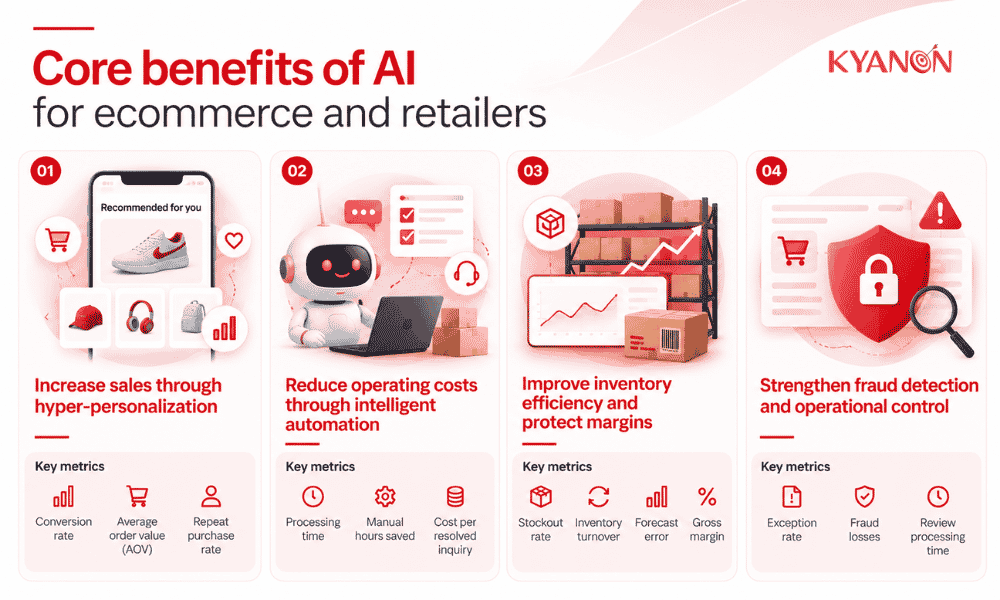
Increase sales through hyper-personalization
AI-powered recommendations and targeted campaigns help retailers deliver more relevant shopping experiences. This is particularly useful when product discovery, cross-selling, or repeat purchases are underperforming.
Key metrics: Conversion rate, average order value (AOV), and repeat purchase rate.
Reduce operating costs through intelligent automation
AI assistants and workflow automation reduce repetitive activities across customer support, merchandising, order handling, and back-office processes. They are most relevant when growing transaction volumes create manual bottlenecks.
Key metrics: Processing time, manual hours saved, and cost per resolved inquiry.
Improve inventory efficiency and protect margins
Predictive analytics supports replenishment, stock allocation, and promotion decisions using sales history, seasonality, and demand signals. Retailers facing frequent stockouts or excess inventory can evaluate these capabilities against existing planning methods.
Key metrics: Stockout rate, inventory turnover, forecast error, and gross margin.
Strengthen fraud detection and operational control
AI-powered anomaly detection helps identify suspicious transactions, duplicate submissions, and operational exceptions for review. This is valuable for retailers managing large transaction volumes or complex multi-store operations.
Key metrics: Exception rate, fraud losses, and review processing time.
Key AI use cases and solutions in ecommerce
AI in ecommerce addresses two priorities: increasing revenue through better customer experiences and improving operational efficiency through forecasting and automation. The suitability of each application depends on the retailer’s existing challenges, data capabilities, and expected outcomes.
AI for customer experience and product discovery
How AI drives ecommerce conversions through smarter discovery, personalized shopping, and automated engagement.
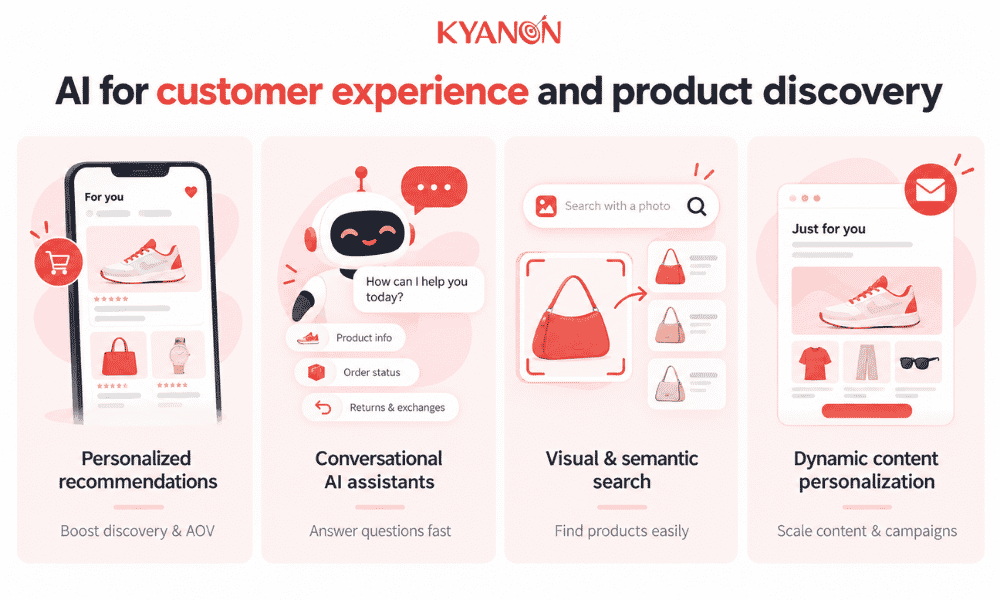
- Personalized product recommendations: AI analyzes browsing behavior, purchase history, and preferences to recommend relevant or complementary products. It is particularly useful for retailers seeking to improve product discovery, cross-selling, and AOV.
- Conversational AI chatbots and virtual assistants: AI assistants answer product questions, support purchase decisions, track orders, and handleroutine return inquiries. They can reduce repetitive service workloads while escalating complex cases to human agents.
- AI-driven visual and semantic search: Computer vision and semantic search allow customers to find products through images or natural-language descriptions. This helps retailers with extensive catalogs reduce product discovery friction.
- Dynamic content and marketing personalization: Generative AI supports product descriptions, localized content, and personalized campaigns. It is particularly relevant when frequent catalog updates or multi-market operations create merchandising bottlenecks.
Retailers considering AI-powered pricing can explore Kyanon Digital’s practical guide to building AI-driven pricing systems for implementation steps, pricing controls, and build-versus-buy considerations.
AI for retail operations and supply chain optimization
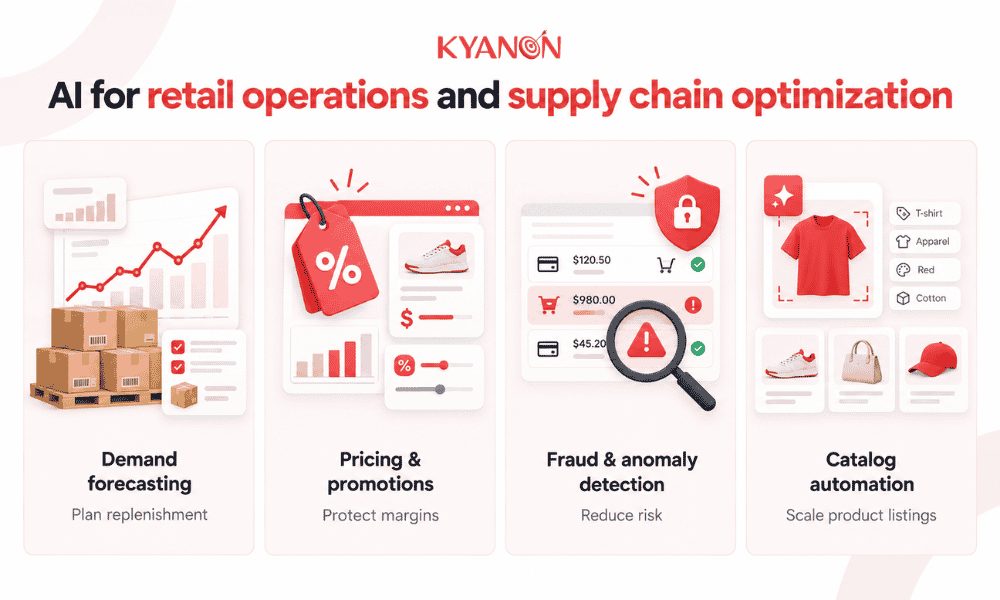
- Predictive demand forecasting and inventory planning: AI analyzes sales history, seasonality, and demand signals to support replenishment and stock allocation. Retailers with recurring stockouts or excess inventory can use forecasting to improve planning decisions.
- Dynamic pricing and promotion optimization: AI evaluates demand, competitor pricing, inventory, and margin constraints to recommend price or promotion adjustments. This is useful for large assortments and frequent campaigns, provided commercial controls remain in place.
- AI-powered fraud detection and anomaly monitoring: Machine learning identifies suspicious transactions, duplicate submissions, and unusual operational patterns. It supports faster exception handling and financial oversight.
- AI-powered product catalog automation: Generative AI and computer vision streamline product classification, attribute tagging, image processing, and listing creation, helping retailers manage expanding catalogs across channels.
How important is AI ecommerce automation for first-time online retailers?
AI ecommerce automation can help first-time retailers reduce repetitive tasks, manage increasing order volumes, and maintain service quality without proportionate staffing increases. The most practical starting points are customer-service FAQs, abandoned-cart messaging, product listing assistance, and automated inventory synchronization.
However, not every task requires advanced AI. Standard ecommerce automation is often sufficient for inventory updates, order notifications, and predefined marketing workflows.
First-time retailers should prioritize reliable checkout, product data, and inventory processes before investing in complex AI solutions. As sales volumes and integration needs grow, Kyanon Digital’s Comprehensive E-Commerce Solution Services can support the evaluation of commerce platform development, modernization, and integration requirements.
Which AI use case should retailers prioritize first?
The best AI investment depends on the business constraint, system readiness, and measurable outcome.
| Business challenge | Suitable AI starting point |
Success metric |
|
Low conversion or weak cross-selling |
Personalized recommendations | Conversion rate, AOV |
| High service workload | Conversational AI |
Resolution time, cost per inquiry |
|
Poor product discovery |
Visual and semantic search | Search conversion rate |
| Inventory imbalances | Predictive forecasting |
Stockout rate, inventory turnover |
|
Margin pressure |
Pricing optimization | Gross margin, markdown rate |
| Manual reviews and exceptions | Anomaly detection |
Processing time, exception rate |
Before implementing AI, retailers should validate whether existing commerce platforms, ERP, POS, CRM, and inventory systems can provide the required data.
Kyanon Digital’s implementation perspective: prioritize integration and workflow readiness before adding AI complexity. A targeted AI capability may be sufficient when existing systems are reliable; fragmented processes may require modernization first.
What can retailers learn from real-world AI implementations?
How Kyanon Digital turns customer data into personalized retail engagement
In an AI-powered loyalty engagement project for a leading beverage brand, Kyanon Digital connected real-time consumer behavior tracking with AI-driven segmentation and automated CRM campaigns. The platform improved customer behavior visibility, enabled more relevant rewards and retargeting, and strengthened customer retention and loyalty.
How Kyanon Digital leveraged AI-driven personalization to improve customer engagement and loyalty for a leading beverage brand.
Business takeaway: From this experience, Kyanon Digital recommends prioritizing the connection between customer data and marketing execution before investing in more advanced personalization. Retailers should assess whether behavioral insights can trigger timely, relevant actions and measure their impact through repeat purchases, retention, and campaign performance.
Amazon: Scaling AI-powered shopping experiences
Amazon initially introduced its AI shopping assistant, Rufus, to a limited customer group before expanding availability. In May 2026, Amazon combined Rufus and Alexa+ into Alexa for Shopping, supporting personalized recommendations, product comparisons, price tracking, and automated purchasing features.

In Q2 2026, Amazon reported that active users of the shopping assistant had nearly doubled year over year, while interactions increased more than fivefold.
Business takeaway: Start with a defined customer journey, validate adoption and experience quality, and expand AI capabilities through controlled releases rather than committing immediately to full-scale deployment.
Walmart: Connecting retail intelligence to operational decisions
Walmart is expanding AI-supported retail intelligence through its Scintilla platform, connecting first-party data with inventory, merchandising, and supplier workflows.
In September 2026, Walmart outlined capabilities that help suppliers identify stockout risks and move from insights into replenishment or in-store actions. Its approach emphasizes integrated data, existing operational systems, and human decision-making.

Business takeaway: AI becomes more useful when recommendations connect directly to the teams and systems responsible for execution, rather than remaining isolated in analytics dashboards.
While Amazon and Walmart demonstrate how AI can scale across customer experiences and retail operations, Kyanon Digital brings practical implementation expertise in connecting AI with existing commerce platforms, customer data, and business workflows.
For retailers, the next step is to identify one measurable business bottleneck, assess data and integration readiness, and pilot a focused AI solution before scaling based on proven commercial or operational outcomes.
Conclusion
AI in ecommerce and retail offers opportunities to improve sales, customer experience, inventory decisions, and operational efficiency. However, successful implementation depends on selecting the right use case and ensuring that data, systems, and business processes can support it.
Retailers should start with a measurable problem, validate implementation readiness, and expand investment only when the selected AI capability demonstrates value against agreed KPIs. For businesses evaluating AI-enabled commerce, personalization, or retail automation, discuss your ecommerce transformation priorities with Kyanon Digital to explore suitable use cases, integration dependencies, and implementation scope.
References
- Own the Agentic Commerce Experience — National Retail Federation and IBM, 2026.
- 2026 AI and Digital Trends in Retail and Consumer Goods — Adobe, 2026.
- Integrated Commerce Platform for Thailand’s Largest Retail Group — Kyanon Digital.
- Amazon Q2 2026 Earnings Report — Amazon, 2026.
- Walmart Data Ventures Is Building the Future of Commerce Intelligence — Walmart, 2026.
- How a Leading Singapore Retail Chain Automated Compliance and Store Operations at Scale — Kyanon Digital.








 Create project brief with AI