Dedicated tech teams vs. project-based development in Singapore has become a strategic decision for enterprises facing increasing pressure to scale engineering capabilities while maintaining speed, cost efficiency, and operational control.
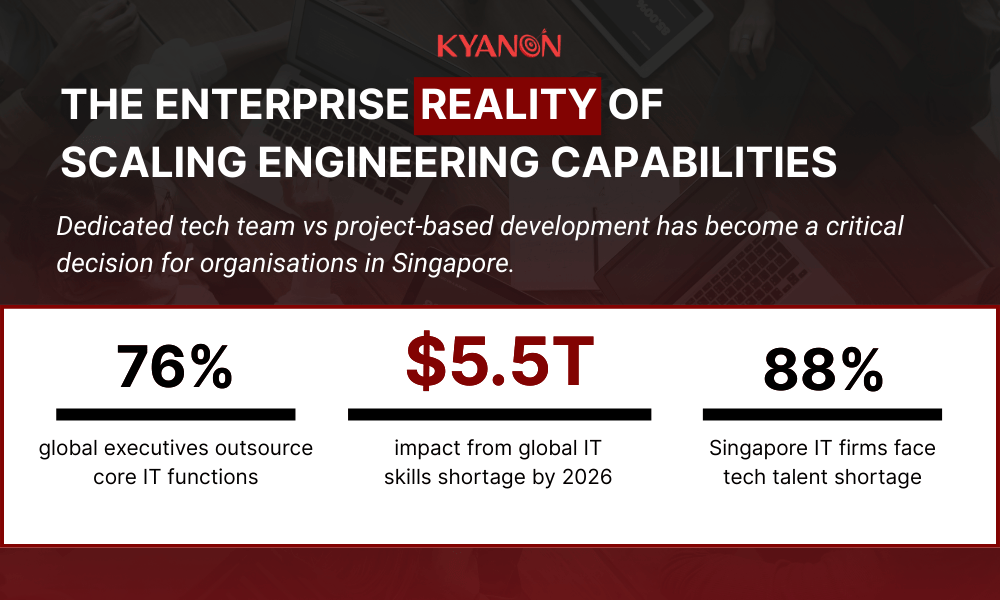
Global research shows that 98% of C-suites find that a talent shortage is affecting their IT vision (FM Magazine), which is leading to outsourcing core functions to overcome talent shortages and improve time-to-market
IDC estimates the global IT skills gap could contribute up to $5.5 trillion in economic impact by 2026. The challenge is particularly visible in Singapore, where 83% of IT firms struggle to find skilled talent for high-demand roles such as AI and cybersecurity (ManpowerGroup), forcing organizations to rethink how software teams are structured and scaled.
Combined with ongoing salary growth and higher total remuneration costs in 2026 (SBR), enterprises must carefully evaluate whether to build sustained capability or outsource defined outcomes.
In this guide, Kyanon Digital compares a dedicated tech team vs. project-based development in Singapore for founders and CTOs seeking the most scalable, secure, and cost-effective software engineering frameworks to future-proof their business roadmaps.
Key takeaways
- A dedicated tech team equals long-term capability ownership: Best for product platforms, continuous innovation, and IP-sensitive systems in Singapore’s talent-constrained market.
- Project-based development defines outcome delivery: Ideal for MVPs, automation projects, or grant-supported digital transformation initiatives.
- Singapore talent shortage drives adoption: With 83% of firms struggling to hire skilled tech talent, embedded teams help maintain delivery velocity.
- Cost structure differs over time: Project models optimize short-term budgets; dedicated IT teams reduce long-term total cost through knowledge retention and lower rework.
- Governance determines success: Dedicated teams require KPI-driven product leadership; project delivery relies on strong upfront scoping.
- Contracts shape operational risk: IP ownership, PDPA compliance, and change management clauses directly affect scalability and data governance.
- Growth stage guides the model choice: Startups and scaling firms favor dedicated development teams; SMEs digitizing operations often start with project-based delivery.
- Hybrid adoption is common in Singapore: Many enterprises validate with projects first, then transition to dedicated teams for scaling.
Further reading:
- Why Singapore Enterprises Hire Dedicated Developer
- From MVP to Robust Product: Hire Dedicated Development Team For Startup Growth
- How to Evaluate the Cost vs. Value of Hiring a Dedicated Software Development Team
- Why Dedicated Teams Work in Startups, FinTech, Healthcare, and More
Dedicated tech team in Singapore
Why Singapore enterprises adopt this model
- Talent constraint is structural, not temporary. 83% of IT firms in Singapore struggle to hire skilled professionals in high-demand areas such as AI and cybersecurity (Manpower Singapore).
- Hiring cycles for senior engineers in Singapore remain prolonged, increasing time-to-market risk.
- Regional delivery hubs allow enterprises to secure specialized expertise while maintaining Singapore-level governance standards.
Strategic implication: Dedicated teams are increasingly used not as cost arbitrage tools, but as capacity multipliers to bypass domestic talent bottlenecks.
Typical team structure
A mature, dedicated team operates with end-to-end delivery capability:
- Project Manager / Delivery Lead
- Business Analyst
- Backend & Frontend Developers
- UI/UX Designer
- QA/Automation Engineer
- Optional: DevOps, Cloud Architect, Data/AI Engineer
This structure reduces dependency on internal managers for day-to-day execution.
Enterprise-level benefits
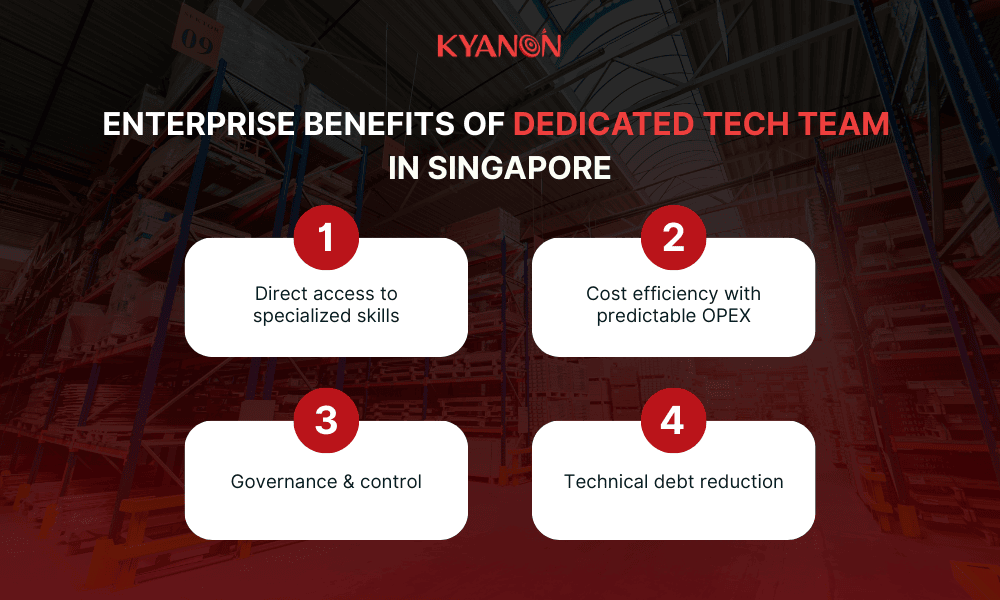
Direct access to specialized skills
- Cloud-native architecture
- AI/ML engineering
- Data engineering & analytics
- DevOps & platform reliability
Enterprises gain on-demand access without permanent headcount expansion.
Cost efficiency with predictable OPEX
- Typically, 40–60% operational cost optimization compared to equivalent local hiring.
- Converts fixed employment costs (CAPEX-like commitment) into scalable OPEX.
Governance & control
- Full control over backlog, sprint cadence, and architecture decisions.
- IP ownership is typically transferred from day one (subject to contract).
Technical debt reduction
- Continuous team engagement builds institutional knowledge.
- Reduces rework caused by vendor turnover or fragmented project ownership.
Risk considerations
- Requires internal product leadership maturity.
- Needs structured KPIs (velocity, cycle time, release frequency).
- Poor governance can erode ROI despite a cost advantage.
Project-based development in Singapore
Project-based development delivers a predefined output within a fixed scope, timeline, and budget, optimized for defined objectives rather than long-term capability building.
Singapore use cases
This model is commonly adopted when:
Testing MVP before scaling investment.
Implementing one-time digital transformation initiatives.
Automating a specific business process with clear boundaries.
Singapore enterprises often align this model with controlled-budget modernization efforts.
Best-fit conditions
Scope is clearly defined and stable.
The timeline is fixed.
Limited need for post-launch iteration.
Internal engineering oversight is minimal.
Strategic advantages
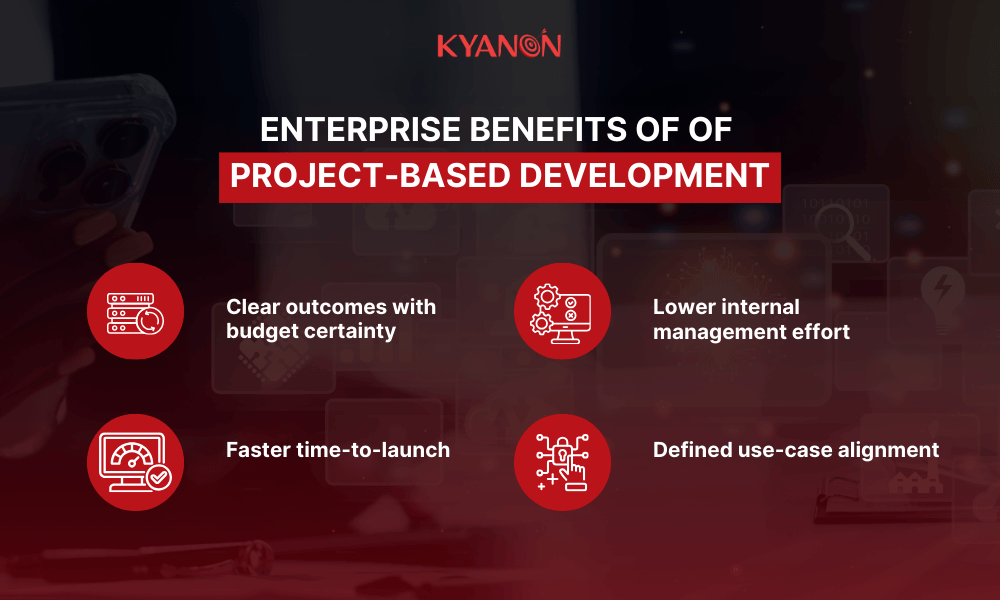
- Budget certainty: Fixed-price or milestone-based contracts cap financial exposure.
- Lower management overhead: The vendor manages staffing and execution mechanics.
- Faster initial launch: Effective for concept validation before committing to long-term scaling.
Risk & enterprise trade-offs
- Scope dependency
- High reliance on the accuracy of the initial requirement definition.
- Changes typically trigger contract renegotiation.
- Knowledge drain
- Once the project concludes, institutional knowledge exits with the vendor team.
- Long-term cost inflation
- Iterative enhancements may become more expensive than maintaining a standing team.
Dedicated team vs. project-based development
Navigating the Singapore market requires aligning your development model with local regulatory frameworks, grant ecosystems, and intellectual property expectations.
The following breakdown illustrates the operational trade-offs between the two approaches.
|
Decision factor |
Dedicated tech team | Project-based development |
|
Best for |
Long-term platforms, ongoing ops |
MVPs, discrete migrations, short initiatives |
|
Cost model |
Monthly/retainers (predictable for R&D) |
Fixed price or T&M (predictable per project) |
|
Control |
High-client-run backlog |
Low – vendor-run delivery |
|
Agility |
High – continuous pivoting |
Low-medium – formal change process |
|
Knowledge |
Retained institutional knowledge |
Minimal retention after handover |
|
IP / Ownership |
Typically direct transfer/owned |
Often deliverable-only unless negotiated |
| Data risk (PDPA) |
Client controls DPO process |
Vendor acts as an intermediary; stricter contracts needed |
Contract structure determines not only legal protection but also delivery flexibility, IP ownership, and long-term operational risk.
In Singapore, where PDPA compliance and IP governance are critical, enterprises must align contract clauses with their delivery model, capability ownership (dedicated team) vs. deliverable ownership (project-based).
Essential contract clauses for dedicated vs project-based development in Singapore
|
Clause type |
Dedicated team | Project-based |
Impacts for business |
|
Ownership (IP rights) |
Immediate transfer of all work outputs | Transfer applies only to final deliverables |
Dedicated model ensures long-term control of source code and architecture; project model may limit reuse rights unless negotiated |
|
Security & compliance |
Aligns with client’s internal DPO policies | Vendor acts as PDPA data intermediary |
Dedicated teams integrate into internal security governance; projects require stricter compliance monitoring |
|
Performance measurement |
KPIs (velocity, delivery quality, innovation metrics) | SLAs (delivery deadlines, uptime, acceptance criteria) |
Teams optimize continuous improvement; projects optimize completion accuracy |
|
Staffing control |
Client interviews and approves team members | Vendor assigns resources independently |
Dedicated teams provide talent transparency; projects prioritize delivery outcome over personnel continuity |
| Change management | Flexible backlog reprioritization | Formal change request process |
Dedicated teams adapt quickly; projects incur cost/time impacts for scope changes |
Why contract design matters in Singapore
- Singapore’s PDPA regulations place primary data responsibility on the hiring organization, even when vendors are involved.
- Misaligned contracts often create hidden risks in IP ownership, data liability, and future scalability.
- Enterprises increasingly treat vendor contracts as technology governance tools, not procurement documents.
Ownership defines future scalability
- Dedicated contracts secure long-term IP control.
- Project contracts often transfer only agreed outputs, not reusable components.
Security responsibility never transfers fully
- Under the Singapore PDPA, accountability typically remains with the client organization.
- Contracts must clearly define data-processing roles.
KPI vs SLA reflects operating philosophy
- KPIs = continuous product evolution.
- SLAs = successful project completion.
Change clauses directly affect agility
- Flexible backlog management supports agile innovation.
- Formal change requests slow iteration but protect budgets.
Executive decision rule
The contract is the operating model in written form; choosing the wrong clause structure often creates more long-term risk than choosing the wrong vendor.
- If software is core business infrastructure, prioritize IP ownership, staffing visibility, and KPI-based governance.
- If software is a finite initiative, prioritize SLAs, acceptance criteria, and scope protection.
Key decision drivers for Singapore firms
Startup & growth companies
When product equals business value, capability ownership becomes critical.
VC-backed and high-growth firms in Singapore increasingly adopt dedicated tech teams because continuous product evolution requires stable engineering capacity rather than episodic project delivery.
Reality-driven factors:
- Investors prioritize IP ownership and engineering continuity as part of valuation and due diligence.
- Singapore’s Tech@SG initiative enables companies to access global tech talent, encouraging long-term team structures over short-term outsourcing.
- Product-led companies must release features continuously to remain competitive in fintech, SaaS, and digital platforms.
Strategic advantages of the dedicated model
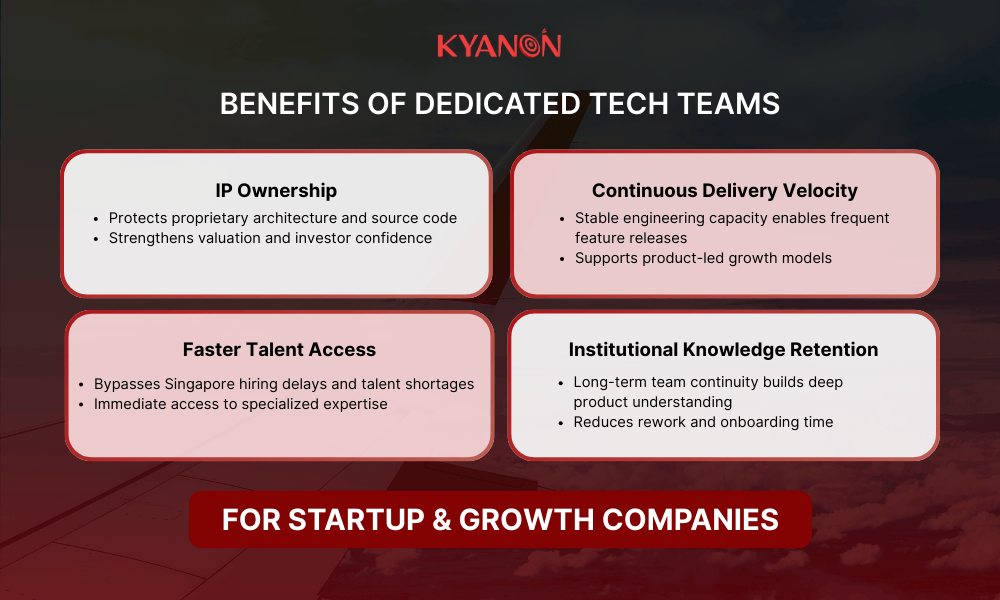
- Protects proprietary architecture and source code.
- Maintains delivery velocity during scaling phases.
- Reduces hiring delays caused by local talent shortages.
- Builds institutional engineering knowledge over time.
For scaling startups, the main risk is not cost; it is losing product momentum due to fragmented development ownership.
SMEs in Singapore: Why project-based development works
For SMEs, software typically supports operational efficiency rather than acting as the core business product. As a result, cost control, delivery predictability, and risk reduction become primary decision drivers.
Typical SME use cases
- E-commerce website or portal launch
- CRM or ERP implementation
- Workflow automation initiatives
- Customer experience improvement projects
Why SMEs prefer project-based development
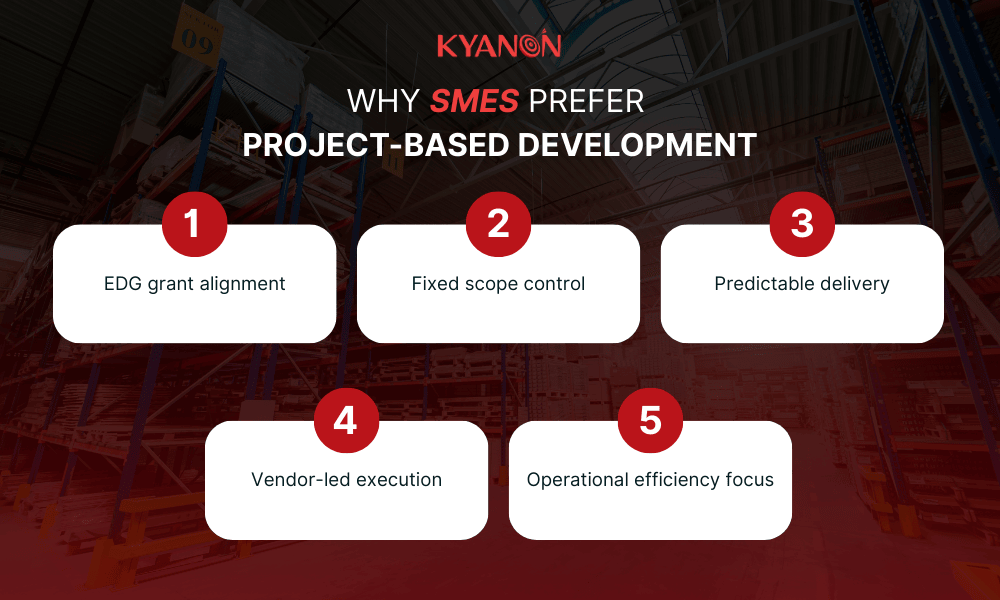
- Alignment with government funding programs such as the Enterprise Development Grant (EDG).
- Fixed scope reduces financial risk during digital adoption stages.
- Limited internal engineering governance makes vendor-led delivery more practical.
Strategic outcome
Project-based delivery enables SMEs to modernize operations efficiently without committing to long-term engineering team ownership.
Enterprise transformation: Structured delivery for large-scale modernization
For enterprises, digital transformation initiatives focus on process modernization, system integration, and organizational efficiency rather than continuous product innovation.
Common enterprise transformation initiatives
- Legacy system modernization
- Enterprise platform integration (ERP, CRM, data platforms)
- Large-scale workflow digitization
- Omnichannel customer experience transformation
Why project-based development fits enterprise transformation
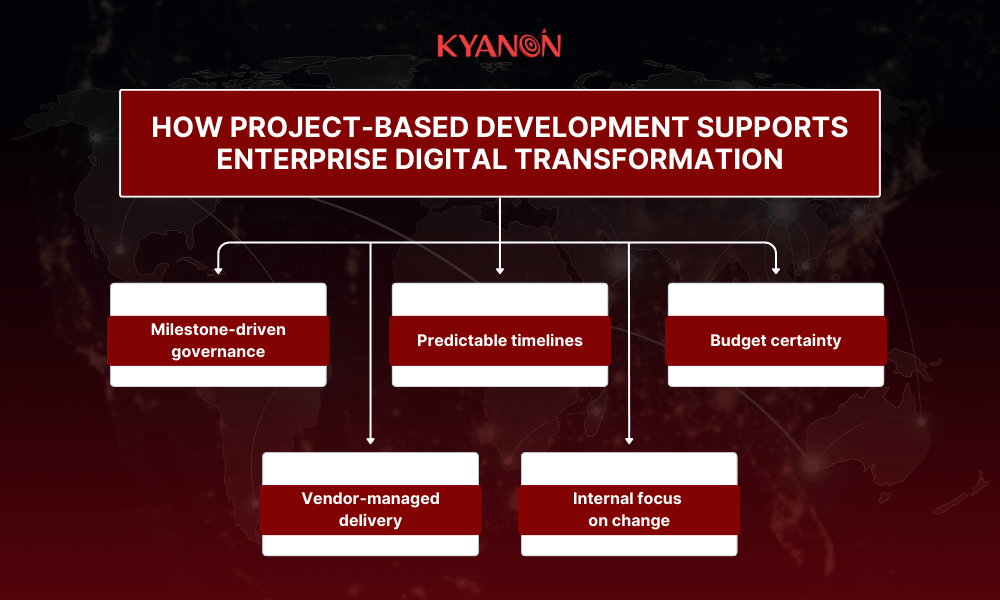
- Clearly defined milestones support governance and executive oversight.
- Predictable timelines align with transformation roadmaps and budgeting cycles.
- Vendors manage execution complexity while internal teams focus on change management.
Strategic outcome
Project-based development minimizes operational disruption while enabling controlled, phased transformation aligned with enterprise governance standards.
Growth stage determines delivery model
|
Business situation |
Preferred model |
Strategic reason |
|
VC-backed scaling company |
Dedicated tech team |
Protect IP + sustain product velocity |
|
AI/Data platform development |
Dedicated tech team |
Continuous iteration required |
|
SME digitizing operations |
Project-based |
Controlled scope & funding alignment |
|
MVP experimentation |
Project-based → Dedicated later |
Validate before scaling |
| Core platform expansion | Dedicated tech team |
Long-term capability ownership |
Why choose Kyanon Digital as your partner?
Kyanon Digital acts as a technology partner, helping enterprises build dedicated development teams aligned with product strategy, delivery governance, and long-term scalability, not just staffing needs.
Tech partner, not a recruiter
- Teams built based on product roadmap and engineering goals, not only job roles
- Supported by internal experts and continuous upskilling via the Center of Excellence
- Ensures delivery quality and long-term capability growth
Comprehensive talent ecosystem
- 500+ internal tech professionals
- Talent pipeline from 18 partner universities (K-Fresh Program)
- 15,000+ vetted external candidates
- 1,000+ ecosystem partners
- Enables fast scaling while maintaining quality standards.
One-stop talent management
- Talent sourcing, onboarding, and HR operations managed end-to-end
- Reduces internal management workload
- Allows teams to focus on product and innovation
Case study: Scaling Accenture’s digital capabilities with Kyanon Digital’s dedicated software engineers

Accenture is a global professional services company renowned for its expertise in digital transformation, technology, consulting, and operations.
Challenges:
- High in-house hiring costs: Recruiting and retaining specialized engineers were costly and slow.
- Talent shortages: Niche skills in modern tech stacks were difficult to source.
- Project-specific demands: Client projects required varied technical and domain expertise.
- Seamless integration: Engineers needed to quickly align with enterprise standards and agile ways of working.
Solution:
- Strategic talent selection & engineering excellence
- Center of Excellence (CoE) for continuous upskilling
- Meeting rigorous vendor approval requirements
Results: By leveraging Kyanon Digital’s Dedicated Software Engineer Services, Accenture has successfully expanded its digital capabilities while maintaining cost efficiency, technical excellence, and business agility.
Explore the full case study here: Scaling Accenture’s Digital Capabilities with Kyanon Digital’s Dedicated Software Engineers
In conclusion
Evaluating IT delivery models is a critical step in fortifying your enterprise architecture, optimizing R&D spending, and safeguarding intellectual property. The optimal choice balances your immediate delivery needs against the necessity for long-term technological resilience.
Would you like an expert review to determine which engineering model aligns best with your 2026 roadmap?
Contact Kyanon Digital today to build a highly scalable, secure, and cost-effective tech foundation.