


Singapore organizations continue to compete for specialized technology skills, but the 2026 challenge is increasingly about skills specificity rather than a simple shortage of developers. Singapore’s Ministry of Manpower (MOM) reports continued demand for software developers, systems analysts and data scientists, while specialized PMET vacancies can take longer to fill because employers need specific technical skills and relevant experience.
For technology and business decision-makers, the question is therefore not simply whether external developers cost less. It is whether the delivery constraint comes from insufficient capacity, missing specialist skills, weak product ownership, or a project that should be outsourced end to end.
A dedicated development team fits best when the roadmap is ongoing, priorities will evolve, and the organization needs stable external engineering capacity that can integrate with its existing product and technology functions.
Drawing on our Singapore–Vietnam delivery model, Kyanon Digital explains when dedicated developers make sense, what delivery and governance risks to control, and when staff augmentation or project-based delivery may be a better fit. Kyanon Digital’s Singapore operation combines local consultants, project managers and solution architects with engineering teams in Vietnam.
Key takeaways:
- Choose a dedicated team when the roadmap is ongoing and the main constraint is sustained engineering capacity or specialist skills, not when the work is a short, fixed deliverable.
- Compare total delivery cost, not salary alone: include internal management time, onboarding, vendor governance, replacement/knowledge-transfer risk, and rework.
- Define continuity rules before signing: named engineers, replacement approval, overlap period, documentation ownership and handover obligations.
- For Singapore organizations handling personal data, vendor governance should cover data-intermediary responsibilities, access controls, incident handling and exit management.
- Kyanon Digital’s 2026 dedicated-team model increasingly combines stable sprint capacity with AI-assisted requirements, development, QA preparation, documentation and reporting; buyers should still judge success by accepted outcomes and delivery quality.
Further reading:
- How to Evaluate the Cost vs. Value of Hiring a Dedicated Software Development Team
- Hidden Costs and Common Pitfalls Of Dedicated Team Hiring
- Why Dedicated Teams Work in Startups, FinTech, Healthcare, and More
- First 90 Days with a Dedicated Team: Milestones & KPIs
What are dedicated developers?
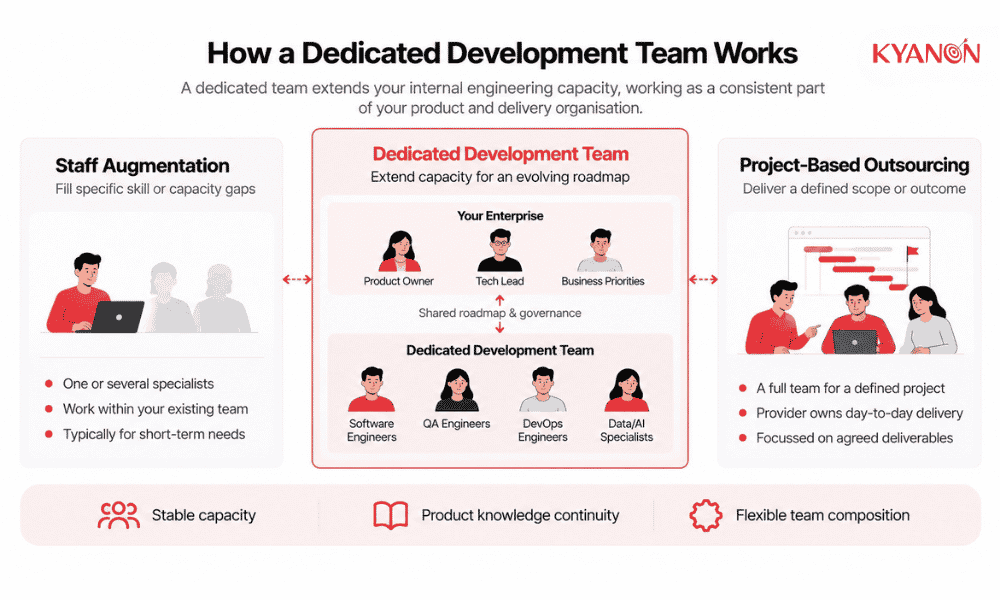
Dedicated developers are software engineers assigned by an external technology partner to work consistently, often full-time, on one organization’s product, platform or technology roadmap over an extended period.
Unlike freelancers who may support several clients at once or project-based teams contracted to deliver a fixed scope, dedicated developers typically operate as an extension of the internal engineering organization.
The model usually includes three characteristics:
- Dedicated capacity: Engineers remain focused on the agreed product, roadmap or engineering scope rather than rotating between unrelated client assignments.
- Team integration: They work within shared tools, ceremonies, code repositories, documentation practices and delivery workflows.
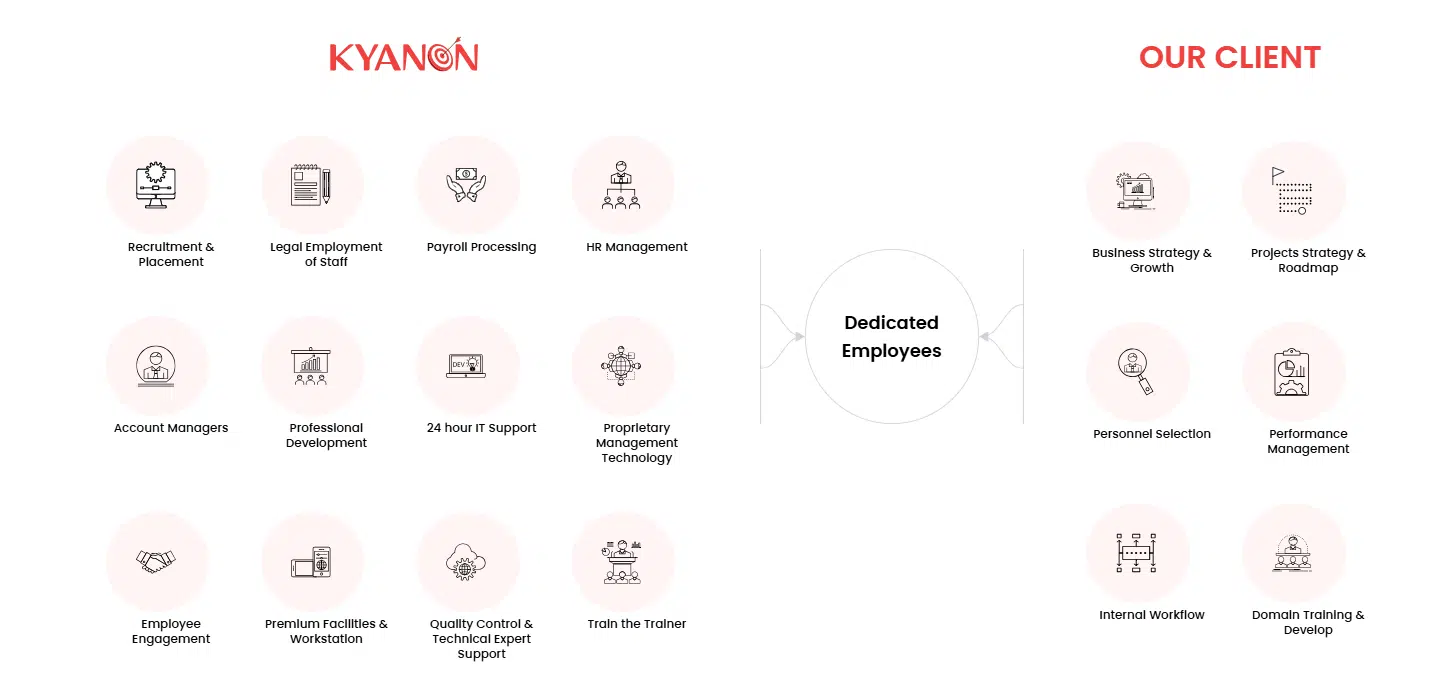
- Provider support: The external partner typically manages employment, onboarding and professional support; depending on the engagement model, it may also take responsibility for agile governance and delivery coordination.
Organizations can engage individual specialists or build a cross-functional dedicated team spanning software engineering, QA, DevOps, and data and AI capabilities.
The practical distinction is continuity: the team retains product and system knowledge across releases instead of being assembled only for a one-off deliverable.

Why Singapore enterprises are turning to dedicated hiring
Singapore enterprises are increasingly considering dedicated development teams as they balance digital and AI transformation priorities with a more selective approach to technology hiring.
The shift is not simply about finding lower-cost developers. It reflects four structural pressures: specialized skill requirements, tighter permanent headcount decisions, changing technology capabilities, and greater acceptance of distributed delivery models.
For more context on this shift, see Kyanon Digital’s guide to why Singapore enterprises hire dedicated developers
Specialized technology skills remain difficult to secure
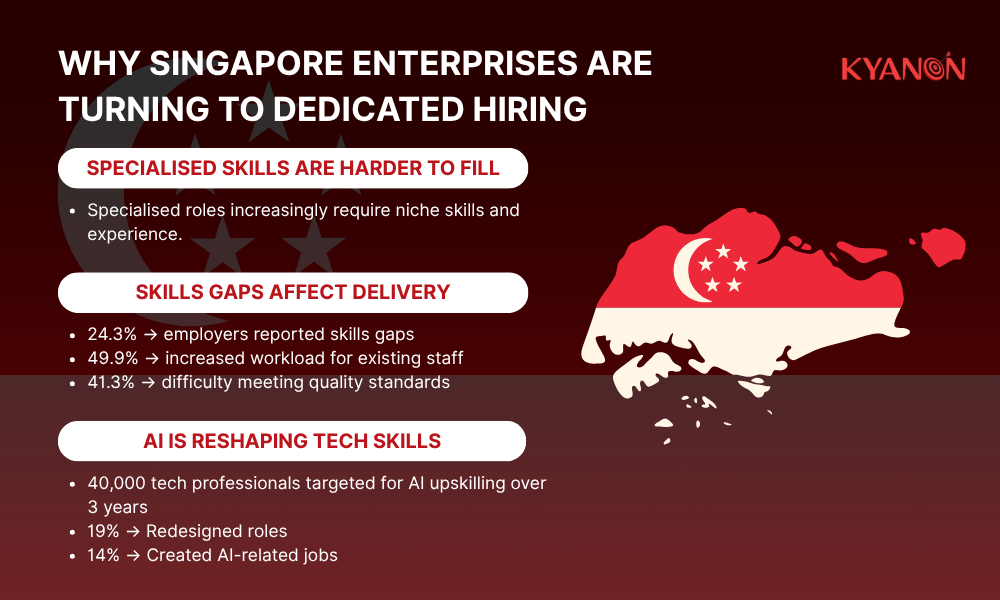
Singapore continues to see strong demand for technology and engineering roles. MOM’s 2026 Job Vacancies report states that software developers, systems analysts and data scientists remained in demand, while some specialized PMET roles became harder to fill because employers required specific technical skills and relevant experience.
Among PMET roles, the share of vacancies remaining unfilled for at least six months increased from 14.4% in 2024 to 16.0% in 2025. MOM also found that 24.3% of employers experienced skills gaps, with affected organizations reporting higher workloads and difficulty meeting quality standards.
This makes dedicated teams relevant when an ongoing roadmap depends on capabilities that are difficult to add quickly through permanent hiring.
AI is changing the skills required from engineering teams
The technology requirement itself is also changing. In May 2026, IMDA announced an expansion of TechSkills Accelerator to upskill 40,000 technology professionals over three years. Its AIxTech program specifically covers AI-assisted software engineering and agentic systems across the software-development lifecycle.
Enterprise Singapore is also prioritizing enterprise-wide AI adoption and transformation in 2026. For organizations building digital products, this means the requirement is increasingly not simply “more developers.”
Teams may need a mix of:
- Software engineering
- AI/ML
- Data engineering
- Cloud and DevOps
- Integration
- AI-enabled engineering practices.
A dedicated model can be useful when these capabilities need to remain attached to an evolving roadmap rather than being sourced as isolated short-term roles.
Organizations need more flexibility in how engineering capacity is added
Dedicated teams provide an alternative between permanent hiring and fixed-scope outsourcing.
Instead of turning every new requirement into a permanent headcount decision, organizations can establish external engineering capacity around an ongoing product or transformation roadmap.
This becomes particularly useful when:
- Priorities are expected to change
- The required skill mix will evolve
- Several specialist roles are needed over time
- Internal teams already have product and architecture ownership but lack sufficient execution capacity
The value is therefore workforce flexibility and delivery continuity, rather than a guaranteed cost-saving percentage.
Distributed delivery is becoming more practical
For technology organizations, this supports a regional delivery model where product leadership, architecture and stakeholder governance can remain close to Singapore while engineering execution is supported by teams elsewhere in the region.
At Kyanon Digital, this is reflected in our Singapore–Vietnam delivery model: Singapore-based engagement and governance are combined with engineering capacity in Vietnam.
The model should still be evaluated on:
- Architecture ownership
- Delivery accountability
- Communication overlap
- Security and system access
- Knowledge continuity
What this means for Singapore enterprises
Dedicated hiring is becoming less about expanding headcount and more about adding the right capability under a delivery model that can evolve with the roadmap.
The model is most relevant when an organization needs:
- Sustained engineering capacity
- Specialist technology skills
- Flexibility as priorities change
- Regional delivery scale without giving up governance
Strategic value of dedicated developers for Singapore enterprises
A dedicated team creates value when it removes a specific delivery constraint. Instead of assuming that more engineers automatically improve performance, define the current problem and the metric that should change.
Business constraint | What a dedicated team changes | What to measure |
Roadmap delivery is constrained by insufficient capacity | Adds stable engineering capacity without waiting for every role to be hired permanently | Sprint carry-over, cycle time, accepted work |
| Specialist capabilities are difficult to fill | Adds targeted software, cloud, data or AI expertise | Time blocked by skill gaps, time-to-productive-delivery |
Internal teams are overloaded | Moves a defined engineering workload to a persistent external team | Internal management hours, backlog age |
| Priorities change across an evolving roadmap | Allows team composition and skills to adapt without restarting the delivery model | Capacity utilization, accepted outcomes |
Distributed delivery creates rework | Establishes shared cadence, Definition of Done and delivery governance | Rework, escaped defects, hand-off delays |
| External access introduces governance risk | Makes access, IP, documentation and exit responsibilities explicit | Access reviews, documentation coverage, offboarding completion |
The decision should therefore start with which constraint needs to change, not how many developers can be added.
How is AI changing the dedicated-team model in 2026?
AI is changing how enterprises evaluate software delivery partners, but it does not eliminate the distinction between staff augmentation, dedicated teams and project-based delivery. The right model still depends on what the enterprise needs to buy: individual skills, sustained engineering capacity, or a defined business outcome.
Singapore’s technology workforce strategy reflects this shift. In May 2026, IMDA announced an expansion of TechSkills Accelerator to upskill 40,000 technology professionals over three years, alongside AIxTech programs designed to strengthen AI capabilities across technology roles. For software engineering, this includes using AI across development activities while technology professionals move toward higher-value work.
For business, the practical change is that developer availability and hourly rates are becoming less useful as standalone measures of value. AI can assist requirements analysis, development, test preparation, documentation and other engineering activities, but architecture, security, code review, acceptance and release decisions still require clear human accountability.
The impact also differs by delivery model:
| Delivery model | What the enterprise buys | How AI changes the evaluation |
In-house hiring | Permanent capability and organizational knowledge | Evaluate how internal engineers use AI without weakening engineering, security or governance standards |
| Staff augmentation | Additional individual skills or temporary capacity | Evaluate whether AI helps the specialist contribute faster within the enterprise’s existing delivery process |
Dedicated development team | Stable external capacity for an evolving roadmap | Evaluate accepted work, cycle time, defects and rework—not simply team size or coding output |
| Project-based outsourcing | A defined scope or deliverable | Evaluate whether AI improves delivery efficiency while the provider remains accountable for the agreed output |
For a dedicated team specifically, this means the buyer should ask more than “How many developers can you provide?” A stronger evaluation looks at how quickly the team becomes productive, how much planned work is accepted, whether cycle time improves, and whether faster execution introduces additional defects or rework.
But there is an important boundary. If the enterprise can define the business outcome and success criteria upfront and wants the technology partner to take greater responsibility for achieving that result, buying developer capacity may no longer be the most appropriate commercial model.
That is where an outcome-based AI engagement becomes a different option. Instead of primarily paying for engineering capacity, the engagement can be structured around a defined AI-enabled business outcome, measurable success criteria and delivery accountability.
For initiatives where the question is less “How many engineers do we need?” and more “What measurable outcome should this AI initiative deliver?”
Explore Kyanon Digital’s Outcome-Based AI Dedicated Agile Team to assess whether an outcome-led engagement is a better fit than capacity-based delivery.
When hiring dedicated developers makes the most sense
Hiring dedicated developers is most effective when enterprises need speed, scale, and sustained delivery, not short-term or ad-hoc support. The model delivers the highest value in the following scenarios:

Large-scale digital transformation programs
When initiatives span multiple systems, phases, or business units, dedicated teams provide continuity, accountability, and execution stability over the long term.
Legacy system modernisation and cloud migration
Dedicated developers enable enterprises to modernize core platforms without overloading internal teams or disrupting day-to-day operations.
Projects with long timelines and evolving roadmaps
When requirements change over time, the dedicated model offers flexibility to scale teams and adapt skills without restarting recruitment cycles.
Situations where speed-to-market is a competitive advantage
When delayed delivery means lost market opportunities, dedicated teams shorten ramp-up time and accelerate execution.
Enterprises with overstretched internal teams
Dedicated developers absorb execution workload, allowing internal teams to focus on governance, innovation, and business strategy.
A dedicated team becomes more suitable when the roadmap extends beyond a single release and the business needs engineering knowledge to remain with the product as requirements evolve. For teams moving from an MVP into sustained product development, see how the dedicated development team model supports the transition from MVP to a robust product.
What should Singapore enterprises check before giving a dedicated team system access?
A dedicated team can work closely with an enterprise’s codebase, cloud environments, internal systems and customer data. That makes access governance part of the hiring decision—not something to address only after developers have joined.
Where an external provider processes personal data on behalf of the enterprise, the relationship may involve a data intermediary under Singapore’s PDPA. PDPC guidance recommends that organizations consider the risks involved in outsourced data processing across areas including governance and risk assessment, service management and exit management.
Before onboarding a dedicated team, enterprises should therefore define:
- Data access: What personal or commercially sensitive data can each role access?
- System privileges: Which development, staging and production environments are accessible, and under what permissions?
- Security accountability: Who approves access, monitors activity and responds to incidents?
- IP and code ownership: How are source code, credentials, documentation and generated assets controlled?
- Offboarding: How are accounts revoked, data returned or deleted, and knowledge transferred when an engineer leaves or the engagement ends?
For financial institutions, the assessment can extend further. Depending on the institution and arrangement, MAS requirements or guidance concerning outsourcing, third-party risk and technology risk may apply. MAS also proposed amendments to its Technology Risk Management Notices in June 2026 covering areas including IT asset management, risk assessment and monitoring, change management, and backup and recovery.
The practical question is therefore not simply “Is the provider PDPA compliant?” It is whether the engagement gives the enterprise sufficient visibility and control over who can access what, how that access is governed and audited, and what happens to access, data and knowledge when the engagement changes or ends.
Can Singapore grants support a dedicated development initiative?
Yes. Singapore government grants can support qualifying digitalization, automation or innovation initiatives, but hiring a dedicated development team is not automatically grant-eligible. Eligibility depends on the underlying activity and the costs allowed under the applicable grant.
As of 30 September 2026, Singapore’s new EDGE Grant has replaced the EDG, MRA, and PSG for new applications. Enterprise Singapore states that EDGE covers business areas including automation & digitalization and innovation, with support levels of up to 70% for SMEs and up to 50% for non-SMEs depending on the activity. Total grant support is capped at S$100,000 per year across EDGE activities.
Existing EDG, MRA and PSG projects submitted before the transition continue under the previous arrangements.
The practical rule is:
Do not build the business case around the assumption that external developer capacity will be funded. First confirm whether the digitalization or innovation activity itself qualifies and which project costs are eligible.
Kyanon Digital’s Dedicated Development Team model helps enterprises extend engineering capacity around the skills, delivery cadence and governance their roadmap requires, without treating external developers as disconnected resources.
Hire dedicated developers with Kyanon Digital
Expand your development capabilities with top Vietnamese tech talent at a competitive cost. Our dedicated teams of software engineers, data specialists, and digital experts help you innovate and scale efficiently, without the overhead of an in-house team.
Vietnam’s IT services market is estimated at US$2.63 billion in 2026 and projected to reach US$4.39 billion by 2031, growing at a 10.82% CAGR. IT outsourcing remains its largest service segment, accounting for 39.05% of the market in 2025.
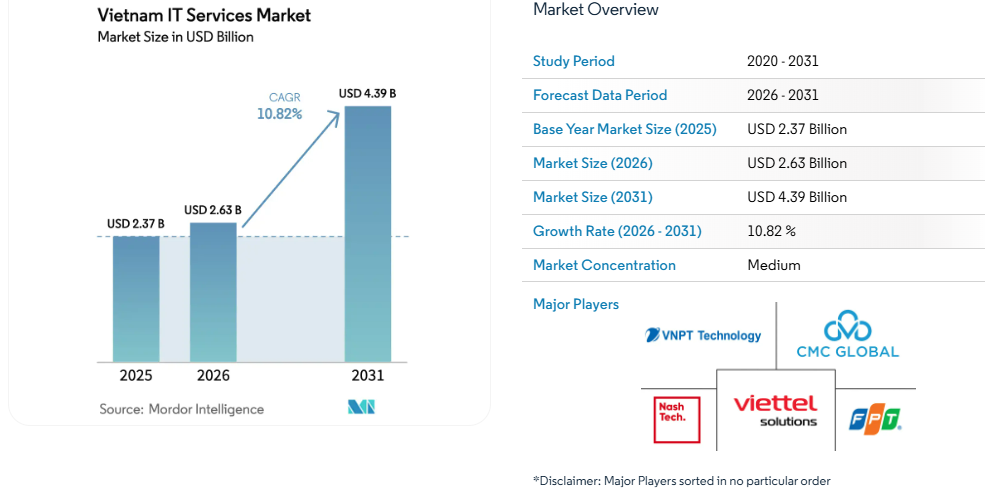
For Singapore enterprises, the more relevant consideration is whether a Vietnam-based team can provide the specialist capabilities, delivery continuity and regional collaboration their roadmap requires.
Why consider Kyanon Digital for a dedicated development team?
An engineering partner, not a recruitment provider
Kyanon Digital builds dedicated teams around your product roadmap, backlog and engineering requirements, rather than filling roles in isolation. For the AI-driven Dedicated Agile Team model, sprint deliverables are planned and tracked against backlog readiness and team capacity, giving enterprises stable engineering capacity with clearer delivery accountability.
AI-enabled engineering with human accountability
Kyanon Digital applies AI-assisted practices across requirements analysis, user-story preparation, development, QA preparation, documentation and delivery reporting. Human review and engineering accountability remain part of the delivery model, so AI is used to improve execution rather than simply increase coding output.
Comprehensive talent ecosystem
Kyanon Digital talent ecosystem encompasses over 50,000 technology professionals
- 500+ internal technology professionals
- Talent pipeline across 18 Vietnamese universities through K-Fresh
- 15,000+ external candidates
- 1,000+ ecosystem partners
Delivery support beyond team assembly
KD supports the team beyond recruitment through account management, onboarding, professional development, technical support and its Center of Excellence. This is particularly relevant for longer product roadmaps where team integration, capability development and knowledge continuity matter as much as initial access to talent.
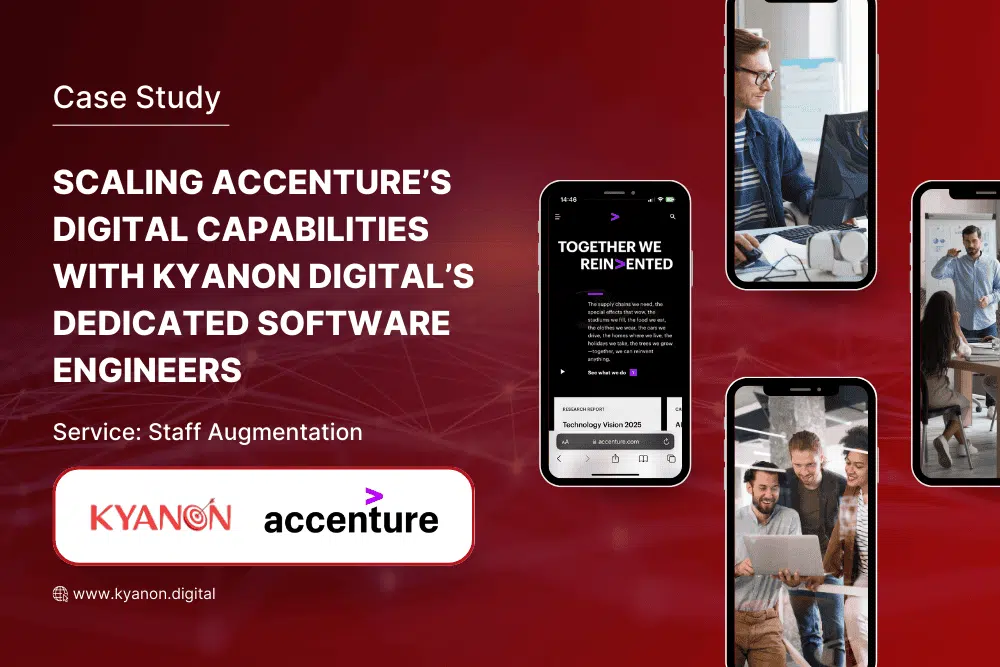
Case study: Scaling Accenture’s Digital Capabilities with Kyanon Digital’s Dedicated Software Engineers
Challenges
Accenture needed to scale its engineering capacity across education and retail projects while maintaining the technical capability and team fit required for different client environments. The challenge was not simply adding developer headcount but ensuring engineers could integrate into existing delivery teams, adapt across domains and contribute effectively within established Agile ways of working.
Solution from Kyanon Digital
Kyanon Digital provided dedicated software engineers selected for both technical capability and cultural fit. Engineers were prepared to work within Accenture’s Agile and DevOps delivery practices and supported in adapting between different project and domain requirements.
Kyanon Digital also used its Center of Excellence (CoE) to strengthen capabilities in areas including cloud, AI, and software engineering, alongside communication skills needed for collaborative delivery. This allowed the engagement to function as an extension of Accenture’s engineering capacity rather than as disconnected outsourced resources.
Results and impact
- Expanded engineering capacity across Accenture’s education and retail initiatives.
- Provided engineers selected for both technical and cultural fit.
- Supported engineers in working within Agile and DevOps delivery environments.
- Enabled engineers to adapt across different domains as project requirements changed.
- Provided ongoing capability development through Kyanon Digital’s CoE.
For enterprises, the case illustrates an important distinction: a dedicated-team model creates more value when the provider supports team integration, capability development and continuity, not simply developer placement.
Read the Accenture dedicated software engineering case study
In conclusion
A dedicated development team is a strong fit when the constraint is sustained engineering capacity on an evolving roadmap and when the enterprise has enough product ownership and governance to direct that capacity effectively. If the need is a single specialist for a short period, staff augmentation may be simpler; if the outcome is fixed and ownership should sit with the vendor, project-based delivery may fit better.
Before committing, baseline the delivery problem you are trying to remove: hiring delay, sprint carry-over, specialist skill blockage, management overhead, defects or release lead time. Then evaluate the provider against that baseline, plus continuity, IP/data controls, and exit readiness.
If your roadmap needs stable engineering capacity but you are still deciding between augmentation, a dedicated team and project delivery, discuss your delivery model and governance requirements with Kyanon Digital before fixing the team structure.






 Create project brief with AI