


Reliable software failures are no longer isolated technical incidents; they are operational, regulatory, and reputational risks for Singapore enterprises.
As digital platforms increasingly power core business functions, even short periods of downtime can disrupt operations, breach compliance requirements, and erode customer trust.
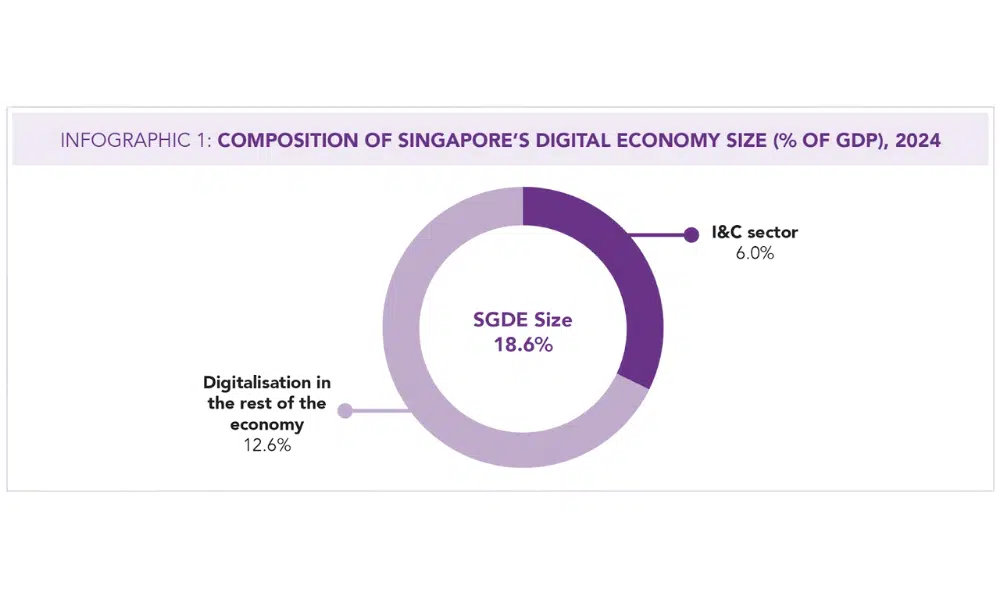
This risk is intensifying as Singapore’s digital economy scales. According to IMDA, the digital economy contributes about 18.6 percent of national GDP, with strong year-on-year growth driven by cloud adoption, digital services, and technology talent expansion.
As a result, more mission-critical software is running in production across finance, logistics, healthcare, retail, and GovTech. System reliability now directly underpins revenue continuity, service availability, and regulatory confidence.
However, the cost of failure is material. IBM highlights that large-scale system incidents frequently result in multi-million-dollar total losses, excluding long-term brand impact.
For senior leaders, the conclusion is clear: reliable software is a business imperative, not an engineering preference. This is why many Singapore enterprises are taking a proven shortcut, partnering with experienced software teams that bring mature engineering processes, cloud-native reliability, and predictable delivery models to reduce risk while accelerating digital growth.
In this blog, Kyanon Digital examines why reliable software has become a board-level concern and how enterprises can accelerate delivery while balancing speed, cost, and operational resilience.
Key takeaways
- Reliable software has become a business imperative in Singapore, as digital platforms now underpin daily operations, compliance, and customer experience across industries.
- Enterprise reliability is defined by operational outcomes, such as availability, resilience, predictable performance, fast recovery, and safe releases, not by features alone.
- Many reliability challenges are structural, including legacy architectures, fragmented delivery processes, talent constraints, limited observability, and security overhead that are difficult to scale internally.
- Partnering with experienced software teams is a proven shortcut, enabling enterprises to adopt mature delivery practices without rebuilding reliability capabilities from scratch.
- Vietnam has emerged as a strategic offshore delivery hub for Singapore enterprises, supporting scalable, high-quality software delivery through strong engineering talent and close regional collaboration.
- With the right delivery model and partner, enterprises can accelerate digital initiatives while maintaining reliability, governance, and long-term return on investment.
Further reading:
- Software Development Outsourcing Services
- Singapore’s Guide to Software Outsourcing ROI
- Why SG Enterprises Build Software in Vietnam, Not In-House?
- Top 11 Enterprise Software Development Companies in Singapore
What ‘reliable software’ really means for enterprise systems
In an enterprise environment, reliable software does not mean software that never fails. It means systems that behave in predictable, controllable ways, even when something goes wrong (DAU).
From a business perspective, reliable software consistently delivers measurable operational outcomes, not just functional features. These outcomes determine whether an organization can scale safely, release updates without fear, and maintain service continuity across increasingly complex digital ecosystems.
This is why modern enterprises evaluate reliability using delivery and operational metrics, rather than subjective quality assessments.
Core metrics that define reliable software include:
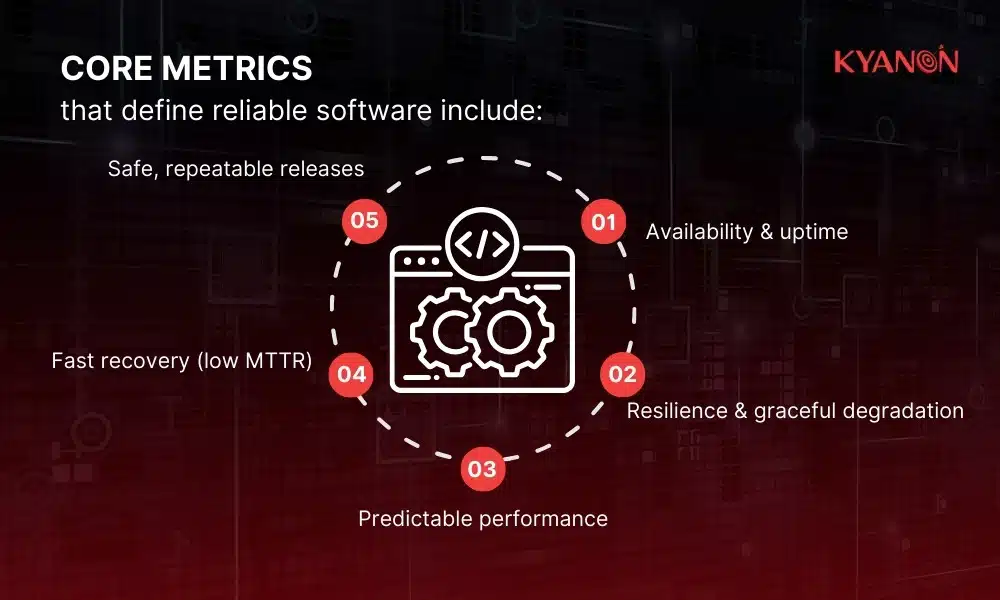
- Availability & uptime: The percentage of time a system remains reachable and usable for customers and internal teams.
- Resilience & graceful degradation: The system’s ability to remain partially functional under load, failure, or unexpected conditions.
- Predictable performance: Stable latency and throughput that stay within agreed service-level objectives (SLOs).
- Fast recovery (low MTTR): Mean Time to Recovery reflects how quickly teams can detect incidents, respond, and restore services.
- Safe, repeatable releases: Low change-failure rates and short lead times, enabling frequent updates without increasing risk.
Common enterprise challenges in building reliable software
Even organizations with experienced teams and modern tools face recurring reliability challenges. These issues are not caused by the lack of effort but by structural limitations that slow execution, increase risk, and make reliability difficult to scale consistently.
Below are the most common enterprise challenges and their measurable business impact.
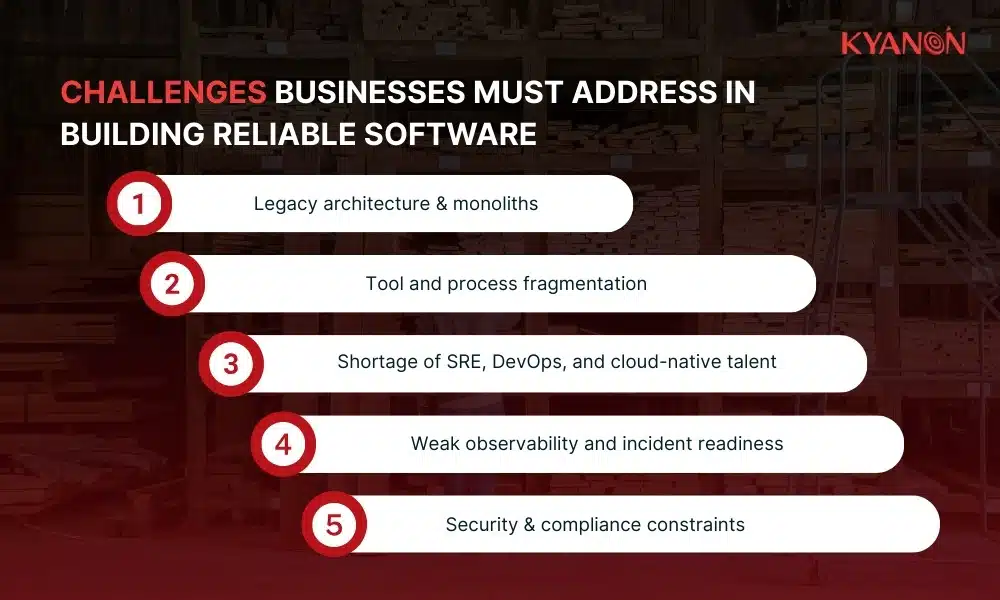
- Legacy architecture & monoliths: Tightly coupled systems slow change and amplify failure impact.
- Google DORA shows low-performing teams deploy up to 46× less frequently and experience higher failure rates than teams using modern, modular architectures.
- Tool and process fragmentation: Siloed teams and manual handoffs increase errors and extend release cycles.
- According to IBM, 82% of enterprises report that data silos disrupt critical workflows, while 68% of enterprise data remains nonanalyzed, limiting coordination, slowing decisions, and delaying delivery.
- Shortage of SRE, DevOps, and cloud-native talent: Reliability depends on specialized skills, such as SRE, DevOps, and cloud-native engineering, that are scarce and hard to hire quickly.
- According to Singapore Tech Talent Trends 2025, 79% of companies report difficulty filling tech positions, and Singapore will need an estimated 1.2 million additional digitally skilled workers by 2025, highlighting severe talent scarcity in tech roles, including cloud-native and DevOps skills.
- Weak observability and incident readiness: Insufficient observability delays issue detection and resolution, increasing downtime cost.
- Report from DevOps shows full-stack observability significantly reduces unplanned outages and troubleshooting time.
- Security & compliance constraints: Manual security and compliance processes extend release cycles without automatically reducing risk.
- IBM’s analysis indicates that cybersecurity staffing gaps have contributed to an average USD 1.76 million increase in breach costs, showing the financial consequences when teams can’t secure systems efficiently.
Each issue increases lead times, raises change-failure rates, and multiplies downtime risk, which in turn increases cost and damages customer trust.
The Singapore shortcut: Outsourcing to a reliable software development company
For Singapore enterprises, the shortcut to reliable software delivery is not outsourcing for cost savings; it is adopting mature delivery capabilities without rebuilding them internally in a market where digital platforms are now central to business continuity and growth.
According to the IMDA, Singapore’s digital economy expanded by roughly $128.1 billion and contributed about 18.6% of GDP in 2024, reflecting the broad adoption of digital services and technologies across sectors. Moreover, 95.1% of enterprises adopted at least one digital capability, driven by cloud services, cybersecurity, data analytics, and AI adoption.
In this environment, many organizations find that building reliable software with the right tech partner accelerates delivery and reduces operational risk more effectively than trying to mature these capabilities entirely in-house.
Why enterprises in Singapore turn to specialized partners to accelerate delivery
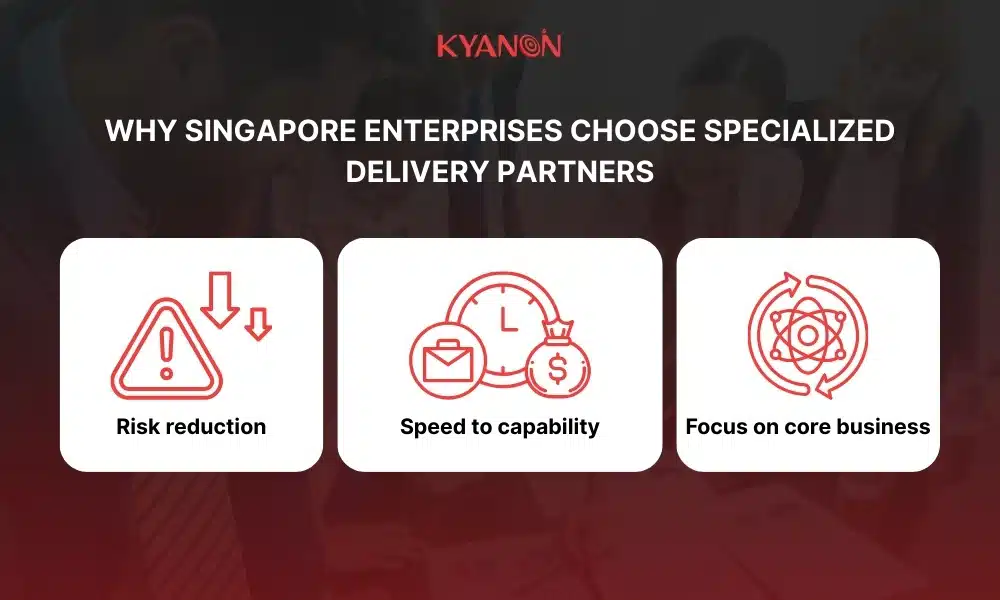
- Speed to capability: Mature delivery partners already operate modern engineering practices (DevOps, SRE, and automation) that take years to build internally, enabling enterprises to accelerate time-to-value.
- Risk reduction: Partners bring standardized delivery frameworks and cloud-native tool chains that improve reliability outcomes while maintaining compliance with Singapore’s regulatory expectations (e.g., PDPA, Cybersecurity Act).
- Stay focused on core business: Outsourcing non-core software execution allows internal teams to focus on strategic innovation, not day-to-day engineering firefighting.
According to enterprise market research, the software and services segment is one of the fastest-growing in Singapore’s ICT landscape, driven by increased demand for digital transformation, operational resilience, and automation.
The role of offshore and nearshore hubs in reliable delivery
Enterprise software research shows sustained investment and growth in platforms focused on visibility, risk management, and execution reliability, with 488 financing transactions recorded in the past year alone (Houlihan Lokey)
To support this demand, Singapore enterprises increasingly adopt hybrid delivery models, retaining governance and architecture locally while extending execution through offshore or nearshore hubs.
When aligned with strong delivery processes, this model enables:
- Faster delivery cycles
- Predictable quality and uptime
- Scalable engineering capacity without proportional overhead growth
For Singapore enterprises, building reliable software with the right tech partner is less about cost arbitrage and more about speed, reliability, and risk reduction.
Reliable software technology: What enterprises should look for
Reliable software is not defined by individual tools, but by technology capabilities that consistently reduce failure risk, shorten recovery time, and stabilize releases.
For enterprise systems running in production 24/7, the following technology pillars have the most direct impact on reliability outcomes.
Quick overview: Reliable software technology for enterprises
|
Technology capability |
Reliability outcome |
Business impact |
|
Cloud-native architecture |
Limits failure blast radius; improves resilience |
Fewer large-scale outages; stable operations under peak load |
|
DevOps & CI/CD automation |
Lower change-failure rate; faster recovery |
Safer releases, shorter downtime; predictable delivery |
|
QA automation & continuous testing |
Defects caught before production |
Reduced incident frequency; higher release confidence |
|
Security-first development |
Fewer security-triggered incidents |
Lower breach risk; improved compliance and trust |
| AI-powered observability | Faster detection and root-cause analysis |
Reduced MTTR; minimized business disruption |
Cloud-native architecture and microservices
Reliability outcome: smaller blast radius, faster isolation, resilient scaling
- By decoupling services, failures are contained, and recovery can be targeted (one service, not the whole platform).
- Business lens: reduces full-platform outages for systems like customer apps, ERP extensions, and supply chain integrations that run continuously across regions.
DevOps and CI/CD automation for stable releases
Reliability outcome: lower change-failure rate, faster lead time for fixes
- Automated pipelines reduce manual errors and make releases repeatable.
- DORA’s “Four Keys” metrics (deployment frequency, lead time, change failure rate, time to restore) are the industry standard for measuring this (Dora).
- Benchmarks commonly referenced from the 2024 DORA report summaries: elite teams deploy multiple times per day, keep change failure rate ≤5%, and recover in <1 hour (Dora).
QA automation and continuous testing
Reliability outcome: fewer production defects, safer releases
- Continuous testing (regression + performance + reliability tests) catches defects before they become incidents.
- Business lens: fewer emergency fixes and less downtime during peak business periods (e.g., payments, claims, logistics surges).
Cybersecurity-first development
Reliability outcome: fewer incidents triggered by vulnerabilities; lower financial exposure
- Security failures frequently become availability failures (shutdowns, service degradation, forced containment).
- IBM’s Cost of a Data Breach 2024 reports the average breach cost at USD 4.88M.
- Severe security staffing shortages correlate with USD 1.76M higher breach costs, and increased use of AI/automation in security correlates with USD 2.2M lower breach costs in prevention workflows.
- Singapore lens: with high digital adoption and strong compliance expectations, “secure-by-design” reduces both incident frequency and regulatory risk.
AI-powered observability and incident management
Reliability outcome: lower MTTR via faster detection + faster root cause analysis
- Observability connects metrics, logs, and traces across distributed systems to reduce time-to-diagnose.
- The same DORA performance model emphasizes time to restore service as a core reliability outcome (paired with change safety).
- Singapore lens: for regional platforms, faster incident triage protects SLAs across multiple markets and time zones.
Quick comparison table of traditional vs. reliability-driven stack
|
Area |
Traditional approach |
Reliability-driven approach |
|
Architecture |
Monolithic, tightly coupled |
Cloud-native, modular (smaller blast radius) |
|
Delivery |
Manual, infrequent releases |
CI/CD automation (safer, repeatable changes) |
|
Testing |
Late QA, limited coverage |
Continuous testing (fewer production defects) |
|
Security |
Manual checks at the end |
Built-in security (lower incident risk) |
|
Operations |
Reactive monitoring |
Observability + automation (faster recovery) |
A proven model for building reliable software fast (without compromising quality)
This framework helps enterprises understand how reliable software is actually delivered in practice. Each step outlines what a capable software partner should demonstrate, so business and technology leaders can assess readiness and fit.
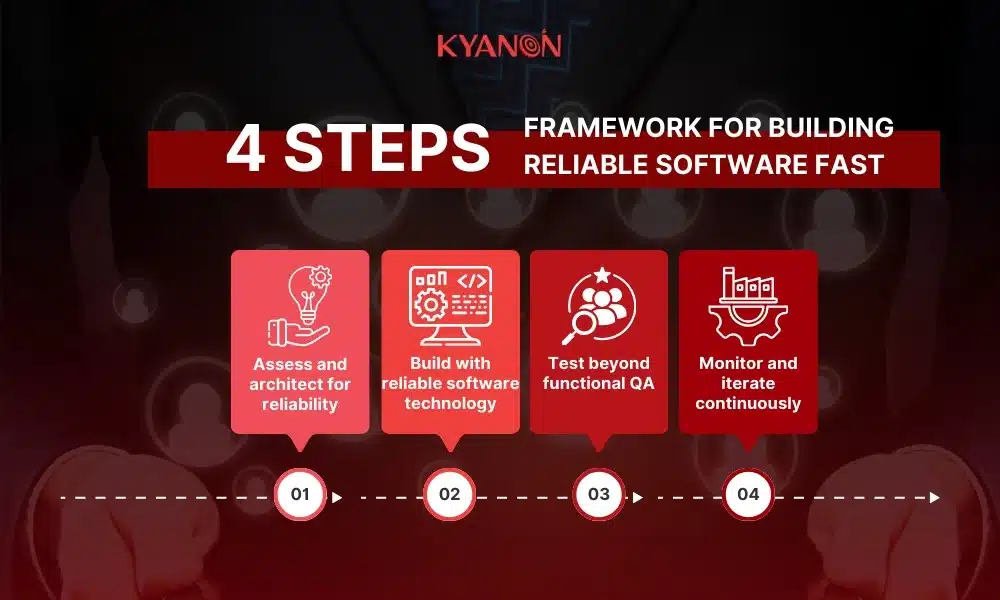
Step 1: Assess and architect for reliability
Before building anything, a reliable software development company should begin with structured assessment and architectural planning, not immediate execution.
What to expect from a partner:
- A clear evaluation of current architecture, dependencies, and failure risks
- Identification of scalability limits, single points of failure, and cloud readiness gaps
- Architecture recommendations aligned with business priorities (growth, uptime, compliance, regional expansion)
This step ensures reliability is designed in, not retrofitted later.
Step 2: Build with reliable software technology
Execution should focus on consistency and automation, rather than individual developer heroics.
What to expect from a partner:
- Standardized development workflows and environments
- Automated build and deployment pipelines (CI/CD) to reduce manual error
- Engineering practices that support frequent, low-risk releases
This allows enterprises to scale delivery without increasing operational instability.
Step 3: Test beyond functional QA
Reliable software requires validation under real operating conditions, not just feature checks.
What to expect from a partner:
- Testing strategies that include performance, load, and failure scenarios
- Security testing is integrated into the delivery lifecycle, not added at the end
- Clear criteria for release readiness tied to business risk, not just test pass rates
This step protects enterprises from hidden risks surfacing in production.
Step 4: Monitor and iterate continuously
Reliability does not stop at go-live. Ongoing visibility and improvement are essential.
What to expect from a partner:
- Full-system observability covering applications, infrastructure, and user impact
- Clear incident response processes and operational runbooks
- Continuous optimization based on production data and real usage patterns
This ensures systems remain stable as usage, load, and business requirements evolve.
Why Singapore enterprises choose offshore teams in Vietnam
As Singapore enterprises scale digital platforms across Asia-Pacific, many adopt offshore delivery models in Vietnam to balance speed, reliability, and cost efficiency. This choice is increasingly driven by structural advantages, not short-term cost considerations.
|
Dimension |
Singapore (onshore delivery) |
Vietnam (offshore delivery) |
|
Senior engineer cost |
Senior software engineers typically earn SGD 9,000–15,000+/month, with DevOps and data roles often exceeding this range |
Comparable senior roles are 40–60% lower, even after management overhead, based on Vietnam IT salary benchmarks |
|
Talent availability |
High demand, limited supply; strong competition for cloud, DevOps, SRE roles |
Large, growing pool of engineers across cloud, DevOps, QA, and data engineering |
|
Hiring speed |
Weeks to months due to competition and compliance |
Teams can be staffed in weeks, not quarters |
|
Scalability |
Scaling teams increases fixed headcount and long-term cost |
Teams scale up/down flexibly without disrupting core operations |
|
Delivery economics (TCO) |
High fixed costs + rising wages |
Predictable delivery cost with lower long-term TCO |
|
Time zone fit |
Local |
Near-shore to Singapore, enabling real-time collaboration |
Source: Salary Guide 2025; IT Salary Report; Vietnam IT Market Reports.
Vietnam as a trusted engineering hub for reliable software development
Vietnam is now one of Southeast Asia’s largest software engineering hubs.
- Vietnam has 500,000+ software engineers, with 50,000–60,000 IT graduates added annually (TopDev).
- Vietnam ranks among the top outsourcing destinations globally for software development, particularly for cloud, DevOps, and enterprise systems.
This scale allows Singapore enterprises to extend engineering capacity quickly, rather than competing in a constrained local hiring market.
Cost efficiency without delivery compromise
From a total cost of ownership (TCO) perspective, senior software engineering costs in Vietnam are typically 40–60% lower than in Singapore, even after accounting for management and governance overhead.
Importantly, cost efficiency comes from operational scale and talent availability, not from lowering engineering standards.
For Singapore enterprises, this means:
- Lower fixed headcount costs
- More budget available for architecture, security, and reliability engineering
- Predictable delivery economics at scale
Access to senior engineering talent experienced in enterprise systems
Vietnam’s software ecosystem includes a growing pool of senior engineers with experience in:
- Enterprise platforms (ERP, supply chain, transaction systems)
- Cloud-native architectures and microservices
- Reliability-focused practices such as CI/CD, observability, and security automation
This allows Singapore enterprises to supplement internal teams with ready-to-deploy expertise, reducing reliance on scarce local talent.
24/7 delivery cycle advantage for regional platforms
Vietnam operates in GMT+7, only 1 hour behind Singapore.
This enables:
- Real-time collaboration with Singapore stakeholders
- Overlapping working hours for agile ceremonies
- Extended delivery cycles that support near-continuous development and faster incident response
For regional platforms serving multiple APAC markets, this directly improves delivery speed and reliability.
Case example from Kyanon Digital: Accelerating reliable software delivery for a leading Singapore enterprise
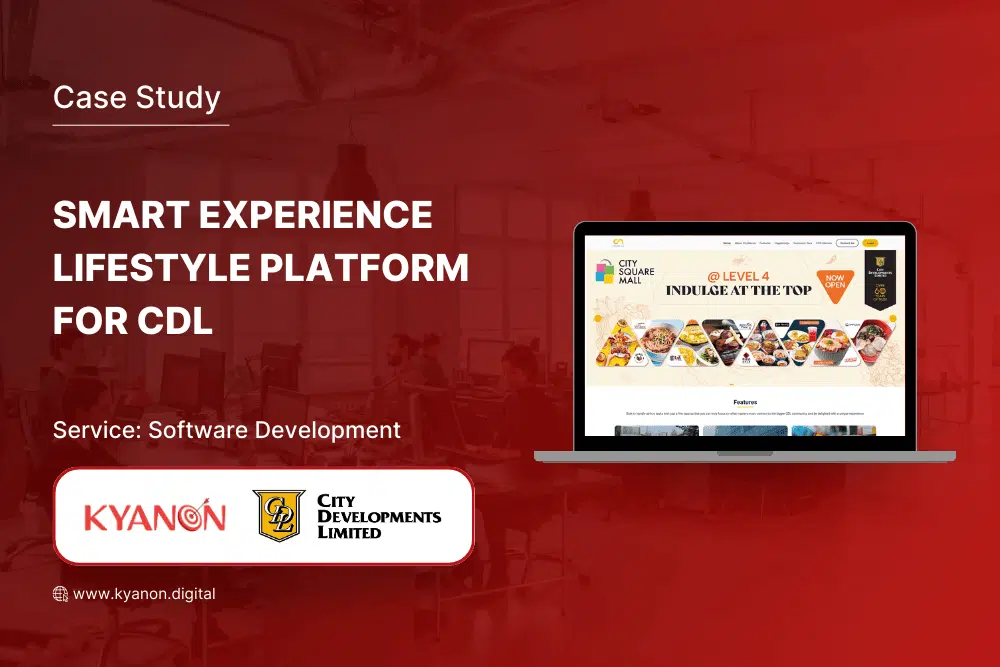
CDL, one of Singapore’s leading real estate groups, needed to modernize resident engagement across multiple properties. Its challenge was not only feature delivery, but building a unified, reliable platform that could integrate with existing systems and scale across locations.
Challenge
CDL required a single, integrated digital platform to:
- Unify resident engagement and lifestyle services
- Streamline service delivery across properties
- Modernize legacy systems without disrupting operations
This demanded high reliability, seamless integration, and predictable delivery—typical constraints faced by large Singapore enterprises.
Solution
Kyanon Digital delivered an integrated smart experience lifestyle platform using a reliability-driven delivery model:
- End-to-end development across mobile app, membership ecosystem, and service modules
- Seamless integration with existing property systems and backend services
- Cloud-native architecture to support scalability and resilience
- Dedicated Agile squads to accelerate delivery while maintaining delivery discipline
Results
- Unified digital platform connecting multiple properties and services
- Stable integration across complex backend systems and touchpoints
- Improved customer experience through consistent, end-to-end digital journeys
- Faster, more predictable delivery cycles enabled by cloud-native design and Agile execution
Instead of rebuilding cloud-native capability, integration expertise, and Agile delivery internally, CDL adopted a proven approach, reducing delivery risk while achieving measurable digital outcomes.
Read more: Smart Experience Lifestyle Platform for CDL
How to choose a reliable software development company
For Singapore enterprises, selecting the right partner is a risk management decision, not just a procurement exercise.
The checklist below helps business and technology leaders quickly assess whether a software development company can deliver reliability at scale, not just features.
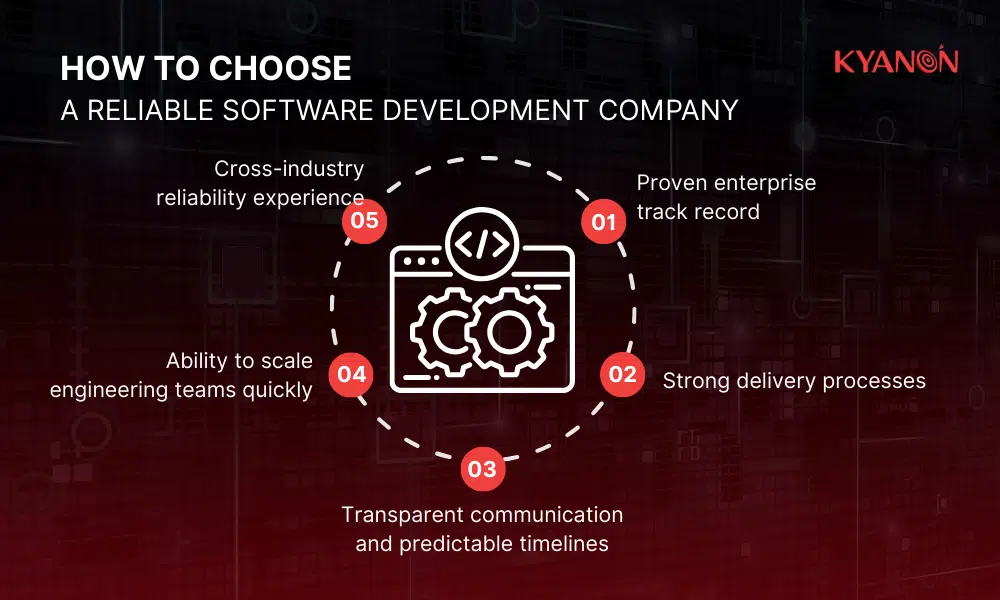
- Proven enterprise track record: Demonstrated experience delivering large-scale platforms for enterprises, including complex integrations, legacy modernization, and multi-stakeholder environments.
- Strong delivery processes: Clear, repeatable delivery frameworks covering Agile execution, DevOps automation, and QA automation, ensuring stable releases and controlled change risk.
- Transparent communication and predictable timelines: Defined delivery milestones, regular progress reporting, and clear escalation paths, no hidden dependencies or unclear ownership.
- Ability to scale engineering teams quickly: Proven capability to ramp teams up or down within weeks, without compromising quality, delivery standards, or governance.
- Cross-industry reliability experience: Experience building reliable software across multiple industries (e.g., finance, logistics, retail, healthcare, platforms), showing the ability to handle different reliability, compliance, and performance requirements.
How Kyanon Digital delivers reliable software for business in Singapore
Kyanon Digital helps Singapore enterprises accelerate reliable software delivery by embedding cloud-native architecture, DevOps automation, and disciplined engineering practices into every stage of the development lifecycle.
- End-to-end delivery ownership: From architecture and development to deployment and support, reliability is designed in, not added later.
- Cloud-native, scalable architecture: Modular, cloud-ready systems built for high availability, resilience, and long-term scalability.
- DevOps & CI/CD automation: Automated pipelines reduce manual errors, stabilize releases, and enable faster, safer deployments.
- Reliability-focused quality assurance: Testing goes beyond functionality to include performance, security, and failure scenarios.
- Observability & incident readiness: Built-in monitoring and logging enable early issue detection and faster recovery.
- Transparent governance & execution: Clear milestones, predictable timelines, and continuous alignment with business priorities.
These capabilities allow Singapore enterprises to build reliable software faster, while controlling risk and supporting long-term digital growth.
Conclusion
Reliable software is now essential for growth, automation, and digital transformation in Singapore enterprises. As more mission-critical systems run continuously in production, reliability directly affects business continuity, customer trust, and scalability.
Instead of rebuilding delivery capability internally, many organizations accelerate outcomes by partnering with an experienced, reliable software development company that brings proven processes, cloud-native architecture, and scalable teams.
If your organization is ready to accelerate its digital roadmap, Kyanon Digital is here to help. Connect with our team to explore how the right outsourcing model can unlock real, sustainable ROI for your business.