

Software outsourcing ROI in Singapore should be measured against a baseline, not an hourly-rate discount. The business case should combine total delivery cost, time-to-value, engineering throughput, reliability, internal management effort and capability gained. Outsourcing creates value when the provider improves these outcomes without adding disproportionate coordination, security or transition risk.
Singapore enterprises are no longer evaluating outsourcing only as a way to access lower-cost development capacity. In 2026, the decision increasingly sits at the intersection of AI-enabled software engineering, cloud economics, delivery resilience, and scarce specialist skills.
IMDA’s National AI Impact Programme is designed to support 10,000 enterprises over three years, while its AIxTech initiative is expanding AI fluency across the software engineering lifecycle. Gartner’s 2026 software-engineering guidance similarly puts AI applications and agents, observability, scalable platforms, and AI-ready architecture among the priorities for engineering leaders.
That changes the ROI question. The relevant comparison is not “local engineer rate versus offshore engineer rate.” It is whether an outsourcing model can improve delivery economics, speed, reliability, and access to specialist capability while keeping governance, security, IP ownership, and knowledge continuity under control.
This guide shows how Singapore leaders can build that business case, choose the right outsourcing model, and validate whether a partner can produce measurable outcomes.
Key takeaways
- Start with a measurable baseline. Evaluate outsourcing against current delivery cost, cycle time, reliability, defect levels, and internal management effort, not an assumed savings percentage.
- Match the model to delivery ownership. Kyanon Digital supports AI-enabled staff augmentation, outcome-based dedicated agile teams, and full software outsourcing, giving businesses different levels of engineering capacity and delivery responsibility.
- Measure operational evidence before financial ROI. First-quarter signals such as cycle time, deployment frequency, defects, MTTR, backlog aging, and coordination effort can show whether the delivery system is improving.
- Calculate TCO, not just developer rates. Cloud, tooling, security, AI governance, retained management, and transition costs can materially change the business case.
- Kyanon Digital’s delivery perspective: define the delivery constraint, ownership model, baseline KPIs, and expected outcome before deciding how much engineering capacity to add.
Further reading:
- Enterprise IT Solutions Provider in Singapore
- Top 11 Offshore Development Companies in Singapore
- Top 10 IT Staff Augmentation Companies in Singapore
Understanding software outsourcing ROI
Software outsourcing ROI measures whether the business value created by an external engineering model outweighs its total cost of ownership.
The basic formula is:
ROI = (Quantified benefits – Total outsourcing cost) / Total outsourcing cost × 100
However, the calculation should go beyond labor-rate savings. For software outsourcing, ROI can come from several sources:
- Cost efficiency: avoided recruitment, employment, tooling or infrastructure costs.
- Faster delivery: earlier releases or shorter delivery cycles where the resulting business value can be evidenced.
- Greater engineering capacity: more roadmap work completed without permanently expanding every internal capability.
- Improved operational performance: lower rework, defects, incidents or internal coordination effort.
- Access to specialist expertise: faster access to cloud, AI, data, integration or security skills that would otherwise delay delivery.
The key is to distinguish operational improvement from financial ROI. Metrics such as deployment frequency, velocity, test coverage, or sprint completion show whether engineering performance is improving, but they become ROI only when they can be connected to a measurable economic or business outcome.
For this reason, Singapore businesses should establish a baseline before outsourcing and evaluate the engagement against total cost, delivery performance, reliability and management effort, rather than treating a lower hourly rate as proof of return.

Key advantages of software outsourcing
The main advantages of software outsourcing are lower delivery costs, faster access to talent, quicker execution, and greater scalability. These benefits are strongest when the outsourcing model is matched to a clear delivery need rather than used purely to reduce hourly rates.
- Cost efficiency: Reduce recruitment, employment, infrastructure, and tooling overhead compared with building every capability in-house.
- Access to specialist talent: Bring in engineers with expertise in areas such as cloud, AI, data, cybersecurity, or complex integrations without relying only on local hiring.
- Faster delivery: Add engineering capacity without waiting through a full internal recruitment and onboarding cycle.
- Flexible scalability: Scale teams up or down as roadmap priorities, workloads, and project phases change.
- Greater internal focus: Allow internal leaders to spend more time on product direction, architecture, and strategic priorities instead of day-to-day delivery gaps.
- Access to broader technology capabilities: Use external expertise across modern platforms, cloud environments, and specialist engineering disciplines when those capabilities are not available internally.
When does software outsourcing create ROI for Singapore businesses?
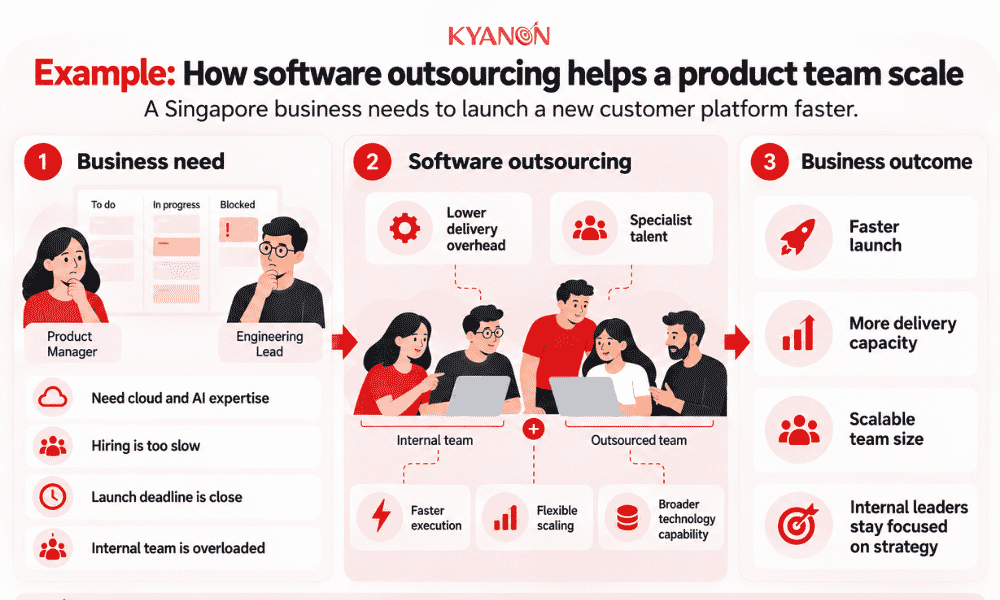
Software outsourcing creates ROI when it helps a business overcome a delivery or capability constraint faster and more efficiently than building the same capacity internally. For Singapore enterprises, the strongest cases usually involve talent shortages, speed-to-market pressure, specialist engineering needs or workloads that require flexible scaling.
When ROI is more likely to materialize
- Talent gaps are delaying delivery. Outsourcing can help when critical roles in cloud, AI, data, cybersecurity or platform engineering are difficult to hire quickly enough for the roadmap.
- Speed-to-market matters. External engineering teams can add delivery capacity without waiting for a full internal recruitment cycle, which is valuable when launch timing, modernization milestones, or market commitments are already at risk.
- The project needs niche expertise. Outsourcing is particularly relevant when the work requires capabilities that would be expensive or slow to build internally, such as cloud-native modernization, complex integrations, AI implementation or security engineering.
- Workload and team size need to stay flexible. A clear backlog with strong product ownership can benefit from external capacity that scales with delivery demand instead of permanently expanding fixed headcount.
What protects the ROI?
- Avoid choosing on rate alone. Lower hourly rates can be offset by rework, weak QA, coordination overhead or poor delivery predictability.
- Set a baseline before the engagement starts. Track metrics such as cycle time, deployment frequency, defects, MTTR, backlog aging, management effort and total delivery cost so that improvement can be measured.
- Match the model to delivery ownership. Staff augmentation fits teams that already have strong internal leadership. Dedicated agile teams are more suitable when the business needs greater delivery accountability, while full outsourcing fits bounded initiatives where broader delivery responsibility can move to the provider.
- Build security and compliance into delivery. Where personal data is in scope, Singapore businesses should define data-handling, access, retention and security responsibilities in line with applicable PDPA requirements from the start.
- Account for total cost, not just vendor fees. Include transition, retained management, cloud and tooling, governance, security, change requests, knowledge transfer and exit costs in the business case.
When may outsourcing fail to create ROI?
Software outsourcing is less likely to generate a strong return when:
- No one internally owns product priorities
- Requirements change faster than the delivery team can execute them
- Critical architecture and interfaces are undocumented
- Security and access responsibilities remain unresolved
- Vendor management creates more coordination than the capacity it adds
- The engagement is too small to justify onboarding and governance overhead
- Management evaluates success mainly through hourly rates or developer utilization
In these situations, the first move may be to stabilize ownership, architecture, or delivery governance before increasing external engineering capacity.
What should a software outsourcing TCO comparison include?
A credible outsourcing business case should compare total cost of ownership (TCO), not just headline hourly rates.
Cost category | In-house team | Outsourced team |
People cost | Salary, employer contributions and benefits | Vendor fees |
| Hiring & onboarding | Recruitment, vacancy cost, onboarding and training | Vendor transition and onboarding |
Management | Internal management and coordination time | Product / architecture oversight retained by the client |
| Tools & infrastructure | Engineering tools, environments and internal infrastructure | Cloud, tooling and license costs not included in the contract |
Security & integration | Internal security, access and system setup | Integration, security and access setup |
| Scaling cost | Hiring or redeploying employees as demand changes | Change requests, scope expansion or team scaling |
Continuity risk | Retention, replacement and knowledge-loss risk | Vendor governance, reporting and team continuity |
| Exit / transition | Internal reassignment or redundancy cost where relevant | Knowledge transfer, handover and exit cost |
Specialist capability | Expertise may remain underutilized outside peak demand | Specialist skills can be added for specific project needs |
Delivery economics should consider both speed and total cost rather than hourly rates alone. For example, Kyanon Digital reports that software development outsourcing model has delivered software 1.5–2.5 times faster and at around one-third the cost of in-house development. Actual results, however, will depend on scope, complexity, team structure and the client’s existing delivery environment.
What should businesses measure in the first 90 days?
Businesses should avoid promising a universal financial return within the first quarter. The strongest early evidence is normally operational improvement against the pre-outsourcing baseline.
| Area | Useful first-quarter indicators |
Delivery | Cycle time, deployment frequency, milestone or sprint predictability |
| Quality | Escaped defects, regression failures, reopen rate |
Reliability | Availability, incident volume, MTTR, rollback frequency |
| Capacity | Backlog aging, throughput, parallel workstreams |
Management | Internal coordination and reporting hours |
| Cost | Monthly run rate and variance to plan |
Continuity | Onboarding time, documentation, and handover readiness |
The first-quarter decision is whether to scale, adjust, or stop the model, not whether an arbitrary ROI percentage has already been achieved.
How is AI changing software outsourcing economics in 2026?
AI-assisted and agentic engineering can affect coding, testing, documentation, and analysis, but it also creates additional cost and governance considerations.
IBM reported in 2026 that organizations may see productivity improvements while still struggling to measure ROI confidently because the economics include model consumption, review, rework, security, integration, and governance.
FinOps is expanding accordingly. The FinOps Foundation’s 2026 survey found AI cost management had become a mainstream technology-value responsibility, with 98% of respondents managing AI spend.
For an outsourcing engagement, evaluate:
- Which SDLC activities use AI.
- Which outputs require human approval.
- How generated code is tested and secured.
- Whether AI tooling is included in commercial pricing.
- How proprietary code and data are handled.
- Whether productivity is measured through cycle time, quality and outcomes rather than code volume.
AI should be treated as an engineering accelerator inside a governed delivery model, not as a substitute for architecture ownership, QA or release accountability.
Software outsourcing models for Singapore
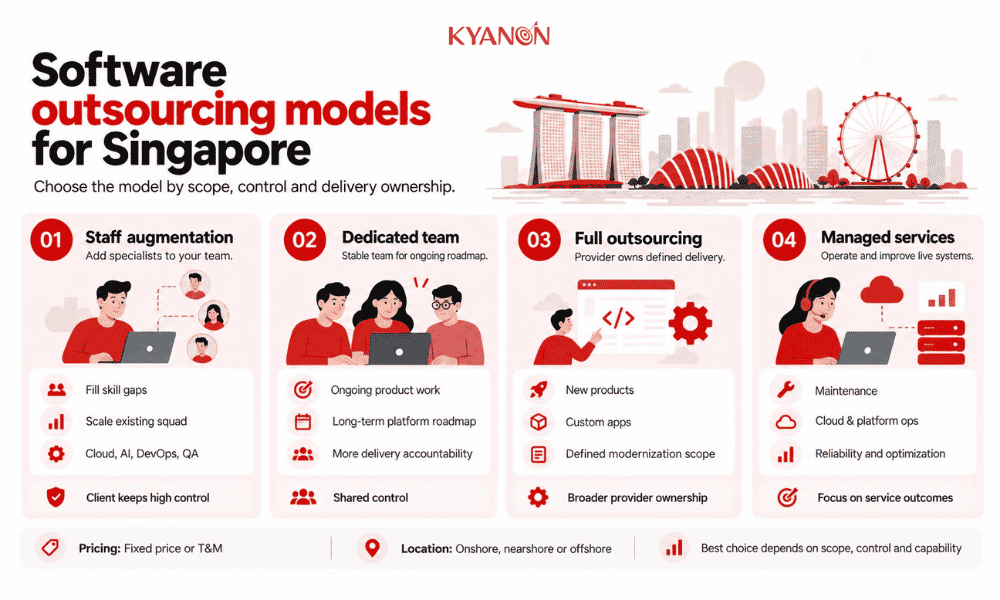
For Singapore enterprises, the right software outsourcing model depends less on company size and more on how much delivery ownership, governance and specialist capacity should sit with the external partner.
Kyanon Digital currently structures software outsourcing around three core engineering models: AI-Enabled Staff Augmentation, AI-Driven Dedicated Agile Team, and AI-Assisted Full Software Outsourcing, with managed services used when the priority shifts from project delivery to ongoing application performance, maintenance and optimization.
AI-Enabled Staff Augmentation
AI-enabled staff augmentation adds individual specialists to an existing internal team while the client retains control over priorities, architecture, processes and day-to-day delivery.
Best for:
- Filling specific engineering skill gaps
- Scaling an established internal squad
- Adding cloud, AI, data, DevOps or QA expertise
- Supporting short- or medium-term delivery peaks
- Organizations with mature product and technical leadership
What to consider:
This model provides the most client control but also requires the most internal coordination. It works best when the backlog, architecture and engineering processes are already well managed.
AI-Driven Dedicated Agile Team
Kyanon Digital’s AI-Driven Dedicated Agile Team provides a stable agile team aligned to the client’s product roadmap and backlog. Under the Agile Contract model, sprint deliverables are planned, agreed upon, and tracked against backlog readiness, priorities and team capacity, while AI is applied across requirements, development, QA preparation, documentation and reporting.
Best for:
- Ongoing product development
- Long-term platform roadmaps
- Application modernization
- Enterprise web and mobile platforms
- Businesses that need stable capacity without managing individual engineers
What to consider:
A dedicated team is appropriate when the client wants to retain product direction and strategic ownership while transferring more sprint execution, coordination and delivery responsibility to the provider.
AI-Assisted Full Software Outsourcing
Full software outsourcing is appropriate when the client wants the provider to take broader responsibility for delivering a defined software initiative. Kyanon Digital combines end-to-end delivery ownership with agile governance, quality controls and AI-assisted engineering across the software development lifecycle.
Best for:
- New digital products
- Custom enterprise applications
- Greenfield platforms
- Major application extensions
- Defined modernization initiatives
- Projects where internal teams do not want to manage individual engineering roles
What to consider:
This model can reduce internal project-management overhead, but it requires clear scope, acceptance criteria, dependencies and governance. It is strongest when the initiative can be bounded well enough for the provider to own delivery outcomes rather than just supply capacity.
Application Modernization & Managed Services
Managed services are better suited when the business wants to transfer responsibility for ongoing operation, maintenance and improvement, rather than only build a new solution.
Kyanon Digital’s Application Modernization & Managed Services supports ongoing application performance, enhancement and operational optimization.
Best for:
- Application maintenance and enhancement
- Cloud and platform operations
- DevOps and release management
- Reliability and performance improvement
- Ongoing security and technical optimization
- Continuous improvement after launch
What to consider:
Define service ownership, escalation paths, SLOs and improvement responsibilities clearly. Managed services should be judged on outcomes such as availability, MTTR, incident reduction and cost control rather than resource volume alone.
Which software outsourcing model fits your business?
Model | Best when | Client ownership | Kyanon Digital ownership |
AI-Enabled Staff Augmentation | You have strong internal delivery leadership but need more or specialized talent | High | Individual engineering capacity |
| AI-Driven Dedicated Agile Team | You need an ongoing cross-functional team with stronger delivery accountability | Medium-high | Sprint governance and agreed team outcomes |
AI-Assisted Full Software Outsourcing | You want broader responsibility transferred for a defined initiative | Medium | End-to-end project delivery |
| Managed Services | You need ongoing application stability, maintenance and optimization | Strategic governance | Operational service delivery |
Pricing and location are separate decisions
The engagement model does not determine how the work must be priced or where the team must be located. Fixed-price arrangements can fit well-defined scopes, while time-and-materials models provide more flexibility when requirements are expected to evolve. Teams may also be delivered onshore, nearshore or offshore depending on collaboration, cost, time zone, and governance requirements.
The practical distinction is delivery ownership. If your organization primarily lacks specialist capacity, staff augmentation may be sufficient. If coordination and delivery predictability are becoming the bottleneck, an AI-driven dedicated agile team may be more appropriate. If you want a provider to assume broader responsibility for a bounded initiative, full software outsourcing is the stronger fit.
What should Singapore businesses validate before choosing an outsourcing partner?
Singapore businesses should evaluate an outsourcing partner on regulatory fit, security, comparable delivery experience, governance and scalability, not price alone. The goal is to determine whether the provider can operate safely and predictably within your technology environment as the engagement grows.
Regulatory and data protection fit
Confirm how the provider handles personal data, system access, cross-border delivery and subcontractors.
For Singapore businesses, review responsibilities under the Personal Data Protection Act (PDPA) where personal data is in scope, including access controls, retention, incident handling and overseas transfers.
For regulated industries, also identify sector-specific requirements before delivery begins rather than assuming a vendor certification automatically establishes compliance.
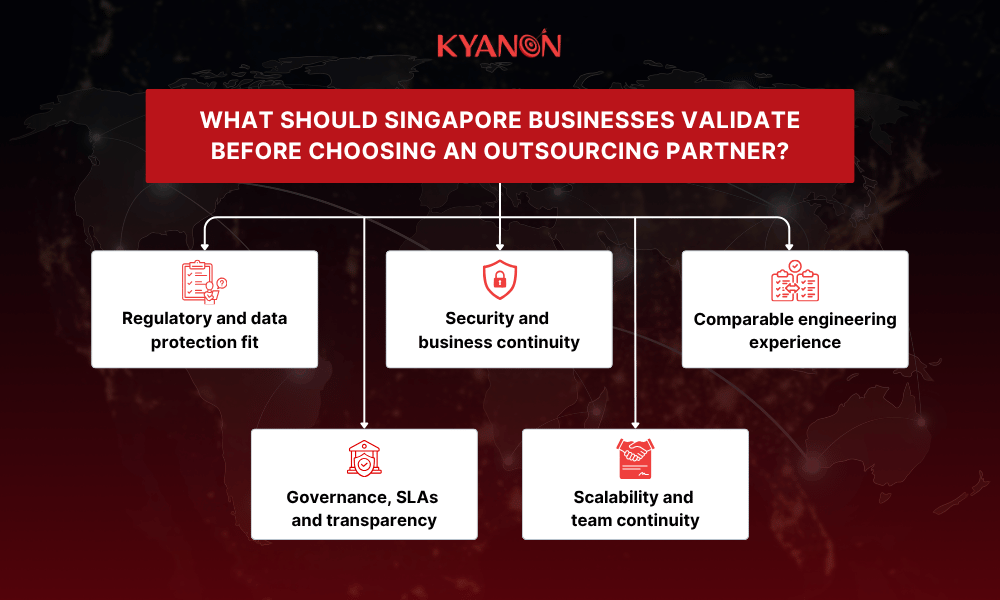
Security and business continuity
Assess whether the partner can protect source code, credentials, production environments and customer data throughout the engagement.
Validate:
- Repository and production-access controls
- Secure development and code-review practices
- Incident-response responsibilities
- Backup and recovery procedures
- Business-continuity arrangements
- Controls around AI coding tools and external development services
Comparable engineering experience
Look beyond a general client list. Ask for evidence from projects with similar:
- Architecture and integration complexity
- Cloud or data workloads
- Security requirements
- User or transaction volumes
- Modernisation scope
- Delivery model
A provider experienced in small web applications may not automatically be the right fit for a high-volume enterprise platform.
Governance, SLAs and transparency
Clarify how performance will be managed before signing the engagement.
Review:
- Delivery and escalation ownership
- Reporting cadence
- Sprint or milestone governance
- SLAs and SLOs where relevant
- Quality and reliability KPIs
- Change-request process
- Commercial transparency
For software delivery, operational SLAs should be combined with metrics such as cycle time, defect leakage, MTTR and release predictability.
Scalability and team continuity
Confirm how the provider scales when workload, roadmap or capability needs change.
Ask:
- How quickly can critical roles be added or replaced?
- How is project knowledge documented?
- Is backup capability available for key roles?
- Can the team support parallel workstreams?
- What happens when the engagement scales down?
- How is knowledge transferred at exit?
The strongest outsourcing partner is not necessarily the largest or cheapest. It is the one whose delivery model, governance and operating controls match the responsibility you actually want to transfer.
Once these criteria are clear, the next step is to compare providers against the same requirements rather than starting with brand recognition or hourly rates. See Kyanon Digital’s guide to the top software development outsourcing companies in Singapore for a broader view of providers and the capabilities to compare.
How Kyanon Digital delivered measurable outsourcing outcomes for a Singapore digital insurance platform
Explore how Kyanon Digital demonstrated measurable software outsourcing ROI in the Singapore case study.
Challenges
- Mobile launch risks affected priority insurance journeys, including claims, policy viewing, document upload, and notifications.
- Stakeholders lacked clear visibility into blockers and readiness.
- The internal tech lead carried substantial coordination and reporting responsibility.
- Testing and repository-access controls needed stronger release discipline.
Solution from Kyanon Digital
- Provided an AI-driven agile team combining mobile engineering with delivery governance.
- Introduced sprint planning, acceptance criteria, blocker tracking and launch-readiness reporting.
- Applied AI-assisted coding, refactoring and test generation while keeping human review and release control.
- Strengthened code review, static checks, smoke testing and repository-access controls.
Results and Impact
- Pilot readiness improved from 62% to 91% across priority journeys.
- Open launch blockers fell 72%, from 18 to 5 lower-risk items.
- Sprint completion predictability reached 86%.
- Internal Tech Lead coordination time fell by approximately 35%.
- High-priority frontend defects fell by 46%.
- Smoke testing covered 100% of priority launch journeys.
- Repetitive frontend-fix turnaround improved by approximately 25% with AI-assisted development and human release control.
The case does not establish a universal financial ROI percentage. It demonstrates something more useful for outsourcing evaluation: an external team can be measured against delivery readiness, quality, management effort, and execution control, rather than headcount alone.
Leadership playbook: How to protect outsourcing ROI
Protect outsourcing ROI by managing the engagement as a business operating model, not a vendor contract. The strongest controls are tiered governance, outcome-based metrics, total cost tracking, knowledge retention and integrated delivery. If cost falls while rework, coordination effort or dependency rises, the engagement may be cheaper on paper but weaker in real ROI.
The key question is which controls must be in place before the outsourcing relationship scales. Clear ownership, performance measures, cost visibility and escalation paths help prevent delivery risk from increasing with team size.
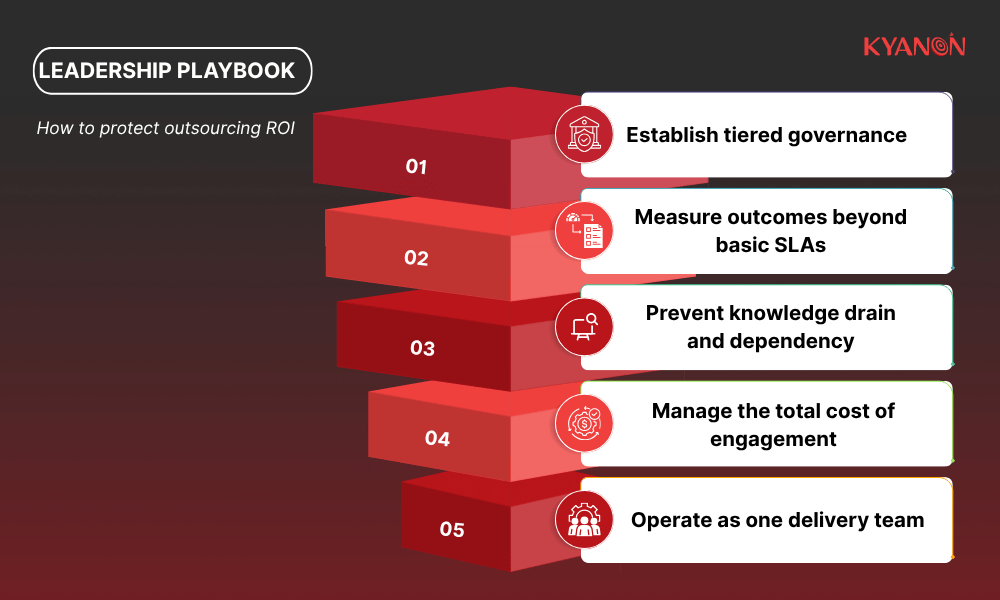
Establish tiered governance
Use different review levels for different decisions:
- Strategic: quarterly reviews of business alignment, major risks and contract fit
- Tactical: monthly reviews of SLAs, delivery performance, cost and improvement priorities
- Operational: weekly or daily reviews of blockers, milestones and execution issues
Choose this structure when multiple stakeholders, vendors or workstreams are involved. A single project contact is usually not enough for enterprise-scale outsourcing.
Measure outcomes beyond basic SLAs
SLAs such as uptime, ticket closure and response time are useful, but they do not prove business value.
Pair them with metrics such as:
- Cycle time
- Release predictability
- Defect and incident trends
- Time-to-value
- User experience where relevant
- Internal coordination effort
Where appropriate, use Experience Level Agreements (XLAs) to connect service performance with the experience or business outcome the service is intended to support.
Prevent knowledge drain and dependency
Outsourcing creates long-term risk when critical knowledge sits only with the provider.
Before scaling, require:
- Architecture and API documentation
- Client-accessible repositories
- Clear IP and source-code ownership
- Internal ownership of critical product and architecture decisions
- Regular knowledge transfer or shadowing
- Defined transition and exit procedures
A partner should increase delivery capacity without reducing your ability to change providers or bring capability back in-house.
Manage the total cost of engagement
Do not evaluate ROI using vendor rates alone.
Track:
- Internal management time
- Onboarding and transition effort
- Rework and defect correction
- Cloud and infrastructure cost
- Licenses and security tooling
- Scope changes
- Knowledge transfer and exit cost
If a lower-cost provider requires more supervision or rework, the apparent saving may disappear at the TCO level.
Operate as one delivery team
External engineers need enough business and technical context to make good decisions.
Use:
- Shared roadmap context
- Common delivery tools
- Joint sprint reviews and retrospectives
- Shared engineering standards
- Clear Definition of Done
- Agreed escalation paths
The objective is to reduce handoffs, information gaps and avoidable rework.
Decision rule
Scale the outsourcing relationship only when three things remain healthy together: delivery performance, total cost and dependency risk.
Why choose Kyanon Digital for a dedicated development team in Singapore?
An engineering partner, not a recruitment provider
Kyanon Digital builds dedicated development teams around your product roadmap, backlog, technology stack, and delivery objectives, rather than simply filling individual roles. Our AI-driven Dedicated Agile Team model provides Singapore enterprises with stable engineering capacity, sprint-based delivery, and clear accountability aligned with backlog readiness and team capacity.
AI-enabled engineering with human accountability
Kyanon Digital integrates AI-assisted practices across requirements analysis, user-story preparation, software development, QA preparation, documentation, and delivery reporting. AI helps teams improve productivity and accelerate engineering workflows, while experienced engineers remain accountable for technical decisions, quality, and delivery outcomes.
Kyanon Digital talent ecosystem encompasses over 50,000 technology professionals
- 500+ internal technology professionals
- Talent pipeline across 18 Vietnamese universities through the K-Fresh Program
- 15,000+ external candidates
- 1,000+ ecosystem partners
Delivery support beyond team assembly
Kyanon Digital supports dedicated teams throughout the engagement, including onboarding, account management, professional development, technical support, and access to its Centers of Excellence. This enables Singapore enterprises to build long-term engineering capabilities while maintaining knowledge continuity, delivery consistency, and alignment with their internal teams.
Conclusion
Software outsourcing produces defensible ROI when it changes a measurable constraint: delivery speed, specialist capacity, reliability, quality, management effort or total technology cost.
For Singapore leaders, the strongest next step is to establish the baseline before selecting a vendor. Define the work to transfer, the responsibilities that stay internal, the engagement model, the metrics that prove value, and the conditions that would justify scaling or changing the approach.
If engineering capacity, delivery ownership or modernization execution is becoming a constraint, discuss your software outsourcing scope and operating model with Kyanon Digital. The conversation should focus on the required outcomes, retained client ownership, suitable engagement model, baseline KPIs and governance needed to build a defensible business case.
References
- National AI Impact Programme — IMDA.
- Major Push to Upskill Tech Professionals and Grow the Next-Generation of Tech Leaders — IMDA.
- Enterprise Gateway to AI Transformation (GAIT) Playbook — IMDA, SkillsFuture Singapore and Workforce Singapore.
- Personal Data Protection Act (PDPA) — Personal Data Protection Commission Singapore.
- Where AI Costs Are Made or Saved in Software Development — IBM.
- Measuring ROI of AI-Assisted Development: How IBM Did It — IBM.
- State of FinOps 2026 — FinOps Foundation.
- Accelerating Singapore Digital Insurance App Launch Readiness with an AI-Driven Agile Team — Kyanon Digital.
- Accelerating Singapore Digital Insurance App Launch Readiness with an AI-Driven Agile Team — Video — Kyanon Digital.
- AI-Enabled IT Staff Augmentation — Kyanon Digital.
- Outcome-Based AI Dedicated Agile Team — Kyanon Digital.
- Software Development Outsourcing — Kyanon Digital.
- Application Modernization & Managed Services — Kyanon Digital.







 Create project brief with AI