
What is Algolia Search?
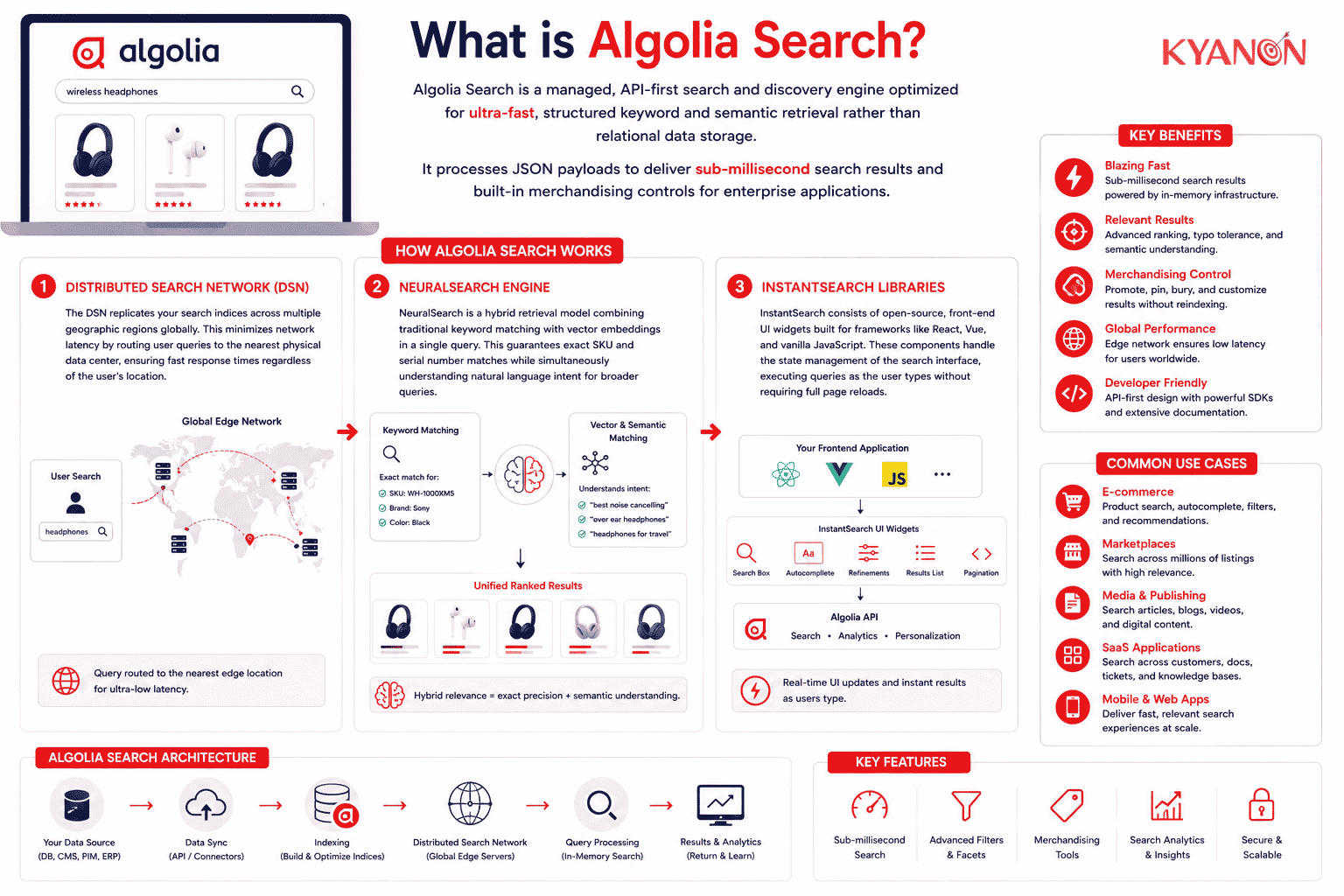
Algolia Search is a managed, API-first search and discovery engine optimized for ultra-fast, structured keyword and semantic retrieval rather than relational data storage. It processes JSON payloads to deliver sub-millisecond search results and built-in merchandising controls for enterprise applications.
How Algolia search works
Algolia bypasses database querying by pre-computing indices and distributing them across a global network of edge servers. This architecture focuses on computational speed at indexing time, ensuring that end-user search queries are resolved entirely from memory (RAM) rather than disk reads.
Distributed Search Network (DSN)
The DSN replicates your search indices across multiple geographic regions globally. This minimizes network latency by routing user queries to the nearest physical data center, ensuring fast response times regardless of the user’s location.
NeuralSearch Engine
NeuralSearch is a hybrid retrieval model combining traditional keyword matching with vector embeddings in a single query. This guarantees exact SKU and serial number matches while simultaneously understanding natural language intent for broader queries.
InstantSearch Libraries
InstantSearch consists of open-source, front-end UI widgets built for frameworks like React, Vue, and vanilla JavaScript. These components handle the state management of the search interface, executing queries as the user types without requiring full page reloads.

Common use cases of Algolia Search
- E-Commerce: Helping shoppers instantly find products, brands, or specific SKUs.
- SaaS Applications: Enabling users to quickly navigate dashboards, files, or internal data.
- Media & Content: Powering search and category discovery for large blogs, news sites, or streaming platforms.
- Documentation: Allowing developers to instantly find technical guides, API references, or tutorials.
Algolia Search vs Elastic Search
Both engines provide advanced search capabilities, but differ strictly in infrastructure management and primary application architectures.
Dimension | Algolia Search | Elastic Search |
| Deployment speed | Fast (Hosted SaaS) | Slower (Requires infrastructure setup) |
Primary use case | E-commerce, site search, product discovery | Raw log analysis, complex backend queries |
| Upfront complexity | Low | High |
Infrastructure management | Zero (Fully managed API) | High (Self-hosted or managed clusters) |
| Relevance tuning | Visual dashboard & AI-driven | Manual query DSL writing |
Cost model | OpEx (Usage-based per request/record) | CapEx or OpEx (Node/Cluster capacity based) |
When to consider Algolia Search
Consider Algolia Search if:
- Your e-commerce conversion rates are dropping because users abandon sessions after encountering “zero results” pages for misspellings or natural language queries.
- Your engineering team spends excessive sprint capacity maintaining an in-house search cluster instead of building core product features.
- You require business users and merchandisers to manually pin, boost, or hide specific products in search results without requiring code deployments.
It may not be the right priority if:
- Your primary goal is processing terabytes of raw system logs or executing heavy backend numerical analytics where infrastructure like Elasticsearch is required.
- You lack structured data and operate a strictly content-based, static blog with fewer than 100 pages.
Why Algolia Search matters for E-commerce
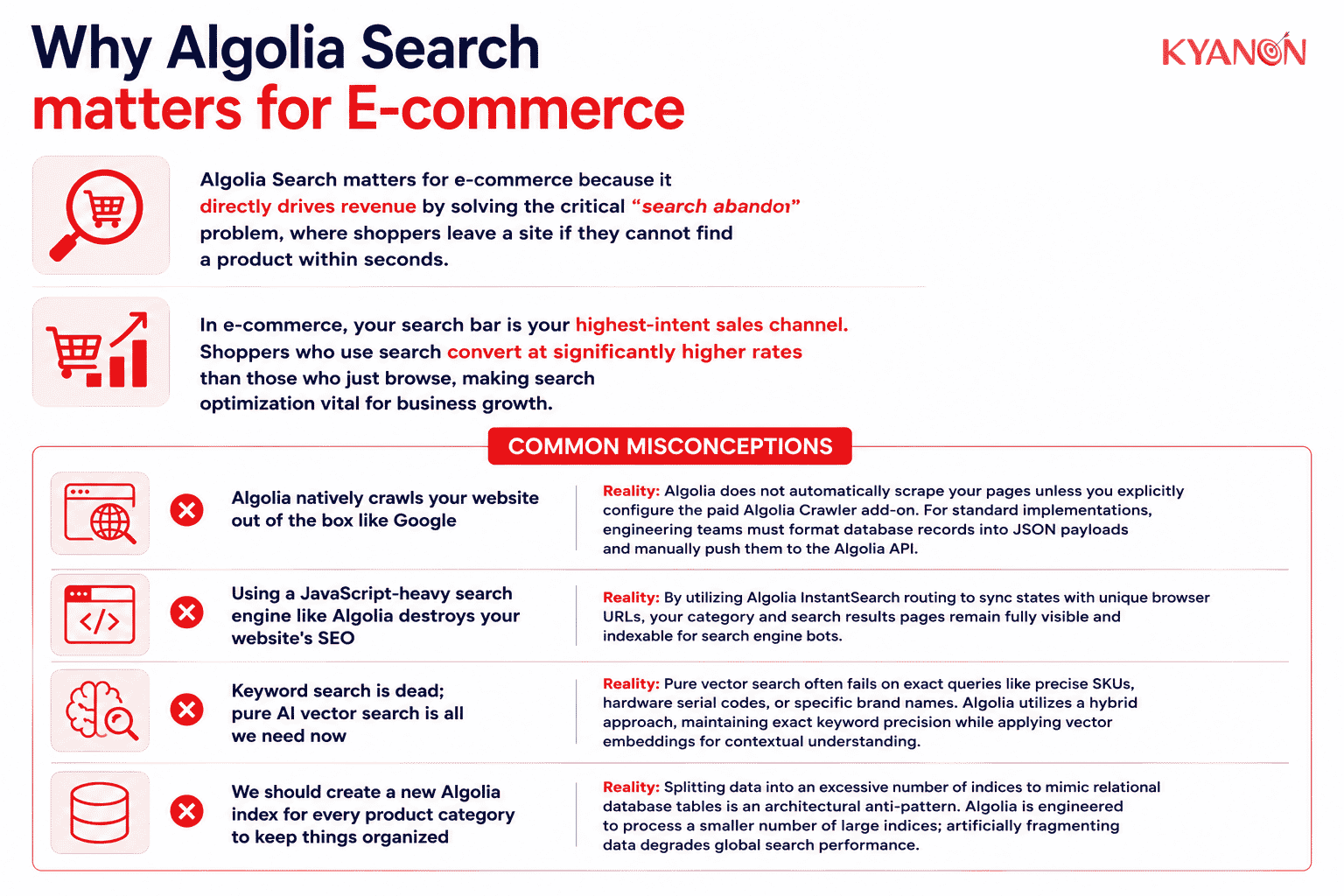
Algolia Search matters for e-commerce because it directly drives revenue by solving the critical “search abandon” problem, where shoppers leave a site if they cannot find a product within seconds.
In e-commerce, your search bar is your highest-intent sales channel. Shoppers who use search convert at significantly higher rates than those who just browse, making search optimization vital for business growth.
Common misconceptions
Algolia natively crawls your website out of the box like Google
Reality: Algolia does not automatically scrape your pages unless you explicitly configure the paid Algolia Crawler add-on. For standard implementations, engineering teams must format database records into JSON payloads and manually push them to the Algolia API.
Using a JavaScript-heavy search engine like Algolia destroys your website’s SEO
Reality: By utilizing Algolia InstantSearch routing to sync states with unique browser URLs, your category and search results pages remain fully visible and indexable for search engine bots.
Keyword search is dead; pure AI vector search is all we need now
Reality: Pure vector search often fails on exact queries like precise SKUs, hardware serial codes, or specific brand names. Algolia utilizes a hybrid approach, maintaining exact keyword precision while applying vector embeddings for contextual understanding.
We should create a new Algolia index for every product category to keep things organized
Reality: Splitting data into an excessive number of indices to mimic relational database tables is an architectural anti-pattern. Algolia is engineered to process a smaller number of large indices; artificially fragmenting data degrades global search performance.
How Kyanon Digital applies Algolia Search
Kyanon Digital implements Algolia Search using automated JSON data pipelines for enterprise clients across the APAC and ANZ regions. Our implementation focuses on structuring product catalogs for ultra-fast retrieval while equipping merchandising teams with visual dashboards to control ranking logic, directly tying search performance to measurable TCO reduction and conversion improvements.
Explore our services:

 Create project brief with AI