
What is attribute-based filtering?
Attribute-based filtering is a catalog navigation method that allows e-commerce shoppers to refine search results or category pages by selecting specific, structured data fields such as size, color, brand, or technical specifications. It relies on standardized metadata attached to individual product listings to accurately match user intent with available inventory.
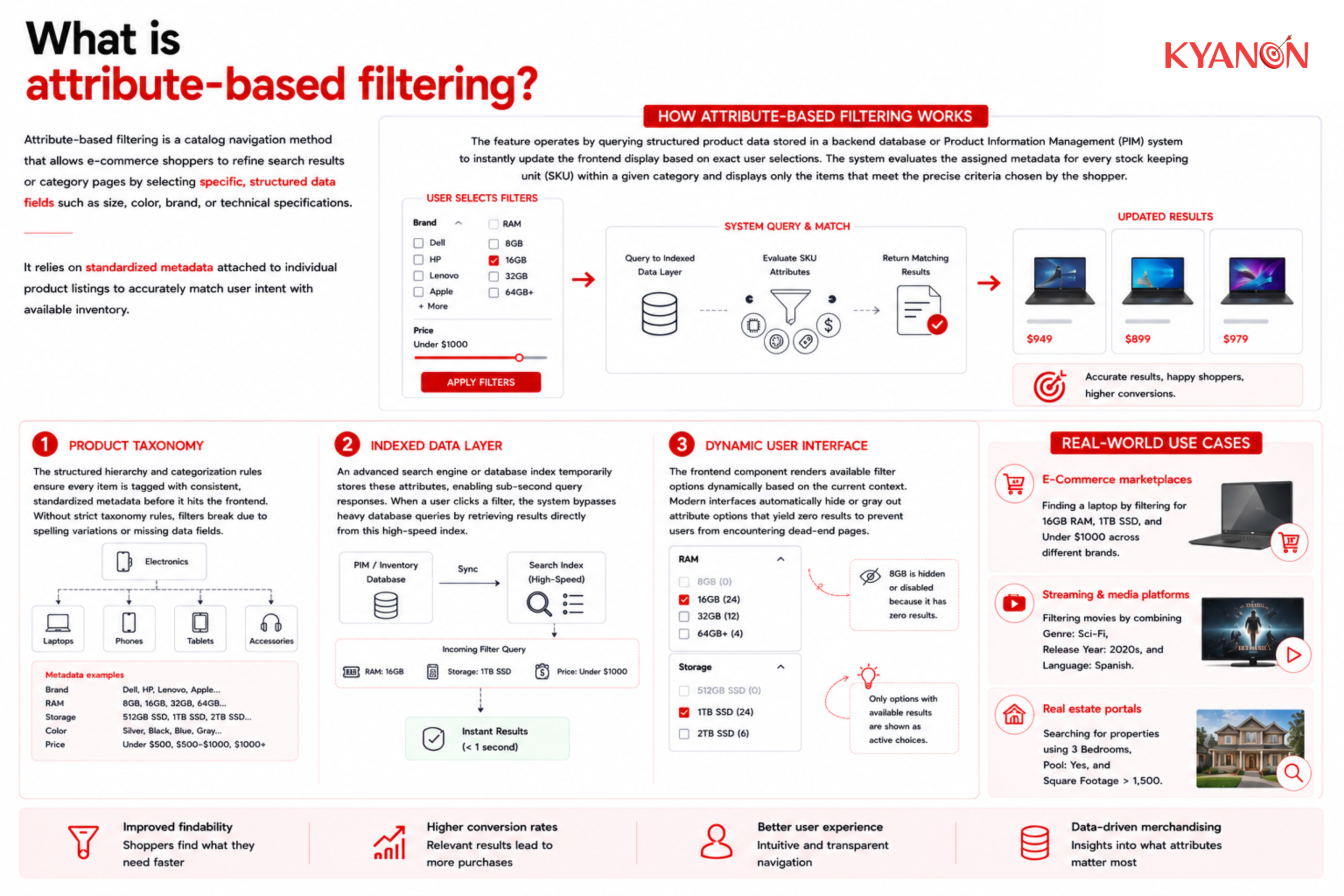
How attribute-based filtering works
The feature operates by querying structured product data stored in a backend database or Product Information Management (PIM) system to instantly update the frontend display based on exact user selections. The system evaluates the assigned metadata for every stock keeping unit (SKU) within a given category and displays only the items that meet the precise criteria chosen by the shopper.
product taxonomy
The structured hierarchy and categorization rules ensure every item is tagged with consistent, standardized metadata before it hits the frontend. Without strict taxonomy rules, filters break due to spelling variations or missing data fields.
Indexed data layer
An advanced search engine or database index temporarily stores these attributes, enabling sub-second query responses. When a user clicks a filter, the system bypasses heavy database queries by retrieving results directly from this high-speed index.
Dynamic user interface
The frontend component renders available filter options dynamically based on the current context. Modern interfaces automatically hide or gray out attribute options that yield zero results to prevent users from encountering dead-end pages.

Real-world use cases
- E-Commerce marketplaces: Finding a laptop by filtering for 16GB RAM, 1TB SSD, and Under $1000 across different brands.
- Streaming & media platforms: Filtering movies by combining Genre: Sci-Fi, Release Year: 2020s, and Language: Spanish.
- Real estate portals: Searching for properties using 3 Bedrooms, Pool: Yes, and Square Footage > 1,500.
Attribute-Based Filtering vs Faceted Navigation
Both approaches help users narrow down product choices, but they differ in how they dynamically present and update available options in response to user actions.
Dimension | Attribute-Based Filtering | Faceted Navigation |
| Scope of options | Focuses on specific data fields like color or size | Combines multiple categories, attributes, and price ranges simultaneously |
Dynamic adaptation | Options may remain static even if yielding zero results in legacy setups | Options update and recalculate dynamically based on remaining available inventory |
| Data dependency | Requires basic structured product data points | Requires a highly structured, multi-dimensional taxonomy |
Implementation complexity | Medium | High |
| Best for | Small to medium catalogs with straightforward variants | Large, complex catalogs like B2B parts or multi-vendor marketplaces |
When to consider attribute-based filtering
Consider attribute-based filtering if:
- Your customers frequently abandon category pages because they have to scroll through dozens of irrelevant variants to find their specific size or technical requirement.
- You are migrating to a composable architecture and need to decouple your search and discovery experience from your monolithic core commerce engine.
- Your product catalog has expanded beyond 1,000 SKUs and manual merchandising fails to cover the diverse, specific search intents of your user base.
It may not be the right priority if:
- Your catalog consists of a highly curated, limited-edition product line under 50 SKUs where discovery relies heavily on visual scrolling and storytelling rather than specific technical parameters.
Why attribute-based filtering matters for B2B and enterprise retail
Attribute-based filtering matters for B2B and enterprise retail because it allows buyers to navigate massive, highly complex product catalogs instantly. Unlike basic B2C filtering (such as size or color), enterprise filtering must handle multi-dimensional specifications, compliance rules, and dynamic contract pricing across millions of stock-keeping units (SKUs). (Baymard Institute)
- Handles technical complexity: Allows buyers to filter by precise industrial specifications (e.g., tensile strength, voltage) rather than basic categories.
- Speeds up procurement: Helps professional buyers find exact components instantly, reducing costly ordering mistakes and freight returns.
- Enforces compliance: Filters products by critical regulatory mandates, safety certifications (e.g., FDA, RoHS), or country of origin.
- Supports contract pricing: Dynamically adjusts visible product attributes, regional availability, and pre-negotiated vendor rules per corporate account.
- Powers headless search: Integrates with PIM systems and high-speed search engines (like Elasticsearch) via a BFF to deliver instant UI updates.
Common misconceptions
It works automatically once we install a search plugin like Algolia
Reality: Search engines only index the data they are fed by the backend architecture. If your Product Information Management (PIM) data is messy, inconsistent, or lacks standardized tags across SKUs, the frontend filtering experience will be fundamentally broken regardless of the software vendor used.
We only need to offer filters for price and brand to keep the UI clean
Reality: Relying solely on broad categories ignores specific buyer intent, particularly in technical B2B sales. Shoppers look for highly specific, use-case-driven attributes, such as ‘water resistance rating’ or ‘operating voltage’, which are the primary drivers for completing complex purchasing decisions.
How Kyanon Digital applies attribute-based filtering
Kyanon Digital implements attribute-based filtering and faceted navigation using composable search engines like Algolia and standardized PIM integrations for enterprise clients across Singapore, Thailand, and ANZ. Our approach focuses on structuring clean taxonomy data at the source, ensuring that frontend filtering delivers fast, relevant results that directly lower total cost of ownership (TCO) for catalog management.
Explore our services:

 Create project brief with AI