
What is Chain-of-Thought Prompting?
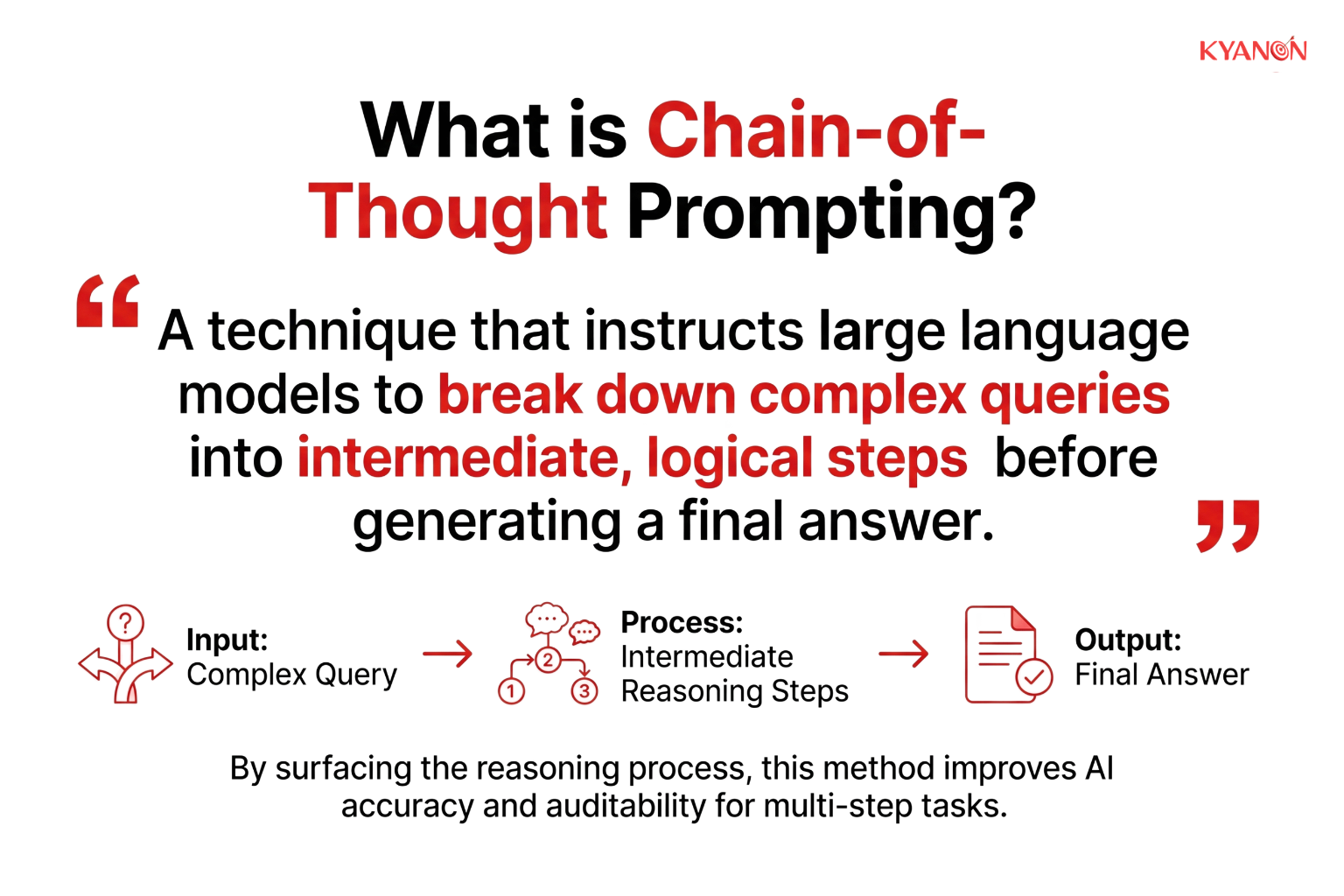
Chain-of-Thought (CoT) Prompting is a prompt engineering technique that improves large language model (LLM) reasoning by encouraging the model to generate intermediate reasoning steps before producing a final answer. Instead of returning a direct output immediately, the model decomposes the problem into smaller logical stages, simulating a structured reasoning process.
In practice, CoT prompting helps AI systems perform better on tasks involving:
- Multi-step reasoning
- Logical deduction
- Mathematical analysis
- Decision sequencing
- Complex workflow orchestration
- Context-sensitive enterprise operations
The approach became foundational to modern enterprise AI because it significantly improves reasoning consistency, transparency, and explainability compared to direct-response prompting.
For example:
- Standard Prompt: “Should a bank approve this loan application?”
- Chain-of-Thought Prompt: “Analyze the applicant’s income stability, debt-to-income ratio, credit history, repayment risk, and regulatory constraints step by step before making a lending recommendation.”
The second approach encourages structured inference generation rather than shallow pattern completion.
As enterprise AI systems evolve toward autonomous agents, retrieval-augmented generation (RAG), and orchestration pipelines, CoT prompting increasingly functions as a reasoning architecture layer rather than a simple prompting trick.
How Chain-of-Thought Prompting Works
Chain-of-thought prompting works by converting a direct prompt into a structured reasoning sequence. Rather than jumping from question to answer instantly, the language model generates visible intermediate steps that guide the final response. This process improves consistency and reduces reasoning errors in complex enterprise workflows.
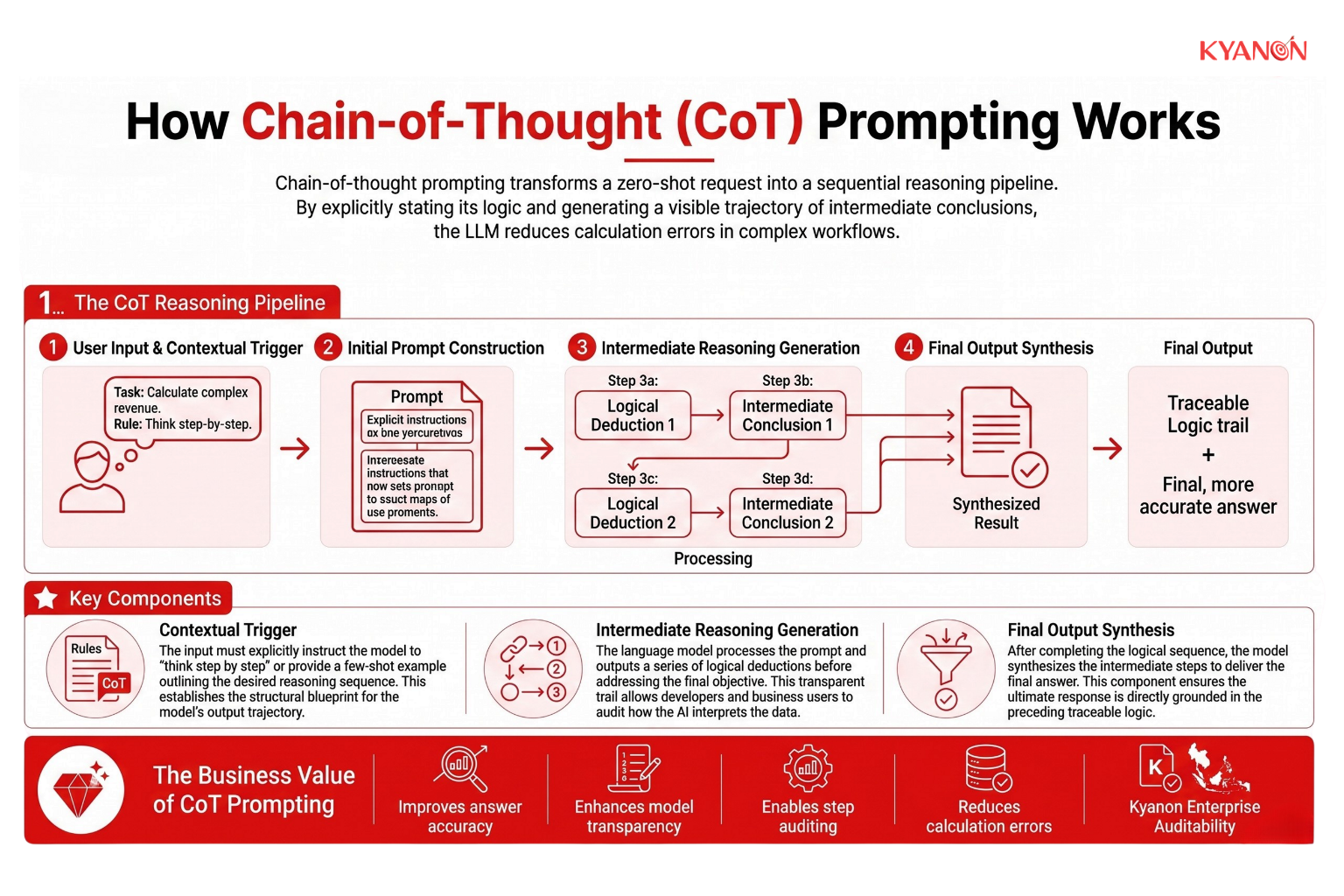
Contextual Trigger
The prompt must explicitly instruct the model to “think step by step” or include examples that demonstrate the desired reasoning structure. However, production-grade systems typically use more advanced examples that demonstrate how reasoning should unfold under domain-specific constraints. This stage establishes the reasoning format, depth, and operational boundaries.
This can occur through:
- Explicit instructions
- Worked examples
- Demonstration chains
- Structured decomposition prompts
- Tool-augmented orchestration logic
In enterprise deployments, contextual triggering often integrates with:
- Retrieval-Augmented Generation (RAG)
- Policy retrieval layers
- Knowledge graphs
- Workflow orchestration engines
- AI guardrail systems
The goal is not merely better text generation, but controlled reasoning behavior.
Intermediate Reasoning Generation
The model generates a sequence of deductions, calculations, or logical evaluations before arriving at the final conclusion. These intermediate steps create a traceable reasoning path that developers and enterprise teams can review for validation.
This reasoning chain may include:
- Assumption evaluation
- Constraint analysis
- Comparative scoring
- Hypothesis testing
- Sequential decomposition
- Probabilistic estimation
- Rule validation
In modern transformer systems, these chains emerge through token prediction dynamics rather than symbolic logic. The model predicts reasoning tokens that statistically correlate with coherent analytical progression.
This distinction matters because CoT reasoning is not true human cognition. It is probabilistic sequence generation that approximates structured reasoning patterns.
Nevertheless, the approach materially improves performance on:
- Arithmetic tasks
- Legal reasoning
- Financial analysis
- Code generation
- Strategic planning
- Multi-variable operational analysis
This is why CoT prompting became foundational to advanced agentic AI systems such as:
- ReAct (Reason + Action)
- Tree-of-Thoughts (ToT)
- Graph-of-Thought reasoning
- Multi-agent orchestration frameworks
These systems extend CoT from a linear reasoning chain into branching decision architectures.
Final Output Synthesis
After generating intermediate reasoning steps, the model synthesizes a final response.
High-quality CoT implementations typically add grounding layers that validate outputs against:
- Enterprise policies
- External databases
- Retrieval systems
- Compliance constraints
- Validation APIs
- Deterministic business rules
Without grounding, CoT can still produce persuasive but incorrect reasoning chains.
This is a critical enterprise concern because plausible reasoning does not guarantee factual accuracy.
Modern production systems therefore combine:
- CoT reasoning
- Retrieval-Augmented Generation (RAG)
- Verification pipelines
- AI guardrails
- Human-in-the-loop review
- Confidence scoring
The enterprise objective is not merely “reasoning visibility,” but operational reliability under real-world uncertainty.

Chain-of-Thought Prompting vs Standard Prompting
Both techniques guide AI outputs, but they differ significantly in reasoning depth, transparency, and computational cost.
|
Dimension |
Chain-of-Thought Prompting | Standard Prompting |
| Processing method | Sequential reasoning steps |
Direct answer generation |
|
Processing speed |
Slower | Faster |
| Token consumption | High |
Low |
|
Best for |
Multi-step analysis, logic-heavy tasks | Simple queries, content generation |
| Auditability | High |
Low |
|
Hallucination control |
Reduces logical errors |
Higher risk in complex reasoning |
The trade-off is fundamentally an accuracy-versus-efficiency optimization problem.
CoT improves analytical depth but introduces:
- Additional token costs
- Longer inference times
- More orchestration complexity
- Higher infrastructure consumption
For enterprise AI systems operating under strict SLAs, this trade-off becomes strategically significant.
When to Consider Chain-of-Thought Prompting
Consider chain-of-thought prompting if:
- Your organization requires auditable AI reasoning for financial modeling, compliance analysis, or enterprise decision support.
- Your AI workflows involve complex mathematical, logical, or multi-step problem-solving tasks.
- Your large language model consistently produces inaccurate outputs despite receiving detailed contextual instructions.
- Your engineering team needs more transparent AI behavior for debugging and governance purposes.
It may not be the right priority if:
- Your application prioritizes ultra-fast response times for simple customer interactions or lightweight automation tasks.
- Your models are relatively small and struggle to maintain coherent reasoning chains.
- Your workflow primarily involves direct retrieval, summarization, or low-complexity content generation.
Why Chain-of-Thought Prompting Matters for Enterprise AI
In complex enterprise architectures, the transition from experimental AI sandbox projects into production-grade deployment demands rigorous governance, meticulous oversight, and unbreakable control mechanisms. The holistic business case for Chain-of-Thought prompting extends far beyond simple, isolated accuracy improvements; it serves as the absolute foundational layer for Explainable AI (XAI) and strict regulatory compliance. CoT directly addresses the immense systemic risks inherently associated with autonomous model deployment at an institutional scale.
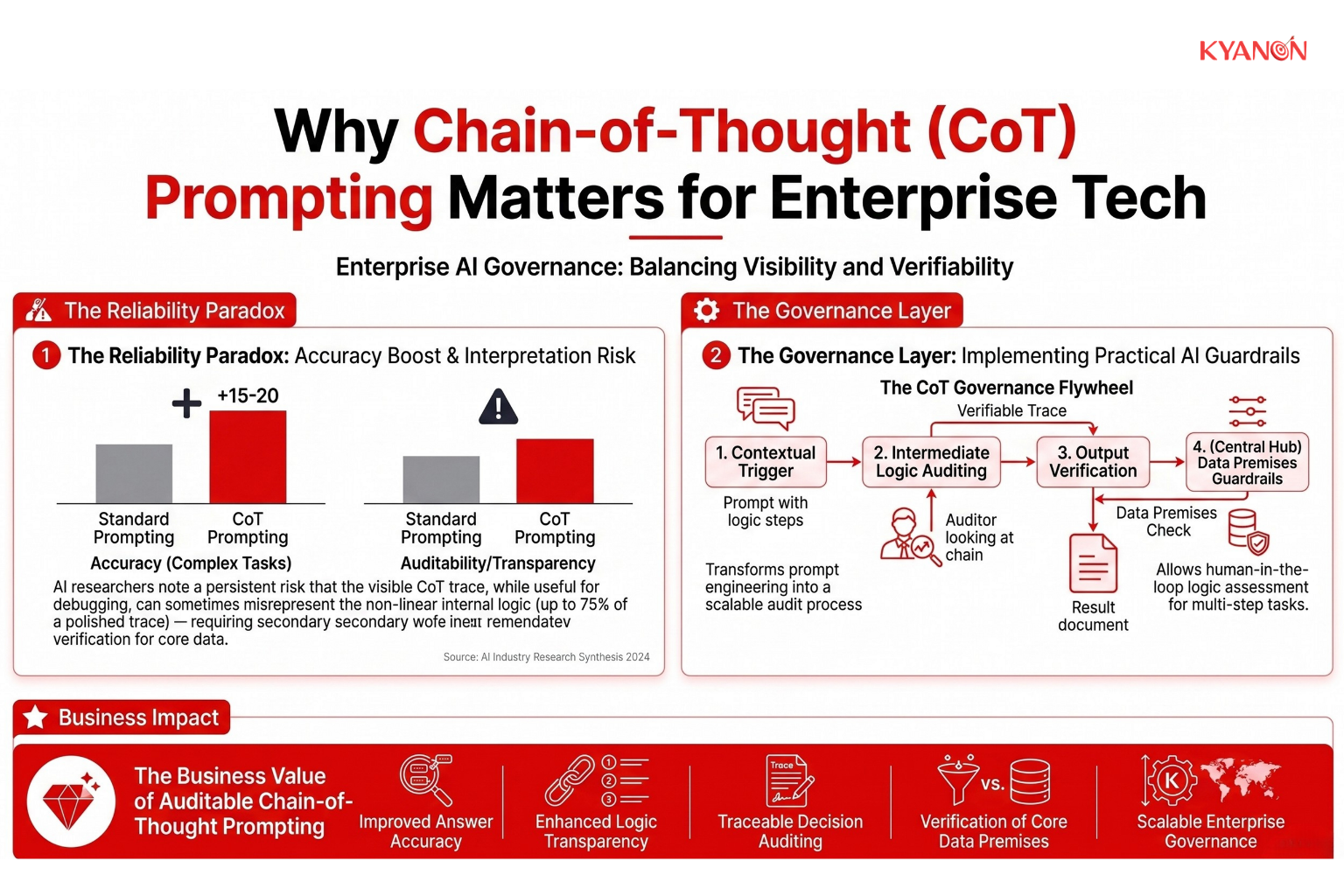
Enhancing Explainable AI (XAI) & Audit Trails
In regulated industries like finance, healthcare, and insurance, opaque AI decision-making is unacceptable. Regulations such as the EU AI Act and Fair Lending Laws mandate documented reasoning to prevent bias. Without transparent audit trails, institutional and regulatory trust in agentic systems erodes.
Chain-of-Thought prompting natively generates this mandatory auditability by default. By systematically forcing the AI to articulate its granular reasoning step-by-step, organizations can flawlessly capture the model’s internal monologue and store it securely alongside the final output decision. A comprehensive, legally defensible enterprise audit trail for an AI agent consists of three deeply correlated data layers:
- The Contextual Layer: This preserves user identity metadata, explicit policy and rule versions applied during the session, the exact raw prompt utilized, and the specific documents securely retrieved via Retrieval-Augmented Generation (RAG) indices.
- The Reasoning Layer: This meticulously logs the CoT internal monologue, including intermediate planning steps, specific condition evaluations, extraction confidence scores for targeted variables, and the exact timestamp chain for every logical step.
- The Action Layer: This firmly documents the specific external API calls executed by the agent, exact tool parameters utilized, delegation lineage, and the final deterministic outputs rendered to the end-user.
Integrating these three data layers creates a complete, immutable narrative of automated events. When an AI agent denies a mortgage or flags fraud, the preserved CoT trace allows auditors to verify the mathematical logic used, ensuring decisions are data-driven rather than biased or hallucinated. Storing these reasoning chains on tamper-resistant, compliant storage provides the empirical evidence required for regulatory reporting. This enables organizations to identify policy violations immediately and refine system guardrails using factual performance data.
Mitigating Complex AI Hallucinations
AI Hallucinations, critical instances where a language model generates highly fluent, completely plausible, but entirely factually incorrect or nonsensical information, pose a severe, existential risk to enterprise data integrity. Standard prompting techniques massively exacerbate this risk because the model attempts to map a highly complex input directly to a final output without engaging any mechanisms to independently verify its own latent logic.
Chain-of-Thought prompting intrinsically mitigates complex hallucinations. By enforcing a sequential deductive process, the model enables constant self-correction, anchoring responses to established facts to reduce fabricated assertions. Visible reasoning allows engineering teams to use observability tools and automated frameworks—like Galileo’s Luna-2 or ChainPoll—to monitor chain quality and detect anomalies before they impact users. This creates a closed-loop feedback mechanism where flagged reasoning flaws refine the system, increasing operational advantages with every transaction.
Integrating with Enterprise AI Orchestration
In mature, highly developed enterprise deployments, large language models do not operate in a standalone vacuum; they are deeply embedded within broader AI Orchestration frameworks that continuously integrate massive vector databases, custom internal APIs, and high-velocity real-time data streams. Chain-of-Thought plays an absolutely vital role in these multi-agent workflows, specifically within advanced architectures like ReAct (Reasoning and Acting).
ReAct frameworks integrate CoT reasoning with executable actions to create a “think-act-observe” cycle. For example, in managing supply chain disruptions, a model uses CoT to identify missing info, triggers API calls for database inventory (Action), and updates its reasoning based on the retrieved data. materially improves performance on complex reasoning tasks. Success requires robust IT infrastructure where CoT ensures predictable, logical delegation by autonomous agents.
Common Misconceptions
“Chain-of-thought prompting reveals the AI’s true internal reasoning.”
Reality: The generated reasoning steps are not necessarily the model’s actual internal process. In many cases, the reasoning chain is a constructed explanation rather than a transparent representation of how the model reached the conclusion.
“Chain-of-thought prompting eliminates AI hallucinations.”
Reality: While it reduces logical inconsistencies, the model can still produce highly structured reasoning based on inaccurate or fabricated information. Logical flow does not guarantee factual correctness.
“Longer step-by-step prompts always improve AI performance.”
Reality: Chain-of-thought prompting is task-dependent and performs best on complex reasoning tasks using sufficiently capable models. Applying it to simple queries often increases latency and token costs without improving results.
How Kyanon Digital Applies Chain-of-Thought Prompting
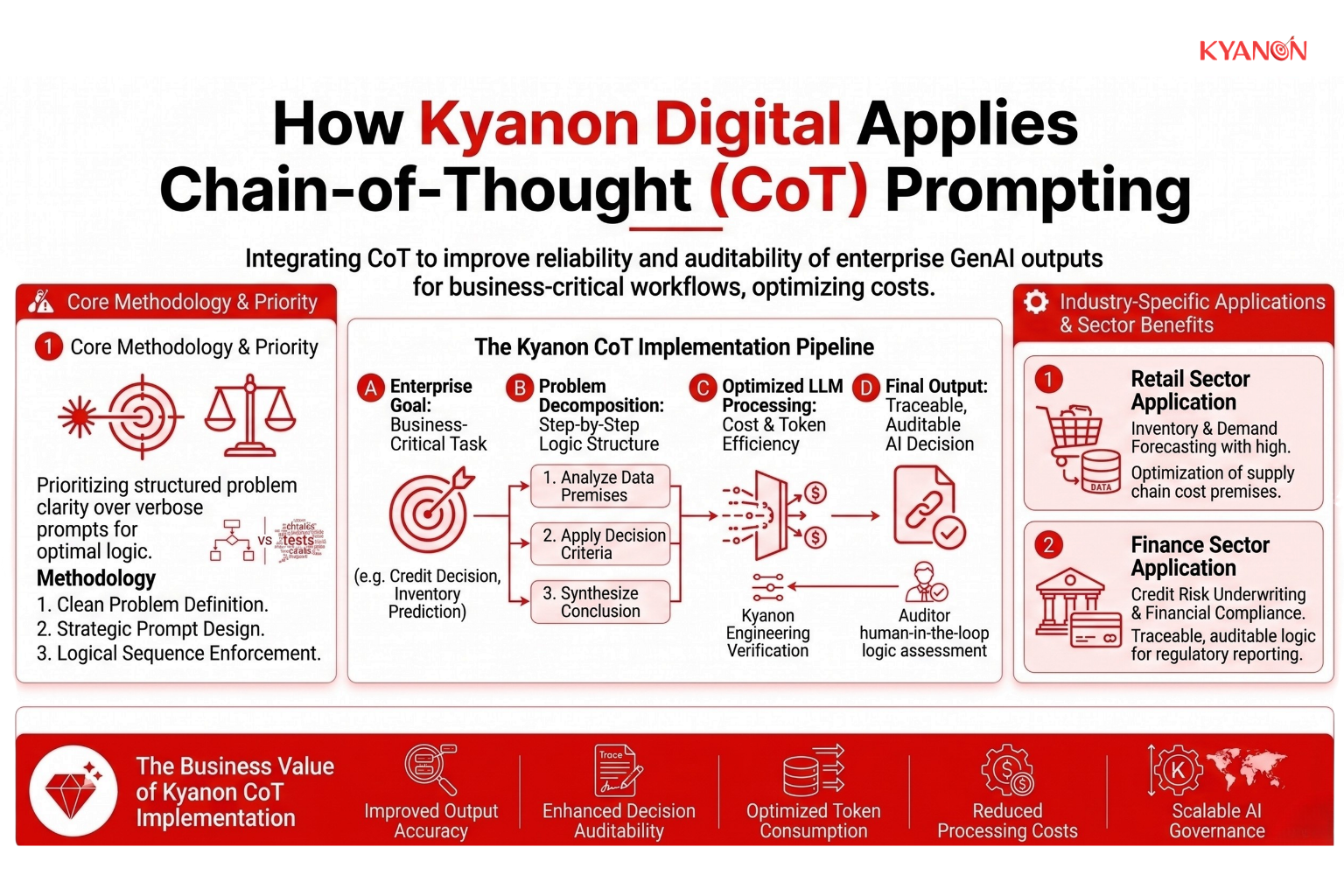
Kyanon Digital integrates chain-of-thought prompting into enterprise AI solutions to improve reasoning reliability, governance, and auditability for business-critical workflows. Our engineering teams design structured prompting frameworks that help organizations achieve more traceable AI outputs while controlling token consumption and infrastructure costs. By aligning reasoning architecture with business objectives, Kyanon Digital helps enterprises deploy scalable generative AI systems with higher operational confidence.
→ Explore our Generative AI Consulting services.

 Create project brief with AI