
What is a Large Language Model (LLM)?
A Large Language Model (LLM) is an AI model trained on large-scale text and code data to understand, generate, summarize, translate, classify, and reason over language-based inputs.
For enterprises, an LLM should be treated as a probabilistic language engine, not a verified knowledge base or autonomous decision-maker.
Key Capabilities of Large Language Models
A Large Language Model (LLM) can support multiple natural language processing tasks, including content generation, summarization, translation, reasoning, classification, and conversational interaction.
Common LLM capabilities include:
- Content generation: Drafting emails, product descriptions, reports, marketing copy, articles, and code.
- Summarization: Turning long documents, meeting transcripts, policies, or research notes into concise summaries.
- Translation: Translating text across languages while preserving tone and context.
- Reasoning support: Explaining concepts, comparing options, structuring arguments, and planning multi-step workflows.
- Classification and extraction: Categorizing tickets, extracting fields from documents, and identifying intent from customer messages.

Common Applications of Large Language Models
Large language models are commonly used in enterprise workflows where teams need to process, generate, or retrieve language-based information at scale.
Common applications include:
- Customer service AI: Powering chatbots, virtual assistants, support-ticket summarization, and response drafting.
- Internal knowledge search: Helping employees find answers from SOPs, policies, product documents, and knowledge bases.
- E-commerce content operations: Generating product descriptions, category copy, SEO briefs, and localized content.
- Programming support: Assisting with code generation, debugging, documentation, and technical explanation.
- Document intelligence: Summarizing contracts, invoices, reports, emails, compliance documents, and meeting notes.
- Workflow automation: Supporting approval flows, data entry assistance, internal Q&A, and task routing.
How Large Language Model (LLM) Works
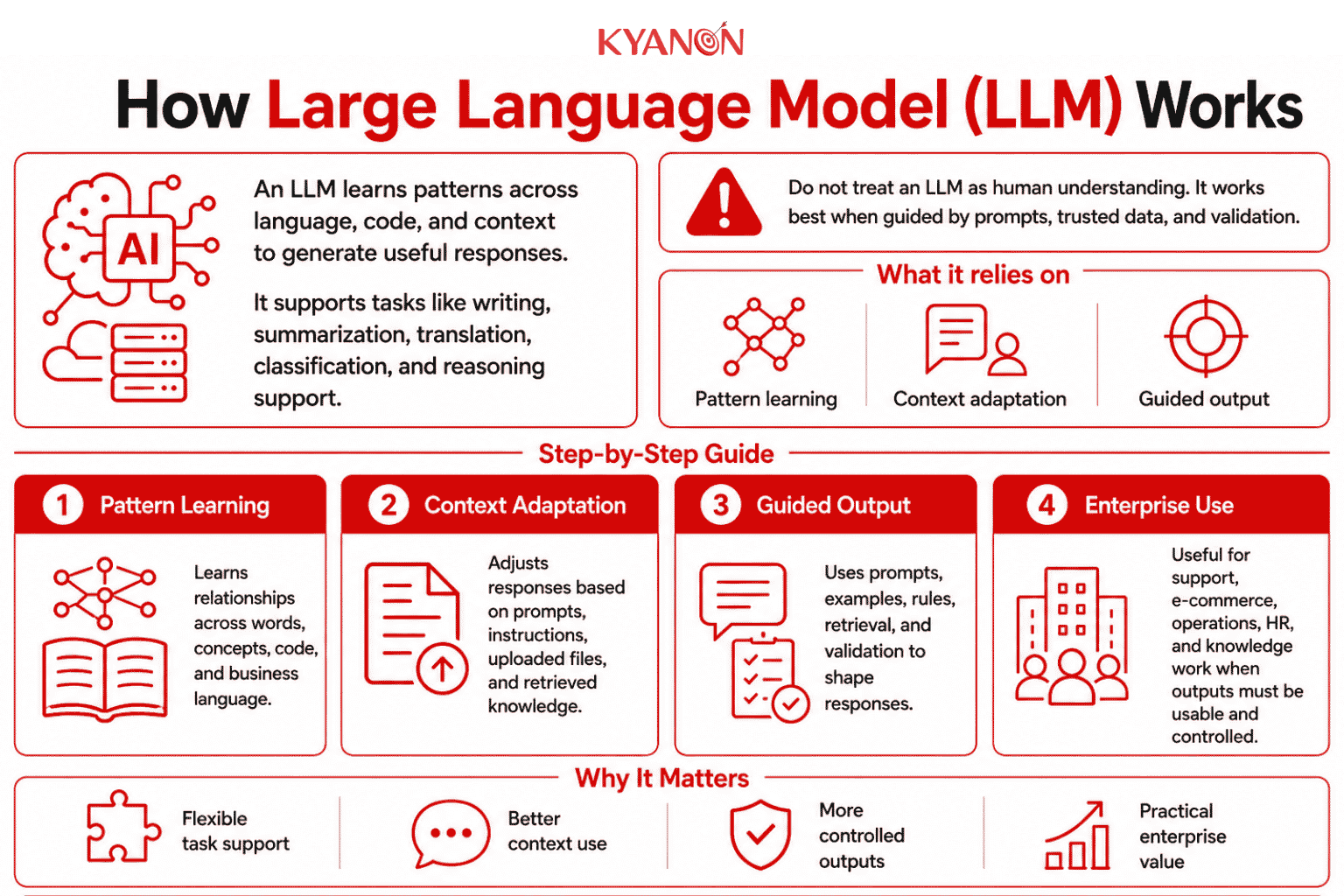
A large language model (LLM) works because it can detect patterns across language, code, and context at a scale that humans cannot process manually. This allows the model to generate useful outputs for writing, summarization, translation, classification, and reasoning support by predicting what response is most relevant to the user’s prompt.
The reason LLMs are effective in enterprise workflows is not that they “understand” business like humans do, but that they can reuse learned language patterns and adapt them to new tasks when guided by clear prompts, trusted data, and validation rules.
Pattern Learning
Pattern learning allows an LLM to recognize relationships between words, phrases, concepts, code, and business context. This is why the same model can support many language-heavy tasks, from summarizing a policy document to drafting a customer-service response.
Context Adaptation
Context adaptation allows an LLM to adjust its response based on the prompt, instructions, uploaded documents, retrieved knowledge, or user intent. For enterprises, this is what makes LLMs useful across different functions such as e-commerce, support, operations, HR, and knowledge management.
Guided Output
Guided output means the LLM’s response can be shaped by prompts, examples, business rules, retrieval systems, and validation layers. In production, this is critical because enterprise teams need outputs that are not only fluent but also accurate, secure, structured, and usable in real workflows.
Main Limitations of Large Language Models
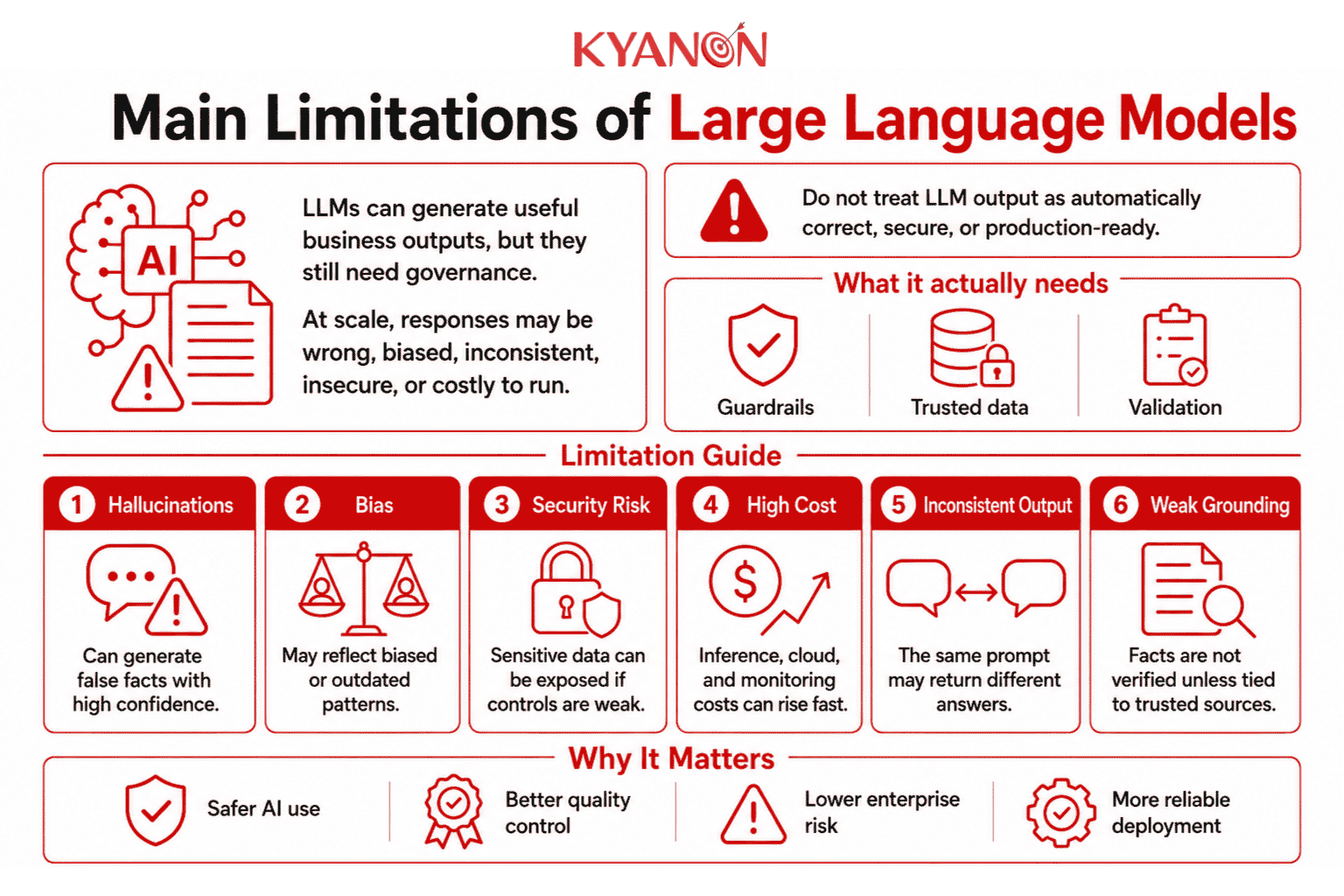
A large language model can produce useful business outputs, but it still requires governance because its responses may be incorrect, biased, inconsistent, or expensive to run at scale.
Key limitations include the following:
- Hallucinations: LLMs can generate false or fabricated information with a confident tone.
- Bias: LLM outputs can reflect bias, outdated assumptions, or low-quality patterns from training data.
- Data security risk: Sensitive enterprise data can be exposed if access control, logging, and deployment design are weak.
- High operating cost: Large-scale inference can require significant cloud, GPU, API, and monitoring costs.
- Inconsistent outputs: The same prompt may produce different responses unless guardrails and validation are applied.
- Weak factual grounding: LLMs do not automatically verify facts against live enterprise systems unless connected to trusted sources.
Large Language Model (LLM) vs Traditional NLP
A large language model is better suited for open-ended language tasks, while traditional NLP is often better for narrow, predictable, rules-based tasks.
Dimension | Large Language Model (LLM) | Traditional NLP |
Main use | Generate, summarize, reason, translate, classify | Classify, extract, match, parse |
Output style | Flexible and probabilistic | More fixed and deterministic |
Best for | Chatbots, knowledge search, document review, content generation | Sentiment analysis, keyword matching, entity extraction |
Business risk | Hallucination, bias, privacy, inconsistent answers | Limited flexibility, brittle rules |
Cost model | Ongoing inference, API, cloud, monitoring costs | Lower runtime cost for narrow tasks |
| Governance need | High: grounding, access control, validation, audit trail | Medium: rule and data-quality governance |
When to Consider Large Language Model (LLM)
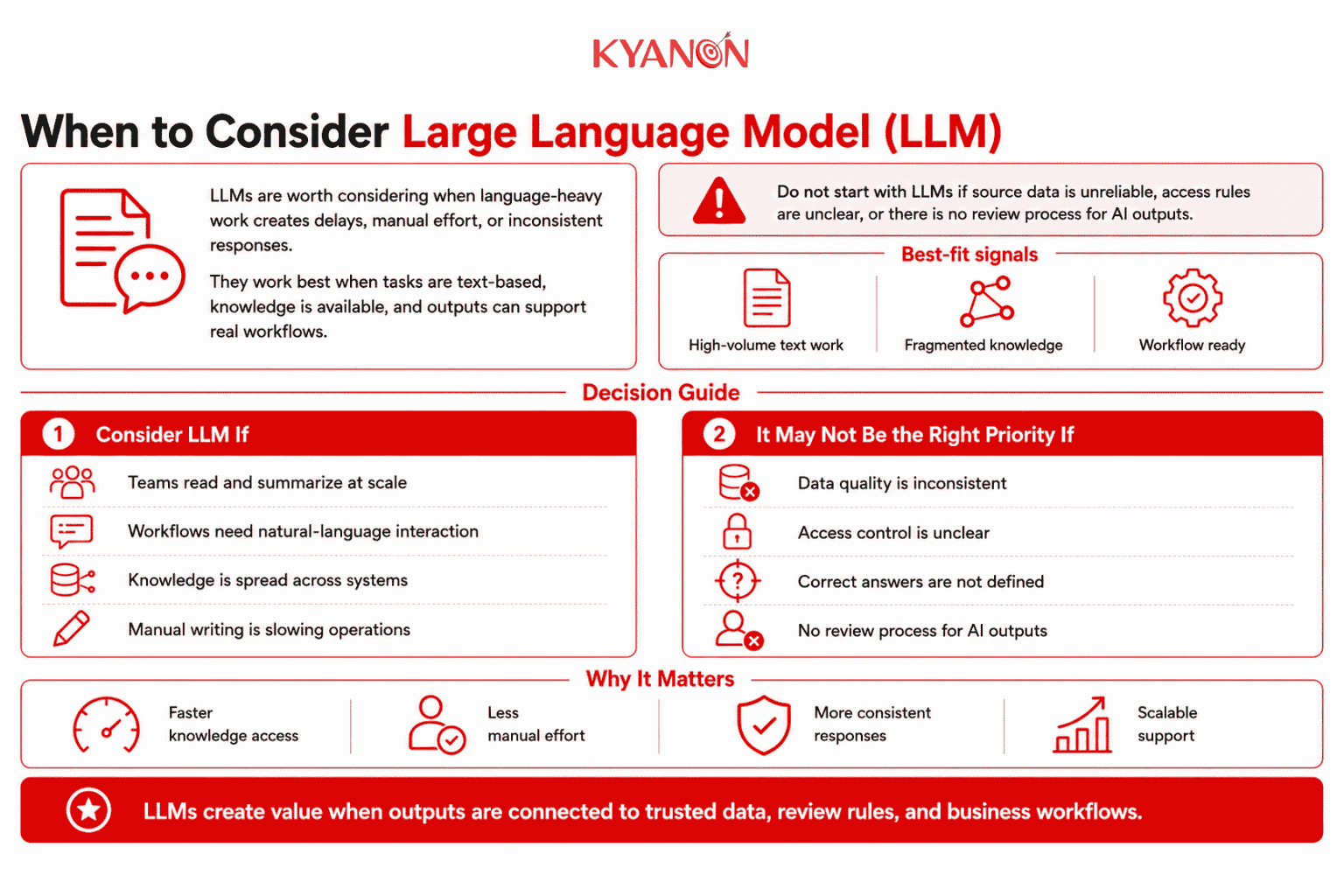
Consider Large Language Model (LLM) if:
- Your teams spend significant time reading, summarizing, rewriting, or extracting information from documents, emails, tickets, product data, policies, or knowledge bases.
- Your customer, employee, or partner workflows require natural-language interaction across multiple systems, not just static FAQ retrieval.
- Your enterprise already has valuable internal knowledge, but it is fragmented across documents, platforms, departments, or markets.
It may not be the right priority if:
Your source data is unreliable, access control is unclear, or business owners cannot define what a correct answer should look like. In that case, data readiness, process design, and governance should come before LLM deployment.
Why Large Language Models Matter for Enterprise AI
Large Language Models matter because they allow enterprises to apply AI to language-heavy workflows such as customer support, internal search, content operations, software development, document review, and decision support.
- According to McKinsey 2025, 78% of surveyed organizations use AI in at least one business function, showing that AI adoption is moving from experimentation into operating models.
- Stanford AI Index 2025 reported that 78% of organizations used AI in 2024, up from 55% the previous year, indicating faster enterprise adoption across industries.
- IBM 2025 found that only 52% of CEOs say their generative AI investments are delivering value beyond cost reduction, which shows why LLM projects need measurable workflow design, data readiness, and governance.
Common Misconceptions
“An LLM is a knowledge base.”
Reality: An LLM is not a verified enterprise knowledge base. It predicts language and must be connected to trusted data sources, retrieval workflows, permissions, and validation before supporting business decisions.
“The biggest model is always the best model.”
Reality: The largest model is not always the best enterprise choice. Smaller or domain-specific models may perform better when latency, cost, privacy, and workflow fit matter more than general capability.
“If the answer sounds confident, it is correct.”
Reality: Fluent writing is not proof of factual accuracy. Enterprise teams should evaluate LLM outputs against approved sources, business rules, and human review standards.
How Kyanon Digital Applies Large Language Model (LLM)
Kyanon Digital applies Large Language Models through its GenAI service line by helping enterprise clients select models, design RAG systems, fine-tune domain-specific workflows, validate outputs, and integrate LLMs into production business systems.
Kyanon Digital’s approach focuses on implementation readiness: connecting LLMs to enterprise data, governance rules, workflow logic, and measurable outcomes such as faster time-to-market, lower TCO, improved customer experience, and higher operational efficiency.
→ Explore our GenAI implementation services for enterprise LLM workflows.

 Create project brief with AI