
What is Explainable AI?
Explainable AI (XAI) is a set of frameworks, methodologies, and techniques designed to make the decision-making processes of artificial intelligence and machine learning models transparent, auditable, and understandable to human stakeholders. It helps organizations understand the reasoning behind algorithmic outputs, enabling users to see how specific inputs contributed to a particular prediction, recommendation, or decision.
Rather than being a single technology, Explainable AI is an umbrella term that encompasses a range of approaches aimed at improving the transparency and interpretability of AI systems. It serves as a bridge between complex computational models and human understanding, translating abstract mathematical relationships into explanations that business users, analysts, regulators, and decision-makers can evaluate and trust.
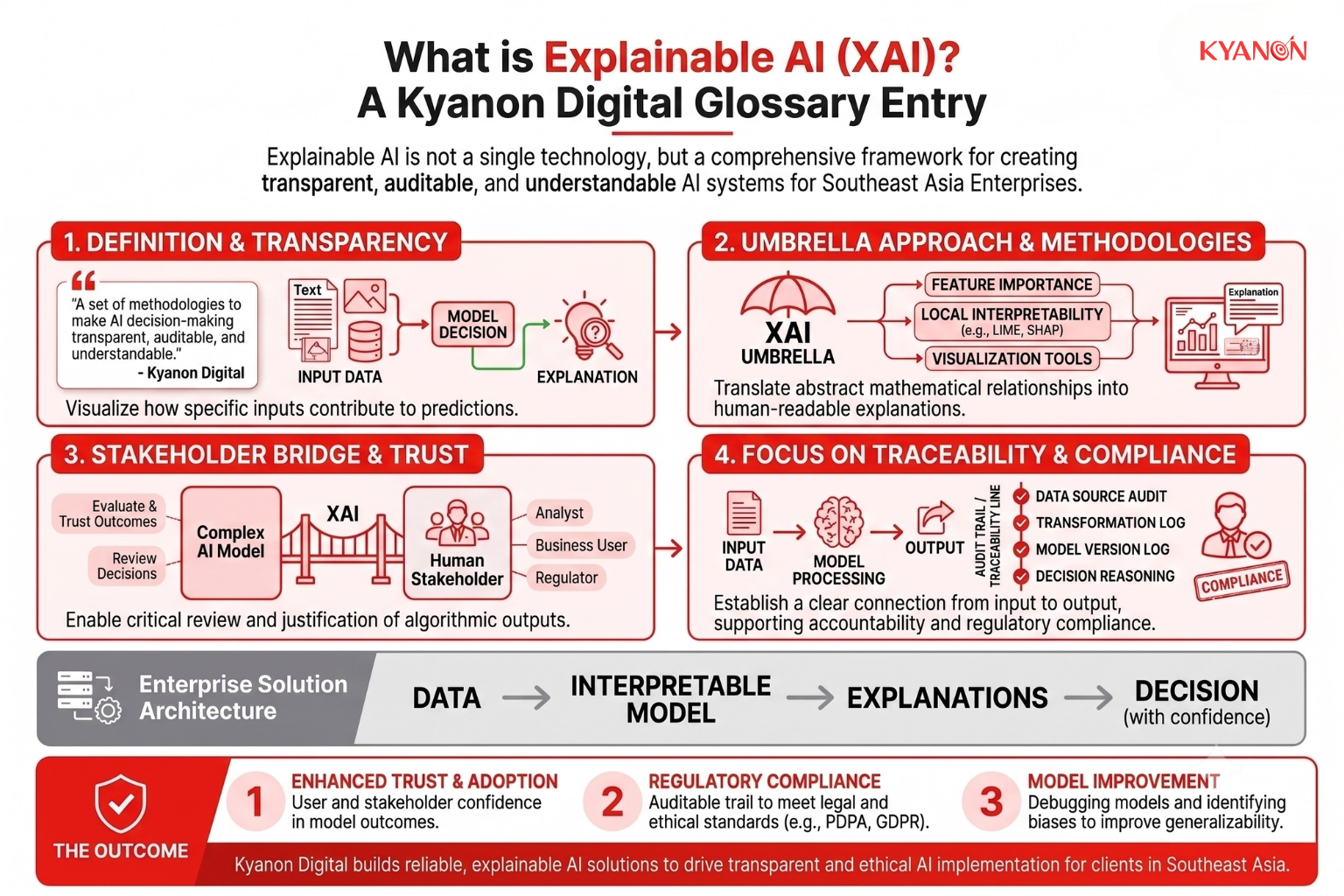
A defining characteristic of XAI is its focus on traceability. By providing visibility into the factors that influence an outcome, Explainable AI allows organizations to establish a clear connection between input data and model outputs. This makes AI-driven decisions easier to review, justify, and audit, particularly in environments where accountability and regulatory compliance are critical.
How Explainable AI Works
Explainable AI (XAI) bridges the gap between complex machine learning computations and human understanding by transforming model behavior into transparent, interpretable explanations. Rather than modifying how an AI model makes predictions, XAI operates as an observational layer that analyzes decision pathways, feature contributions, and statistical relationships to reveal why a particular outcome was generated.
At a high level, XAI works by examining how changes in input data affect model outputs, identifying the variables that have the greatest influence on predictions, and translating these findings into formats that humans can understand and evaluate. This process enables organizations to audit AI systems, validate decision quality, and establish clear traceability between inputs and outputs.

Post-Hoc Explanation Methods
Post-hoc explanation techniques analyze a machine learning model after training has been completed. These methods leave the original model entirely unchanged and instead function as external interpreters that investigate how the model behaves.
Frameworks such as SHAP (SHapley Additive exPlanations) and LIME (Local Interpretable Model-agnostic Explanations) generate explanations by systematically altering, masking, or removing portions of the input data and then observing how the prediction changes. By measuring the impact of these small perturbations, the XAI layer can determine which variables contribute most significantly to a decision.
LIME focuses on explaining a single prediction by constructing a simplified local approximation of the model around a specific data point. SHAP takes a broader mathematical approach based on cooperative game theory, assigning contribution scores to each feature and quantifying how much each variable influenced the final prediction. Together, these techniques help organizations audit complex “black box” systems without requiring modifications to the underlying algorithms.
Inherently Interpretable Models
Some AI systems are designed to be transparent from the outset, eliminating the need for external explanation layers. These inherently interpretable, or “glass box,” models expose their decision logic directly through their structure and mathematical formulation.
For example, decision trees provide a visible sequence of if-then rules that users can follow from input to outcome. Linear and logistic regression models explicitly show how each variable influences a prediction through fixed coefficients. Generalized Additive Models (GAMs) extend this approach by isolating the contribution of individual variables while maintaining greater predictive flexibility than traditional linear models.
Because the internal logic of these architectures is inherently visible, stakeholders can inspect decision pathways directly rather than relying on post-hoc interpretation techniques.
Role-Specific Interfaces
The outputs generated by explanation methods often consist of complex attribution scores, statistical weightings, and mathematical relationships that may not be meaningful to all audiences. Role-specific interfaces serve as a translation layer, converting technical explanation data into formats tailored to different stakeholders.
For data scientists, XAI platforms may provide feature importance rankings, attribution scores, dependency plots, and diagnostic visualizations that support model debugging and performance analysis. Compliance and risk teams may receive audit reports, bias assessments, and governance documentation designed to demonstrate regulatory compliance and decision traceability. End users typically see simplified explanations presented in natural language, helping them understand the primary factors that influenced an automated decision without requiring technical expertise.
By adapting explanations to the needs of different audiences, role-specific interfaces ensure that AI decisions remain transparent, actionable, and understandable across the organization.

Explainable AI vs Deep Learning
Both Explainable AI (XAI) and Deep Learning play important roles in modern enterprise AI, but they are designed to solve different challenges. Deep learning prioritizes predictive performance and pattern recognition at scale, while Explainable AI focuses on transparency, accountability, and human understanding of model decisions.
Dimension | Explainable AI (XAI) | Deep Learning (Black Box) |
| Operational transparency | High | Low |
Primary architectural objective | Auditability and trust | Maximum predictive accuracy |
| Regulatory compliance | Easy to document and validate | Difficult to prove logically |
Typical enterprise use case | Credit scoring, medical diagnosis | Computer vision, NLP generation |
| Computational overhead | Requires interpretation processing layer | Streamlined execution pipeline |
The primary trade-off is transparency versus complexity. Deep learning models excel at identifying patterns in large datasets but often operate as “black boxes” with limited visibility into their decision-making process. Explainable AI adds the transparency needed to validate outcomes, build stakeholder trust, and support governance requirements, making it particularly valuable in high-risk and highly regulated industries.
When to Consider Explainable AI
Consider Explainable AI if:
- Your organization operates in heavily regulated sectors like banking or insurance where documenting the rationale behind automated decisions is a strict legal requirement.
- Your business stakeholders are rejecting AI-driven recommendations because they lack visibility into how the system formulates its outputs and assesses risk.
- Your technical team is deploying models that dictate customer access to critical services (e.g., loan approvals, premium pricing) and must actively monitor for algorithmic bias.
It may not be the right priority if:
- Your product relies on low-risk automation tasks, such as internal document tagging or basic product recommendations, where the cost of an incorrect prediction is minimal and execution latency is the primary metric.
Why Explainable AI Matters for Financial Services
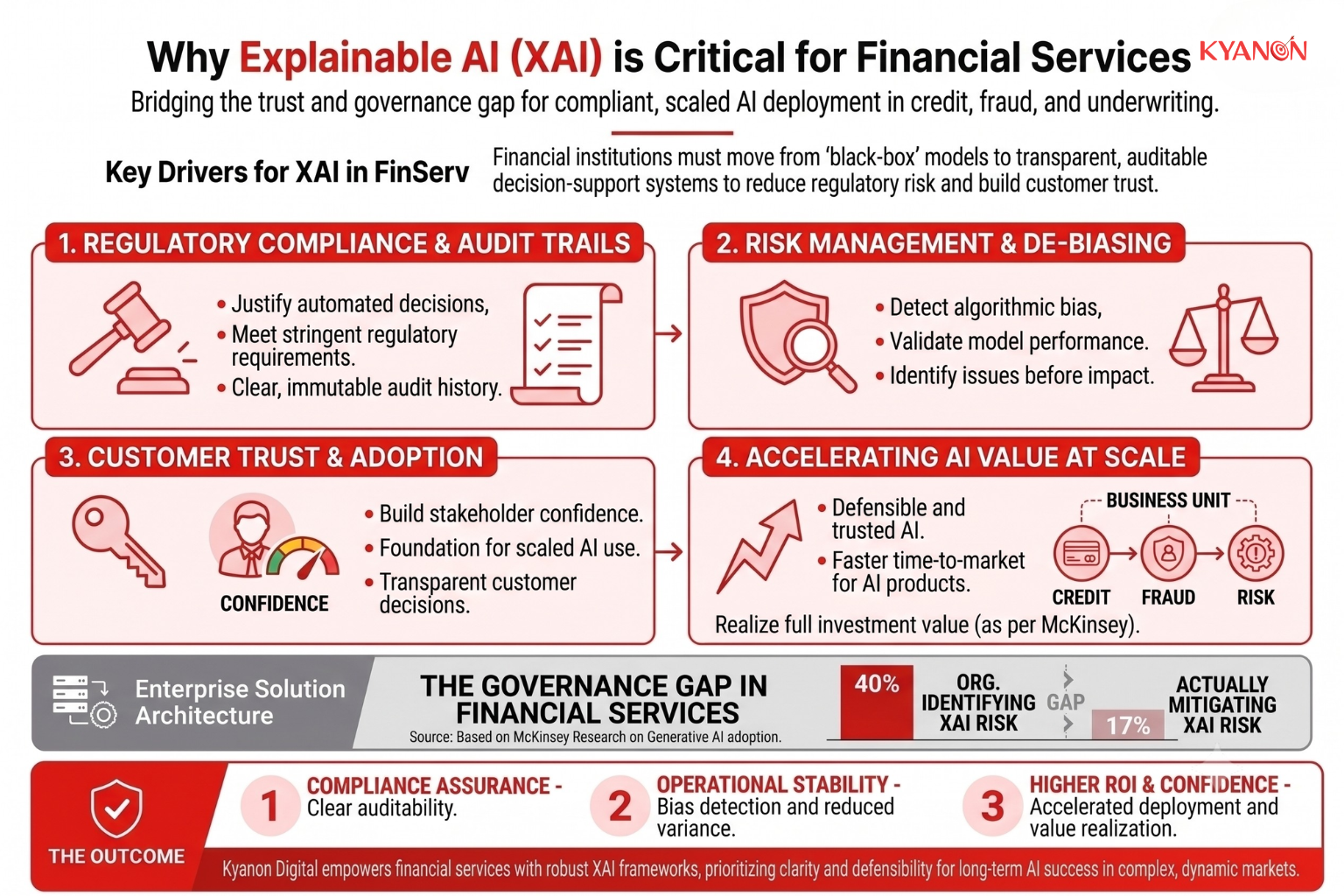
Financial institutions cannot rely on AI-driven decisions without understanding and documenting how those decisions are made. Because AI is increasingly used for credit scoring, fraud detection, underwriting, and risk assessment, transparency has become essential for regulatory compliance, governance, and customer trust.
Explainable AI provides clear audit trails that show which factors influenced a model’s prediction, helping organizations justify automated decisions and demonstrate compliance with regulatory requirements. This visibility also enables risk teams to detect bias, validate model performance, and identify potential issues before they affect business operations.
The business case for explainability extends beyond compliance. Trust is the foundation of AI adoption, and organizations that cannot explain AI outputs often struggle to scale AI initiatives across critical workflows. McKinsey’s research found that 40% of organizations identify explainability as a key risk in generative AI adoption, yet only 17% are actively working to mitigate it, highlighting a significant governance gap.
For financial services organizations, Explainable AI helps transform AI from a black-box experiment into a trusted decision-support system. By making model decisions understandable, auditable, and defensible, institutions can reduce regulatory risk, strengthen governance, increase stakeholder confidence, and accelerate the deployment of AI across mission-critical business functions. As McKinsey notes, AI trust is increasingly a foundational requirement for realizing value from AI investments at scale.
Common Misconceptions
Explainable Means the Model is Fair and Accurate
An explanation simply describes how a model works; it does not correct underlying mathematical or data flaws. A model can perfectly explain a heavily biased or incorrect decision, meaning XAI must be used to audit and detect bias actively, rather than functioning as a rubber stamp for systemic safety.
You Must Sacrifice Accuracy for Explainability
Organizations do not have to choose between a highly accurate “black box” and a weak, interpretable model. Modern tools can explain complex models post-hoc, and inherently interpretable models can match deep learning performance on tabular data, allowing teams to pick the best model for the data without sacrificing transparency.
How Kyanon Digital Applies Explainable AI
Kyanon Digital builds Explainable AI components into enterprise AI solutions for regulated clients in banking and finance who must demonstrate model transparency for strict compliance standards. Our approach focuses on embedding interpretable frameworks directly into the MLOps pipeline, ensuring that both engineering teams and compliance officers have real-time, role-based visibility into algorithmic logic, feature importance, and bias detection without degrading system performance.

Our approach combines interpretable modeling techniques, post-hoc explanation frameworks, and MLOps governance practices to provide real-time visibility into model behavior. This enables engineering teams, risk managers, and compliance stakeholders to understand feature importance, monitor model decisions, detect potential bias, and maintain clear audit trails throughout the deployment lifecycle.
By incorporating Explainable AI into production environments, Kyanon Digital helps organizations strengthen regulatory compliance, improve stakeholder trust, and accelerate AI adoption while ensuring that automated decisions remain transparent, defensible, and aligned with business objectives.
→ Explore our Artificial Intelligence services.

 Create project brief with AI