
What is marketplace architecture?
Marketplace architecture is the technical and operating structure that connects buyers, sellers, catalogs, orders, payments, commissions, payouts, fulfillment, and platform administration within a multi-vendor commerce system.
Unlike a conventional eCommerce store operated by one merchant, a marketplace allows multiple independent sellers to offer products or services to a shared customer base under rules defined by the marketplace operator.
How marketplace architecture works
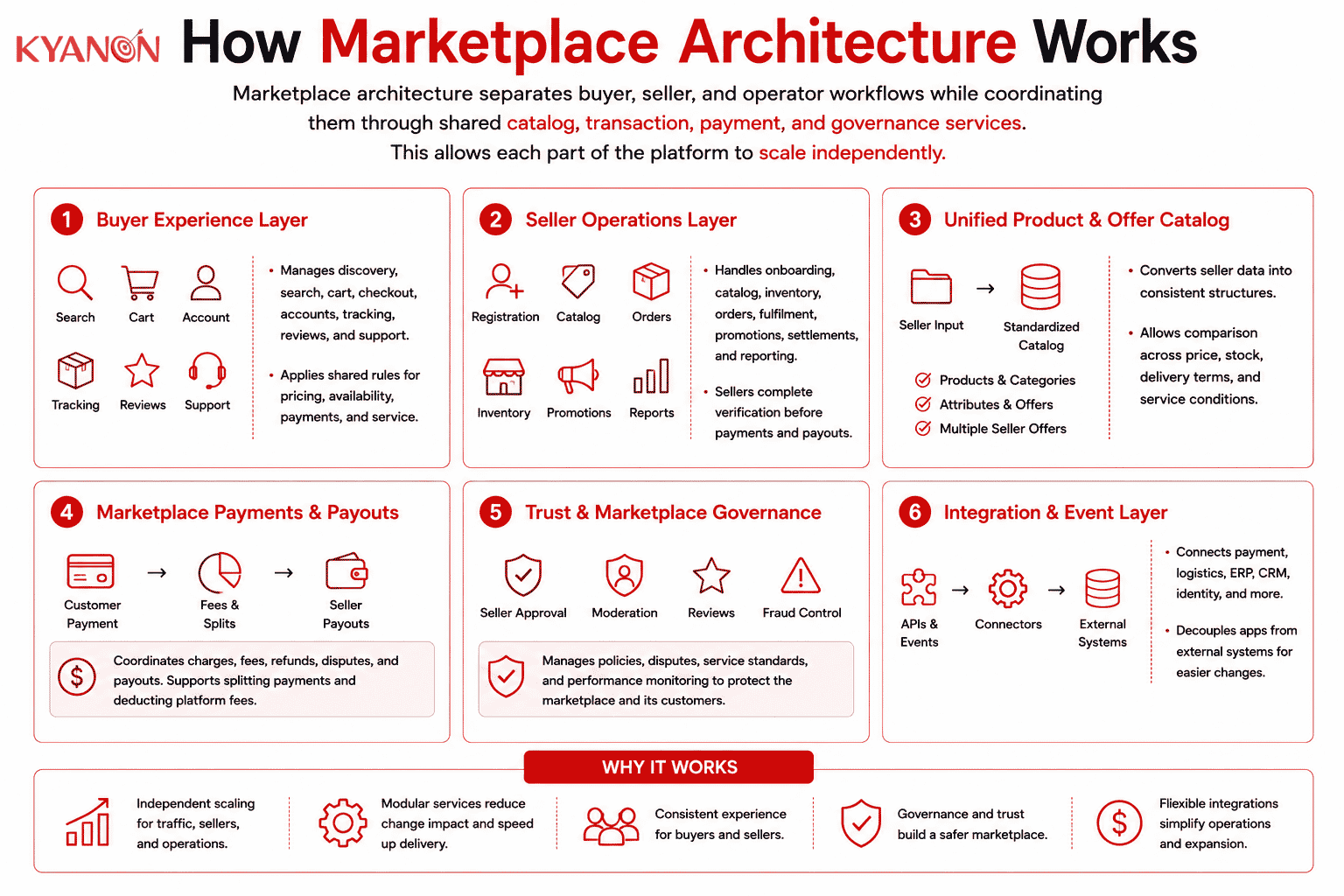
Marketplace architecture is effective because it separates buyer, seller, and operator workflows while coordinating them through shared catalog, transaction, payment, and governance services.
This separation allows customer traffic, seller operations, and back-office processes to scale according to their own workloads without requiring every part of the platform to change together.
Buyer experience layer
The buyer-facing layer manages product discovery, search, comparison, cart, checkout, customer accounts, order tracking, reviews, and support.
It presents products from multiple sellers through one customer journey while applying shared marketplace rules for pricing, availability, payments, and service.
Seller operations layer
The seller layer manages registration, onboarding, business verification, catalog uploads, inventory, orders, fulfillment, promotions, settlements, and performance reporting.
Identity and business verification may be handled through marketplace workflows or payment-platform onboarding. Adyen, for example, requires marketplace users to complete verification before they can process payments or receive payouts.
Unified product and offer catalog
The catalog layer converts seller submissions into consistent product, category, attribute, and offer structures.
This distinction matters because several sellers may offer the same underlying product at different prices, stock levels, delivery terms, or service conditions. Standardized data allows the marketplace to provide useful search, comparison, filtering, and merchandising.
Marketplace payments and payouts
The payment layer coordinates customer charges, platform fees, seller balances, refunds, disputes, and payouts.
Stripe Connect supports splitting one customer payment across multiple connected accounts and allows marketplaces to deduct application fees. Adyen similarly supports dividing payments between marketplace and seller balance accounts.
Trust and marketplace governance
The governance layer manages seller approval, product moderation, permissions, reviews, fraud controls, disputes, service standards, and seller performance monitoring.
These controls protect the marketplace from treating every seller, product, or transaction as equally trustworthy. Human review remains necessary for policy exceptions and disputes that cannot be resolved through predefined rules.
Integration and event layer
APIs and business events connect the marketplace with payment, logistics, warehouse, ERP, CRM, customer service, identity, and marketing systems.
The integration layer also prevents buyer, seller, and operator applications from depending directly on every external system, making connectors easier to monitor, replace, or extend.

Should marketplace architecture use MACH principles?
Marketplace architecture can use MACH principles, microservices, API-first, cloud-native SaaS, and headless delivery when modular scaling and independent capability changes justify the added integration complexity.
A composable marketplace can isolate capabilities such as catalog, search, seller onboarding, orders, payments, and promotions so they can scale or change independently. However, MACH is not mandatory for every marketplace; an early-stage or operationally simple platform may achieve faster time-to-market with a modular monolith or packaged marketplace product.
The architecture decision should follow transaction complexity, seller scale, integration requirements, team capability, and total cost of ownership, not the assumption that every enterprise marketplace must use microservices.
Marketplace architecture vs. vendor management portal
Marketplace architecture operates the full multi-sided commerce ecosystem, while a vendor management portal provides sellers with an interface for managing their participation in that ecosystem.
| Dimension | Marketplace architecture | Vendor management portal |
Primary scope | Entire buyer, seller, operator, transaction, and integration environment | Seller-facing administration and workflows |
| Primary users | Buyers, sellers, operators, service teams, and partners | Sellers, suppliers, and marketplace administrators |
Catalog role | Defines shared product, offer, category, and search structures | Lets sellers submit and maintain catalog information |
| Order role | Splits, routes, tracks, and coordinates multi-seller orders | Lets sellers accept, process, and update assigned orders |
Payment role | Manages payment flows, fees, refunds, balances, and payouts | Displays settlements, revenue, and payout history |
| Monetization role | Supports transaction fees, subscriptions, and other platform charges | Displays or administers fees configured by the platform |
Integration scope | Connects payments, logistics, ERP, CRM, OMS, and external services | Connects sellers to functions exposed by the marketplace |
| Governance role | Enforces platform-wide rules, security, policies, and dispute handling | Enforces permissions and workflows for individual sellers |
Best fit | Building or modernizing a complete multi-vendor platform | Improving seller onboarding and daily seller operations |
A vendor portal is one component of marketplace architecture; it cannot independently provide buyer checkout, payment orchestration, order splitting, or marketplace-wide governance.
When to consider marketplace architecture
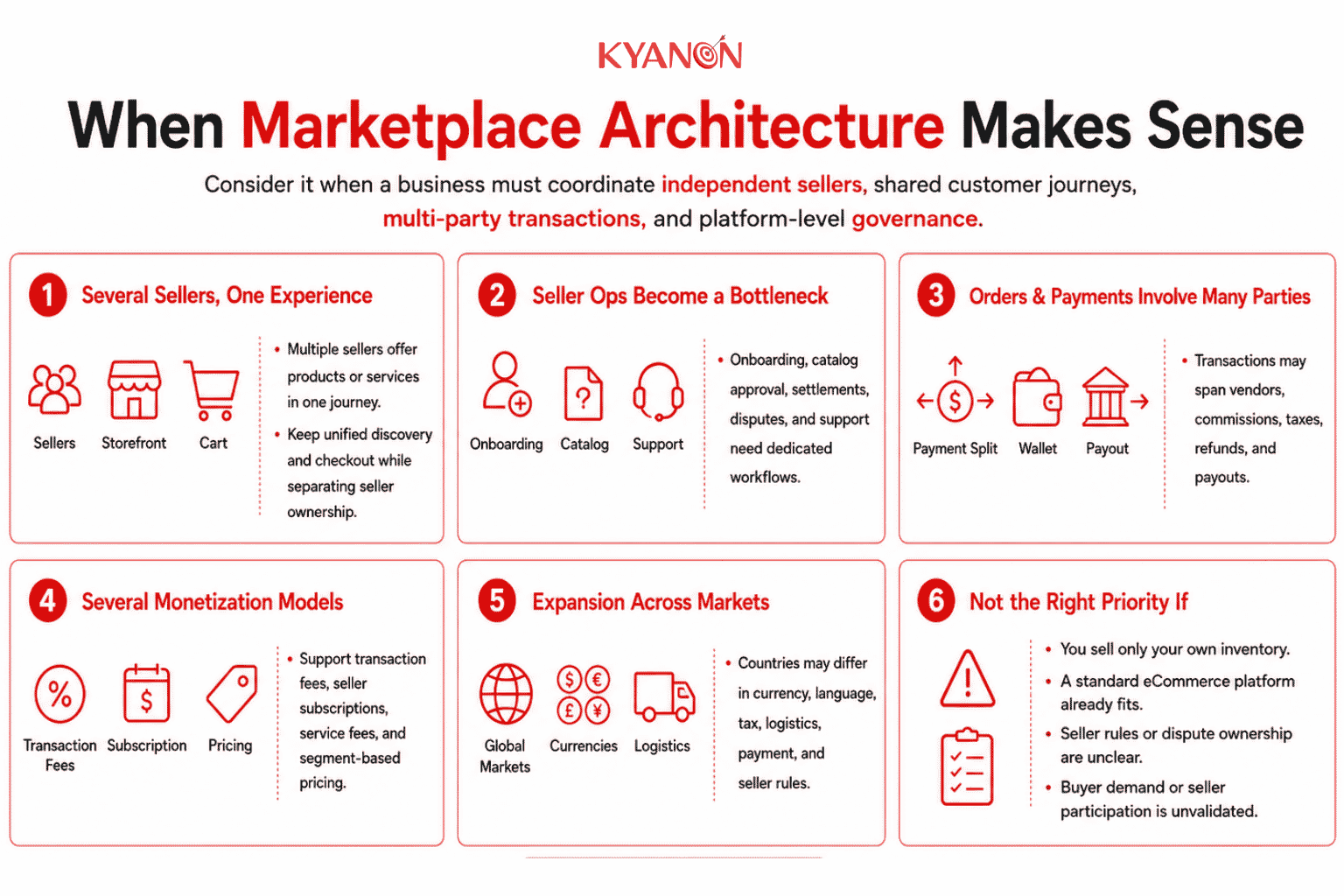
Marketplace architecture should be considered when a business must coordinate independent sellers, shared customer journeys, multi-party transactions, and platform-level governance.
Consider marketplace architecture if:
- Several sellers offer products or services through one customer experience. The platform must separate seller ownership while maintaining unified discovery and checkout.
- Seller operations are becoming a bottleneck. Onboarding, catalog approval, settlements, disputes, and support require dedicated workflows.
- Orders or payments involve multiple parties. Transactions may need to be divided across vendors, commissions, taxes, refunds, and payouts.
- The business needs several monetization models. The operator may require transaction fees, seller subscriptions, service fees, or different pricing rules by seller segment.
- The platform must expand across markets. Currency, language, tax, logistics, payment, and seller requirements differ by country.
It may not be the right priority if:
- The business sells only its own inventory.
- A standard eCommerce platform already supports the required workflows.
- Seller onboarding, commercial rules, and dispute ownership remain undefined.
- The organization has not validated buyer demand or seller participation.
Marketplace architecture should follow a validated multi-sided business model; architecture cannot compensate for weak buyer demand or an unclear seller proposition.
Why marketplace architecture matters for digital commerce
Marketplace architecture matters because adding sellers increases operational complexity across catalogs, orders, payments, fulfillment, customer service, and governance, not only website traffic.
The architecture must allow buyer-facing demand and seller-facing operations to grow independently while maintaining consistent rules and transaction records.
Case study: Seller center for a major Thai conglomerate

Challenges
- Seller operations were fragmented across separate systems.
- Manual onboarding slowed marketplace expansion.
- Catalog, order, payment, and fulfillment data lacked coordination.
- The platform needed to support rapid seller and transaction growth.
Solutions
- Delivered the initial MVP within three months.
- Centralized seller registration, product listings, orders, and payment tracking.
- Added multilingual and multi-currency capabilities.
- Integrated logistics, warehouse, payment, marketing, and customer-support systems.
- Expanded seller analytics, promotions, settlements, and payout management.
Results and impacts
- Created capacity for up to 100,000 sellers.
- Supported targets of 1 million products and 1 million orders.
- Accelerated seller onboarding and marketplace launch.
- Improved visibility across seller, catalog, order, and financial operations.
- Established an API-ready foundation for future marketplace expansion.
Read more: Seller Center For One Of Thailand’s Largest Conglomerates
Common misconceptions about marketplace architecture
Marketplace architecture is not defined by one mandatory technology pattern; its design should follow the platform’s transaction model, seller workflows, data access patterns, and scale requirements.
“Every marketplace needs database sharding from day one.”
Reality: A single relational database can support an early marketplace when transaction volume and operational complexity remain manageable.
Partitioning, caching, read replicas, queues, or purpose-built data stores should be introduced according to measured access patterns and workload constraints—not as automatic requirements. AWS recommends selecting data stores and scaling patterns according to availability, consistency, latency, durability, and query needs.
“Real-time inventory synchronization guarantees perfect availability.”
Reality: Inventory updates across sellers, stores, and external channels can be delayed or eventually consistent.
Marketplace architecture needs stock reservations, availability thresholds, cancellation rules, and exception workflows to manage mismatches. Commercetools documents inventory modes and reservation controls, while noting that some inventory updates use eventual consistency.
“A proprietary build is always better than packaged components.”
Reality: Building every capability from zero can increase delivery time, technical debt, and maintenance ownership.
Businesses can combine custom workflows with packaged payment, search, commerce, identity, or logistics services. The correct balance depends on differentiation, integration requirements, control, and total cost of ownership.
“Scalability only means handling more customers.”
Reality: A marketplace must also scale seller onboarding, catalog ingestion, order allocation, settlements, support, promotions, and disputes.
Stripe’s marketplace documentation treats connected-account creation, verification, payments, fees, payouts, refunds, and disputes as separate operating capabilities.
“One commission model is enough for every seller.”
Reality: Different seller groups may require different commercial arrangements based on category, service level, volume, or platform participation.
Stripe Connect supports application-fee and subscription-fee models, allowing platforms to configure different approaches to seller monetization when the business model requires them.
How Kyanon Digital applies marketplace architecture
Kyanon Digital designs and builds marketplace platforms for retail, B2B, aggregator, and multi-vendor commerce models.
Implementations can include:
- Buyer storefronts and mobile experiences
- Seller onboarding and verification
- Vendor management portals
- Product and offer catalogs
- Order allocation and fulfilment workflows
- Commission, settlement, and payout management
- Promotions and seller campaigns
- Returns, disputes, reviews, and customer support
- Multi-language and multi-currency capabilities
- Payment, logistics, warehouse, ERP, CRM, and marketing integrations
- Cloud-native, API-first, and modular architecture
- Marketplace analytics and seller-performance reporting
For one of Thailand’s largest conglomerates, Kyanon Digital delivered a seller operations platform through an MVP-to-MMP-to-MLP roadmap. The platform connected catalog, order, finance, fulfillment, customer service, promotion, and analytics functions within an API-driven architecture.
Kyanon Digital’s implementation approach focuses on workflow fit, seller adoption, integration ownership, transaction scale, time-to-market, and long-term TCO rather than selecting architecture patterns only for technical novelty.
→ Explore Kyanon Digital’s Omnichannel eCommerce Development Services.

 Create project brief with AI