
What is D2C (Direct-to-Consumer)?
D2C (Direct-to-Consumer) is a retail business model where manufacturers sell products directly to end customers, bypassing third-party distributors, wholesalers, and traditional brick-and-mortar retailers. By owning the entire transaction lifecycle, brands capture higher profit margins per unit and gain exclusive access to first-party behavioral data.
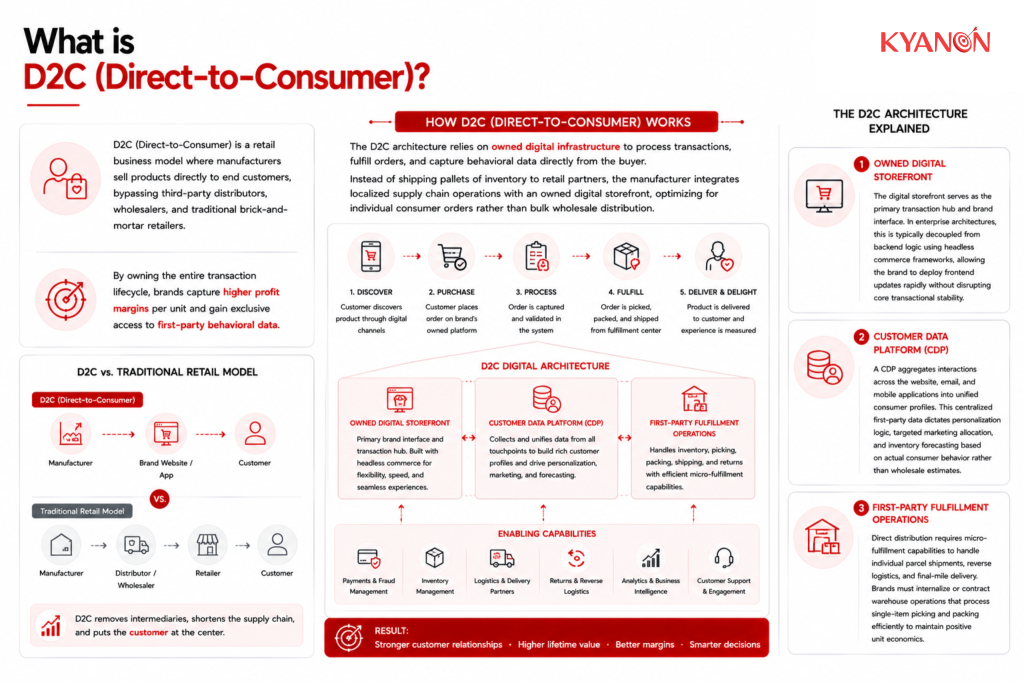
How D2C (Direct-to-Consumer) works
The D2C (Direct-to-Consumer) architecture relies on owned digital infrastructure to process transactions, fulfill orders, and capture behavioral data directly from the buyer. Instead of shipping pallets of inventory to retail partners, the manufacturer integrates localized supply chain operations with an owned digital storefront, optimizing for individual consumer orders rather than bulk wholesale distribution.
Owned digital storefront
The digital storefront serves as the primary transaction hub and brand interface. In enterprise architectures, this is typically decoupled from backend logic using headless commerce frameworks, allowing the brand to deploy frontend updates rapidly without disrupting core transactional stability.
Customer Data Platform (CDP)
A CDP aggregates interactions across the website, email, and mobile applications into unified consumer profiles. This centralized first-party data dictates personalization logic, targeted marketing allocation, and inventory forecasting based on actual consumer behavior rather than wholesale estimates.
First-party fulfillment operations
Direct distribution requires micro-fulfillment capabilities to handle individual parcel shipments, reverse logistics, and final-mile delivery. Brands must internalize or contract warehouse operations that process single-item picking and packing efficiently to maintain positive unit economics.

D2C vs Wholesale Retail
Both approaches distribute consumer goods to the mass market, but differ fundamentally in data ownership and operational overhead.
Dimension | D2C (Direct-to-Consumer) | Wholesale Retail |
| Customer data ownership | Complete (First-party access) | Low (Filtered through retailer) |
Margin structure | Retains full gross margin | Shares 40-50% with distributors |
| Upfront operational complexity | High | Low |
Go-to-market speed | Fast | Slow (Depends on buying cycles) |
| Brand control | Absolute | Relies on retailer execution |
When to consider D2C (Direct-to-Consumer)
Consider D2C (Direct-to-Consumer) if:
- Your product portfolio yields high purchase frequency and you need direct access to consumer buying patterns to optimize product iteration.
- Your current wholesale partnerships are compressing margins below profitability and restricting your ability to control pricing strategies.
- You plan to implement subscription-based revenue models within the next 12–18 months and require a centralized platform to manage recurring billing and fulfillment.
It may not be the right priority if:
- Your business relies exclusively on low-margin, high-volume commodity goods where individual shipping costs completely negate the retained retail markup.
Why D2C (Direct-to-Consumer) matters for Retail & FMCG
D2C enables brands to build direct relationships with consumers, gain greater control over the brand experience, and collect customer data that can inform product and marketing decisions. The model is also becoming increasingly important as businesses seek higher margins and closer customer relationships.
A 2025 McKinsey survey found that 86% of suppliers expected to increase D2C investments, while 72% expected D2C sales to grow by more than 25% over the following two years.
Common misconceptions
Eliminating retailers drastically lowers your expenses
Reality: Direct models often trade retail margins for marketing costs, as businesses absorb the expenses of warehousing, shipping, returns, and customer service. These operational line items rapidly consume the margin previously saved by bypassing traditional intermediaries.
Launching an online store means immediate, cheap sales
Reality: Customer Acquisition Cost (CAC) can easily break a business relying solely on paid Facebook, Instagram, or TikTok ads. Without high customer lifetime value (LTV) and organic community retention, escalating ad costs quickly drain cash flow.
Real D2C brands operate strictly online
Reality: Pure-play e-commerce is incredibly difficult to scale in isolation. Physical stores, wholesale partnerships, and pop-up shops are ultimately necessary to lower blended acquisition costs and achieve true mass-market scale.
D2C is just a modern distribution mechanism
Reality: True success requires optimizing for lifetime customer value through community and data, rather than treating the site as a cheap sales channel relying on heavy discounts. D2C requires an operational focus on building an actual brand to avoid creating throwaway products.
How Kyanon Digital applies D2C (Direct-to-Consumer)
Kyanon Digital architects D2C (Direct-to-Consumer) ecosystems using composable commerce frameworks for enterprise retail and FMCG clients across Southeast Asia and APAC. Our approach focuses on decoupling the frontend brand experience from backend fulfillment and CDP systems, reducing total cost of ownership (TCO) while ensuring the infrastructure scales linearly with customer acquisition efforts.
Explore our services:

 Create project brief with AI