
What is omnichannel commerce?
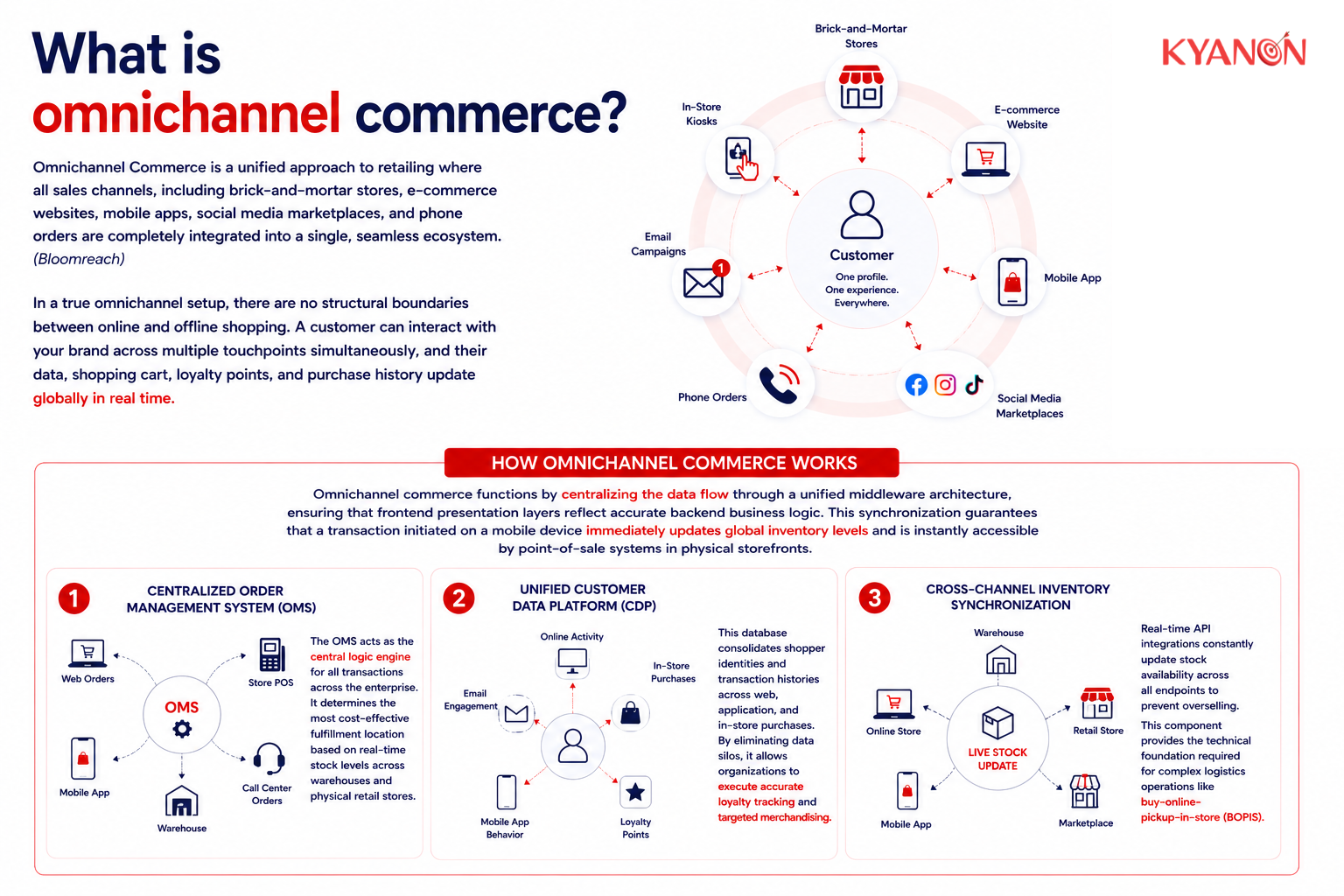
Omnichannel commerce is a unified approach to retailing where all sales channels, including brick-and-mortar stores, e-commerce websites, mobile apps, social media marketplaces, and phone orders are integrated into a unified retail architecture. This architecture enables every customer interaction, inventory update, and transaction to flow seamlessly across the business.
In a true omnichannel setup, there are no structural boundaries between online and offline shopping. A customer can interact with your brand across multiple touchpoints simultaneously, and their data, shopping cart, loyalty points, and purchase history update globally in real time.
How omnichannel commerce works
Omnichannel commerce functions through an integrated commerce infrastructure that centralizes data flow across ERP, POS, OMS, CDP, inventory, and eCommerce platforms. This unified middleware architecture ensures frontend experiences always reflect accurate backend business logic.
Centralized Order Management System (OMS)
The OMS acts as the central logic engine for all transactions across the enterprise. It determines the most cost-effective fulfillment location based on real-time stock levels across warehouses and physical retail stores.
Unified Customer Data Platform (CDP)
This database consolidates shopper identities and transaction histories across web, application, and in-store purchases. By eliminating data silos, it allows organizations to execute accurate loyalty tracking and targeted merchandising.
Cross-channel inventory synchronization
Real-time API integrations enable cross-channel integration, constantly updating stock availability across all sales and fulfillment endpoints to prevent overselling. This provides the technical foundation for BOPIS, BORIS, ship-from-store, and other omnichannel fulfillment models.

Omnichannel Commerce vs Multichannel Commerce
Both frameworks allow retail brands to sell across multiple touchpoints, but they differ fundamentally in backend data integration and inventory visibility.
Dimension | Omnichannel Commerce | Multichannel Commerce |
| Data architecture | Centralized (Unified database) | Siloed (Separate databases) |
Inventory visibility | Real-time global view | Channel-specific view |
| Customer identity | Single unified profile | Fragmented profiles |
Fulfillment logic | Cross-channel (BOPIS, BORIS) | Channel-restricted |
| Upfront complexity | High | Low |
When to consider omnichannel commerce
Evaluating an omnichannel strategy requires analyzing current backend operational constraints and cross-channel friction points.
Consider omnichannel commerce if:
- Your customer service agents cannot process returns for online purchases at physical store locations due to disconnected backend systems.
- Your fulfillment costs are rising because distribution centers ship items that are sitting unsold in a retail store much closer to the end consumer.
- You operate across multiple regions and require flexible, localized dynamic pricing strategies while maintaining centralized inventory control.
It may not be the right priority if:
- Your operation consists of a single digital storefront relying entirely on third-party dropshipping with no physical retail footprint or warehouse logistics.
Why omnichannel commerce matters for enterprise retail
Omnichannel commerce is critical for enterprise retail because it protects margins, maximizes inventory asset utilization, and drives exponentially higher Customer Lifetime Value (LTV).
At the enterprise level, operating siloed channels leads to massive inefficiencies. A unified retail architecture supported by cross-channel integration and an integrated commerce infrastructure transforms disconnected stores, warehouses, and digital channels into a single intelligent fulfillment network. The result is lower operating costs, higher inventory utilization, and stronger customer lifetime value.
Common misconceptions
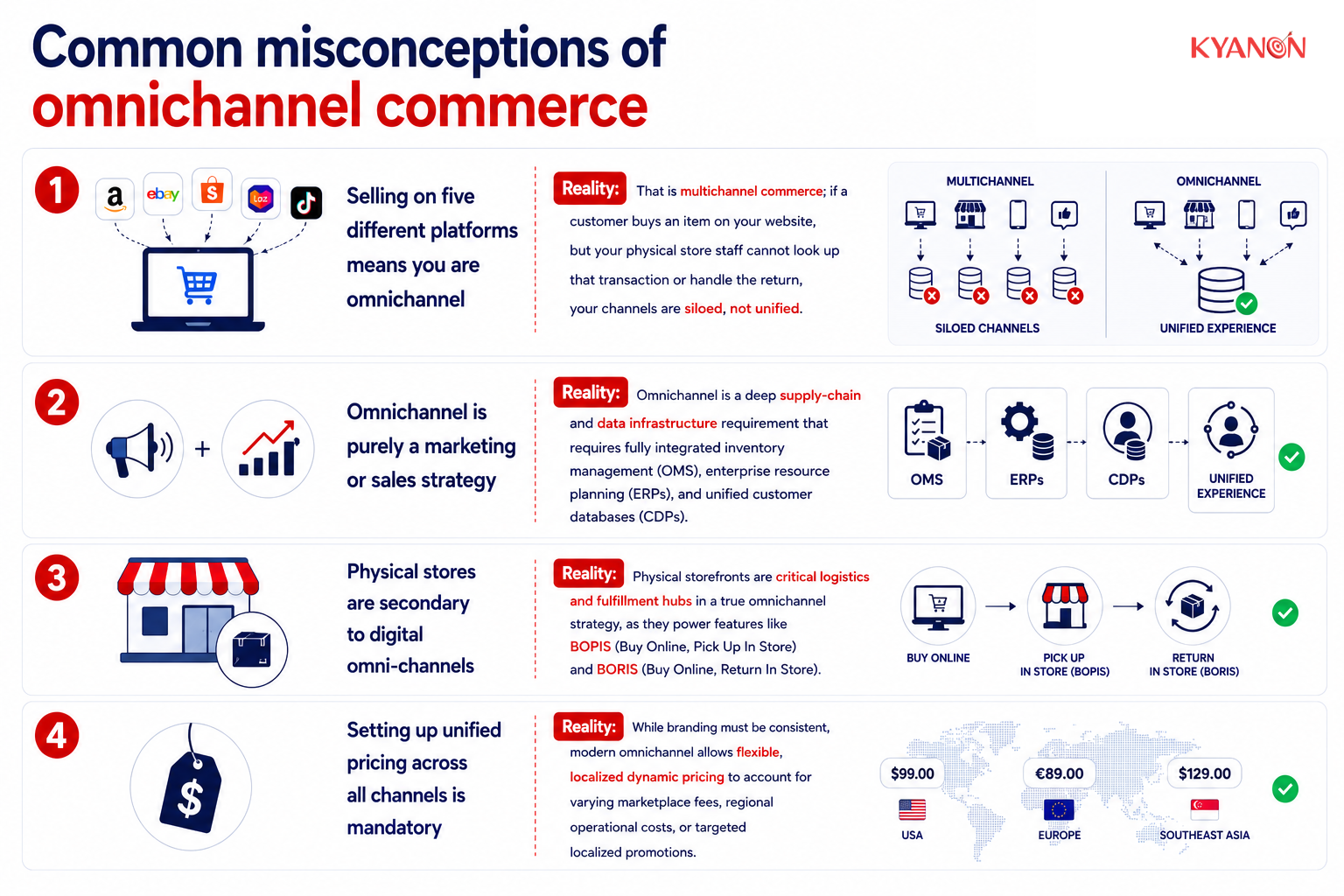
Selling on five different platforms means you are omnichannel
Reality: That is multichannel commerce; if a customer buys an item on your website, but your physical store staff cannot look up that transaction or handle the return, your channels are siloed, not unified.
Omnichannel is purely a marketing or sales strategy
Reality: Omnichannel is a deep supply-chain and data infrastructure requirement that requires fully integrated inventory management (OMS), enterprise resource planning (ERPs), and unified customer databases (CDPs).
Physical stores are secondary to digital omni-channels
Reality: Physical storefronts are critical logistics and fulfillment hubs in a true omnichannel strategy, as they power features like BOPIS (Buy Online, Pick Up In Store) and BORIS (Buy Online, Return In Store).
Setting up unified pricing across all channels is mandatory
Reality: While branding must be consistent, modern omnichannel allows flexible, localized dynamic pricing to account for varying marketplace fees, regional operational costs, or targeted localized promotions.
How Kyanon Digital applies omnichannel commerce
Kyanon Digital designs and implements unified retail architecture by connecting ERP, POS, OMS, CDP, inventory, and digital commerce platforms into an integrated commerce infrastructure. Through robust cross-channel integration, we enable real-time inventory visibility, unified customer profiles, and seamless fulfillment across physical stores, eCommerce websites, mobile apps, and marketplaces.
This approach accelerates time-to-market while reducing operational complexity for enterprise retailers across Vietnam, Singapore, Malaysia, and ANZ.
Explore our services:

 Create project brief with AI