
What is dynamic pricing?
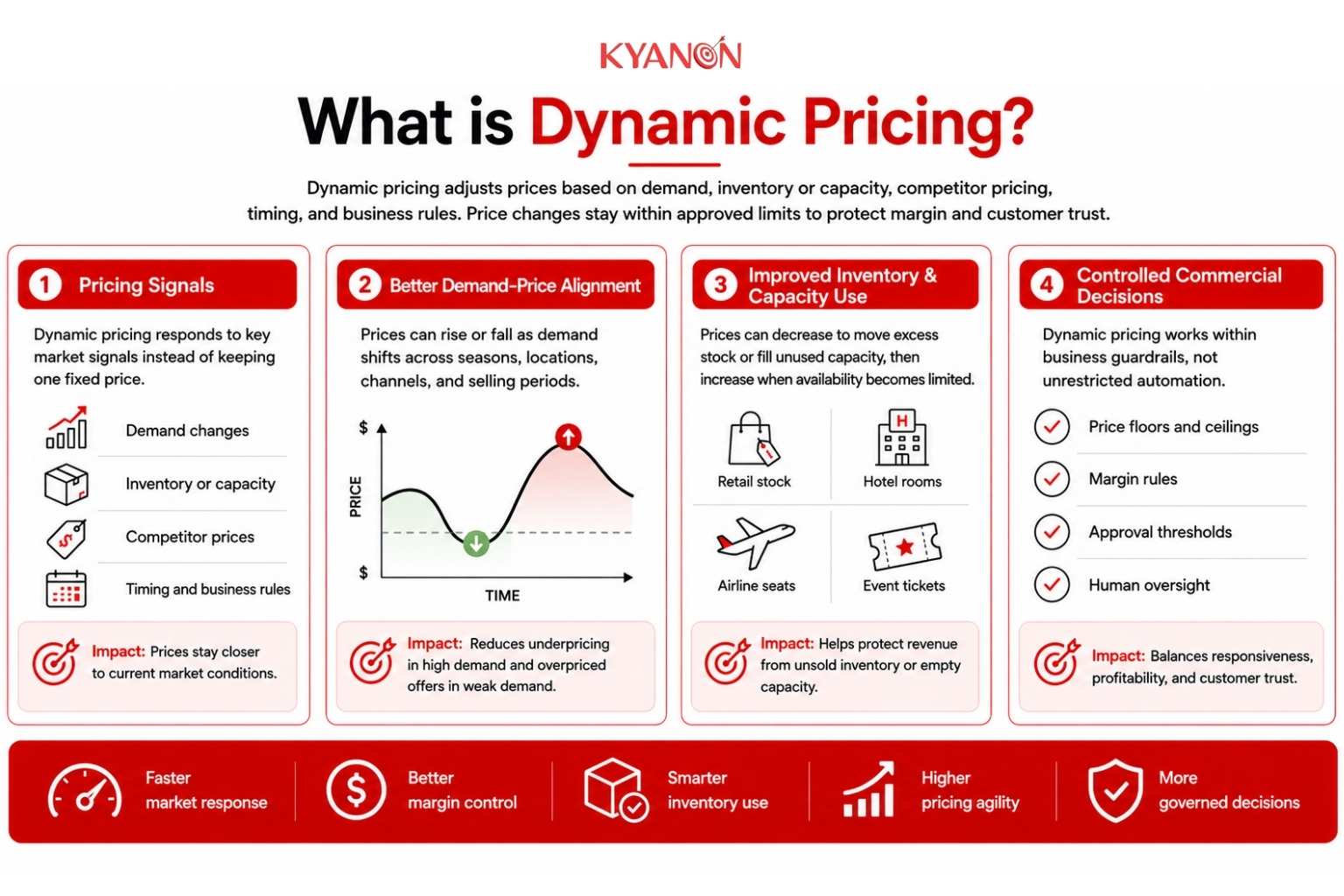
Dynamic pricing is a pricing method that adjusts the price of a product or service according to changes in demand, inventory, capacity, competition, timing, and predefined business rules.
Prices can increase or decrease, depending on the commercial objective and the limits established by the business.
How dynamic pricing works
Dynamic pricing works because a fixed price can quickly become misaligned with changes in demand, inventory, competition, and time. By adjusting prices within predefined limits, businesses can respond to current market conditions while protecting margin, conversion, and customer trust.
Better demand–price alignment
Dynamic pricing reflects how customer demand changes across seasons, locations, channels, and selling periods. This reduces the risk of underpricing high-demand products or keeping prices too high when demand weakens.
Improved inventory and capacity use
Prices can decrease to move excess inventory or fill unused capacity, then increase when availability becomes limited. This is especially relevant for retail stock, hotel rooms, airline seats, and event tickets that lose value when left unsold.
Controlled commercial decisions
Dynamic pricing does not give an algorithm unrestricted control. Price floors, ceilings, margin rules, approval thresholds, and human oversight keep recommendations aligned with business objectives and customer expectations.

Main types of dynamic pricing
Dynamic pricing models differ according to the condition that triggers a price change.
| Type | How it works | Example |
Surge pricing | Prices rise when demand exceeds available supply. | Ride fares during rush hour |
| Time-based pricing | Prices change by hour, day, season, or purchase timing. | Off-peak electricity rates |
Inventory-based pricing | Prices respond to remaining stock or capacity. | Airline seats and hotel rooms |
| Competitor-based pricing | Prices change when competing offers move. | Marketplace product pricing |
Demand-based pricing | Prices respond to predicted demand or booking pace. | Event tickets |
Segmented pricing is not automatically dynamic pricing. A permanent student discount is segmented pricing, while a loyalty offer that changes according to inventory or timing can be both segmented and dynamic.
Common dynamic pricing examples
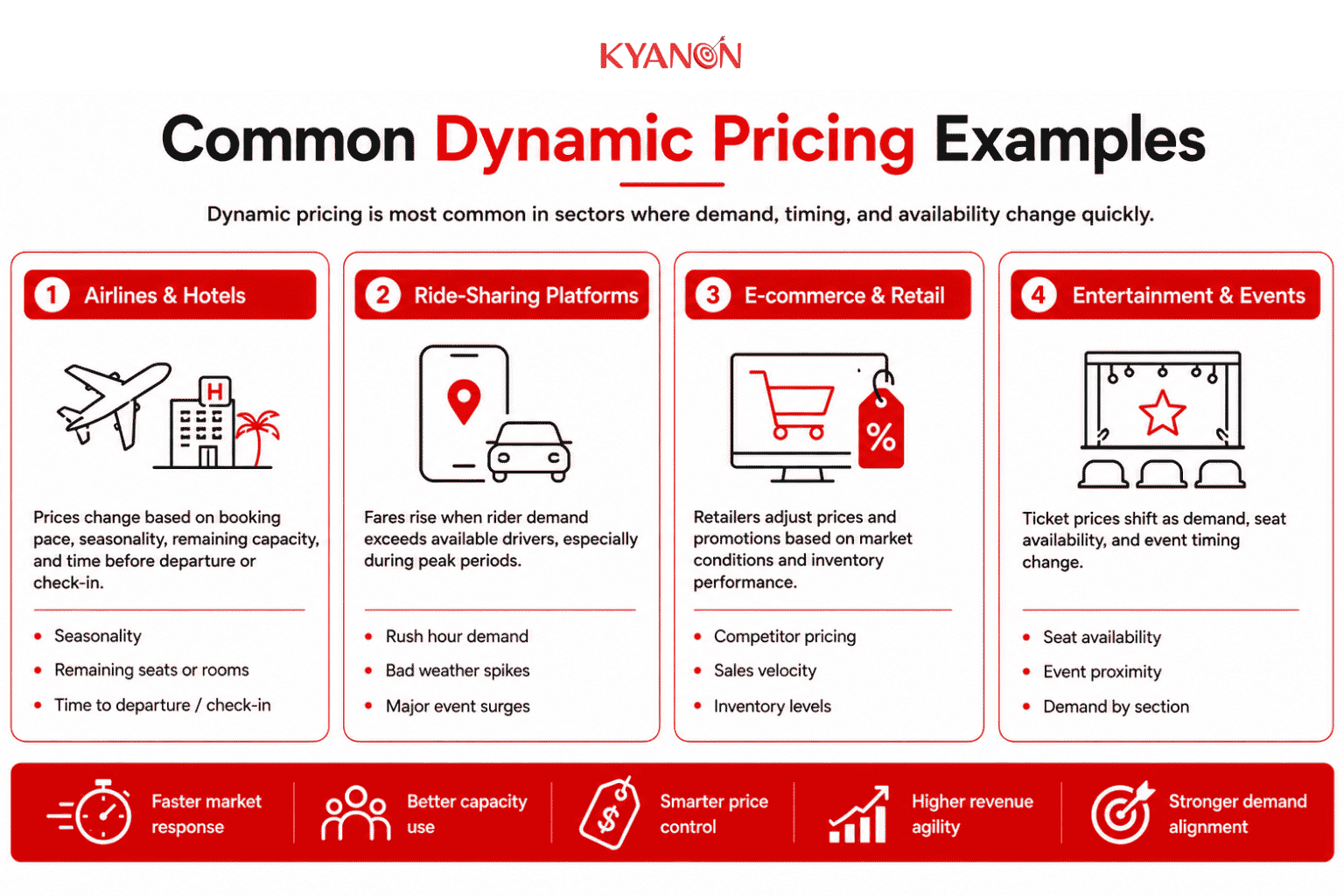
Dynamic pricing is commonly used where demand or availability changes frequently.
Airlines and hotels
Ticket and room prices can change according to seasonality, booking pace, remaining capacity, and time before departure or check-in.
Ride-sharing platforms
Ride fares may increase when there are more passengers than available drivers, such as during rush hour, bad weather, or major events.
E-commerce and retail
Retailers can adjust prices and promotions according to competitor activity, sales velocity, inventory levels, and margin requirements.
Entertainment and events
Ticket prices can change according to demand, seat availability, location, and time remaining before the event.
Benefits and risks of dynamic pricing
Dynamic pricing can improve commercial responsiveness, but poor governance can damage margins and customer trust.
Area | Potential benefit | Potential risk |
Revenue | Captures changes in demand | Higher prices may reduce conversion |
| Margin | Protects profitability | Excessive discounts may erode margin |
Inventory | Moves excess or expiring stock | Weak signals may trigger unnecessary markdowns |
| Competition | Responds faster to market changes | Automated matching may create price wars |
Customer experience | Provides off-peak savings | Unexplained changes may appear unfair |
Dynamic pricing is most effective when businesses monitor revenue, margin, conversion, inventory movement, and customer response together rather than optimizing only one metric.
Dynamic pricing vs. yield management
Dynamic pricing changes the price offered to the market, while yield management controls how limited inventory or capacity is allocated across price classes, customer segments, and time periods.
The two approaches are often combined in airlines, hotels, mobility, entertainment, and other capacity-constrained industries, but they are not interchangeable.
Dimension | Dynamic pricing | Yield management |
Primary decision | What price should be offered now? | How should limited capacity be allocated? |
| Main objective | Balance demand, revenue, margin, conversion, or inventory movement | Maximize revenue from fixed or perishable capacity |
Core inputs | Demand, competitor prices, inventory, timing, elasticity, transactions | Capacity, booking pace, customer segments, cancellation patterns, time to expiry |
| Price structure | Prices may rise or fall based on current conditions | Inventory is assigned to predefined price classes or booking conditions |
Inventory requirement | Can be used with limited, replenishable, or excess inventory | Most relevant when capacity is fixed and loses value after a deadline |
| Common industries | Retail, e-commerce, marketplaces, mobility, travel, entertainment | Airlines, hotels, car rental, events, logistics |
Typical output | Recommended or automatically updated price | Capacity allocation and availability by rate class |
| Governance focus | Price floors, ceilings, frequency, fairness, and transparency | Overbooking, allocation limits, booking restrictions, and capacity utilization |
When to consider dynamic pricing
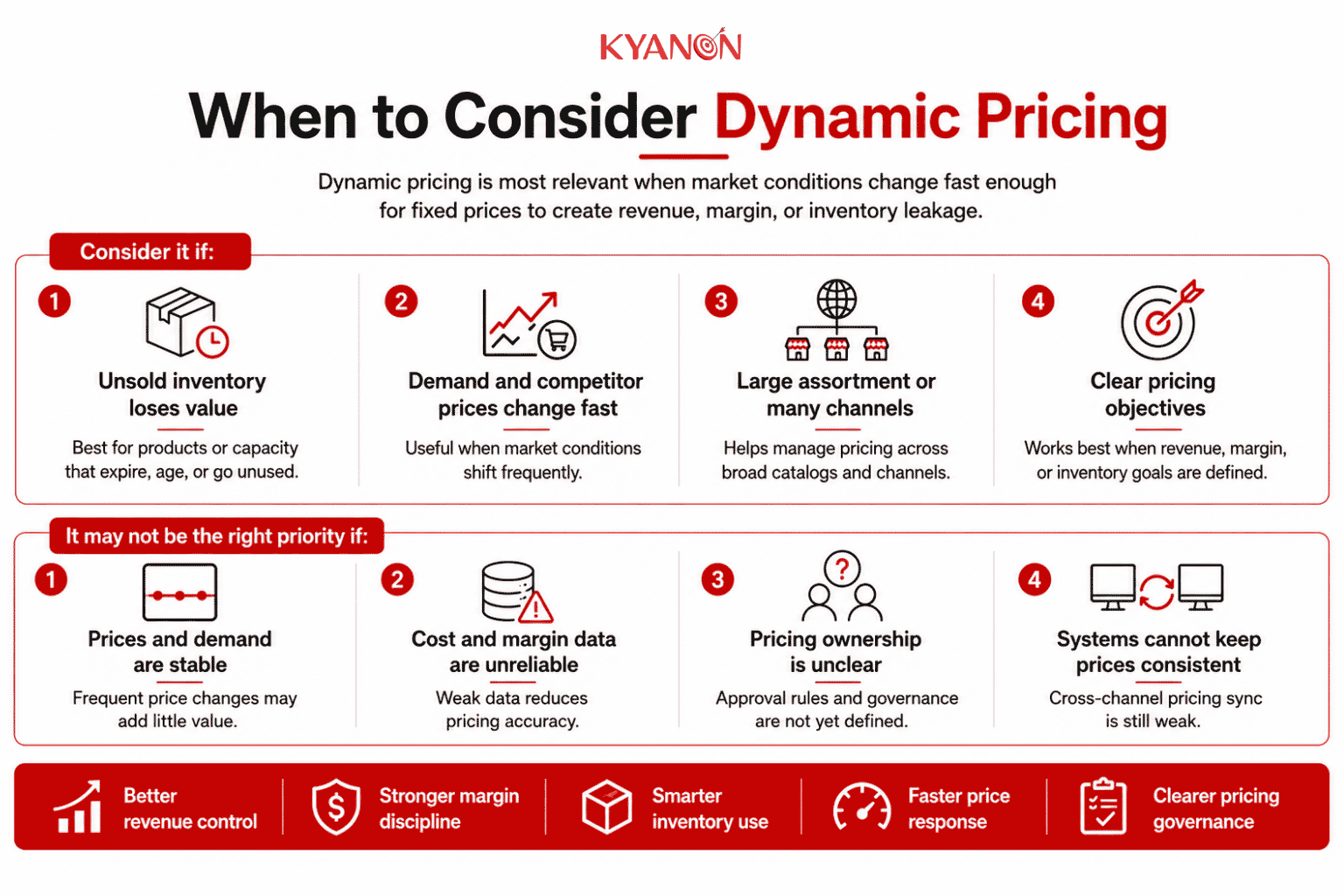
Dynamic pricing is relevant when market conditions change frequently enough for fixed prices or manual reviews to create measurable revenue, margin, or inventory leakage.
Consider it if:
- Inventory or capacity loses value when left unsold.
- Competitor prices and customer demand change quickly.
- The business manages a large assortment or several sales channels.
- Pricing teams already have clear revenue, margin, or inventory objectives.
It may not be the right priority if:
- Prices and demand remain stable.
- Cost and margin data are unreliable.
- Pricing ownership and approval rules have not been defined.
- The current system cannot maintain consistent prices across channels.
In these cases, better pricing data and governance may create more value than an ML pricing model.
Why dynamic pricing matters for retail and travel
Dynamic pricing matters for retail and travel because both sectors operate under changing demand, cost, inventory, and capacity conditions that fixed pricing cannot always reflect accurately.
For retailers, dynamic pricing can coordinate base prices and promotions across large product portfolios while balancing revenue, margin, inventory movement, and customer price perception. For travel businesses, it can align fares and ancillary offers with booking pace, remaining capacity, operating costs, seasonality, and the time before a seat, room, or service loses its economic value.
A 2026 study in the INFORMS Journal on Applied Analytics documented PepsiCo’s deployment of two enterprise pricing systems, PromoAI and PricingAI. The systems combine demand forecasting, price-elasticity modeling, and commercial constraints to optimize promotions and base prices at scale.
For travel, IATA projected in June 2026 that airline ancillary revenue would increase 12.6% year over year to USD 165 billion. This growing revenue category reinforces the importance of adjusting fares, bundles, and optional services according to demand and capacity conditions.
These findings show that dynamic pricing delivers the most value when pricing models are integrated with reliable data, commercial objectives, and human-defined guardrails.
Common misconceptions
Dynamic pricing is not automatically equivalent to price gouging, constant repricing, or uncontrolled automation.
“Dynamic pricing always means higher prices.”
Reality: Prices may decrease when demand is weak, inventory is excessive, or capacity is underused.
“Every price changes every few minutes.”
Reality: Businesses determine the repricing frequency. Retail prices may change daily, weekly, by campaign, or only when a defined threshold is reached.
“We need years of perfect data.”
Reality: A controlled pilot can begin with existing sales, inventory, competitor, promotion, and margin data.
“The algorithm replaces the pricing team.”
Reality: Pricing teams still define objectives, limits, approvals, exceptions, and intervention rules.
“Dynamic pricing is inherently illegal.”
Reality: Dynamic pricing is not inherently unlawful, but businesses must comply with applicable consumer protection, competition, privacy, and pricing-transparency requirements.
How to govern dynamic pricing responsibly
Responsible dynamic pricing requires clear business ownership and enforceable limits.
Businesses should define:
- The metric being optimized, such as revenue, margin, conversion, or occupancy.
- Price floors, ceilings, and minimum-margin requirements.
- Products and price changes that require human approval.
- How final prices are communicated to customers.
- Who can pause, reverse, or override a pricing recommendation.
A dynamic pricing model should be measurable, explainable, reversible, and auditable.
How Kyanon Digital applies dynamic pricing
Kyanon Digital applies dynamic pricing by combining ML pricing models with demand, inventory, competitor, booking, and transaction data, then integrating price recommendations into the client’s commerce, retail, or travel systems.
The implementation may include Python-based machine learning models, data pipelines, pricing APIs, business-rule engines, approval workflows, monitoring dashboards, and model-retraining processes. Kyanon Digital’s machine learning capabilities cover custom model development, predictive analytics, deployment, integration, optimization, and continuous monitoring.
For retail and travel clients, the approach begins with a defined commercial objective, such as protecting gross margin, improving inventory turnover, increasing occupancy, or reducing manual price reviews. Models are introduced through controlled pilots with measurable KPIs before expanding across products, channels, locations, or markets.
The implementation focus is not repricing speed alone. It is the reliability of the data foundation, the enforceability of commercial guardrails, integration with existing platforms, and measurable impact on revenue, conversion, margin, and total cost of ownership.
→ Explore Kyanon Digital’s Omnichannel eCommerce and Machine Learning Services.

 Create project brief with AI