
What is Yield Management?
Yield management is a variable pricing strategy aimed at maximizing revenue from fixed, time-sensitive, or perishable capacity by dynamically adjusting rates based on real-time demand, buyer segmentation, and inventory availability. It calculates optimal price thresholds to capture maximum consumer surplus, ensuring that high-demand windows yield higher profit margins while off-peak capacity is utilized efficiently without diluting brand equity.
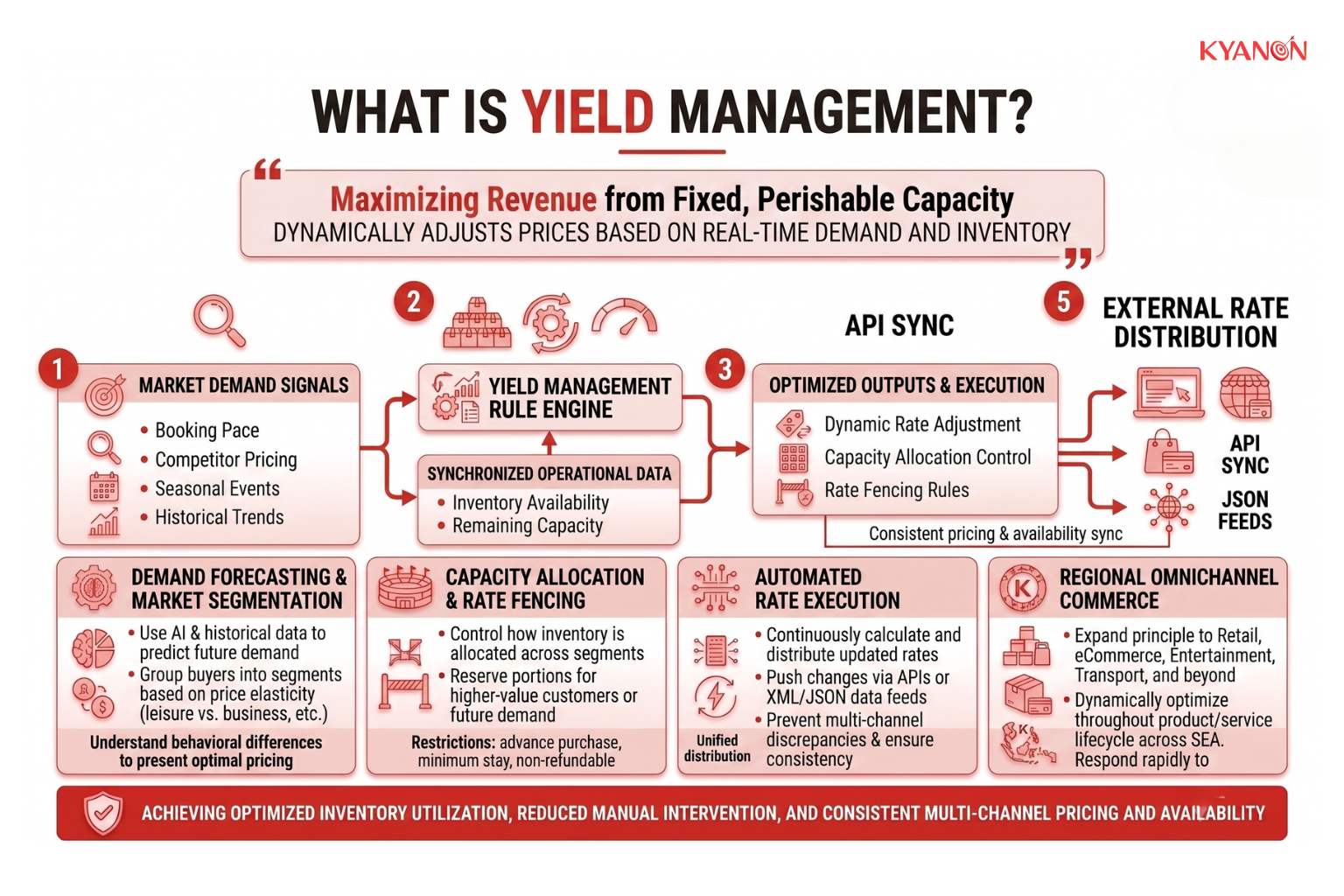
Yield management originated in industries with highly perishable inventory, such as airlines, hotels, and car rentals. Today, the same principles are widely applied across retail, eCommerce, logistics, transportation, entertainment, ticketing, subscription services, and other businesses where demand, capacity, or inventory availability changes over time. Rather than relying on fixed pricing, organizations continuously optimize prices using demand forecasts, inventory levels, competitor pricing, customer behavior, seasonal trends, and purchasing patterns to maximize revenue throughout the product or service lifecycle.
How Yield Management Works
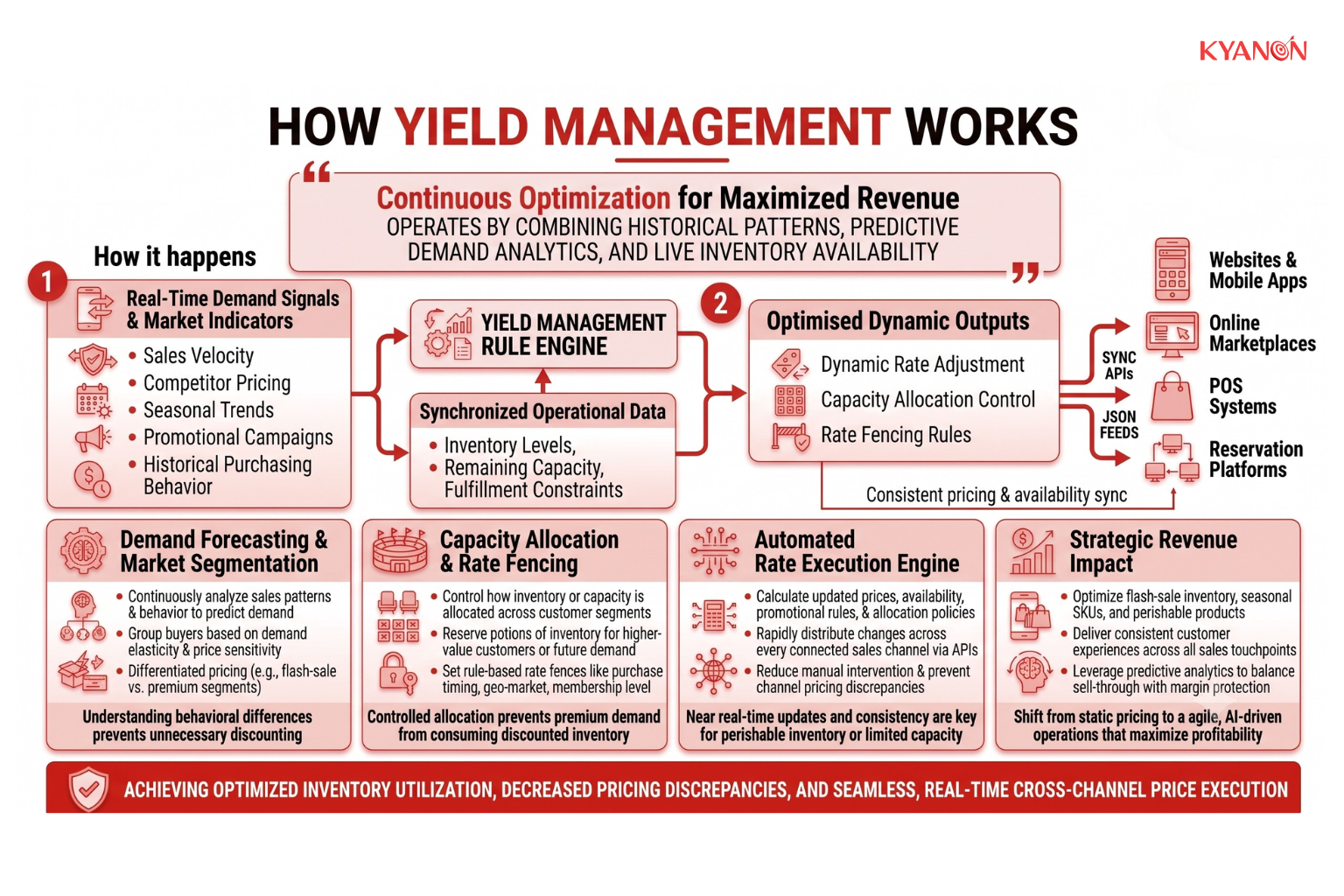
Yield management continuously combines historical demand patterns, predictive analytics, and live inventory availability to optimize pricing across sales channels. Instead of relying on static pricing models, the system evaluates customer willingness to pay, remaining inventory, market conditions, and product or capacity constraints to determine the optimal selling price for every unit at any given moment.
At the architectural level, real-time demand signals, including sales velocity, competitor pricing, seasonal trends, promotional campaigns, and historical purchasing behavior, are combined with operational data such as inventory levels, remaining capacity, and fulfillment constraints. These inputs flow through a centralized yield management engine that evaluates demand elasticity, customer segmentation, and inventory allocation policies before automatically distributing updated pricing and availability to websites, mobile applications, marketplaces, reservation systems, and other connected commerce channels.
Demand Forecasting & Market Segmentation
The forecasting engine continuously analyzes historical sales patterns, demand velocity, seasonal trends, competitor pricing, and real-time purchasing behavior to predict future demand. Rather than treating all customers equally, the platform groups buyers into market segments with different levels of price sensitivity based on demand elasticity.
For example, some customers respond strongly to promotions and discounts, while others prioritize product availability, convenience, delivery speed, or premium service over price. By understanding these behavioral differences, the yield management system can present differentiated pricing and promotional strategies that maximize revenue without unnecessarily discounting inventory.
The system also monitors sales velocity and inventory consumption against historical benchmarks. Significant deviations automatically trigger pricing or inventory allocation adjustments before stock shortages or excess inventory occur.
Capacity Allocation & Rate Fencing
Yield management not only determines pricing but also controls how inventory or capacity is allocated across different customer segments. Rather than making every available unit accessible at the lowest price, the platform reserves portions of inventory for higher-value customers or future demand expected to generate greater revenue.
This is achieved through rate fencing, a collection of business rules that determine eligibility for specific pricing tiers. Common restrictions include promotional periods, minimum purchase quantities, customer membership levels, geographic markets, purchase timing, or channel-specific pricing.
As lower-priced inventory reaches predefined allocation limits, those pricing tiers automatically close while higher-priced tiers remain available. This controlled allocation prevents premium demand from consuming discounted inventory and helps maximize revenue per available unit instead of simply maximizing sales volume.
Automated Rate Execution Engine
Once pricing decisions are calculated, the execution engine distributes updated prices, inventory availability, promotional rules, and allocation policies across every connected sales channel through APIs or standardized XML and JSON data feeds.
This synchronization ensures that eCommerce websites, mobile applications, online marketplaces, POS systems, reservation platforms, and other commerce channels display consistent pricing and inventory information in near real time. Unified distribution reduces manual intervention, prevents channel pricing discrepancies, and ensures that changes triggered by shifting demand or inventory levels are reflected consistently across the entire commerce ecosystem.
Whether managing flash-sale inventory, seasonal SKUs, perishable FMCG products, event tickets, transportation capacity, or hotel rooms, rapid execution is essential whenever inventory value declines over time or available capacity is limited. Automated rate execution enables organizations to respond immediately to changing market conditions, maximizing revenue, improving inventory utilization, and maintaining pricing consistency across all channels.

Yield Management vs Revenue Management
While these concepts are frequently conflated, yield management functions as a tactical, inventory-focused subset of comprehensive revenue management frameworks.
Dimension | Yield Management | Revenue Management |
| Core Focus | Optimizing revenue from fixed, time-sensitive capacity | Maximizing total profitability across all company asset streams |
Operational Scope | Short-term rate adjustments and booking thresholds | Long-term market positioning, channel costs, and product mix |
| Primary Input | Real-time demand velocity and inventory perishability | Macroeconomic trends, total acquisition costs, and customer LTV |
Key Metric | Revenue Per Available Seat/Room (RevPAS / RevPAR) | Net Margin Growth, EBITDA, Total Revenue Per Customer |
| Technical Execution | Directly integrated into booking engines and availability APIs | Connected to enterprise financial dashboards and ERP strategy tools |
When to Consider Yield Management
Consider implementing yield management architectures if:
- Your business manages inventory or capacity whose value declines over time, such as flash-sale inventory, seasonal SKUs, perishable FMCG products, event tickets, transportation capacity, hotel rooms, or appointment slots.
- Demand fluctuates significantly, causing periods of stock shortages, excess inventory, or underutilized capacity.
- Customer segments demonstrate different purchasing behaviors, price sensitivities, or buying windows that can be optimized through differentiated pricing and inventory allocation.
- Your organization requires real-time pricing and inventory synchronization across multiple sales channels to maximize revenue and improve inventory utilization.
It may not be the right priority if:
- Your business primarily sells standardized products with stable demand, predictable pricing, and virtually unlimited replenishment, where long-term price consistency is more important than dynamic price optimization.
- Inventory rarely faces time-based value depreciation or capacity constraints, making sophisticated yield optimization unlikely to generate meaningful business value.
Why Yield Management Matters for Retail & eCommerce
Applying real-time yield management enables retailers and eCommerce businesses to maximize revenue by continuously balancing pricing, demand, and inventory availability. Instead of relying on static pricing, organizations dynamically adjust prices based on demand forecasts, inventory levels, customer segments, and seasonal trends to increase sell-through while protecting margins.
For retail and eCommerce, yield management is particularly valuable for optimizing flash-sale inventory, seasonal SKUs, limited-time promotions, and perishable FMCG products where inventory value declines over time. The same principles also extend to industries managing fixed or time-sensitive capacity, including travel, hospitality, transportation, and event ticketing.
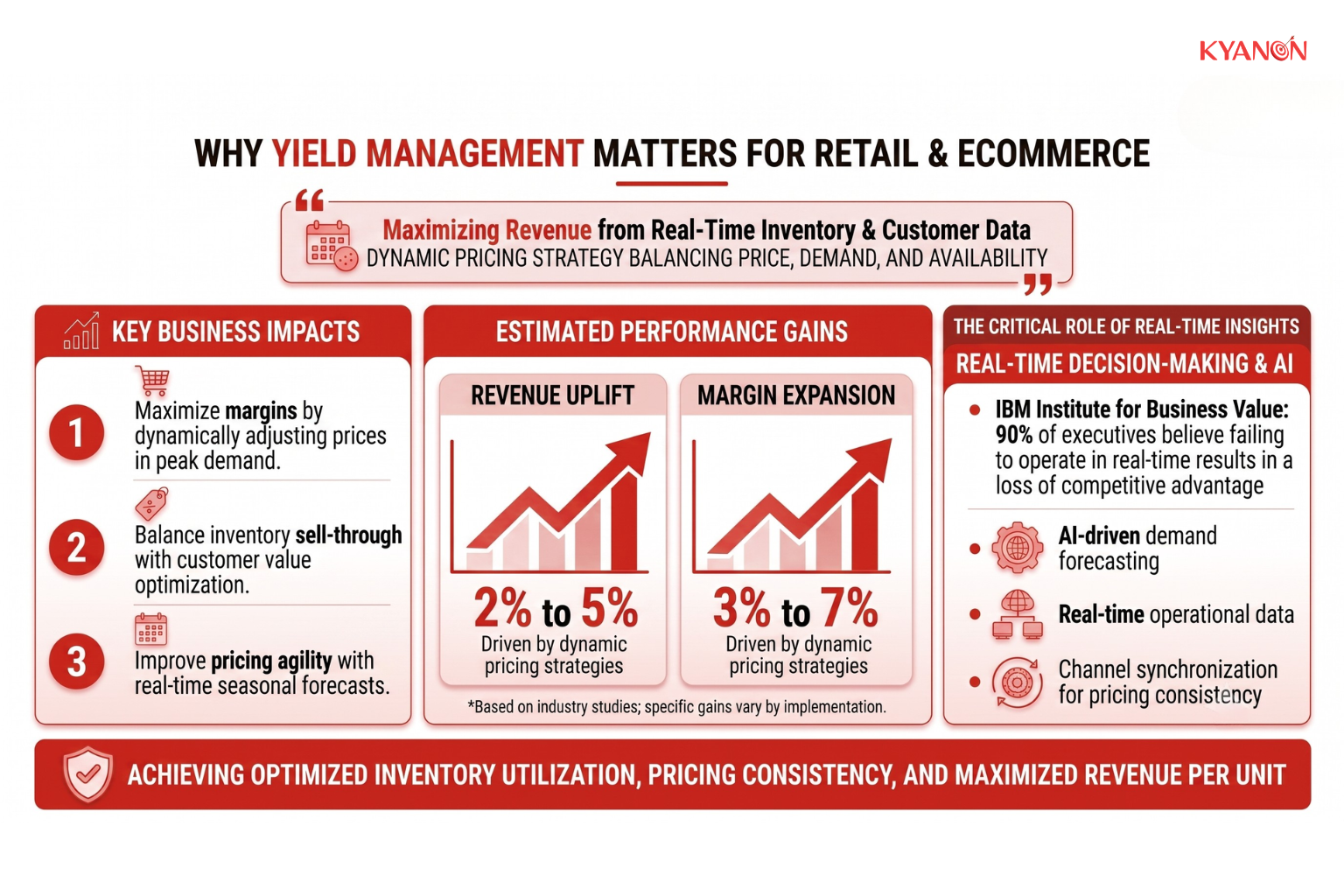
The business value of this approach is increasingly tied to real-time decision-making. According to IBM Institute for Business Value, 90% of executives believe that failing to operate in real time will result in a loss of competitive advantage. By combining AI-driven demand forecasting with live operational data, organizations can optimize pricing as market conditions evolve, allocate inventory more effectively, synchronize prices across sales channels, and maximize both profitability and inventory turnover while delivering a more consistent customer experience.
Common Misconceptions
Yield management is purely a standalone computer system that operates without human strategy
Software serves only as an execution mechanism; yield management is an enterprise process requiring human expertise to interpret market shifts, set policy boundaries, and align algorithms with broader brand strategy.
Yield management is just a tactic to continually lower prices to fill capacity
While discount management is one component, yield management focuses equally on holding or raising rates during peak demand windows to capture higher profit margins.
Yield management is identical to overall Revenue Management
Yield management is technically a specialized subset of revenue management that focuses strictly on maximizing returns from existing capacity, whereas revenue management governs long-term strategy across all enterprise revenue streams.
How Kyanon Digital Applies Yield Management
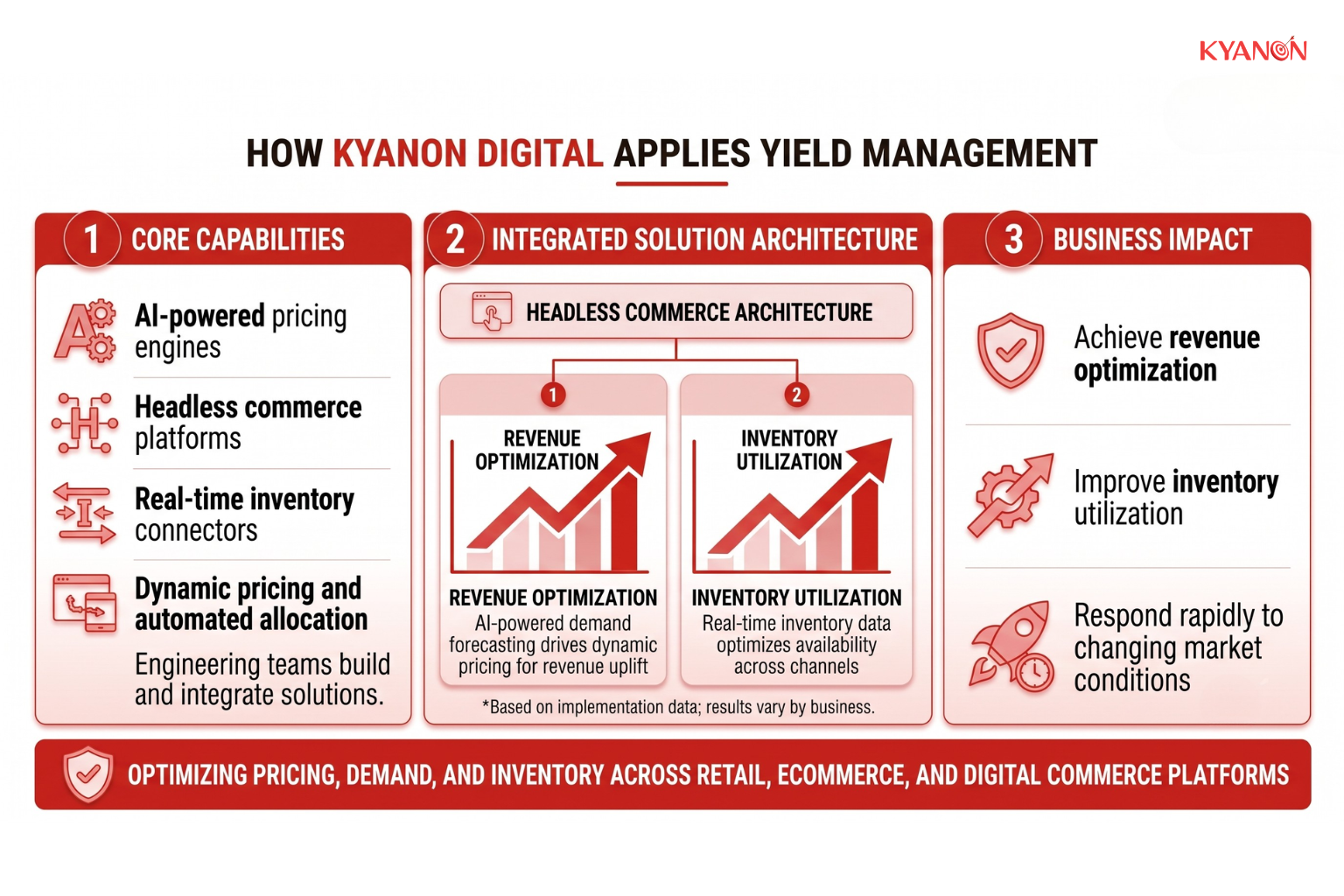
Kyanon Digital applies yield management principles across retail, eCommerce, and other digital commerce platforms where pricing, demand, and inventory optimization directly impact business performance. Our engineering teams build and integrate AI-powered pricing engines, headless commerce platforms, and real-time inventory connectors that enable dynamic pricing, automated inventory allocation, and consistent price synchronization across digital sales channels. This helps enterprises optimize revenue, improve inventory utilization, and respond rapidly to changing market conditions.
Explore our services:

 Create project brief with AI