
What is endless aisle?
Endless aisle is an omnichannel retail strategy that allows in-store shoppers to purchase products not stocked or currently unavailable at that location by accessing inventory from other stores, warehouses, or an extended digital catalog. The order begins in the physical store and is fulfilled through home delivery or later store pickup.
According to Salesforce, endless aisle extends the store’s available assortment beyond its local shelf inventory. Shopify further explains that the transaction relies on connected inventory, point-of-sale, and fulfillment systems to complete the purchase without requiring the customer to restart the journey online.
How endless aisles work
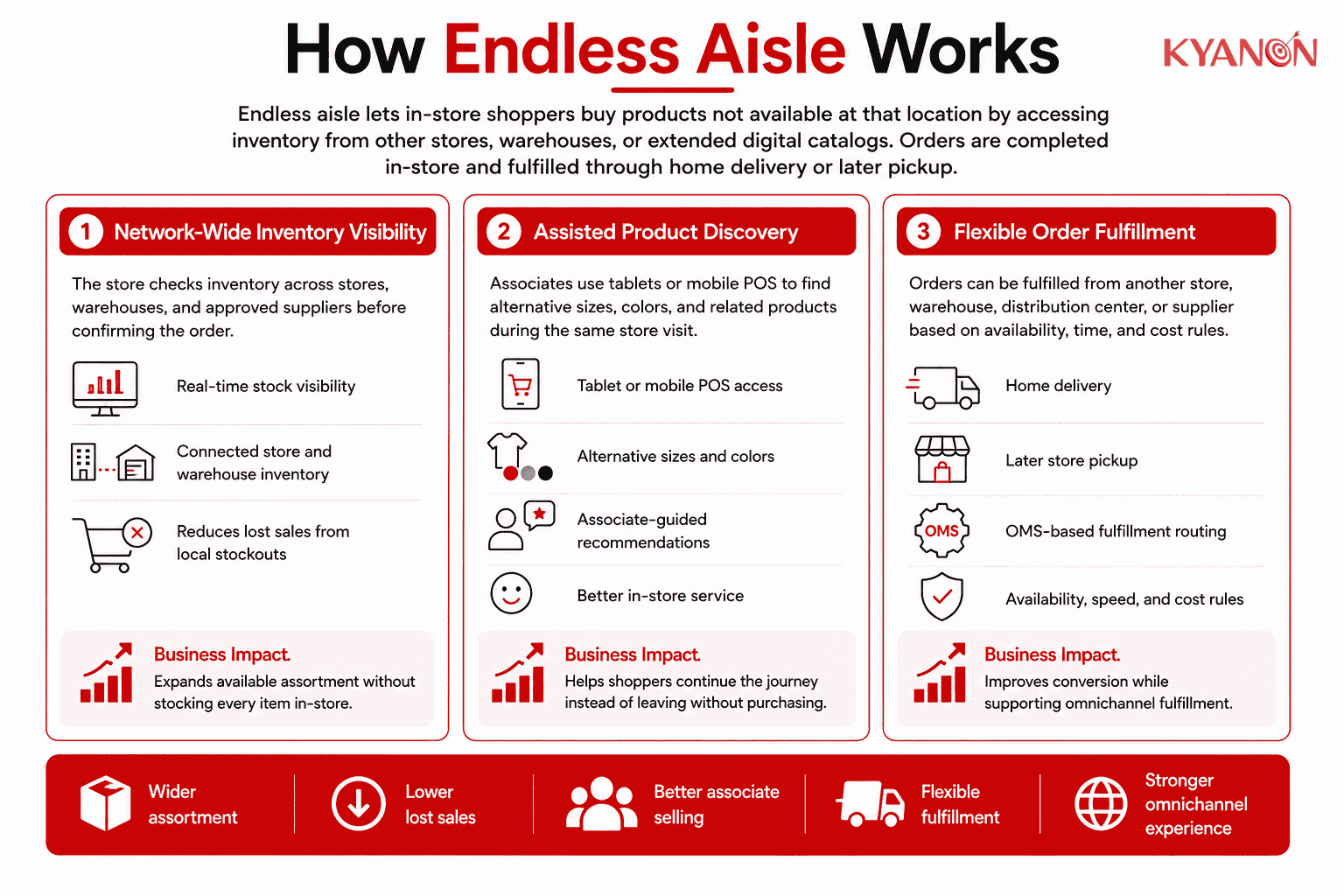
Endless aisle is effective because it converts inventory held outside the customer’s current store into inventory that can still be discovered, purchased, and fulfilled during the same shopping journey.
The capability reduces lost sales from local stockouts while allowing physical stores to offer a broader assortment without holding every product, size, or color on-site.
Network-wide inventory visibility
Endless Aisle requires a current view of inventory across stores, warehouses, distribution centers, and approved suppliers.
This visibility allows the retailer to confirm that an unavailable local item exists elsewhere before accepting the order. IBM identifies real-time inventory visibility as a core requirement for flexible omnichannel fulfillment.
Assisted product discovery
Store associates can use tablets or mobile POS devices to locate alternative sizes, colors, variants, and related products while advising the customer.
The human interaction remains important because the device extends the associate’s selling capability; it does not replace product knowledge, service, or physical product evaluation.
Flexible order fulfilment
An endless aisle order may be fulfilled from another store, a warehouse, a distribution center, or a supplier.
The order management system selects a fulfillment location according to availability, delivery time, cost, and business rules. The order can then be delivered to the customer’s home or collected from a selected store.

Endless aisle vs click-and-collect
Endless aisle begins inside the physical store when a required product is unavailable locally, while click-and-collect normally begins online and ends with collection at a physical location.
| Dimension | Endless aisle | Click-and-collect |
Journey starting point | Physical store | Website or mobile application |
| Primary trigger | Product, size, colour, or variant is unavailable locally | Customer wants to reserve an available product online |
Typical user | Shopper or store associate | Online shopper |
Ordering interface | Kiosk, tablet, mobile POS, QR code, or app | Website or mobile app |
| Inventory source | Wider network of stores, warehouses, or suppliers | Selected store or assigned fulfilment location |
Fulfilment option | Home delivery or later pickup | Store or curbside pickup |
| Primary objective | Recover a sale that may otherwise be lost | Provide convenient fulfilment for an online order |
Associate role | Often supports discovery and order placement | Usually prepares and hands over the order |
| Core system requirement | Unified catalog, inventory visibility, OMS, and assisted selling tools | Accurate store inventory, order reservation, and pickup workflow |
Both capabilities depend on accurate inventory and order orchestration, but they solve different points of friction in the customer journey. IBM defines BOPIS as an online purchase fulfilled through store pickup, while Salesforce positions endless aisle as an in-store capability for locating and ordering unavailable products.
What are the benefits of endless aisle?
Endless aisle allows retailers to recover sales from local stockouts while giving shoppers access to products beyond the physical store’s available assortment.
Benefit | Value for retailers | Value for shoppers |
Fewer lost sales | Captures orders when a size, colour, or product is unavailable locally | Customers can complete the purchase without visiting another retailer |
| Wider product selection | Extends the assortment to online-only products, variants, and supplier inventory | Shoppers can access more sizes, colours, and configurations |
More efficient store space | Reduces the need to display or store every product variation on-site | Stores can provide more choice without overcrowded shelves |
| Better inventory utilization | Makes stock held in other stores or warehouses available to more customers | Customers gain access to inventory across the retail network |
Greater fulfilment choice | Supports ship-from-store, warehouse delivery, or store pickup | Customers can select home delivery or later collection |
Endless aisle creates the most value when wider product access is supported by accurate inventory, reliable fulfillment promises, and store associates who can guide the purchase.
When to consider endless aisle
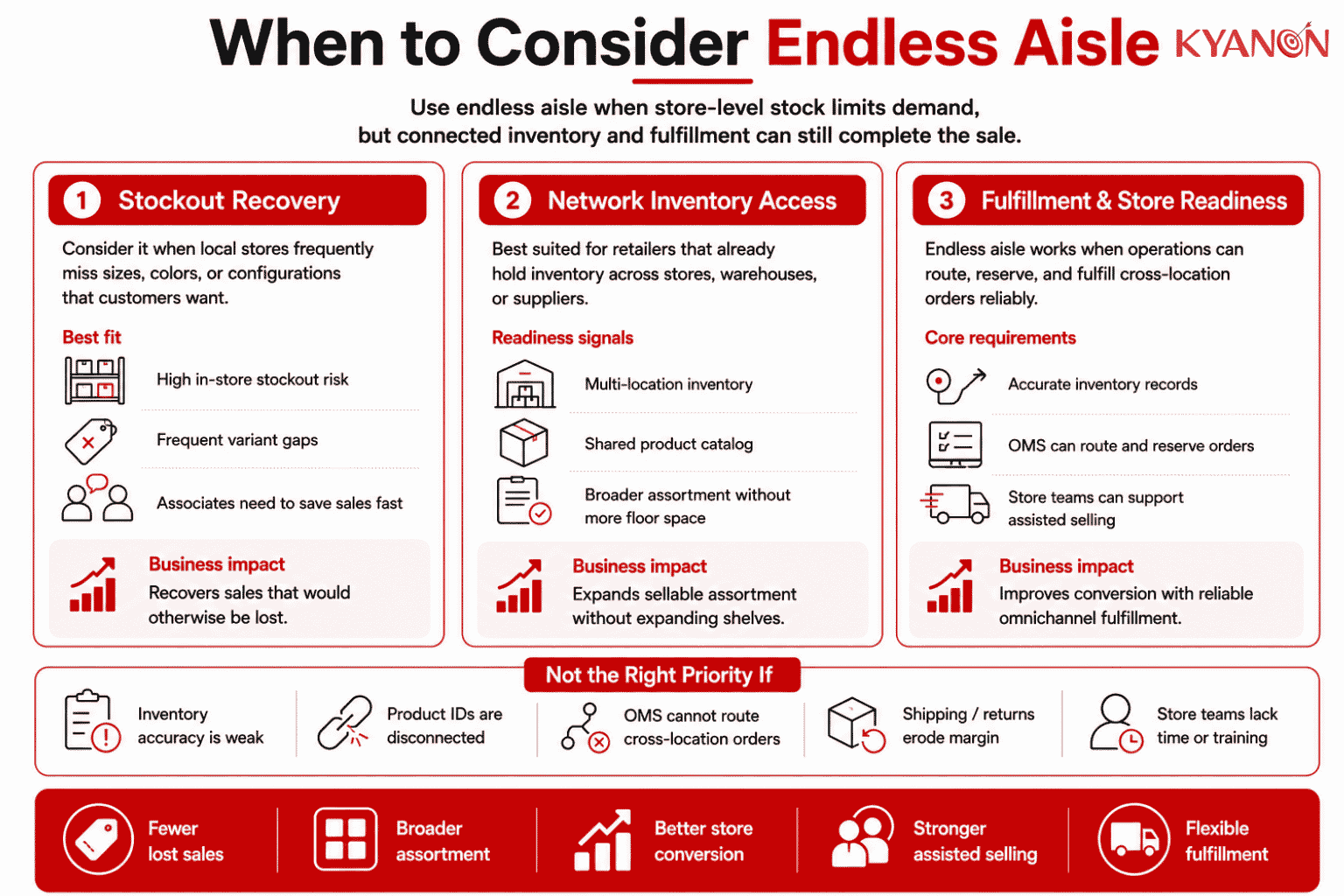
Endless aisle is relevant when local assortment or shelf space prevents stores from meeting customer demand even though suitable inventory exists elsewhere in the retail network.
Consider endless aisle if
- Customers frequently encounter unavailable variants. Fashion, footwear, furniture, electronics, and beauty retailers often carry more sizes, colors, or configurations than one store can display.
- The business operates several inventory locations. Stores, warehouses, and suppliers hold inventory that could fulfill an order initiated elsewhere.
- Store associates regularly lose sales to stockouts. Employees need a way to locate alternatives, accept payment, and arrange fulfillment before the customer leaves.
- The retailer wants a broader assortment without additional floor space. Digital catalogs can expose products that are unsuitable or uneconomical to display in every location.
It may not be the right priority if:
- Inventory records are frequently inaccurate.
- Stores, warehouses, and online channels use disconnected product identifiers.
- The order management system cannot route or reserve cross-location inventory.
- Shipping and return costs would make single-item fulfillment unprofitable.
- Store teams do not have time, training, or incentives to support assisted selling.
Endless aisles should follow inventory and fulfillment readiness rather than being treated as standalone kiosk projects.
Why endless aisle matters for retail
Endless aisle matters because a local stockout does not need to become a lost sale when the required product is available elsewhere in the retail network.
The capability also connects physical product evaluation with digital assortment depth: customers can inspect products in-store, receive associate advice, and access sizes, colors, or configurations beyond the local shelf.
Salesforce’s Sixth Edition Connected Shoppers Report found that 52% of shoppers had used buy online, pick up in store during the previous year, while 52% of retailers offered ship-to-store. These findings show that cross-location inventory and flexible fulfillment have become established parts of the omnichannel customer journey.
Common misconceptions about endless aisle
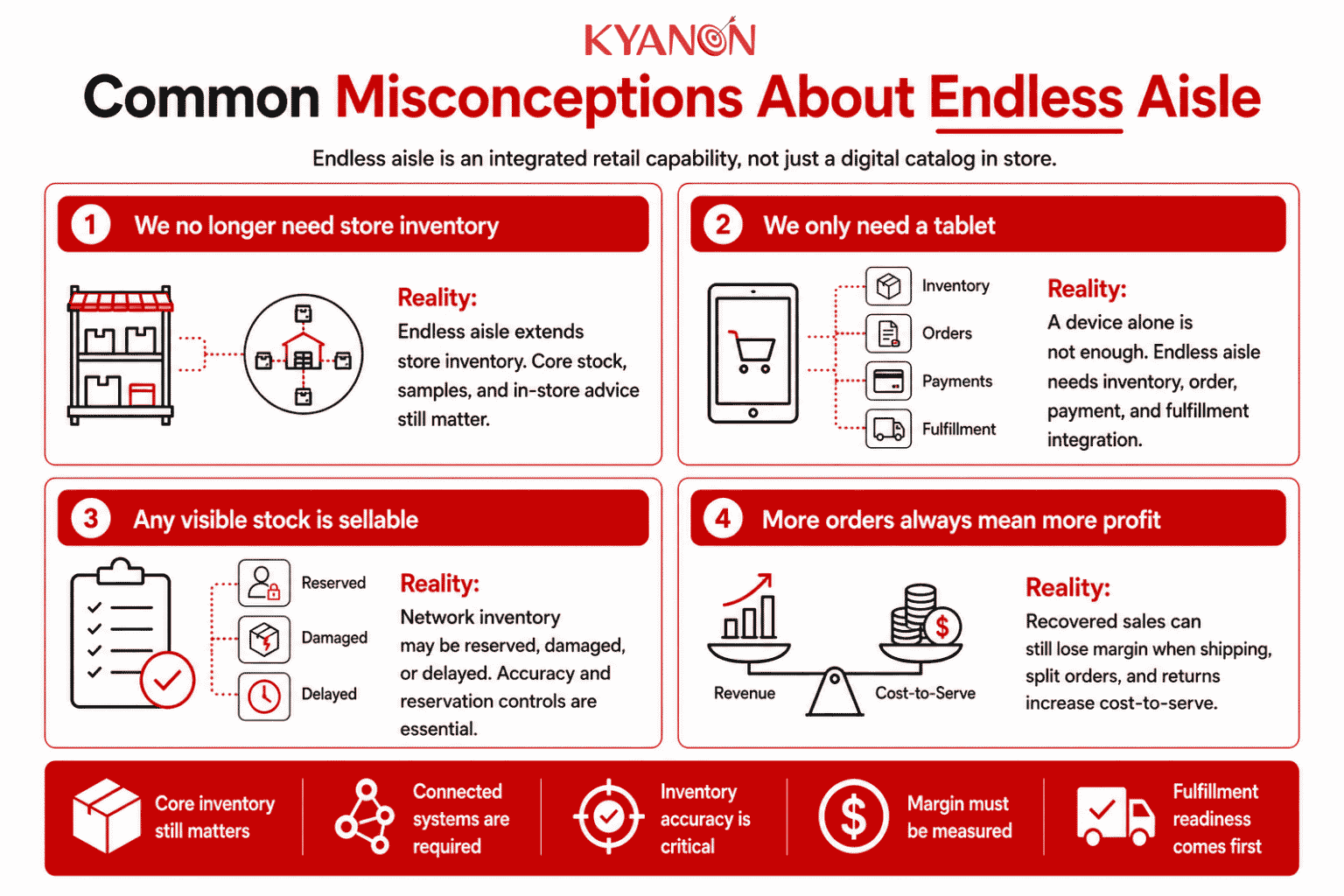
Endless aisle is an integrated retail operating capability, not simply an online catalog displayed on a device inside a store.
“Endless aisle means we no longer need store inventory.”
Reality: Endless aisle extends physical inventory; it does not eliminate it.
Customers still visit stores to inspect products, compare options, receive advice, and purchase immediately. Physical samples and core inventory create the context in which the expanded digital assortment becomes useful.
“We only need to put our website on a tablet.”
Reality: A device without inventory, order, payment, and fulfillment integration cannot reliably complete an endless aisle transaction.
The interface must also support rapid product discovery and a store workflow that associates understand and use consistently.
“Any inventory shown by the system is available to sell.”
Reality: Recorded inventory may already be reserved, damaged, misplaced, or unavailable within the promised fulfillment window.
Retailers need inventory accuracy, reservation controls, fulfillment rules, and realistic delivery promises before exposing network stock to customers.
“More endless aisle orders automatically mean higher profit.”
Reality: Recovered revenue does not guarantee recovered margin.
Single-item shipping, supplier fulfillment, split orders, payment processing, and cross-channel returns can increase cost-to-serve. Retailers should measure contribution margin and fulfillment cost alongside conversion and recovered sales.
How Kyanon Digital applies endless aisle
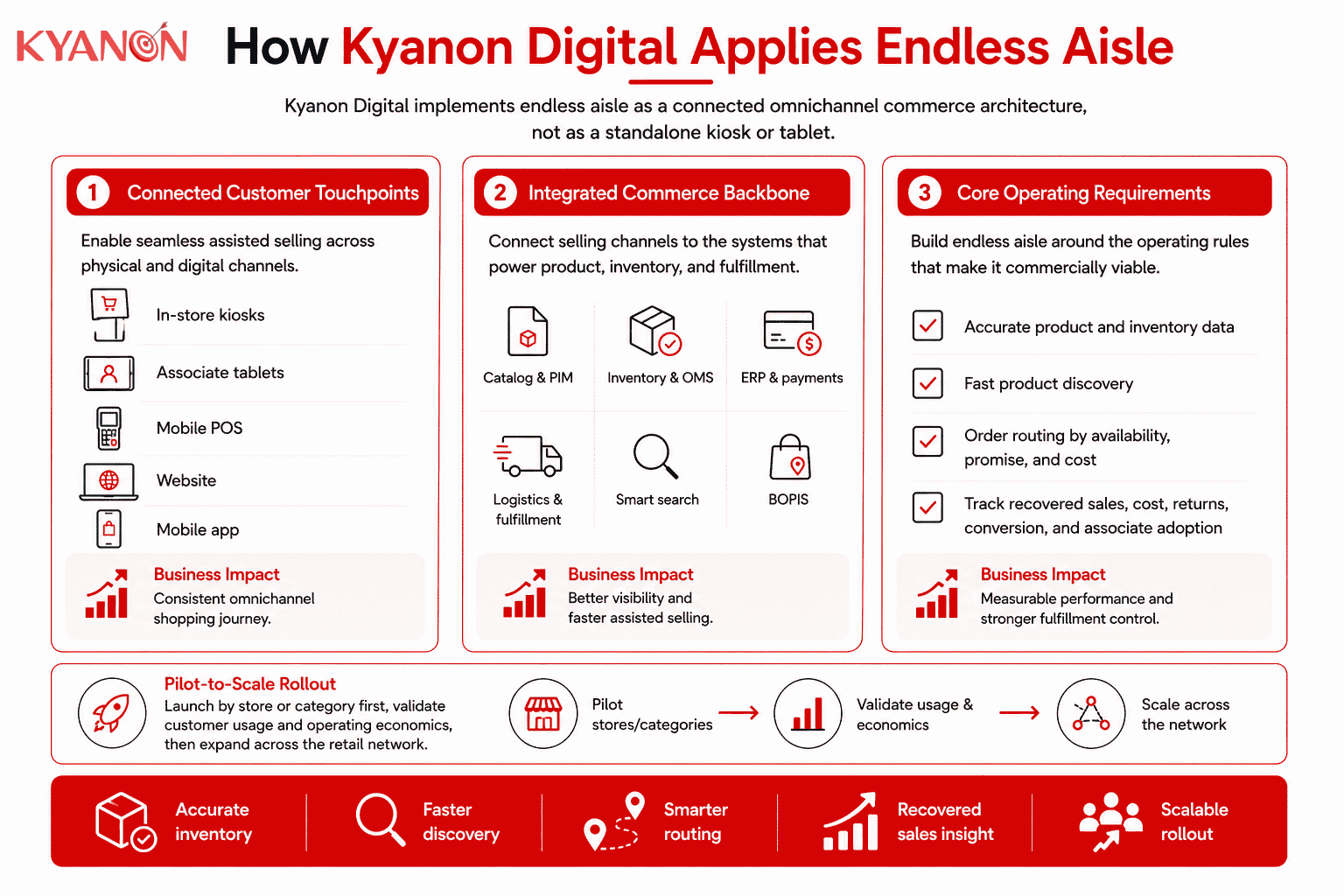
Kyanon Digital implements endless aisle as part of a connected omnichannel commerce architecture rather than as an isolated kiosk or tablet interface.
The implementation can connect in-store kiosks, associate tablets, mobile POS, websites, and mobile applications with product catalogs, inventory management systems, OMS, ERP, PIM, payments, logistics, and fulfillment platforms. Kyanon Digital’s eCommerce capabilities include in-store digital experiences, inventory visibility, BOPIS, smart search, system integration, and logistics and fulfillment connectivity.
The work focuses on four operating requirements:
- Accurate product and inventory information across locations.
- Fast product discovery for shoppers and associates.
- Order routing based on availability, delivery promise, and cost.
- Measurement of recovered sales, fulfillment cost, returns, conversion, and associate adoption.
Kyanon Digital can introduce the capability through selected stores or categories before expanding across the retail network, allowing the business to validate customer usage and operational economics first.
→ Explore Kyanon Digital’s Omnichannel eCommerce Solutions.

 Create project brief with AI