
What is Machine Learning?
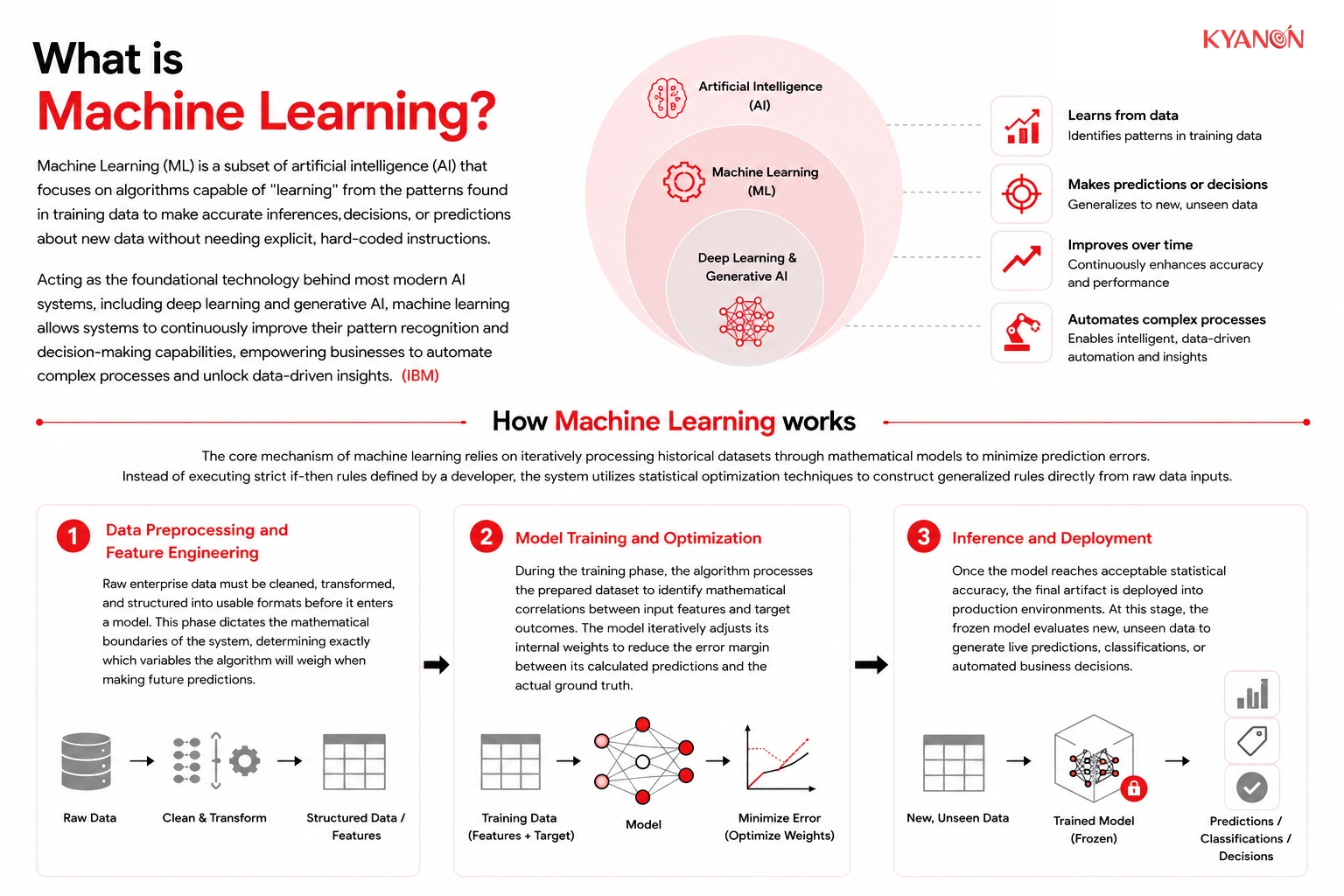
Machine Learning (ML) is a subset of artificial intelligence (AI) that focuses on algorithms capable of “learning” from the patterns found in training data to make accurate inferences, decisions, or predictions about new data without needing explicit, hard-coded instructions. Acting as the foundational technology behind most modern AI systems, including deep learning and generative AI, machine learning allows systems to continuously improve their pattern recognition and decision-making capabilities, empowering businesses to automate complex processes and unlock data-driven insights. (IBM)
How Machine Learning works
The core mechanism of machine learning relies on iteratively processing historical datasets through mathematical models to minimize prediction errors. Instead of executing strict if-then rules defined by a developer, the system utilizes statistical optimization techniques to construct generalized rules directly from raw data inputs.
Data Preprocessing and Feature Engineering
Raw enterprise data must be cleaned, transformed, and structured into usable formats before it enters a model. This phase dictates the mathematical boundaries of the system, determining exactly which variables the algorithm will weigh when making future predictions.
Model Training and Optimization
During the training phase, the algorithm processes the prepared dataset to identify mathematical correlations between input features and target outcomes. The model iteratively adjusts its internal weights to reduce the error margin between its calculated predictions and the actual ground truth.
Inference and Deployment
Once the model reaches acceptable statistical accuracy, the final artifact is deployed into production environments. At this stage, the frozen model evaluates new, unseen data to generate live predictions, classifications, or automated business decisions.

The three main types of Machine Learning
Machine learning is generally divided into three categories, depending on how the algorithm learns:
Supervised Learning (Learning with a Guide)
The algorithm is trained on a “labeled” dataset, meaning every training example already includes the correct answer.
- How it works: The model looks at historical data, makes a guess, compares its guess to the actual answer, and corrects itself.
- Examples: Linear Regression (predicting house prices based on size) or email spam filters (learning from emails marked as “spam” or “not spam”).
Unsupervised Learning (Learning Alone)
The algorithm is given “unlabeled” data and must find patterns, structures, or anomalies entirely on its own.
- How it works: It groups data points together based on how similar they are to each other.
- Examples: Customer segmentation (grouping shoppers by purchasing habits) or fraud detection (flagging a transaction that looks completely different from a user’s normal spending behavior).
Reinforcement Learning (Learning by Trial and Error)
The algorithm acts as an “agent” inside an environment and learns to make decisions through a system of rewards and penalties.
- How it works: It tries different actions, receives a “positive reward” for a good move or a “negative penalty” for a mistake, and optimizes its strategy to maximize total rewards over time.
- Examples: Teaching autonomous vehicles how to drive, optimizing robotics in manufacturing, or training AI to defeat human grandmasters at chess or Go.
Machine Learning vs Traditional Software Engineering
Both approaches aim to solve complex business problems, but they differ fundamentally in how execution logic is generated and maintained.
Dimension | Machine Learning | Traditional Software Engineering |
| Logic generation | Data-driven (learned from historical data) | Rules-driven (hardcoded by developers) |
Input requirements | Large datasets and defined target outcomes | Pre-defined business rules and conditional logic |
| Output predictability | Probabilistic (generates confidence scores) | Deterministic (generates exact outputs) |
Maintenance focus | Data drift monitoring and model retraining | Code debugging and explicit feature updates |
| Primary failure mode | Biased or insufficient training data | Syntax errors or logical flaws in the code |
When to consider Machine Learning
Consider machine learning if:
- Your organization possesses vast amounts of historical data but lacks the human capacity or tools to manually extract actionable forecasting insights from it.
- Your operational workflows require complex, high-volume automated decisions (such as fraud detection or dynamic pricing) that exceed the limits of traditional rules-based engines.
- You are relying on static forecasting models that consistently fail to adapt to multi-variable market shifts and non-linear customer behaviors.
It may not be the right priority if:
- Your operational problems can be solved entirely with basic SQL queries, deterministic business rules, or standard statistical reporting without requiring predictive capabilities.
Why Machine Learning matters for enterprise operations
Machine learning (ML) matters for enterprise operations because it shifts organizations from a reactive posture to a proactive, predictive model of efficiency.
While generative AI handles natural language tasks, core operations, supply chains, risk management, predictive maintenance, and logistics, rely heavily on classical and advanced machine learning to parse structured enterprise data. By integrating ML into daily operations, companies can automate decision-making at a scale and speed that is humanly impossible.
The primary operational impacts of ML:
- Eliminating unscheduled downtime (predictive maintenance)
- Radical supply chain and inventory optimization
- Real-time fraud detection and risk mitigation
- Hyper-personalization of customer operations
Common misconceptions
More data is always better for the model
Reality: High-quality, clean data always outperforms raw data volume. Flooding a model with biased or poorly labeled data simply trains it to find patterns in the noise, making a curated dataset of 10,000 pristine records far more valuable for predictive accuracy than 10,000,000 chaotic, unverified data points.
Models learn continuously in real time once deployed
Reality: Most production models are completely static once deployed into enterprise architectures. They utilize “batch learning”, meaning they are trained offline, frozen into a deployable artifact, and only update when engineers manually execute a retraining pipeline using a new batch of data.
Machine learning is ‘plug-and-play’ software
Reality: Deploying the core model code constitutes only a small fraction of the engineering effort. The true complexity lies in building the surrounding Machine Learning Operations (MLOps) infrastructure, such as data pipelines, drift monitoring, and scalable API hosting, without which models rapidly deteriorate in production.
A model is biased because the algorithm itself is flawed
Reality: Algorithms are neutral mathematical formulas; bias originates strictly from human data and design choices. If a model discriminates, it is reflecting the historical human biases present in its training data or optimizing for a skewed metric explicitly selected by the engineering team.
ML models understand cause and effect
Reality: Machine learning models are strictly pattern recognizers, not causal engines. They excel at identifying mathematical correlations between variables but do not understand the underlying reasons why those features move together, requiring human intervention to identify hidden causal relationships.
How Kyanon Digital applies Machine Learning
Kyanon Digital implements machine learning using scalable MLOps frameworks for enterprise clients across Vietnam, Singapore, ANZ, and the US. Our engineering teams integrate predictive modeling, personalization algorithms, and intelligent automation into core business systems. Our approach focuses strictly on deploying architectures that deliver measurable improvements in conversion rates, time-to-market, and overall operational efficiency.
Explore our AI and ML services:

 Create project brief with AI