
What is a Graph Neural Network (GNN)?
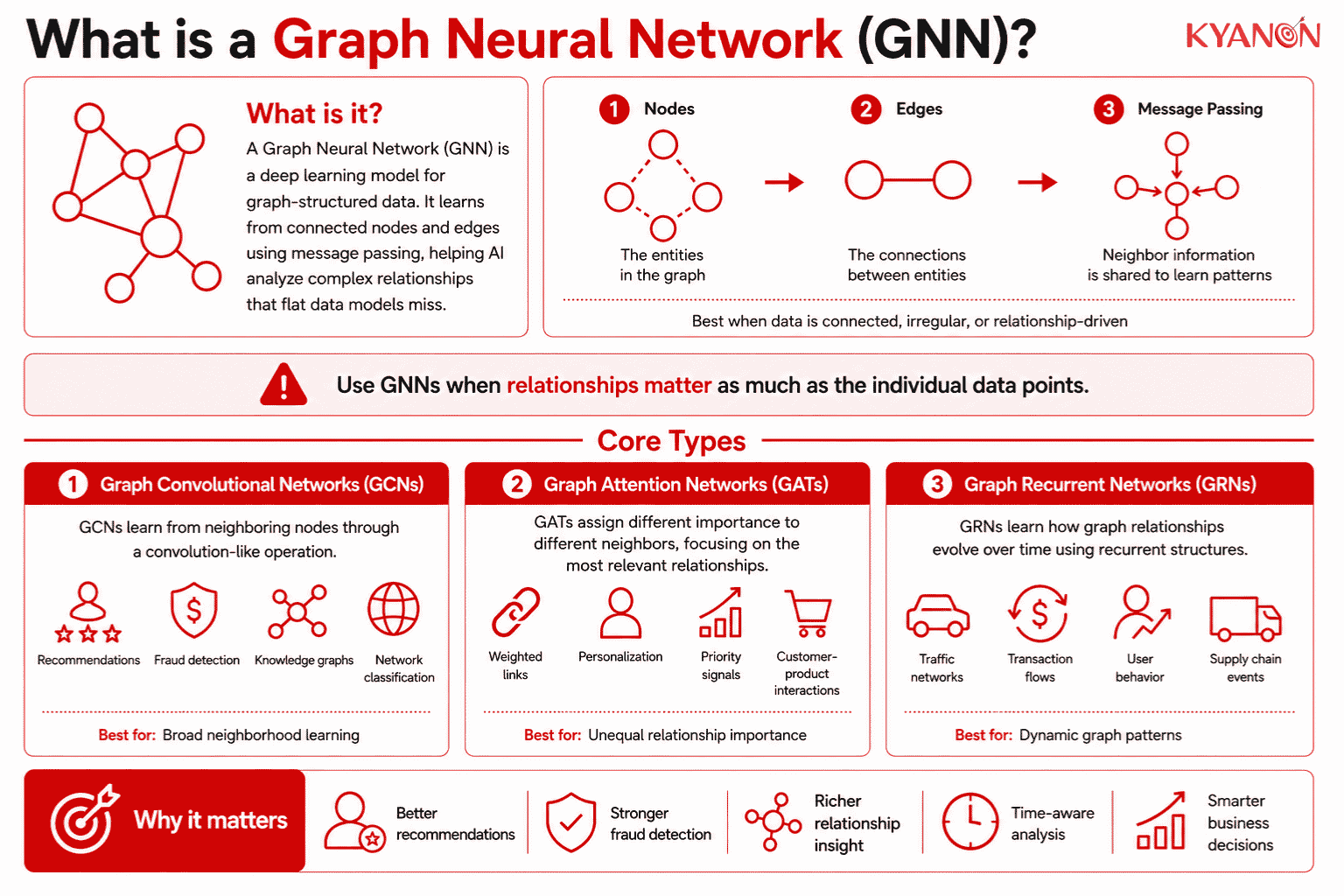
A Graph Neural Network (GNN) is a deep learning architecture that processes data structured as graphs, using mathematical message passing to capture complex relationships between interconnected nodes and edges. This framework allows artificial intelligence systems to analyze irregular, non-Euclidean data structures that traditional flat-file algorithms cannot natively process.
Core Types of Graph Neural Networks
Graph neural networks can be designed in different ways depending on how they learn from graph-structured data. The most common types include Graph Convolutional Networks, Graph Attention Networks, and Graph Recurrent Networks.
Graph Convolutional Networks (GCNs)
Graph Convolutional Networks apply a convolution-like operation across connected nodes. Each node learns from its neighboring nodes, making GCNs useful for recommendation systems, fraud detection, knowledge graph enrichment, and network classification tasks.
Graph Attention Networks (GATs)
Graph Attention Networks assign different importance weights to different neighboring nodes. This helps the model focus on the most relevant relationships instead of treating every connection equally.
For example, in e-commerce, a GAT can prioritize stronger customer-product interactions when generating personalized recommendations.
Graph Recurrent Networks (GRNs)
Graph Recurrent Networks use recurrent architectures to learn how graph relationships change over time. They are useful when connected data is dynamic, such as traffic networks, transaction flows, user behavior sequences, or supply chain events.

Common GNN Tasks and Use Cases
Graph neural networks are commonly used to make predictions at three levels: node level, edge level, and graph level.
| GNN Task | What It Predicts | Business Example |
|---|---|---|
| Node Classification | The category or risk level of one node | Flagging a suspicious account in a fraud network |
| Edge Prediction | Whether a relationship exists between two nodes | Recommending products, friends, or supplier links |
| Graph Classification | The category of an entire graph | Classifying a molecule, transaction network, or process map |
How Graph Neural Networks Work
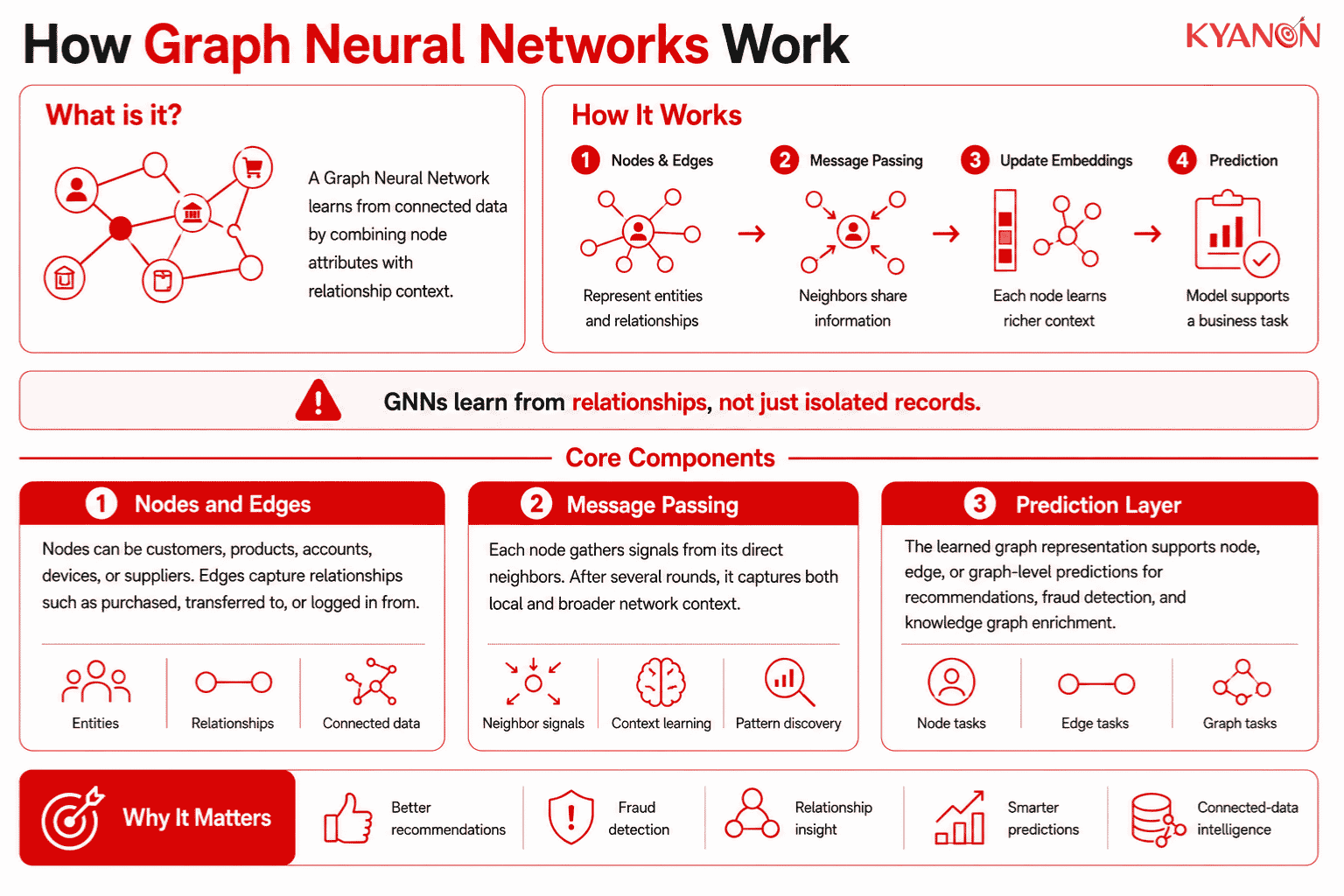
Graph neural networks operate through a localized aggregation process where each data point iteratively updates its mathematical state by pulling information from its direct neighbors. This mechanism, known as message passing, embeds both the individual attributes of a node and the structural context of its surrounding network into a single, highly dense vector representation suitable for predictive modeling.
Nodes and Edges
Nodes represent entities such as customers, products, suppliers, accounts, devices, or transactions. Edges represent relationships between those entities, such as “purchased,” “transferred to,” “recommended with,” “belongs to,” or “logged in from.”
Message Passing
Message passing is the core mechanism that lets each node learn from its connected neighbors. After multiple rounds of message passing, a node representation can encode direct and indirect relationships in the graph.
Prediction Layer
The prediction layer uses the learned graph representation to support a business task, such as ranking recommended products, detecting suspicious transaction links, classifying account risk, or enriching a knowledge graph. A GNN can make predictions at the node level, edge level, or graph level, depending on the operating use case.
Graph Neural Network vs Convolutional Neural Network (CNN)
Both architectures extract contextual features from complex datasets, but they are engineered for fundamentally different geometric data structures.
Dimension | Graph Neural Network (GNN) | Convolutional Neural Network (CNN) |
| Data structure | Non-Euclidean (networks, relationships) | Euclidean (grids, images) |
Spatial relationships | Dynamic, irregular, and variable | Fixed, structured, and uniform |
| Core mechanism | Message passing between connected nodes | Filter convolution over localized pixel grids |
Input format | Adjacency matrices and node features | Multidimensional arrays (tensors) |
| Primary use case | Fraud detection, recommendation engines | Computer vision, object recognition |
When to Consider a Graph Neural Network
A graph neural network should be considered when business outcomes depend on connected behavior, not only on isolated customer, product, transaction, or account attributes.
Consider a Graph Neural Network (GNN) if:
- Your recommendation system needs to understand relationships among customers, products, categories, sessions, and purchase sequences.
- Your fraud detection process needs to identify coordinated behavior across accounts, devices, IP addresses, payment methods, and transactions.
- Your enterprise knowledge graph needs machine learning to infer missing links, classify entities, or improve search and discovery across connected data.
It may not be the right priority if:
- Your current use case can be solved with tabular machine learning, rules, or a standard classification model. If graph relationships do not add a measurable signal, a GNN may increase cost and latency without improving business performance.
Real-World Applications of Graph Neural Networks
- Drug discovery: GNNs can model molecules as graphs, where atoms are nodes and chemical bonds are edges. This helps researchers predict molecular properties and potential drug interactions.
- Traffic forecasting: GNNs can represent road networks as graphs, where intersections are nodes and roads are edges. This helps predict congestion, travel time, and traffic flow.
- Recommendation systems: GNNs can connect users, products, categories, sessions, and behaviors to improve personalized recommendations in e-commerce, media, and digital platforms.
- Fraud detection: GNNs can link accounts, devices, IP addresses, payment methods, and transactions to detect suspicious relationship patterns that traditional row-based models may miss.
- Knowledge graphs: GNNs can help classify entities, infer missing relationships, and improve search or discovery across connected enterprise knowledge.
Why Graph Neural Network (GNN) Matters for E-commerce and Fraud Detection
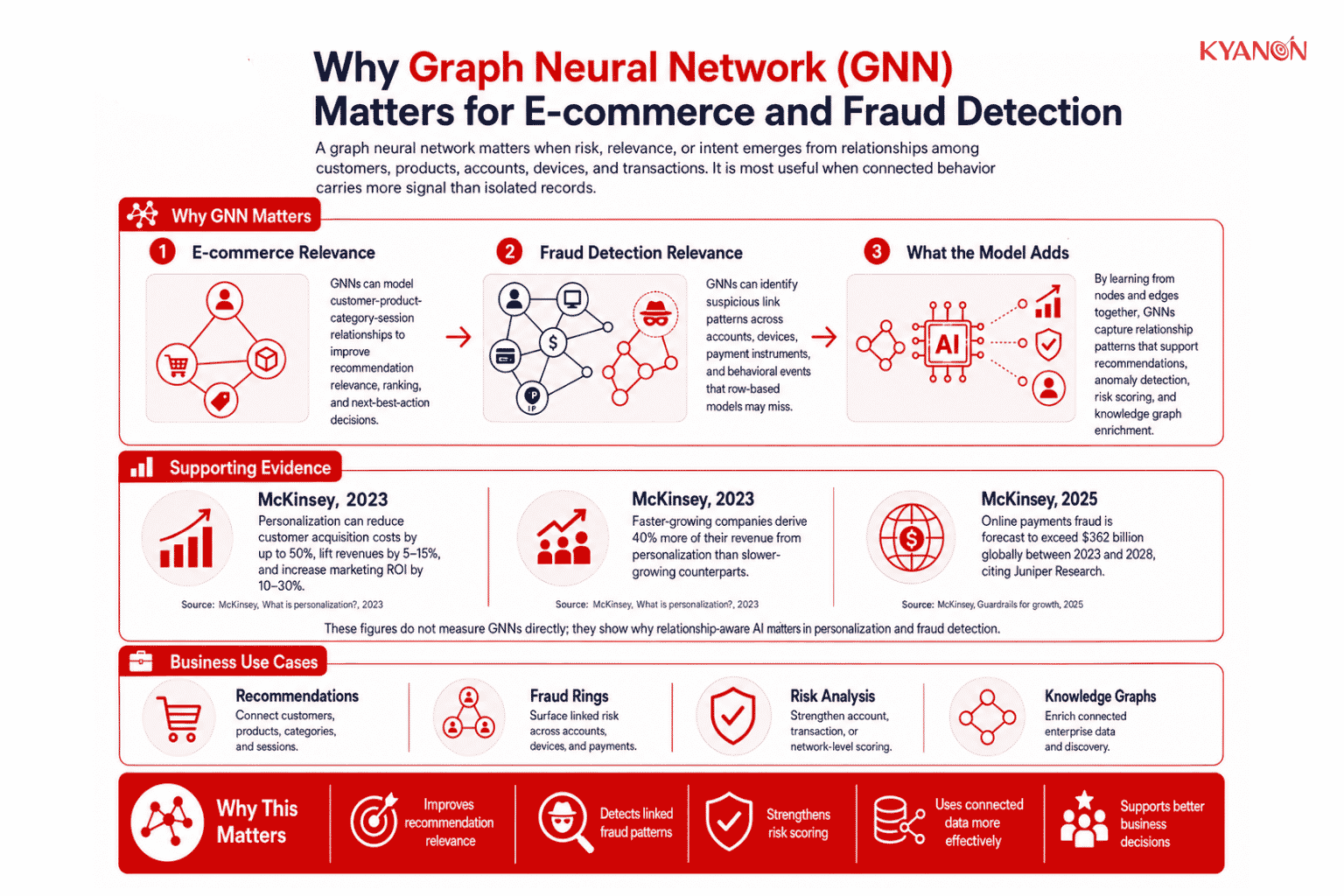
A graph neural network is relevant to e-commerce and fraud detection when risk, relevance, or intent emerges from relationships among customers, products, accounts, devices, and transactions.
The Association of Certified Fraud Examiners reported in 2024 that Certified Fraud Examiners estimate organizations lose 5% of revenue to fraud each year, based on 1,921 fraud cases across 138 countries and territories. For enterprises, this makes relationship-based fraud analysis commercially relevant because suspicious activity often appears across connected entities rather than in a single transaction record.
In e-commerce, a GNN can model customer-product-category-session relationships to improve recommendation relevance or detect abnormal purchasing patterns. In financial services or digital commerce, the same graph approach can connect accounts, devices, payment instruments, and behavioral events to identify risk patterns that row-based models may miss.
Common Misconceptions
Graph neural networks are not automatically better than simpler models; their value depends on whether graph relationships provide a predictive signal that justifies added data, architecture, and operations complexity.
“A deeper GNN will always perform better.”
Reality: More GNN layers can degrade performance because node representations may become too similar or because long-range information is compressed into limited vectors. Research on GNN depth identifies over-smoothing and over-squashing as key limits when stacking graph convolution layers.
“If we have graph data, we should use a GNN.”
Reality: A GNN is only justified when relationships improve the target outcome beyond what simpler models can deliver. Several studies show that graph-aware models may provide limited gains or underperform structure-agnostic approaches when graph structure is weak, noisy, or poorly aligned with the prediction task.
“Oversmoothing is the only reason deep GNNs fail.”
Reality: Oversmoothing is only one failure mode. Over-squashing, optimization difficulty, graph noise, weak edge quality, and poor benchmark fit can also limit GNN performance, so leaders should evaluate architecture choice against business metrics, not model novelty.
How Kyanon Digital Applies Graph Neural Network (GNN)
Kyanon Digital applies graph neural network concepts within AI and machine learning initiatives where connected data can improve recommendations, anomaly detection, fraud analysis, knowledge graph enrichment, or predictive analytics.
Kyanon Digital’s machine learning software development offerings include custom ML solutions, predictive analytics and data modeling, AI-powered automation, NLP and computer vision, and ML model deployment and optimization, which are relevant capabilities for evaluating and operationalizing graph-based AI systems.
→ Explore our machine learning AI development services.

 Create project brief with AI