
What is Knowledge Graph?
A knowledge graph is a semantic data model that connects entities, relationships, and business rules so systems can understand how information is related across a domain (IBM).
In enterprise AI, a knowledge graph gives business context to data by showing how customers, products, contracts, suppliers, assets, policies, transactions, or locations connect.
How Knowledge Graph Works
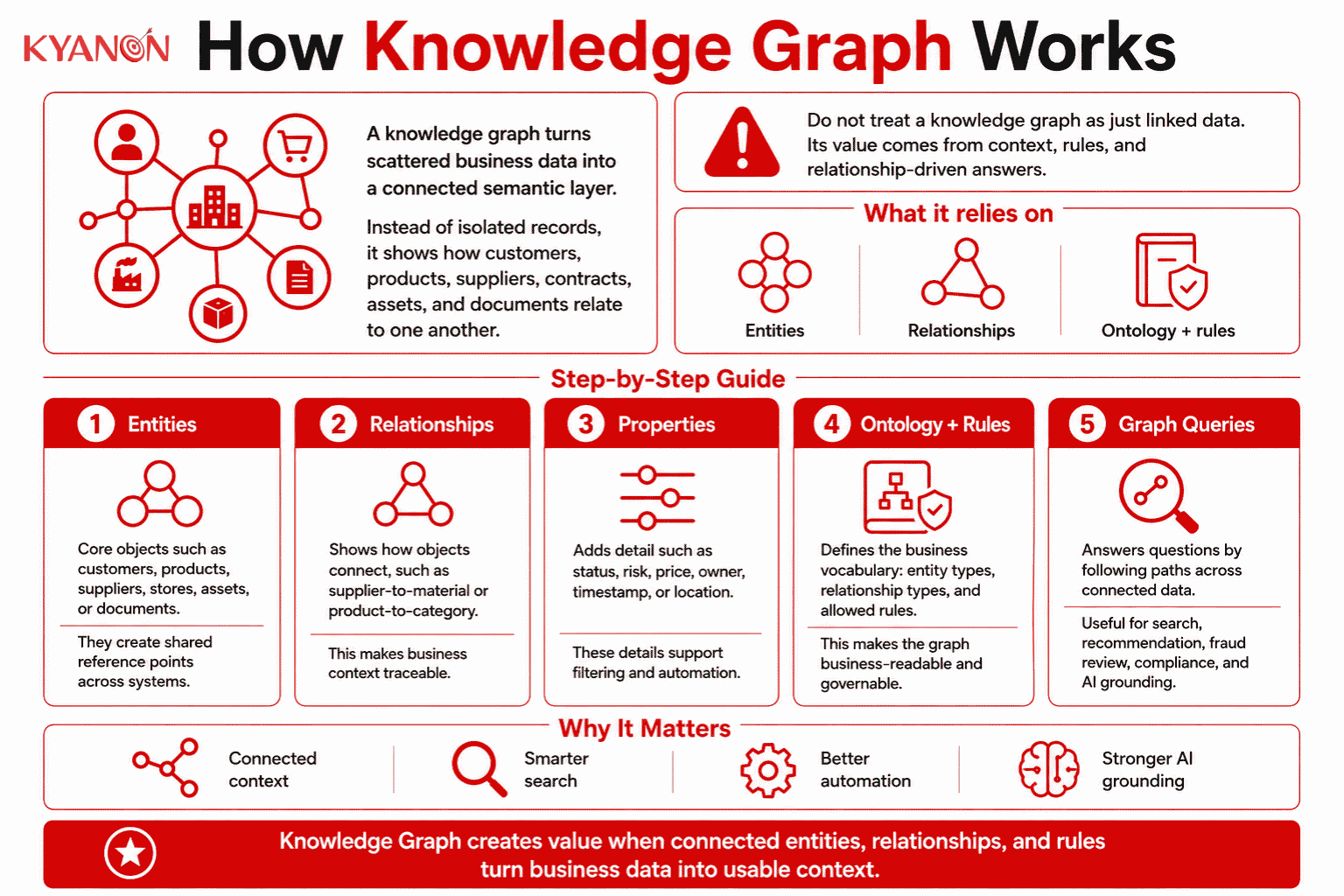
A knowledge graph works by turning scattered business data into a connected semantic layer. Instead of storing information as isolated records, it shows how customers, products, suppliers, contracts, policies, assets, or documents relate to one another.
It works effectively because enterprise questions often depend on context, not just keywords.
Entities
Entities are the core business objects in the graph, such as customers, products, suppliers, contracts, machines, stores, or documents.
They work as shared reference points across systems, so the same customer, supplier, or product can be recognized across CRM, ERP, CMS, data warehouse, and operational platforms.
Relationships
Relationships explain how entities connect, such as “supplier provides material,” “contract contains clause,” or “product belongs to category.”
They make the graph useful because business teams can trace context across systems instead of searching one database at a time.
Properties
Properties add details such as risk level, location, status, timestamp, category, ownership, price, or approval condition.
They help systems filter, rank, validate, and automate decisions based on business rules.
Ontology and Rules
Ontology defines the business vocabulary of the graph, including entity types, relationship types, and allowed rules.
This makes the graph business-readable, so AI search, recommendation, and compliance workflows can use connected data with clearer context.
Graph Queries
Graph queries retrieve answers by following relationship paths across connected data.
This is why knowledge graphs are useful for intelligent search, recommendation, fraud investigation, compliance automation, and AI grounding.

Knowledge Graph vs Graph Database
A graph database stores connected data, while a knowledge graph defines the business meaning of connected data.
Dimension | Knowledge Graph | Graph Database |
Primary purpose | Models business meaning, relationships, rules, and context | Stores and queries connected data |
| Main business value | Improves search, recommendation, AI grounding, compliance traceability, and semantic integration | Improves traversal, relationship queries, and graph data performance |
Semantic layer | Requires ontology, entity definitions, relationship meaning, and governance | May store relationships without formal business semantics |
| Best for | Enterprise AI search, RAG grounding, legal compliance, product discovery, fraud investigation, supplier risk analysis | Network analysis, fraud patterns, pathfinding, dependency mapping, relationship-heavy queries |
AI relevance | Provides structured context that can guide AI retrieval and reasoning | Provides graph storage but does not automatically make AI outputs more reliable |
| Relationship depth | Designed for multi-hop business questions across domains | Designed for efficient graph queries within stored data |
Data warehouse role | Usually complements warehouses, lakes, APIs, and operational systems | Usually acts as a database layer for graph-shaped data |
| Governance need | High: requires data quality, ownership, ontology stewardship, and source provenance | Medium to high: requires database governance, access control, and performance management |
When to Consider Knowledge Graph
Consider a knowledge graph if:
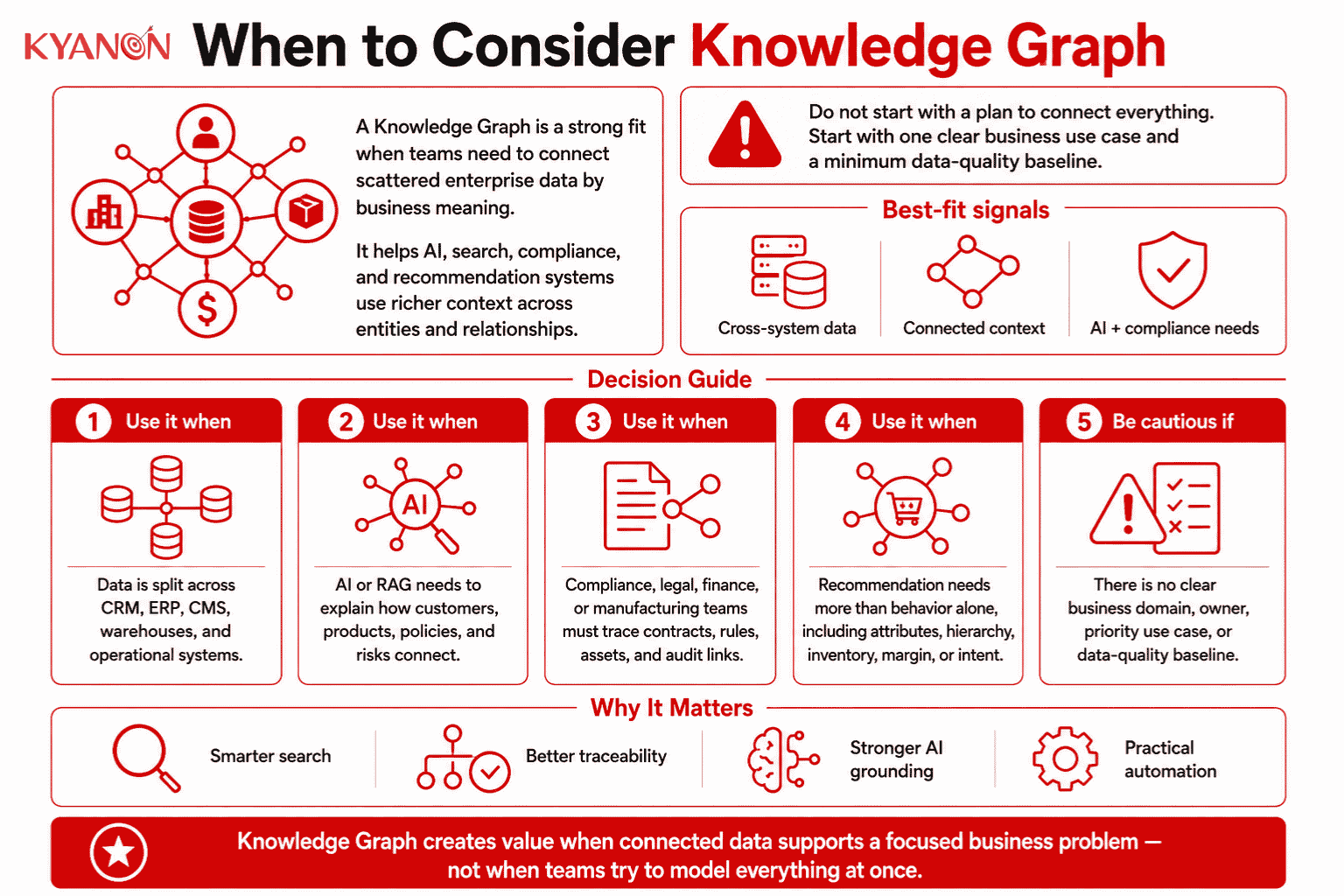
- Your enterprise data is spread across CRM, ERP, CMS, data warehouse, document repositories, and operational systems, and teams cannot search across them by business meaning.
- Your AI or RAG system retrieves documents but cannot explain how customers, products, policies, risks, suppliers, or obligations are connected.
- Your compliance, legal, finance, or manufacturing teams need to trace relationships across contracts, clauses, regulations, transactions, assets, suppliers, and audit evidence.
- Your recommendation system needs more context than user behavior alone, such as product attributes, category hierarchy, inventory status, margin, seasonality, and customer intent.
It may not be the right priority if:
Your organization has not defined a clear business domain, data owner, priority use case, or minimum data quality baseline. A knowledge graph should start with a focused business problem, not a broad plan to “connect everything.”
Why Knowledge Graph Matters for Enterprise AI
Knowledge graphs matter for enterprise AI because they give AI systems a structured business context, not just isolated documents or keyword matches.
This is important as AI investment grows faster than AI maturity. McKinsey reported in 2025 that 92% of companies planned to increase AI investment, but only 1% considered themselves mature in AI deployment.
Knowledge graphs help close this gap by connecting facts, entities, and relationships across enterprise systems. This makes AI search, recommendation, compliance automation, and RAG workflows more explainable and context-aware.
Google’s Knowledge Graph shows the concept at scale. When launched in 2012, it contained 500M+ objects and 3.5B+ facts and relationships, helping Google Search understand “things, not strings.”
Real-World Examples of Knowledge Graph
Google Search
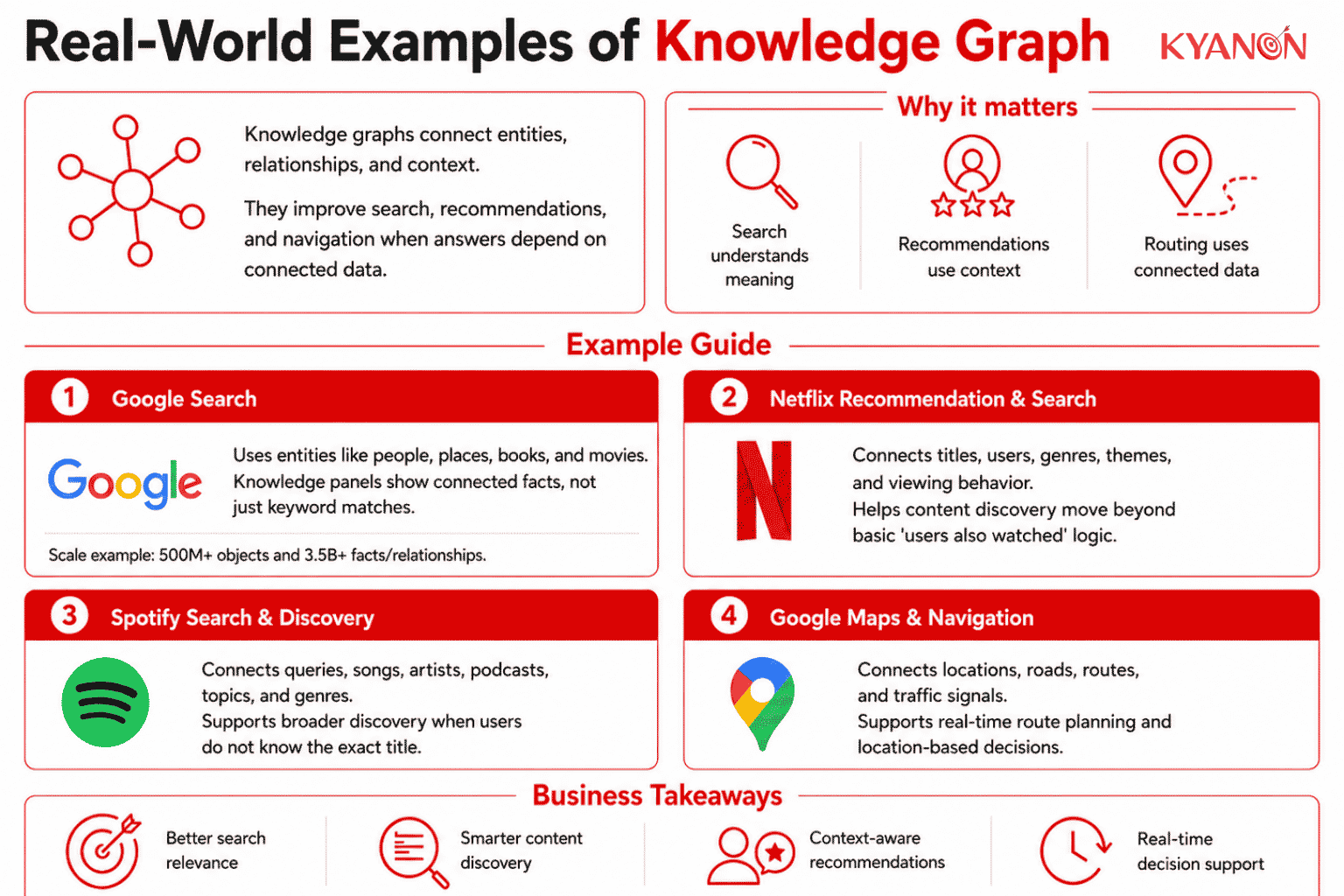
Google uses its Knowledge Graph to understand entities such as people, places, organizations, movies, books, and concepts. When a user searches for a celebrity and sees a side panel with birth date, spouse, movies, and related people, that result is supported by entity relationships rather than only keyword matching.
Google’s Knowledge Graph launched with more than 500 million objects and more than 3.5 billion facts and relationships, making it one of the most visible examples of knowledge graph use in consumer search.
Netflix Recommendation and Search
Netflix applies graph-based approaches to connect titles, users, viewing behavior, genres, themes, and semantic relationships for recommendation and search use cases. In business terms, this helps the platform move beyond “users also watched” logic toward more contextual discovery across content attributes and user intent.
For media and commerce platforms, the lesson is that knowledge graphs can support recommendations where the system needs to understand relationships between users, items, categories, attributes, and behavior signals.
Spotify Search and Discovery
Spotify has discussed graph learning for exploratory search, where graphs connect queries, songs, artists, podcasts, topics, and genres. This allows the system to support discovery paths that are broader than exact keyword matching.
For digital product teams, this shows how graph-based models can improve search and recommendation when users do not know the exact title, product, or category they want.
Google Maps and Navigation
Google Maps connects locations, roads, traffic patterns, live traffic conditions, routes, business places, and geographic signals to support routing and navigation. Google has explained that Maps combines historical traffic patterns with live traffic conditions and machine learning to predict traffic and determine routes (Google DeepMind).
For logistics, retail, and field service businesses, this illustrates how connected location data can support real-time decisions such as route planning, store discovery, delivery optimization, and infrastructure monitoring.
Common Misconceptions
“A knowledge graph is just a graph database.”
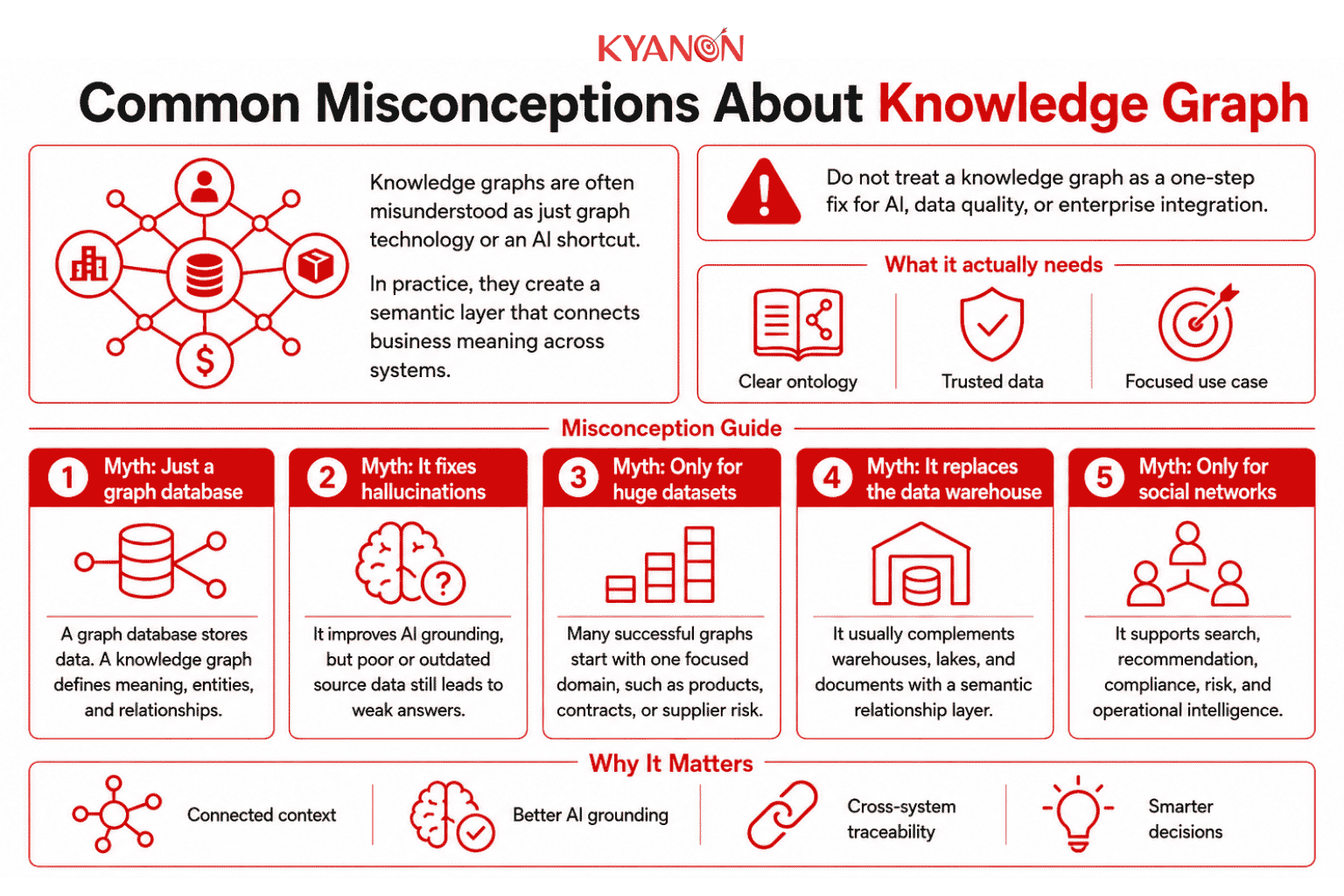
Reality: A graph database is a storage technology; a knowledge graph is a semantic model that defines what the data means. For a CTO, the real decision is not only whether to use Neo4j, Amazon Neptune, or another graph store, but whether the enterprise has a clear ontology, data governance model, and business use case.
“A knowledge graph will completely solve LLM hallucinations.”
Reality: A knowledge graph can improve AI grounding by giving an LLM structured facts and relationships, but it cannot fix incomplete, outdated, or incorrect source data. If the graph contains poor data, the AI system can still produce poor answers.
“Knowledge graphs only work for massive datasets.”
Reality: A knowledge graph does not need to describe the entire enterprise to be useful. Many effective enterprise graphs start with one focused domain, such as product data, legal clauses, supplier risk, customer identity, asset maintenance, or compliance obligations.
“Building a knowledge graph means replacing the data warehouse.”
Reality: A knowledge graph usually complements the data warehouse by adding a semantic relationship layer above existing systems. It can connect data from warehouses, lakes, APIs, documents, and operational databases without requiring every source to be replaced.
“Knowledge graphs are only for social networks.”
Reality: Knowledge graphs are useful wherever the business needs to understand relationships across entities. Finance, legal, manufacturing, retail, logistics, and healthcare all use graph-based models for risk analysis, compliance, recommendation, search, and operational intelligence.
How Kyanon Digital Applies Knowledge Graph
Kyanon Digital builds knowledge graphs for enterprise clients in finance, legal, manufacturing, and commerce contexts where search, recommendation, compliance automation, and AI grounding depend on connected business meaning. The implementation typically combines domain modeling, entity extraction, ontology design, data integration, graph storage, API orchestration, and governance workflows across existing enterprise systems.
For Southeast Asian enterprises, Kyanon Digital’s approach starts with a bounded business domain, validates the use case, integrates with current data platforms, and measures outcomes such as search relevance, review time, compliance traceability, recommendation accuracy, and total cost of ownership.
→ Explore our Data & AI services for enterprise knowledge graph implementation.

 Create project brief with AI