
What is Ground Truth?
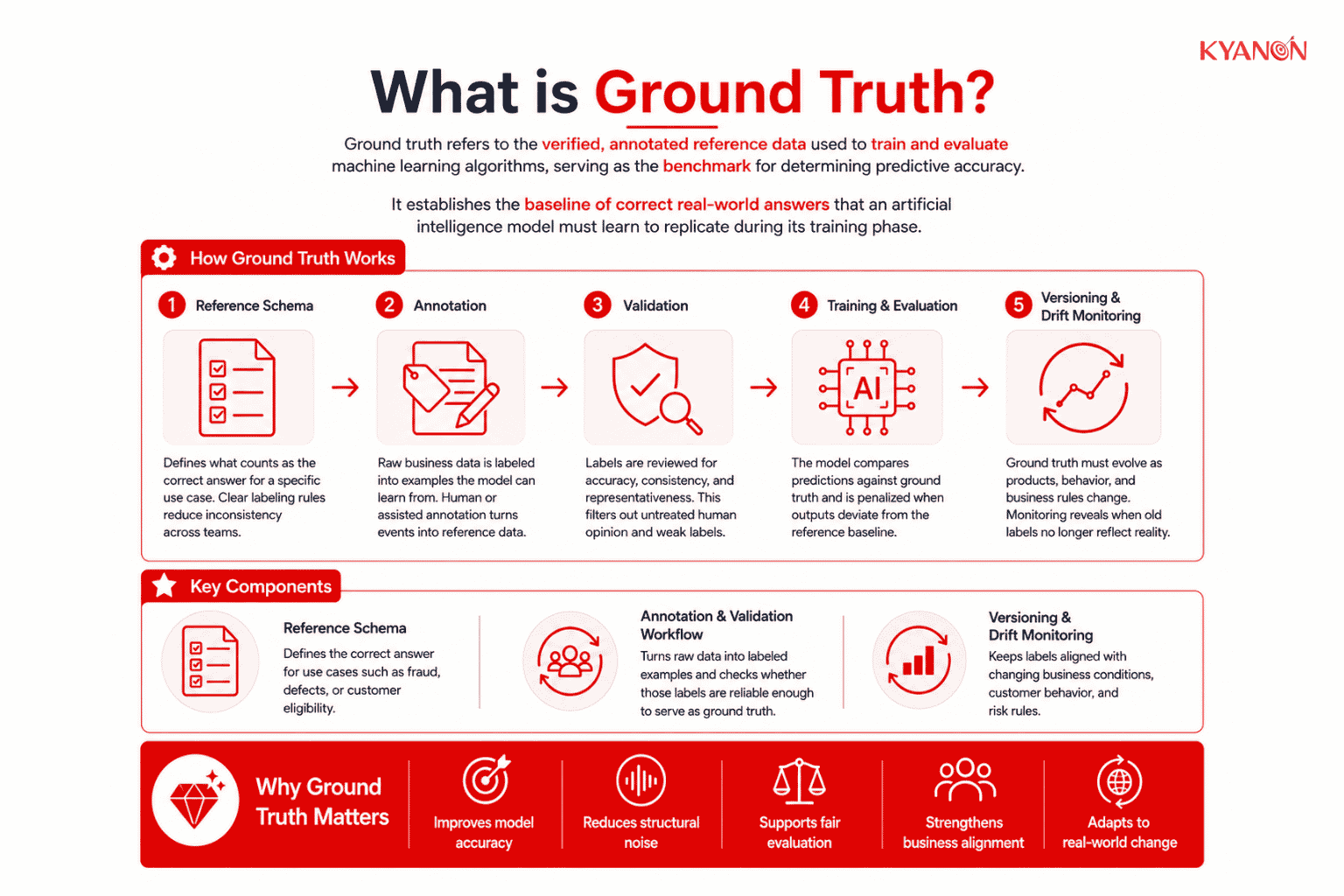
Ground truth refers to the verified, annotated reference data used to train and evaluate machine learning algorithms, serving as the benchmark for determining predictive accuracy. It establishes the baseline of correct real-world answers that an artificial intelligence model must learn to replicate during its training phase.
How Ground Truth Works
Ground truth functions as the calibration standard during the supervised machine learning lifecycle, forcing the algorithm to mathematically penalize itself when its calculated outputs deviate from the established human-annotated baseline. This mechanism ensures the neural network adjusts its internal weights toward documented reality rather than structural noise.
Reference Schema
The reference schema defines what counts as a correct answer for a specific use case, such as “fraudulent transaction,” “defective product,” or “eligible customer.” Without a clear schema, different teams may label the same case differently, which makes the model learn inconsistency rather than business logic.
Annotation and Validation Workflow
Annotation converts raw business data into labeled examples that the model can learn from. Validation checks whether labels are accurate, consistent, and representative enough to be used as ground truth instead of untreated human opinion.
Versioning and Drift Monitoring
Ground truth must be versioned because business definitions, customer behavior, product catalogs, and risk rules change over time. Drift monitoring helps teams detect when historical labels no longer reflect current operating conditions.

Ground Truth by Industry
Ground truth has the same core meaning across industries: it is the verified reference data used to train, test, or calibrate an AI system. However, each industry defines “correct data” differently depending on the business task.
| Industry | What Ground Truth Means | Example |
|---|---|---|
| Machine Learning and AI | The correct label or target answer in a dataset | A human-verified image label such as “cat,” “dog,” or “defective product” |
| Retail and E-commerce | Verified product, customer, transaction, or category data | A product image correctly matched to the right SKU and category |
| Fraud Detection | Confirmed fraud or non-fraud outcomes | A transaction marked as fraudulent after investigation |
| Remote Sensing and GIS | Field-measured data used to verify satellite or aerial imagery | GPS coordinates, soil samples, or land-use observations collected on-site |
| Autonomous Driving | Human-labeled sensor data from cameras, radar, and lidar | A pedestrian, vehicle, lane, or obstacle labeled frame by frame |
| Healthcare AI | Expert-confirmed clinical labels or diagnoses | A radiologist-confirmed anomaly in a medical image |
Why Ground Truth Matters
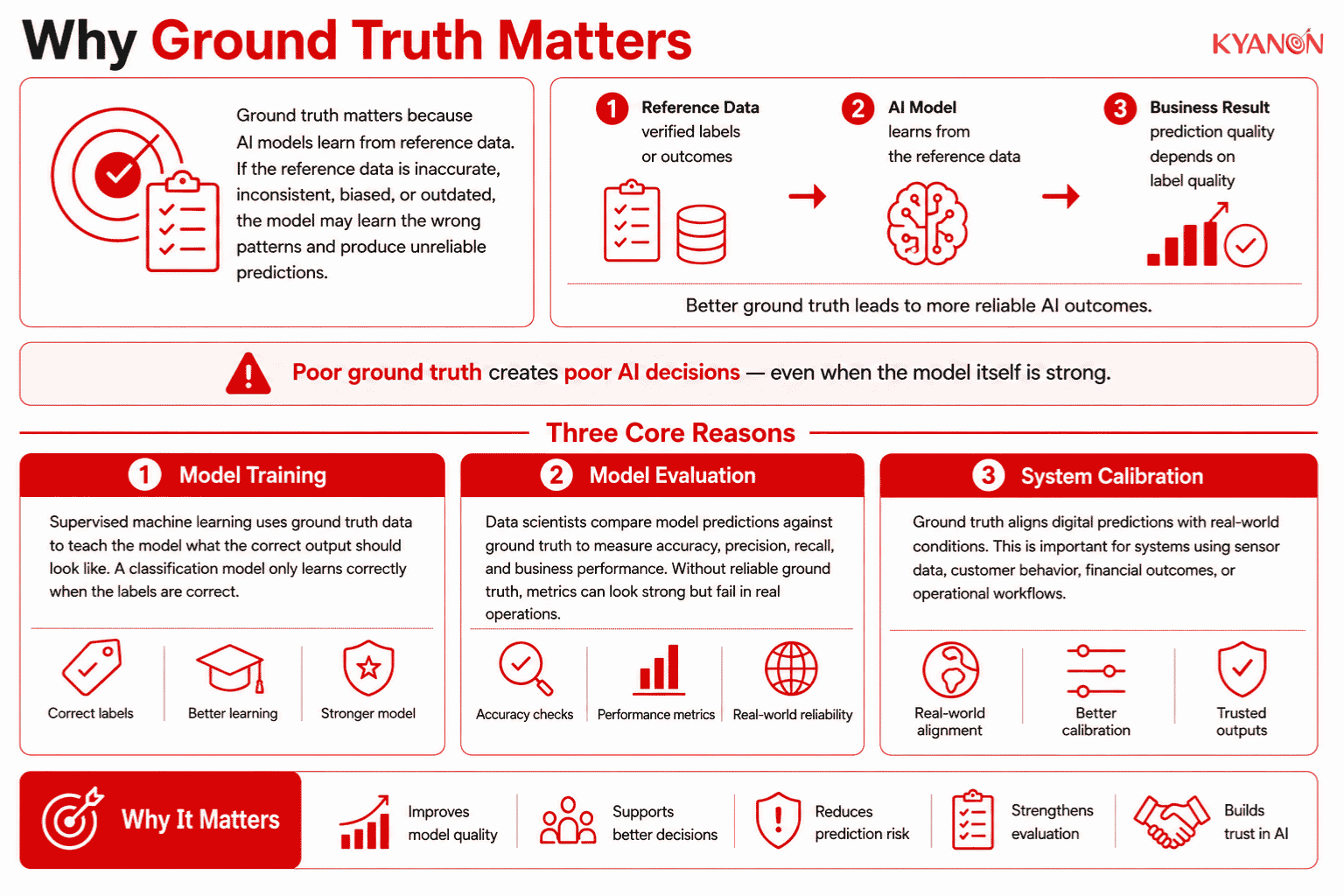
Ground truth matters because AI models learn from reference data. If the reference data is inaccurate, inconsistent, biased, or outdated, the model may learn the wrong patterns and produce unreliable predictions.
Model Training
Supervised machine learning uses ground truth data to teach the model what the correct output should look like. For example, a classification model learns to detect defective products only if the training images are labeled correctly.
Model Evaluation
Data scientists compare model predictions against ground truth to measure accuracy, precision, recall, and business performance. Without reliable ground truth, performance metrics may look strong but fail in real-world operations.
System Calibration
Ground truth helps align digital predictions with real-world conditions. This is important for AI systems that depend on sensor data, physical environments, customer behavior, financial outcomes, or operational workflows.
What Makes Good Ground Truth Data?
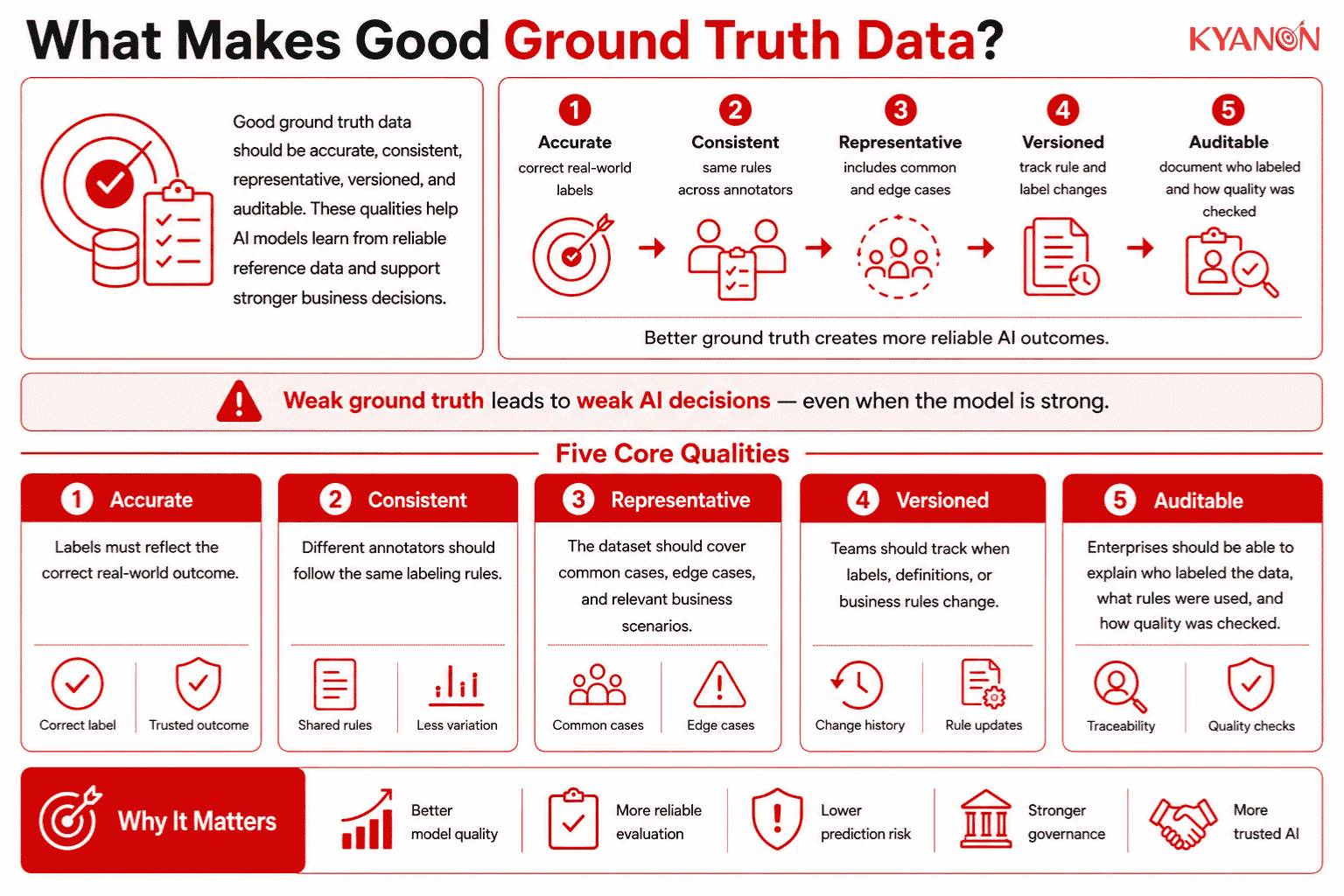
Good ground truth data should be accurate, consistent, representative, and auditable.
- Accurate: Labels must reflect the correct real-world outcome.
- Consistent: Different annotators should follow the same labeling rules.
- Representative: The dataset should include common cases, edge cases, and relevant business scenarios.
- Versioned: Teams should track when labels, definitions, or business rules change.
- Auditable: Enterprises should be able to explain who labeled the data, what rules were used, and how quality was checked.
Ground Truth vs Evaluation Data
Both rely on verified human annotations to function, but they serve distinctly different phases of the algorithmic lifecycle and must remain strictly isolated from one another.
Dimension | Ground Truth (Training Data) | Evaluation Data (Testing Data) |
| Lifecycle Phase | Model training and parameter adjustment | Post-training validation |
Functional Role | The “textbook” the model learns from | The “exam” that tests the model |
| Visibility to Model | Fully exposed during algorithm iterations | Strictly hidden until final testing |
Objective | Minimize loss and adjust weights | Measure real-world generalization |
| Risk of Contamination | High (leads to data leakage if mixed) | Low (must remain isolated) |
When to Consider Investing in Ground Truth Generation
Consider building custom ground truth pipelines if:
- Your engineering team is deploying AI for a highly specialized technical domain where off-the-shelf foundation models lack the necessary industry-specific vocabulary to function.
- Your current automated classification systems are producing high error rates, indicating that the original training data has drifted from current real-world operational conditions.
- Your organization faces strict regulatory compliance requirements that demand fully auditable and transparent training data origins to prove algorithmic fairness.
It may not be the right priority if:
- Your data science initiatives rely entirely on generalized public APIs for broad sentiment analysis, where zero-shot learning achieves your required accuracy thresholds without custom fine-tuning.
Why Ground Truth Matters for Enterprise AI Deployment
For enterprise AI, ground truth determines whether model performance is measured against operational reality or against a flawed proxy.
According to Gartner in 2025, 63% of organizations either do not have or are unsure if they have the right data management practices for AI, based on a survey of 1,203 data management leaders; Gartner also predicts that through 2026, organizations will abandon 60% of AI projects unsupported by AI-ready data.
For a retail or e-commerce enterprise, poor ground truth can mean a product classification model learns from inconsistent category labels, a recommendation model optimizes for the wrong purchase signal, or a fraud model flags legitimate customers. In this context, ground truth is not just a data science input; it is a control layer for model reliability, business alignment, and measurable AI value.
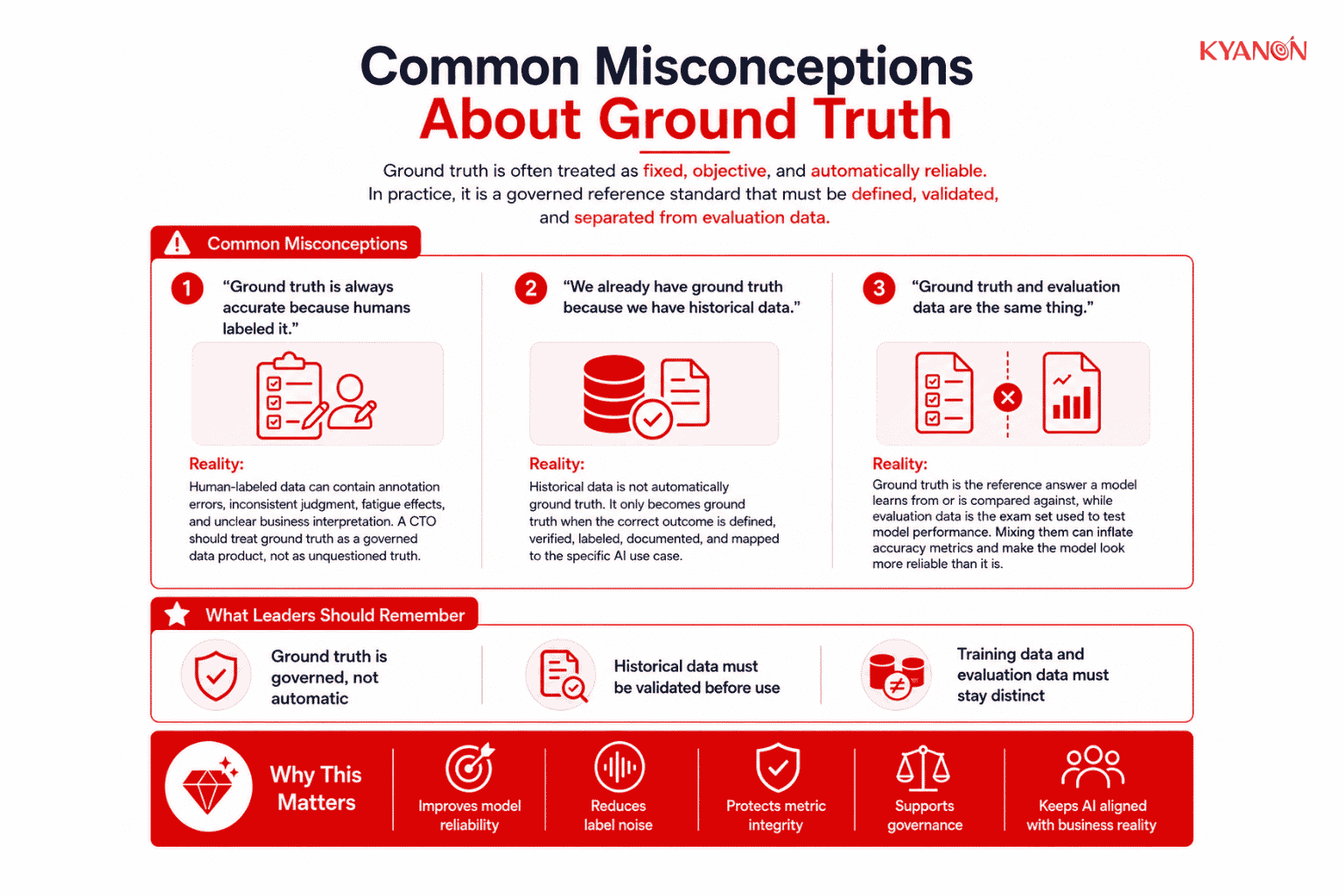
Common Misconceptions
“Ground truth is always accurate because humans labeled it.”
Reality: Human-labeled data can contain annotation errors, inconsistent judgment, fatigue effects, and unclear business interpretation. A CTO should treat ground truth as a governed data product, not as unquestioned truth.
“We already have ground truth because we have historical data.”
Reality: Historical data is not automatically ground truth. It only becomes ground truth when the correct outcome is defined, verified, labeled, documented, and mapped to the specific AI use case.
“Ground truth and evaluation data are the same thing.”
Reality: Ground truth is the reference answer a model learns from or is compared against, while evaluation data is the exam set used to test model performance. Mixing them can inflate accuracy metrics and make the model look more reliable than it is.
How Kyanon Digital Applies Ground Truth
Kyanon Digital applies ground truth through AI and data annotation workflows, labeling schema design, validation rules, quality control, and model evaluation support for enterprise AI use cases across Southeast Asia and global delivery markets. Its Operate & Support portfolio includes AI & Data Annotation Services covering image and video annotation, text and document annotation, audio transcription and labeling, custom annotation workflows, and 3D point cloud annotation.
→ → Explore our AI & Data Annotation Services

 Create project brief with AI