
What is Inference Engine?
An inference engine is a specialized software runtime that executes pre-trained machine learning models to analyze live input data and generate actionable predictions or logical deductions. It serves as the production-facing layer of an AI architecture, translating static mathematical weights into dynamic business outputs such as recommendations, classifications, risk scores, generated responses, or automated decisions.
What Are the Core Deployment Bottlenecks?
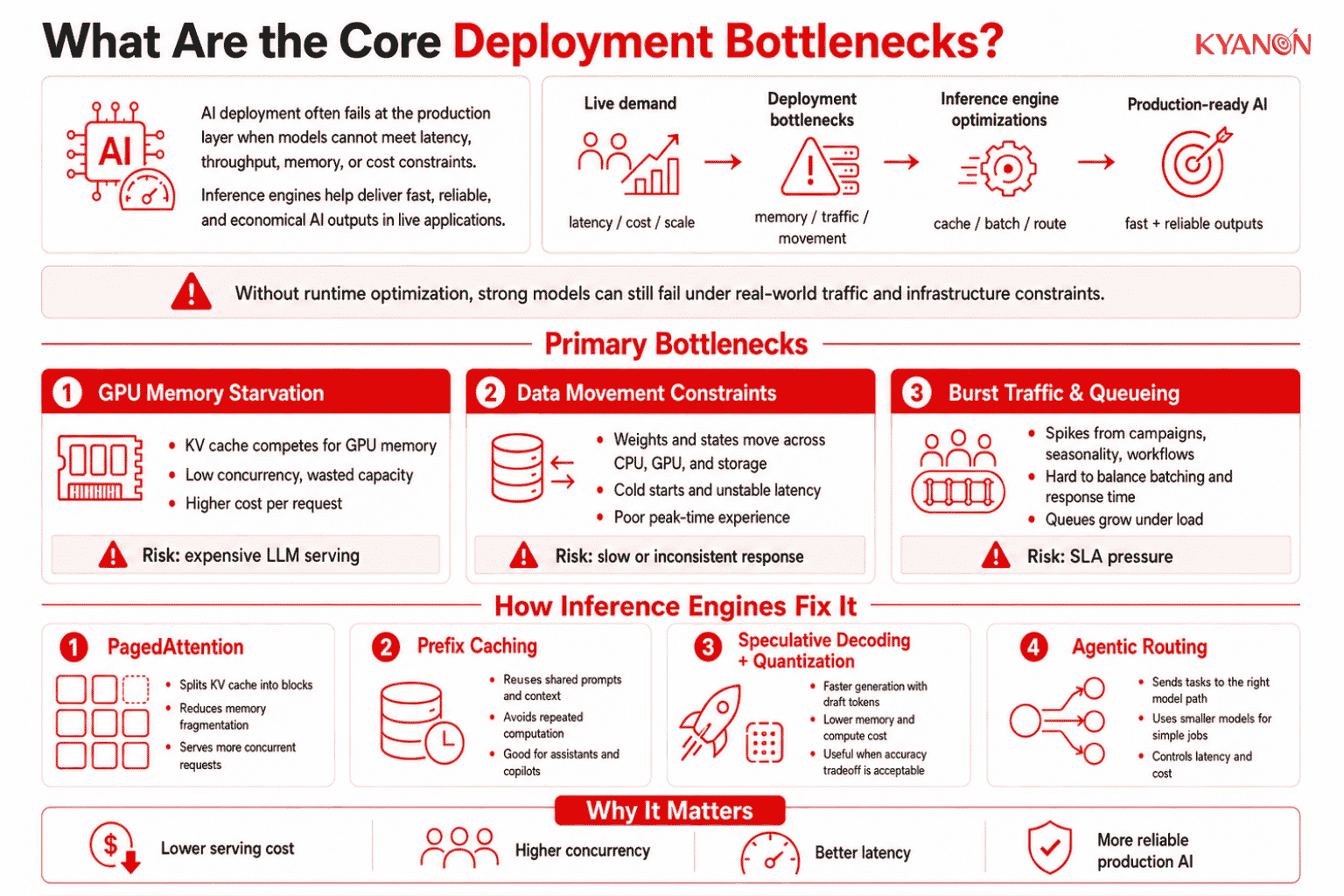
AI deployment often fails at the production layer because trained models must meet real-world constraints such as latency, throughput, memory usage, traffic spikes, infrastructure cost, and system reliability. An inference engine becomes critical when the business needs AI outputs to be delivered repeatedly, quickly, and economically inside live applications.
GPU Memory Starvation
Large language models require memory not only for model weights, but also for runtime data such as the Key-Value cache used during token generation. Poor memory allocation can limit concurrency, waste GPU capacity, and increase the cost per request.
Data Movement Constraints
Production inference can slow down when large model weights, embeddings, or intermediate states must move across CPUs, GPUs, storage systems, or distributed clusters. For enterprise applications, these delays can create cold-start problems, unstable response times, and poor user experience during peak traffic.
Burst Traffic and Queueing
Inference workloads are often unpredictable because customer activity, campaign launches, seasonal demand, or internal business workflows can create sudden query spikes. Standard serving systems may struggle to balance batching efficiency with individual response-time requirements.

How Inference Engines Fix the Problem
Modern inference engines reduce deployment bottlenecks by optimizing how model requests are scheduled, batched, cached, routed, and executed across available hardware. For enterprise AI systems, the inference engine directly influences whether a model can meet production service-level expectations without excessive infrastructure cost.
Paged Attention
Paged Attention divides the Key-Value cache into smaller memory blocks instead of requiring one large contiguous allocation. This reduces fragmentation and allows inference systems to serve more concurrent requests using the same GPU memory.
Prefix Caching
Prefix caching stores repeated context, such as system prompts, policy instructions, or shared conversation history, so the engine does not recompute the same tokens for every request. This is especially useful for enterprise assistants, internal knowledge tools, customer service copilots, and commerce AI agents that reuse common instructions.
Speculative Decoding and Quantization
Speculative decoding uses a smaller draft model to propose tokens that a larger model can verify, reducing generation time for some LLM workloads. Quantization reduces model precision to lower memory and compute requirements, helping enterprises reduce serving cost when accuracy remains acceptable.
Agentic Routing and Orchestration
Agentic routing sends different tasks to the most appropriate model, runtime, or hardware path based on complexity, latency target, and cost. In enterprise environments, orchestration helps prevent high-cost models from being used for simple requests that a smaller model or rules engine can handle.
How Inference Engines Work
An inference engine functions by loading compiled model artifacts into system memory and applying mathematical operations to incoming user requests. Rather than updating neural weights as seen during the training phase, the engine optimizes the execution graph and manages hardware resources, such as CPU threads, GPU memory, and tensor cores, to maximize request throughput while maintaining strict latency thresholds.
Request Scheduler
The scheduler manages incoming API calls by batching concurrent queries together (dynamic batching). This component maximizes underlying compute utilization without exceeding the maximum acceptable latency for any individual user request.
Execution Engine
This layer maps the model’s computational graph to the underlying hardware architecture. It executes highly optimized kernel operations for matrix multiplication and tensor processing, stripping away the gradient descent calculations required during training.
Memory Manager
The memory manager allocates and deallocates VRAM dynamically. Large Language Models (LLMs) utilize techniques like KV caching to prevent memory fragmentation and accelerate token generation for sequential text outputs.
How Inference Engines Work
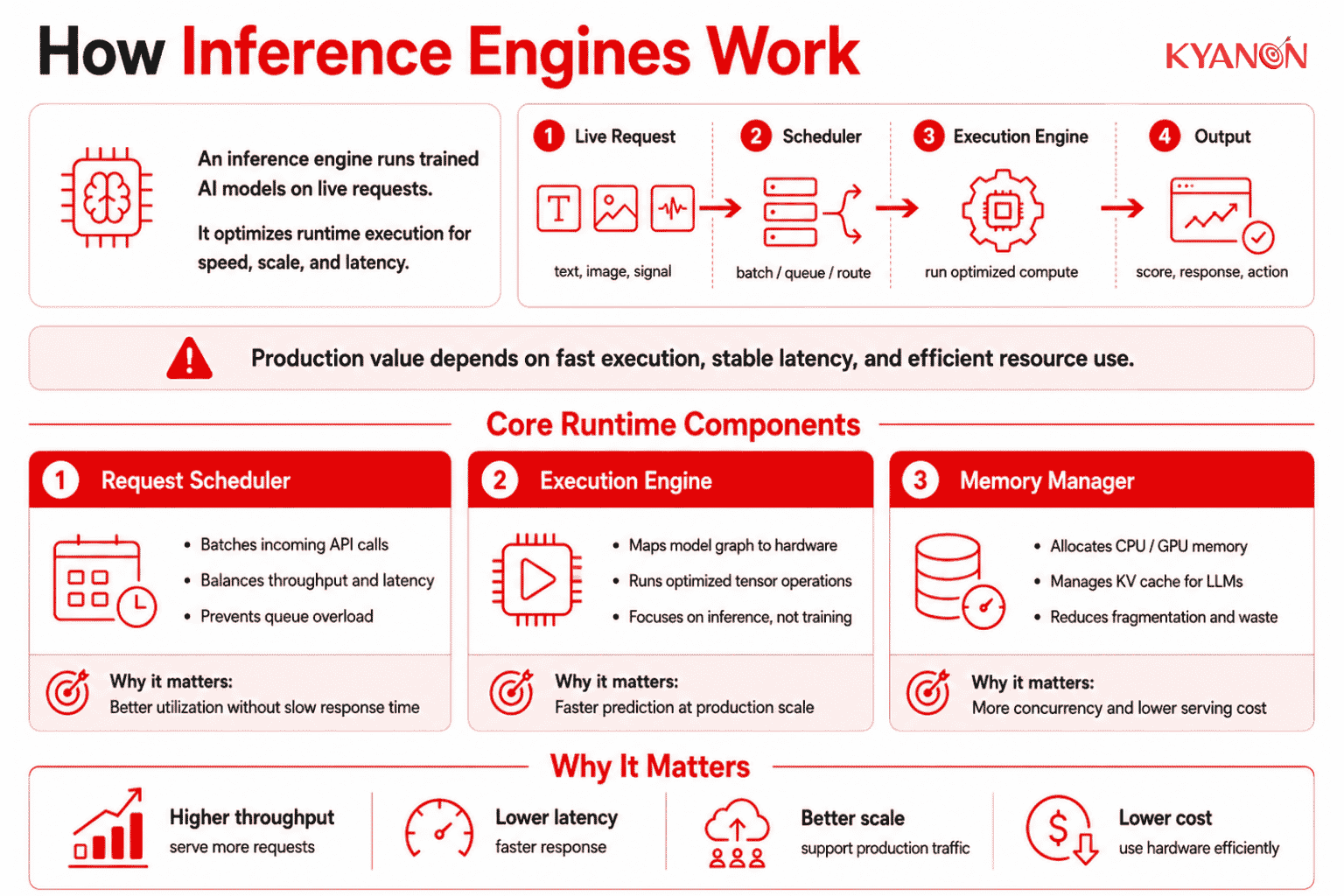
An inference engine functions by loading compiled model artifacts into system memory and applying mathematical operations to incoming user requests. Rather than updating neural weights as seen during the training phase, the engine optimizes the execution graph and manages hardware resources, such as CPU threads, GPU memory, and tensor cores, to maximize request throughput while maintaining strict latency thresholds.
Request Scheduler
The scheduler manages incoming API calls by batching concurrent queries together (dynamic batching). This component maximizes underlying compute utilization without exceeding the maximum acceptable latency for any individual user request.
Execution Engine
This layer maps the model’s computational graph to the underlying hardware architecture. It executes highly optimized kernel operations for matrix multiplication and tensor processing, stripping away the gradient descent calculations required during training.
Memory Manager
The memory manager allocates and deallocates VRAM dynamically. Large Language Models (LLMs) utilize techniques like KV caching to prevent memory fragmentation and accelerate token generation for sequential text outputs.
Inference Engine vs Batch Inference
An inference engine is the runtime system that executes model logic, while batch inference is a processing pattern where predictions are generated in scheduled or bulk jobs. Both support AI deployment, but they solve different production requirements.
| Dimension | Inference Engine | Batch Inference |
|
Primary role |
Executes trained models or rules at runtime | Runs predictions on large groups of records |
| Response pattern | Real-time, near-real-time, or API-driven |
Scheduled, offline, or bulk processing |
|
Best for |
Chatbots, recommendations, fraud scoring, visual search, personalization, AI agents | Customer segmentation, demand forecasting, churn scoring, catalog enrichment |
| Latency requirement | Usually milliseconds to seconds |
Usually minutes to hours |
|
Cost driver |
GPU/CPU utilization, memory, concurrency, token volume, response-time targets | Data volume, job frequency, compute duration, pipeline complexity |
| Scaling challenge | Peak traffic, queueing, memory fragmentation, serving reliability |
Data pipeline reliability, job orchestration, data freshness |
|
Business risk |
Slow response can affect conversion, UX, or operational decisions | Delayed output can affect planning, reporting, or campaign timing |
| Governance need | Runtime monitoring, fallback logic, cost control, safety checks |
Data validation, lineage, scheduling, output quality control |
When to Consider Inference Engine
An inference engine should be considered when AI output becomes part of a live workflow where response time, reliability, and cost affect business performance.
For CTOs, VP Engineering leaders, and IT Directors, this usually happens when AI moves from experiment to production deployment.
Consider the Inference Engine if:
- Your AI deployment experiences latency spikes during peak traffic, causing timeouts, slow recommendations, poor chatbot response times, or lower conversion quality.
- You are moving from traditional machine learning models to large language models and need specialized runtime capabilities such as continuous batching, KV caching, tensor parallelism, or model routing.
- Your cloud compute costs are rising because models are running on general-purpose infrastructure without an optimized model serving runtime.
- Your business needs different inference paths for different workloads, such as real-time personalization, offline scoring, fraud detection, product search, and customer service automation.
It may not be the right priority if:
- Your application relies entirely on third-party AI APIs where the vendor controls the serving infrastructure, model runtime, hardware optimization, and scaling layer.
- Your AI use case is still at the prototype stage and does not yet have stable usage volume, business ownership, or measurable production requirements.
Why an Inference Engine Matters for Enterprise Architecture
An inference engine matters because enterprise AI value depends on the ability to serve model outputs at the right speed, cost, and reliability level for each business workflow. A model that performs well in testing can still fail commercially if the production runtime is too slow, too expensive, or too difficult to scale.
As enterprise AI moves from pilots to production, inference architecture has become a direct TCO concern. Databricks reported in 2026 that its cost-aware load balancing and autoscaling approach saved over 80% in GPU costs compared with static provisioning while maintaining latency targets. The company also noted that its inference platform serves more than 125 trillion tokens per month, showing how production-scale AI creates continuous serving, routing, and capacity-management demands.
NVIDIA’s 2026 inference guidance also reinforces this shift: cost per token is now treated as a key metric for AI infrastructure TCO because inference performance depends on the full stack, including GPUs, networking, storage, runtime software, routing, and orchestration. For enterprise architecture teams, this means inference optimization is not only a model-performance issue; it is a scalability, cost-control, and reliability issue.
A retail enterprise deploying AI-powered product recommendations may need sub-second inference during campaign peaks, while a finance team running monthly risk scoring may be better served by batch inference. The right architecture depends on the business workflow, response-time expectation, model size, hardware profile, cost model, and governance requirements.
Popular Modern Inference Engines
Modern inference engines are designed to improve model serving performance by optimizing batching, memory allocation, hardware execution, request scheduling, and deployment workflows. The right choice depends on the model type, hardware environment, production maturity, and engineering constraints.
vLLM
vLLM is an open-source LLM inference and serving engine known for PagedAttention, a memory management method designed to reduce Key-Value cache waste and improve throughput. It is commonly considered when teams need high-throughput LLM serving across flexible infrastructure environments.
TensorRT-LLM
TensorRT-LLM is NVIDIA’s open-source library for optimizing large language model inference on NVIDIA GPUs. It is often relevant for production environments that standardize on NVIDIA infrastructure and require high-performance serving for large models.
ONNX Runtime
ONNX Runtime is a cross-platform inference runtime for models represented in the ONNX format. It is useful when enterprises need model portability across frameworks, deployment environments, and hardware targets.
Cloud-Native Model Serving Platforms
Cloud-native model serving platforms provide managed deployment, scaling, monitoring, and endpoint management for machine learning models. They can reduce operational burden, but teams still need to evaluate latency, cost, vendor lock-in, and data governance requirements.
Common Misconceptions
Misunderstanding inference engines can lead enterprises to overtrust AI outputs, underestimate runtime cost, or choose the wrong architecture for production AI. The biggest risk is assuming that a good model automatically becomes a reliable business system.
“An inference engine validates truth.”
Reality: An inference engine does not verify whether the underlying data, model, or rule base is factually correct. If the input data is flawed, biased, incomplete, or outdated, the inference engine can still produce a confident but wrong output.
“An inference engine is just a search algorithm.”
Reality: A search algorithm retrieves or ranks existing information, while an inference engine generates predictions, classifications, decisions, or deductions from model logic or rules. For enterprise teams, this distinction matters because inference systems require runtime monitoring, model governance, fallback logic, and cost controls.
“Inference accuracy is always deterministic and objective.”
Reality: Rule-based inference can be deterministic, but modern generative AI inference can vary depending on prompts, sampling settings, model configuration, and runtime behavior. Even deterministic outputs can still be wrong if the model learned biased patterns or lacks the right business context.
“An inference engine thinks like a human.”
Reality: An inference engine does not possess human common sense, intent, or real-world understanding. It applies mathematical patterns, rules, or probabilities to generate outputs that may appear logical without being grounded in human judgment.
“All AI systems use the same type of inference engine.”
Reality: A simple regression model, a rules engine, a computer vision model, and an LLM serving stack can require very different inference architectures. Enterprise teams should select the runtime based on workload type, latency target, throughput, memory use, hardware availability, security, and TCO.
How Kyanon Digital Applies the Inference Engine
Kyanon Digital helps enterprise clients evaluate and optimize inference engines based on production requirements such as latency, throughput, hardware utilization, security, governance, and total cost of ownership. The approach is practical rather than tool-first: workloads are assessed across CPU, GPU, and dedicated AI chip options so each AI deployment can match the right runtime architecture to the right business constraint.
For enterprise clients across Vietnam, Singapore, Malaysia, Thailand, ANZ, the US, and Nordic Europe, Kyanon Digital applies inference engine design to use cases such as AI-powered commerce search, recommendation systems, customer service automation, document intelligence, image recognition, and enterprise AI assistants. The goal is to make AI deployment measurable through response time, serving cost, reliability, conversion impact, and operational scalability.
→ Explore our AI integration development services.

 Create project brief with AI