
What is ONNX (Open Neural Network Exchange)?
ONNX (Open Neural Network Exchange) is an open-source serialization format that represents machine learning models as a standardized graph of mathematical operators, enabling interoperability between different AI training frameworks and deployment environments. By establishing a universal file format, it allows data engineering teams to train an algorithm in one ecosystem and deploy it efficiently across varied hardware architectures without rewriting the model’s core logic.
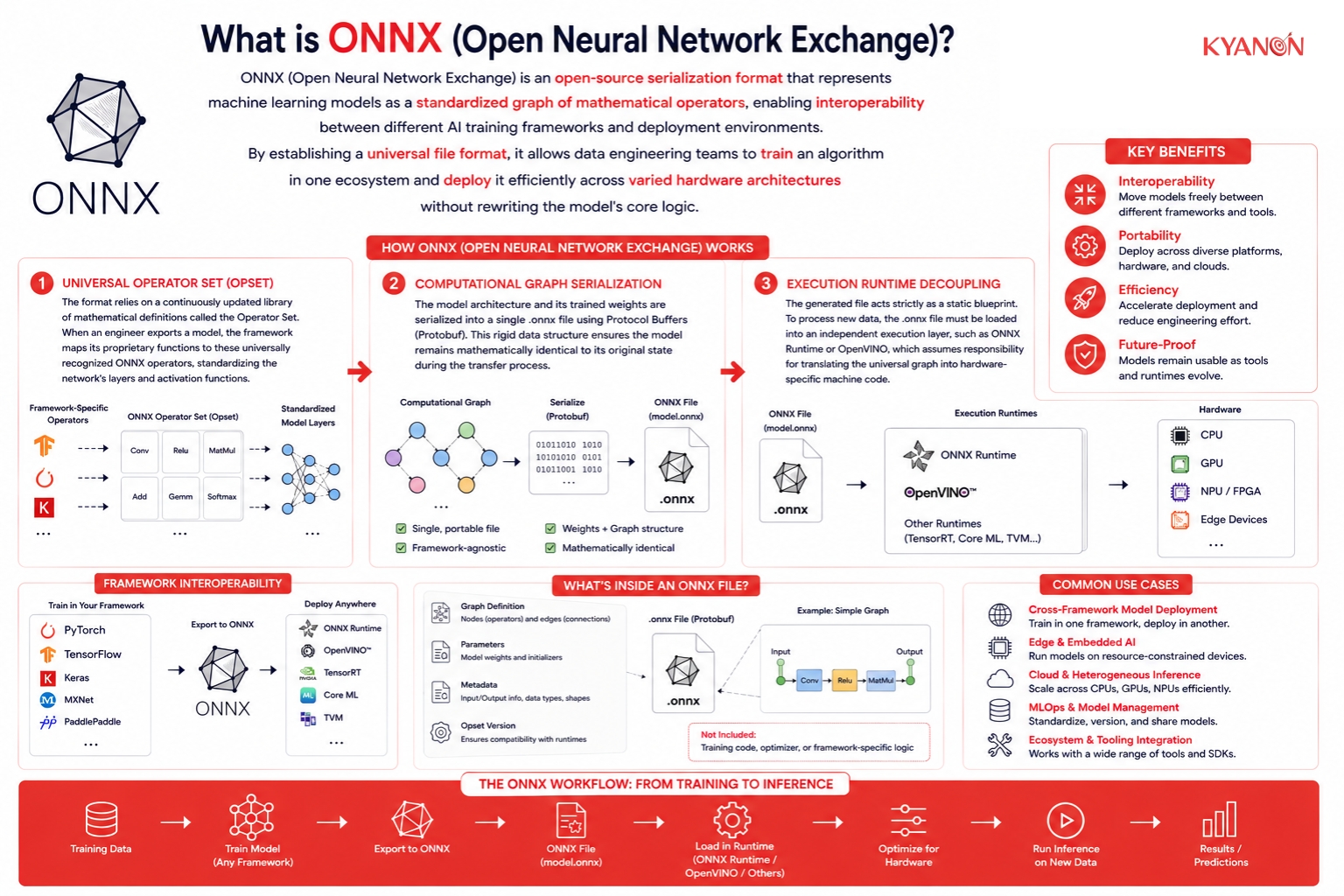
How ONNX (Open Neural Network Exchange) Works
ONNX (Open Neural Network Exchange) functions by translating the framework-specific operations of an AI model into a universal computational graph that independent runtime engines can execute on targeted hardware. The system completely separates the mathematical structure of the neural network from the original Python-based training code.
Universal Operator Set (Opset)
The format relies on a continuously updated library of mathematical definitions called the Operator Set. When an engineer exports a model, the framework maps its proprietary functions to these universally recognized ONNX operators, standardizing the network’s layers and activation functions.
Computational Graph Serialization
The model architecture and its trained weights are serialized into a single .onnx file using Protocol Buffers (Protobuf). This rigid data structure ensures the model remains mathematically identical to its original state during the transfer process.
Execution Runtime Decoupling
The generated file acts strictly as a static blueprint. To process new data, the .onnx file must be loaded into an independent execution layer, such as ONNX Runtime or OpenVINO, which assumes responsibility for translating the universal graph into hardware-specific machine code.

Major Enterprise Benefits of ONNX
- Ecosystem Interoperability (No Vendor Lock-In): ONNX eliminates the rigid barriers between data science teams and software engineering teams. Data scientists can use the latest, most flexible Python training tools, while software engineers can deploy the final model inside native C++, C#, Java, or JavaScript production applications.
- Hardware Acceleration: By decoupling the model from its original training framework, runtime engines like ONNX Runtime can directly interface with hardware-specific accelerators. It optimizes execution paths automatically for NVIDIA GPUs (via TensorRT), Intel CPUs (via OpenVINO), AMD GPUs, or mobile chips (Apple CoreML and Android NNAPI), drastically reducing inference latency and computing costs.
ONNX (Open Neural Network Exchange) vs XML-Based Model Exchange (PMML)
While both frameworks standardise machine learning models for deployment, ONNX targets the mathematical complexity of deep neural networks, whereas PMML relies on XML structures suited for traditional statistical logic.
Dimension | ONNX (Open Neural Network Exchange) | PMML (Predictive Model Markup Language) |
| Core Data Format | Protocol Buffers (Protobuf) | Extensible Markup Language (XML) |
Primary Focus | Deep Learning / Neural Networks | Traditional Machine Learning / Statistics |
| Operator Complexity | High (Supports multidimensional tensor math) | Low (Basic logical and mathematical rules) |
Execution Mechanism | Hardware-accelerated runtime engines | Standard XML parsing engines |
| Ecosystem Support | Modern AI frameworks (PyTorch, TensorFlow) | Legacy BI and data analytics platforms |
When to Consider ONNX (Open Neural Network Exchange)
Consider ONNX (Open Neural Network Exchange) if:
- Your engineering teams train models in PyTorch but must execute inference on edge devices or C++ production servers.
- You need to decouple your inference infrastructure from heavy training frameworks to minimize server memory footprints.
- Your operations require standardizing multiple models built by different internal teams into a unified deployment pipeline.
It may not be the right priority if:
- Your architecture relies exclusively on a single, vendor-locked cloud ecosystem for both training and execution where native API endpoints suffice.
Why ONNX (Open Neural Network Exchange) Matters for Enterprise AI
ONNX (Open Neural Network Exchange) matters for enterprise AI because it breaks vendor lock-in, slashes cloud infrastructure costs, and bridges the operational gap between data science teams and production engineers. In enterprise environments, the framework used to train a model (usually Python-based) is rarely optimal for serving predictions at scale inside enterprise software architectures. ONNX serves as the universal runtime layer that solves this mismatch.
Common misconceptions
Technical leaders frequently mistake serialization formats for automated optimization engines, leading to critical deployment bottlenecks and unexpected architectural failures.
Converting a model to ONNX instantly makes it faster
Reality: The .onnx file itself is just a static graph description; speed enhancements originate exclusively from the runtime engine selected to execute it. ONNX defines your model as a structured graph of mathematical operators. To execute it efficiently, you must feed that file into a dedicated execution engine like ONNX Runtime or TensorRT, which applies the actual hardware-specific optimizations, such as fused operators, to decrease processing time.
ONNX handles model quantization and compression automatically
Reality: ONNX acts strictly as the container, meaning mathematical optimization requires explicit configuration via separate toolkits. While the ecosystem provides companion scripts to compress models by converting FP32 weights to INT8, it is not an intrinsic feature of the file format. Engineering teams must manually execute quantization pipelines, evaluate the resulting accuracy loss, and explicitly save the compressed architecture into a modified ONNX structure.
How Kyanon Digital applies ONNX (Open Neural Network Exchange)
Kyanon Digital implements ONNX (Open Neural Network Exchange) to guarantee model portability and infrastructure efficiency for enterprise AI deployments across Southeast Asia, ANZ, and Nordic Europe. We convert client models trained in PyTorch or TensorFlow into standardized ONNX formats, systematically removing unsupported operators and resolving opset conflicts. By decoupling the training environment from the production layer, we deploy these serialized graphs using optimized execution engines, which decreases API latency, minimizes cloud compute usage, and drives me
Explore our AI and ML services:

 Create project brief with AI