
What is Inference?
In artificial intelligence and machine learning, inference is the process by which a trained model applies its learned parameters to new, unseen input data to produce an output – a prediction, classification, recommendation, or generated response, without any further training occurring. It is the operational phase of AI: the point at which a model transitions from a controlled development environment into live business systems, where it must process real data, meet latency requirements, and return usable outputs continuously at scale.
How Inference Works
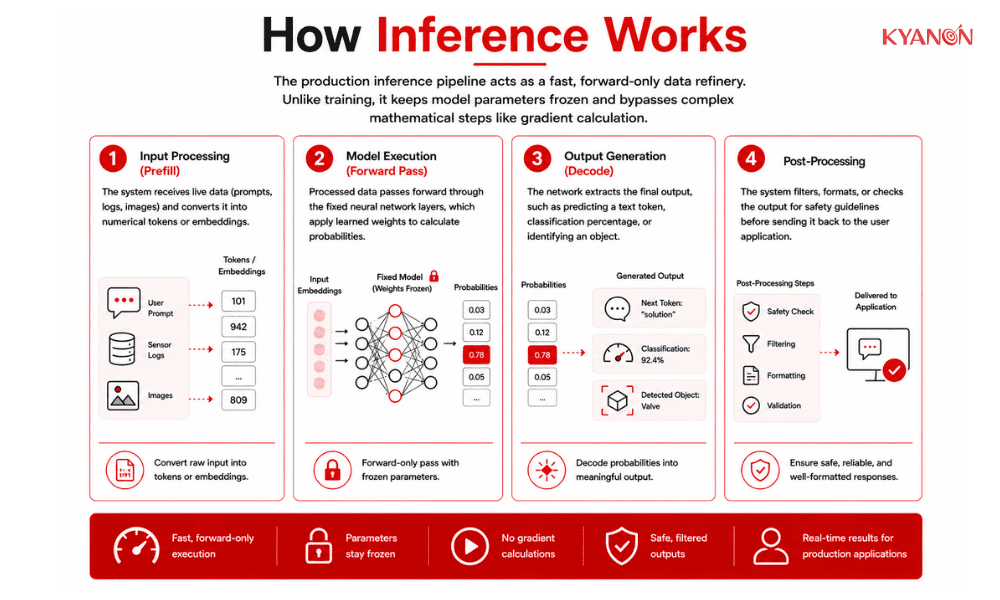
The production inference pipeline acts as a fast, forward-only data refinery. Unlike training, it keeps model parameters frozen and bypasses complex mathematical steps like gradient calculation.
Input Processing (Prefill)
The production system receives live data, user prompts, sensor logs, or images, and converts them into numerical tokens or embedding vectors. This step standardizes raw inputs into the format the model was trained to process, and its speed directly affects the perceived responsiveness of the overall system.
Model Execution (Forward Pass)
The processed data passes forward through the fixed neural network layers, which apply learned weights to calculate probabilities. No parameters are updated during this step. The model is executing a mathematical function built entirely during training, now applied to data it has never seen before.
Output Generation (Decode)
The network extracts the final output, predicting a text token, calculating a classification percentage, or identifying an object. For generative models, this step repeats iteratively until the complete output is assembled, which is why longer outputs carry a higher compute cost than shorter ones.
Post-Processing
The system filters, formats, or checks the generated output against safety guidelines, business rules, or formatting requirements before returning it to the user application. This layer is often where enterprise-specific validation logic sits, the boundary between raw model output and a response that is safe to surface to customers or internal users.

Core Inference Deployment Architectures
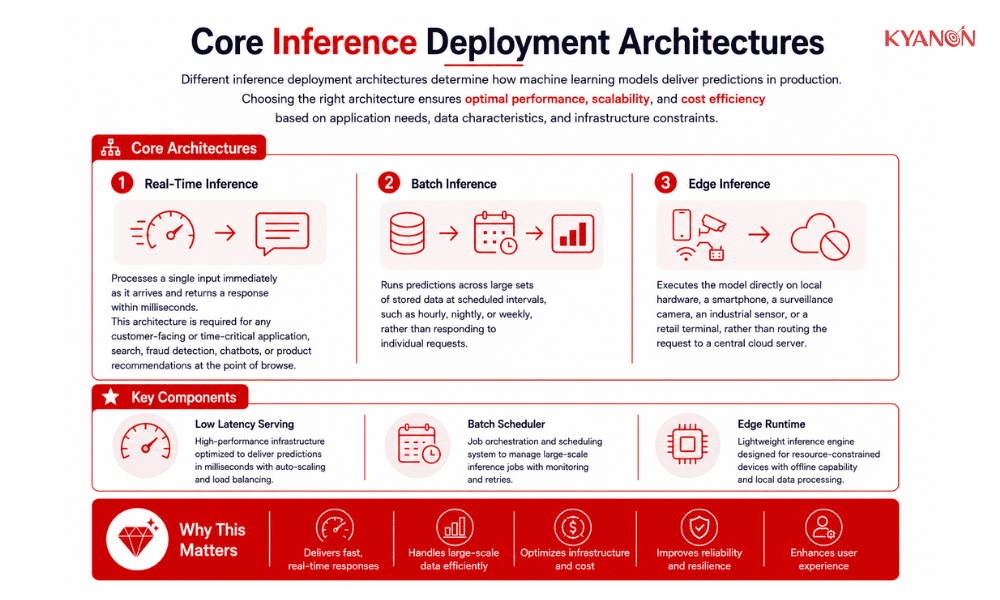
Engineering teams choose between distinct architectural patterns based on latency requirements, data volume, and infrastructure constraints. Selecting the wrong architecture for a use case is one of the most common and costly decisions in production AI deployment.
Real-Time Inference
Processes a single input immediately as it arrives and returns a response within milliseconds. This architecture is required for any customer-facing or time-critical application, search, fraud detection, chatbots, or product recommendations at the point of browse.
The tradeoff is compute cost: dedicated infrastructure must remain available and responsive at all times, regardless of whether request volume is high or low.
Batch Inference
Runs predictions across large sets of stored data at scheduled intervals, such as hourly, nightly, or weekly, rather than responding to individual requests. This approach maximizes compute efficiency for non-urgent workloads: generating marketing segment scores, refreshing recommendation rankings, or processing overnight transaction logs. Batch inference costs significantly less per prediction than real-time serving, but it is unsuitable for any use case where the business outcome depends on immediate response.
Edge Inference
Executes the model directly on local hardware, a smartphone, a surveillance camera, an industrial sensor, or a retail terminal, rather than routing the request to a central cloud server. This eliminates network latency entirely, preserves data privacy by keeping inputs on-device, and maintains functionality in low-connectivity environments. The constraint is hardware: edge devices have limited compute and memory, which means models must be compressed before deployment and cannot match the capability of cloud-hosted frontier models.
Production Optimization Challenges
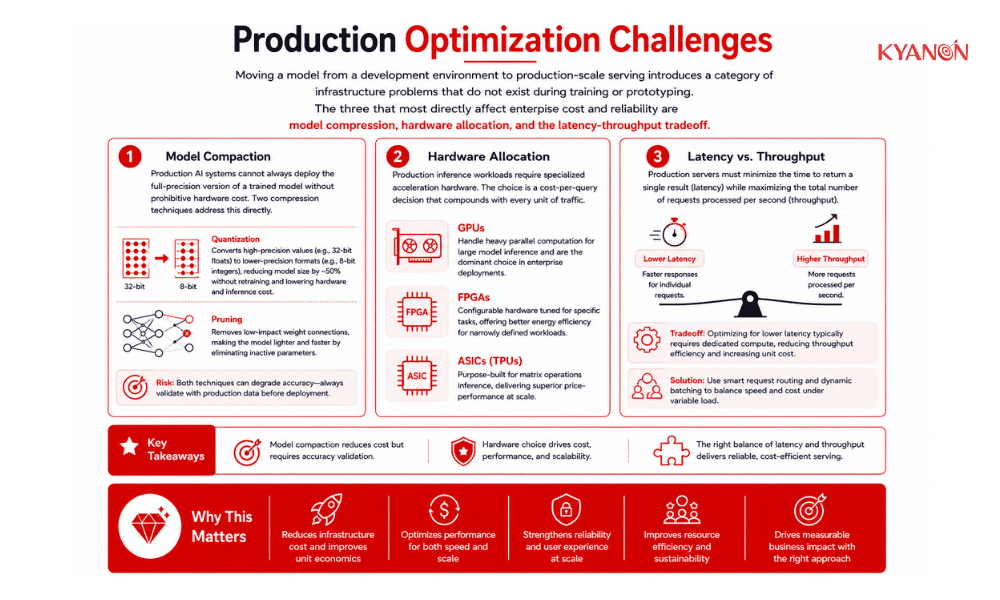
Moving a model from a development environment to production-scale serving introduces a category of infrastructure problems that do not exist during training or prototyping.
The three that most directly affect enterprise cost and reliability are model compression, hardware allocation, and the latency-throughput tradeoff.
Model Compaction
Production AI systems cannot always deploy the full-precision version of a trained model without prohibitive hardware cost. Two compression techniques address this directly.
- Quantization converts high-precision numerical representations, typically 32-bit floating point values, into lower-precision formats such as 8-bit integers. This reduces the memory footprint of the model by roughly half without retraining, cutting both hardware requirements and inference cost per query. Most enterprise inference deployments use some form of quantization as a baseline optimization.
- Pruning removes weight connections within the neural network that contribute minimally to output quality. By stripping inactive or low-impact parameters, the model becomes computationally lighter and faster to execute. The risk in both techniques is accuracy degradation: compression requires validation against production data distributions before deployment, not just benchmark scores.
Hardware Allocation
Production inference workloads require specialized acceleration hardware.
- Graphics Processing Units (GPUs) handle the heavy parallel computation that large model inference demands and remain the dominant infrastructure choice across enterprise deployments.
- Field-Programmable Gate Arrays (FPGAs) offer configurable hardware logic that can be tuned for specific inference tasks, often with better energy efficiency for narrowly defined workloads.
- Application-Specific Integrated Circuits (ASICs), such as Google’s TPUs, are purpose-built for the matrix operations that underpin model inference, delivering superior price-performance for organizations with sufficient scale to justify dedicated silicon.
The infrastructure decision is not purely technical: it is a cost-per-query decision that compounds with every unit of production traffic.
Latency vs. Throughput
Production servers must minimize the time it takes to return a single result (latency) while simultaneously maximizing the total number of requests processed per second (throughput). These two objectives are structurally in tension: optimizing for lower latency typically requires dedicated compute that reduces throughput efficiency and increases unit cost.
Balancing them requires smart request routing and dynamic batching, grouping multiple incoming requests into a single model execution where response timing allows, to maintain both speed and cost discipline under variable load.
Inference vs Training
Both training and inference involve machine learning models, but they operate at opposite ends of the AI lifecycle and carry completely different cost structures, infrastructure requirements, and governance priorities.
Dimension | Inference | Training |
| When it happens | Continuously in production, on live data | Once or periodically, on historical sets |
Compute demand | Lower per-run, but cumulative at scale | Intensive and concentrated in time |
Cost model | Operational scales directly with request volume | Capital or cloud cost, bounded by the training run |
| Latency requirement | Milliseconds to seconds depending on use case | No real-time requirement |
Data involved | New, unseen production data | Labeled or curated historical data |
| Model changes | None, the model’s parameters are fixed | The model’s parameters are actively updated |
Governance priority | Latency SLAs, output monitoring, cost per query, drift detection | Data quality, bias controls, reproducibility, access controls |
| Failure mode | Serving outages, latency spikes, silent output degradation | Training instability, data leakage, overfitting |
When to Consider AI Inference Optimization
Consider implementing advanced inference systems if:
- Your organization generates massive volumes of operational data, but struggles to extract predictive insights, demand forecasting, inventory management, and customer scoring, all of which depend on inference running reliably against live data, not monthly batch exports.
- Your team relies on manual or rule-based systems for fraud detection, automated probabilistic scoring reduces false positives and processes transactions at a speed and scale that rules-based engines cannot match.
- You are moving an AI feature from pilot to production, what runs acceptably at 100 requests per day often breaks structurally at 100,000. Infrastructure not designed for production inference will become the bottleneck before business demand does.
- You are running multiple AI models across different business functions, recommendation engines, fraud detection, content generation, and search, each carry different latency and throughput profiles. Without a unified serving strategy, costs fragment and governance gaps emerge at the boundaries.
It may not be the right priority if:
- Your business processes operate on entirely fixed, deterministic workflows where absolute rules dictate every action, and no probabilistic decision-making is required. Rule engines will outperform inference systems in pure deterministic contexts at a fraction of the cost.
- Your AI use case is still in proof-of-concept; optimizing inference before validating that the model produces measurable business value inverts the investment priority and consumes engineering capacity on the wrong problem.
Why Inference Matters for Enterprise Operations
Applying systematic inference mechanisms allows organizations to move beyond retroactive reporting and directly monetize their data through predictive accuracy.
Industry research consistently places inference at 80-90% of the lifetime cost of a production AI system because, unlike training, inference runs continuously against every user request, every transaction, and every API call at scale. Gartner projects that spending on inference-focused applications will reach $20.6 billion in 2026, up from $9.2 billion in 2025, and that 55% of AI-optimized IaaS spending will support inference workloads in 2026, rising to over 65% by 2029.
For CTOs and IT directors, these numbers reframe the investment question: the ROI of an AI system is determined not primarily by how well the model was trained but by how efficiently inference is architected, monitored, and priced once it is in production.
Common Misconceptions
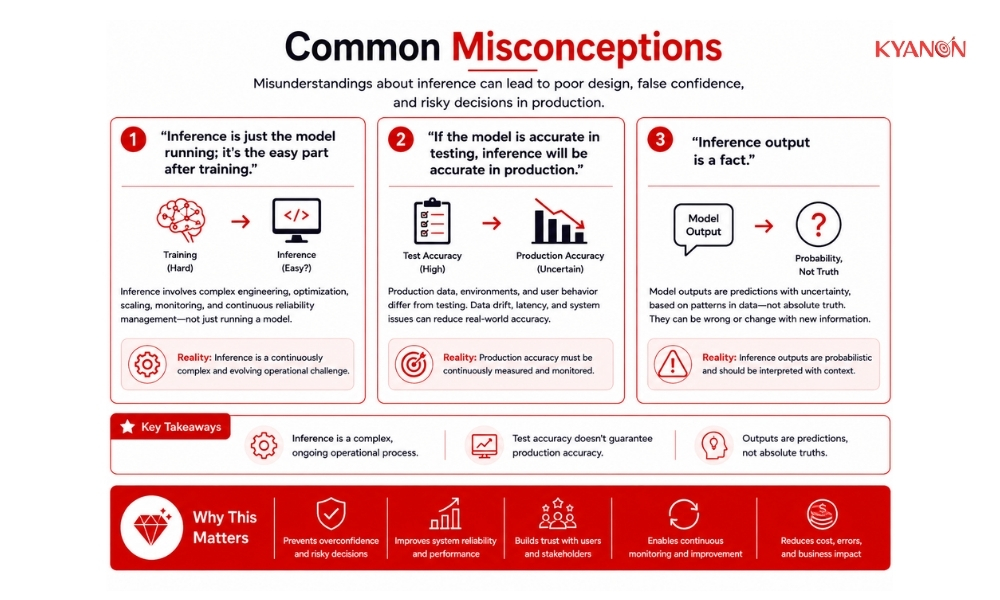
“Inference is just the model running; it’s the easy part after training.”
Reality: Inference is where AI either delivers business value or fails under real-world conditions. Latency, throughput, cost per call, output consistency, and model drift are all inference problems, none of which surface during training.
For enterprise deployments at scale, inference engineering is as complex and consequential as model development, and it requires dedicated ownership, not inherited DevOps practices from non-AI systems.
“If the model is accurate in testing, inference will be accurate in production.”
Reality: Test accuracy and production inference quality diverge the moment real-world data distributions shift from training data, a phenomenon called “data drift.” A model performing at high accuracy in a controlled evaluation can degrade significantly within months if the inputs it receives in production evolve.
Production inference requires continuous monitoring of output quality, not just infrastructure uptime, and a governance process for triggering retraining when drift is detected.
“Inference output is a fact.”
Reality: Inference output is a prediction generated by pattern matching against training data. It is not retrieved from a verified database and carries no inherent guarantee of correctness. AI systems generate inferences based on statistical pattern recognition, not human-like understanding, which means they are prone to producing confident but incorrect outputs, particularly when extrapolating beyond their training distribution.
For enterprise use cases involving customer-facing outputs, financial decisions, or compliance-sensitive content, human-in-the-loop review and output validation controls are architectural requirements, not optional quality measures.
How Kyanon Digital Applies Inference
Kyanon Digital deploys inference as a production engineering discipline, not a standalone model experiment for enterprise clients across Vietnam, Singapore, Malaysia, Thailand, ANZ, the US, and Nordic Europe.
Within the service line, inference sits at the operational core of three specific capabilities: custom ML model deployment, AI-driven decision engines, and GenAI-powered workflow automation. Each of these requires inference pipelines that are production-ready from day one, with defined latency thresholds, cost benchmarking, and output monitoring built into the architecture, not retrofitted after launch.
For clients in retail, banking, logistics, and food services, Kyanon Digital’s AI and ML team makes three decisions that directly determine whether inference delivers business value or becomes a cost liability at scale:
- Which architecture to run (real-time, batch, or edge, depending on the use case)
- How to integrate inference outputs into existing operational systems such as CRM, CDP, loyalty platforms, and ERP
- How to monitor output quality continuously so that model drift is caught before it surfaces as a customer-facing issue.
Kyanon Digital’s broader delivery model, spanning data warehousing, data governance, and MarTech integration, means inference is not deployed on top of fragmented or ungoverned data. The data foundation is addressed first.
This matters because the quality of inference output is bounded entirely by the quality, consistency, and accessibility of the data the model runs against. A custom ML model deployed without a governed, centralized data layer will degrade in production regardless of how well it was trained.
→ Explore our Artificial Intelligence Software Development Services.

 Create project brief with AI