
What is Intent Recognition?
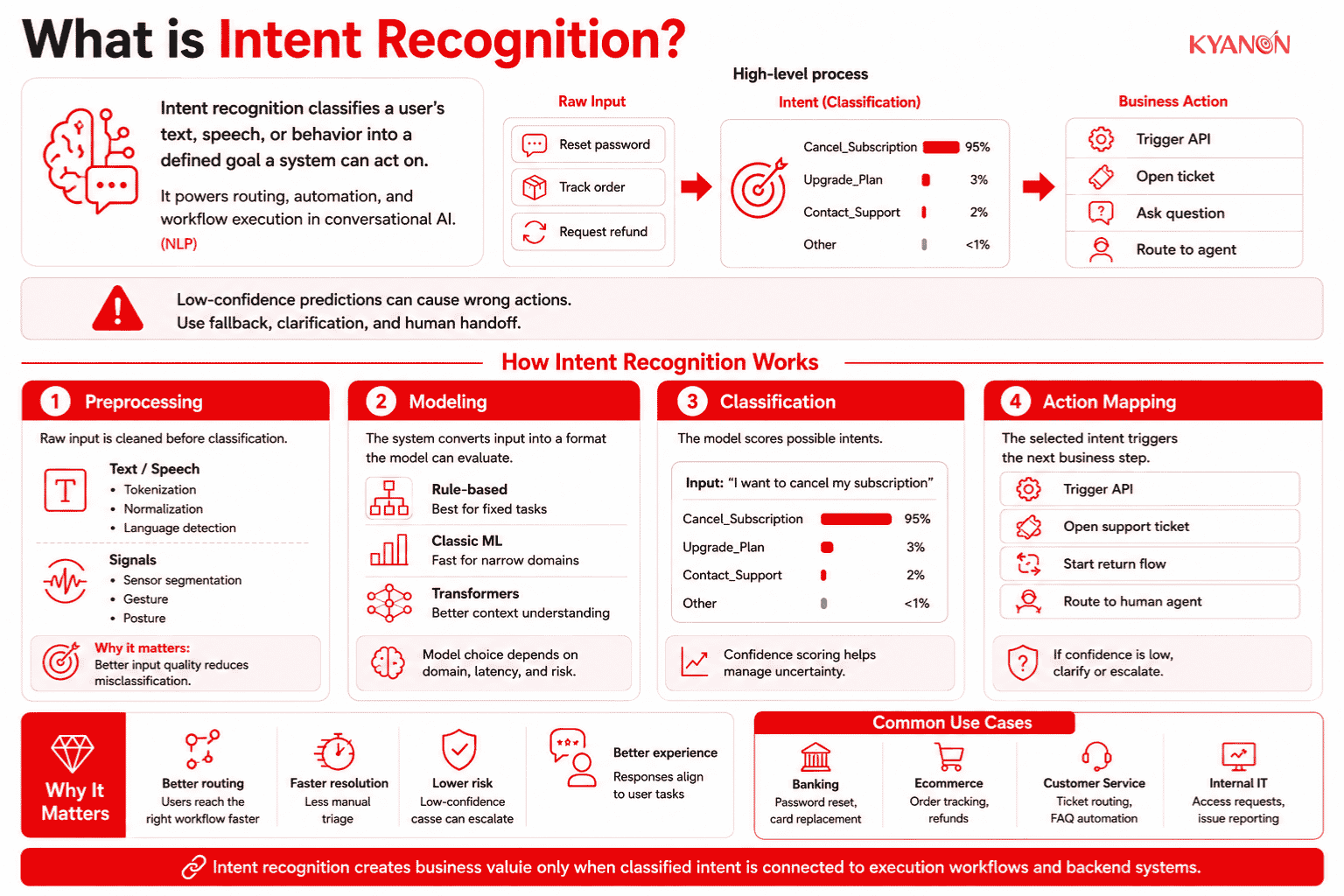
Intent recognition is a machine learning classification process within Natural Language Processing that maps unconstrained user inputs to predefined operational labels to trigger specific system commands. By categorizing text, voice utterances, or behavioral data into explicit classes, it acts as the primary routing mechanism for conversational AI architectures.
The Mechanics of User Intent Recognition
In enterprise AI architecture, intent recognition functions as a classification layer that maps natural language inputs to operational tasks. When a user submits a query, the system parses the input and assigns probability scores to predefined intent labels such as Update_Billing_Info, Reset_Password, Track_Order, Request_Refund, or Escalate_To_Human_Agent.
Accurate intent classification determines whether a conversational AI system routes the user to the right workflow, asks for clarification, retrieves the right enterprise data, or escalates the interaction to a human agent. This makes intent recognition especially important in customer service automation, digital banking, ecommerce support, insurance claims, and internal IT helpdesk systems.
Recent AI adoption data reinforces why intent recognition is becoming more important for enterprise systems. McKinsey’s latest Global Survey on AI reported that 88% of respondents said their organizations regularly use AI in at least one business function, up from 78% a year earlier. NVIDIA’s 2026 State of AI report also found that 64% of surveyed organizations are actively using AI in operations, while its 2026 Retail and CPG survey found that 91% of respondents are either actively using or assessing AI, and 47% are using or assessing agentic AI.
As AI moves deeper into operational workflows, enterprises need systems that do more than generate text. They need AI applications that can understand user intent, connect it to structured business logic, and route each interaction to the right system, data source, workflow, or human decision point.

How Intent Recognition Works
Intent recognition systems process raw, unstructured input through a layered pipeline that converts language, speech, or behavioral signals into a classified intent and then maps that intent to an action. A production-grade intent recognition architecture does not stop at prediction; it also needs confidence scoring, fallback handling, and workflow execution logic.
Preprocessing and Feature Extraction
Preprocessing cleans and structures raw input before the system attempts to classify intent. For text or speech, this may include tokenization, normalization, spelling correction, language detection, or speech-to-text conversion.
For multimodal or physical intent recognition, sensor data from cameras, IMUs, or wearables may be segmented into time windows to extract features such as movement speed, posture, gesture, or joint angle. This step matters because low-quality input representation can cause the model to misclassify the user’s request even when the downstream model is well-trained.
Representation and Modeling
Representation turns processed input into a format that models can evaluate. Enterprise systems may use rule-based engines for predictable domain tasks, classic machine learning models such as Support Vector Machines or Random Forests for narrow and high-speed classification, and transformer-based NLP models such as BERT or fine-tuned RoBERTa variants when the system needs stronger contextual understanding.
The right modeling approach depends on the business domain, latency requirements, available training data, compliance constraints, and cost of misclassification. A banking chatbot that handles account-related requests, for example, may require stricter intent boundaries than an e-commerce product discovery assistant.
Classification and Confidence Scoring
The classification layer compares the input representation against a defined library of intents and assigns probability scores to possible matches. For example, the sentence “I want to cancel my subscription” may return Cancel_Subscription at 95%, Upgrade_Plan at 3%, and Contact_Support at 2%.
Confidence scoring allows the system to track uncertainty instead of treating every prediction as correct. In enterprise systems, low-confidence predictions should trigger clarification, fallback, or human handoff before any irreversible workflow is executed.
Action Mapping and Execution
Action mapping connects the selected intent to the next business step, such as triggering an API, opening a support ticket, starting a return workflow, or routing the user to a human agent. If the confidence score falls below a defined threshold, the system should ask a clarifying question, activate a fallback flow, or hand off the interaction instead of executing the wrong action.
Intent recognition creates business value only when the classified intent is connected to execution logic, backend systems, and measurable process outcomes. Without action mapping, the system may understand the request but fail to resolve it.
Intent Recognition vs. Named Entity Recognition (NER)
Intent recognition and Named Entity Recognition support are natural language understanding, but they answer different questions: intent recognition identifies what the user wants to do, while NER identifies the specific data points inside the request.
Dimension | Intent Recognition | Named Entity Recognition (NER) |
| Core Objective | Classifies the overall purpose of the user’s input. | Extracts precise data points and variables from the input. |
System Output | A single predefined categorical label (e.g., Book_Flight). | Multiple structured key-value pairs (e.g., Destination: SIN, Date: 2026-05-25). |
| NLP Pipeline Stage | Operates as the initial routing and classification layer. | Operates sequentially or in parallel to populate variables. |
Example Input | “I need a one-way ticket to Singapore for tomorrow.” | “I need a one-way ticket to Singapore for tomorrow.” |
| System Action Triggered | Routes the user’s session to the flight booking module. | Populates the API payload parameters for the flight search request. |
Intent Recognition vs Dialog Management
Intent recognition identifies what the user is trying to do, while dialog management determines what the system should do next based on context, history, confidence, and business rules. A conversational AI system needs both layers to move from request detection to actual resolution.
Dimension | Intent Recognition | Dialog Management |
| Core function | Classifies the user’s goal | Controls the conversation flow |
Primary output | Intent label and confidence score | Next best system action |
| Example | Detects Cancel_Order | Asks for order ID, checks return policy, confirms cancellation |
Business role | Selects the right workflow | Guides the user through the workflow |
| Risk if missing | User is routed incorrectly | User gets stuck after the correct intent is detected |
Best used for | Request routing and workflow selection | Multi-step journeys, clarification, escalation, and resolution |
Common Enterprise Use Cases of Intent Recognition
Intent recognition is most valuable when an enterprise needs to turn repeated user requests into structured workflows across digital channels. In banking, ecommerce, customer service, and internal operations, it helps route requests consistently and reduce dependency on manual triage.
Use Case | Example Intent | Business Function |
| Banking self-service | Reset_Password, Check_Loan_Status, Replace_Card | Digital banking and contact center deflection |
Ecommerce support | Track_Order, Cancel_Order, Request_Refund | Customer service and post-purchase experience |
| Product discovery | Find_Product, Compare_Product, Check_Availability | Search, recommendation, and conversion support |
Internal IT helpdesk | Request_Access, Report_Issue, Reset_MFA | Employee support and IT operations |
| Appointment booking | Book_Appointment, Reschedule_Visit | Service operations and branch or store workflows |
Intent recognition is most effective in high-volume, repeatable journeys where user requests can be mapped to clear intent categories and connected to backend workflows. It becomes especially relevant when enterprises need consistent request routing across digital channels such as web, mobile app, marketplace, chat, and contact center.
When to Consider Intent Recognition?
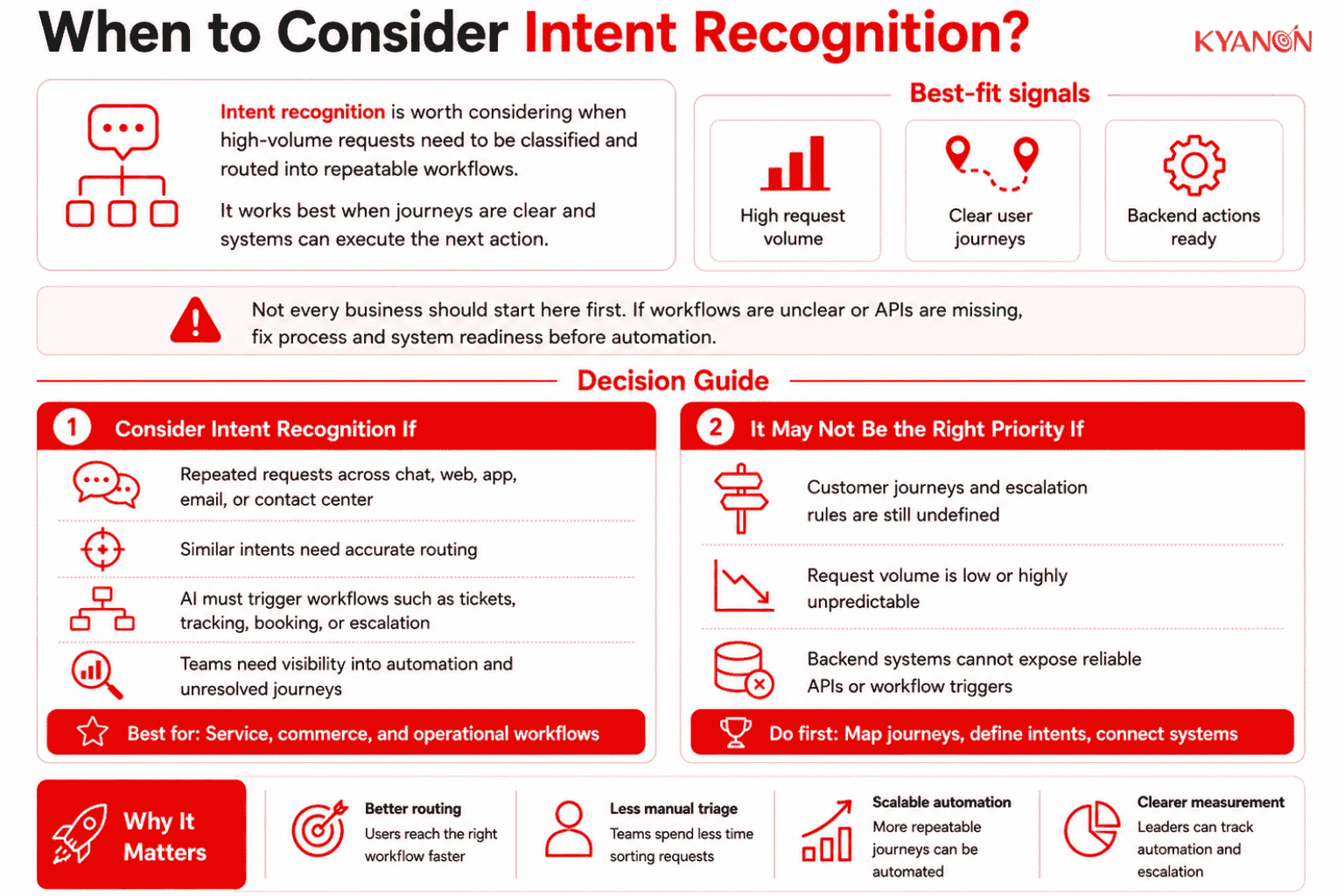
Intent recognition should be considered when an enterprise needs to classify high-volume customer or employee requests into repeatable service, commerce, or operational workflows. It is most relevant when the business already has clear customer journeys, defined escalation paths, and backend systems that can support action execution.
Consider intent recognition if:
- Your support team handles repeated questions across chat, app, website, email, or contact center channels, and the current routing logic depends too much on manual triage.
- Your ecommerce or banking journey requires AI to distinguish between similar requests, such as “track my order,” “cancel my order,” “change delivery address,” and “refund my order.”
- Your business wants conversational AI to trigger backend workflows such as ticket creation, account lookup, order tracking, appointment booking, or agent escalation.
- Your team needs a structured way to measure request categories, automation opportunities, containment rates, escalation reasons, and unresolved journeys.
It may not be the right priority if:
- Your organization has not defined the core customer journeys, escalation rules, supported intents, or backend workflows the AI should connect to. Intent recognition works best when the business has a clear operating model, not only a chatbot interface.
- Your current query volume is low, highly unpredictable, or still handled effectively by a small support team without major service delays.
- Your backend systems cannot yet expose reliable APIs or workflow triggers for the intents the AI is expected to execute.
Why Intent Recognition Matters for Conversational AI
Intent recognition matters for enterprise conversational AI because it connects unstructured user language to structured business actions. Without accurate intent recognition, a chatbot may generate fluent responses but still fail to route requests, collect required information, or trigger the correct workflow.
According to McKinsey’s 2025 Global Survey on AI, 78% of respondents reported that their organizations used AI in at least one business function, up from 72% in early 2024 and 55% a year earlier. For CTOs, IT Directors, and ecommerce leaders, this shows why AI systems need to move beyond standalone chat interfaces and connect to operational workflows.
A bank in Southeast Asia, for example, may use intent recognition to classify digital service requests such as card replacement, loan eligibility, password reset, and branch appointment booking. The business value comes when each classified intent is connected to authentication, CRM, case management, and human escalation rules.
Implementation Risks to Manage
Intent recognition systems can create operational risk when low-confidence predictions are executed without validation, fallback logic, or human escalation. For enterprise teams, the main issue is not whether the model can predict an intent, but whether the architecture can manage uncertainty safely.
Key risks include:
- False intent classification: The system routes the user to the wrong workflow, such as treating a refund request as a product inquiry.
- Out-of-domain queries: The user asks for something outside the trained intent library, causing the model to guess instead of clarifying.
- Domain drift: Customer language changes over time, while the intent taxonomy remains outdated.
- Privacy and consent risk: Intent recognition systems may process sensitive banking, commerce, or service data, so logging and model training need clear governance.
- Poor handoff design: Human agents receive incomplete context, forcing users to repeat information.
- Over-automation: The system executes actions too quickly without human review for high-risk journeys such as financial disputes, account changes, or compliance-sensitive requests.
A reliable intent recognition system should include confidence thresholds, fallback paths, test sets, escalation logic, monitoring dashboards, and continuous taxonomy review. These controls help enterprises reduce misrouting, improve resolution quality, and keep automation aligned with business risk.
Common Misconceptions
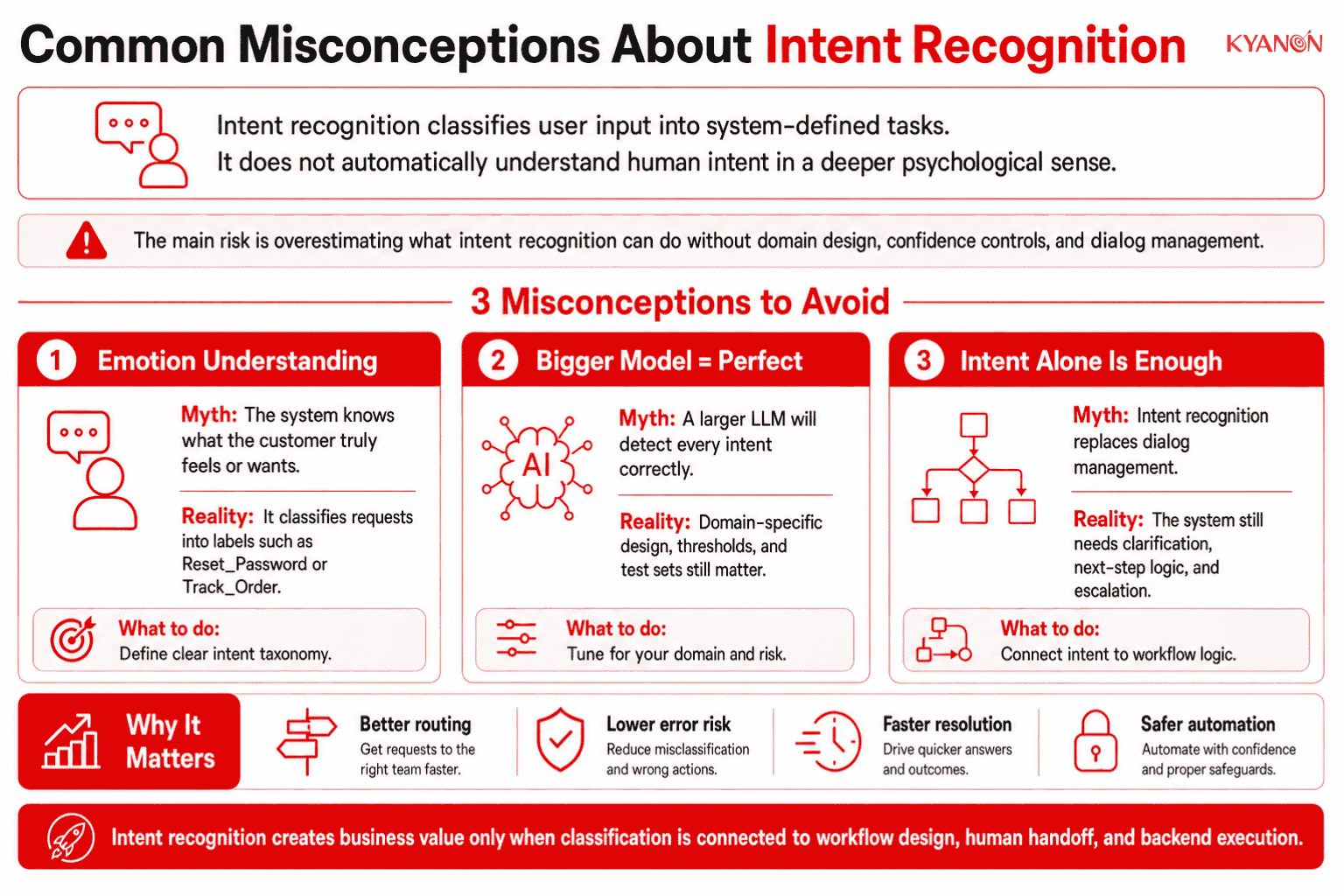
A common enterprise misconception is that intent recognition understands a user’s real desire in the human sense; in practice, it classifies inputs into system-defined categories.
“Intent recognition understands what the customer really feels or wants.”
Reality: Intent recognition does not read emotion or personal desire. It classifies an input into predefined labels such as Reset_Password, Check_Balance, or Track_Order, and the quality of that classification depends on training data, domain scope, and fallback design.
“A larger LLM will detect every intent correctly.”
Reality: Larger models can improve zero-shot understanding, but they do not remove the need for domain-specific intent design. In regulated or high-volume environments such as banking, ecommerce, and customer service, specialized intent taxonomies, test sets, confidence thresholds, and escalation rules are still required.
“Once we have intent recognition, we do not need dialog management.”
Reality: Intent recognition identifies the likely task, but dialog management controls the next step. A system may detect Order_Return, but it still needs to ask for the order number, check return eligibility, explain the policy, and decide whether to escalate to an agent.
How Kyanon Digital Applies Intent Recognition
Kyanon Digital integrates intent recognition into enterprise conversational AI solutions for banking, ecommerce, and customer service clients across Southeast Asia, ANZ, the US, and Nordic Europe. The implementation approach focuses on business-ready intent taxonomies, backend API orchestration, fallback and human handoff design, and measurable outcomes such as faster response handling, improved conversion support, lower manual workload, and more controlled total cost of ownership.
Rather than deploying isolated classification models, Kyanon Digital connects intent recognition with dialog state tracking, CRM, commerce platforms, ticketing systems, service workflows, and data governance requirements. This allows enterprises to move from intent detection to actual workflow execution while keeping control over confidence thresholds, escalation rules, and operational risk.
→ Explore our generative AI development services.

 Create project brief with AI