
What is User Intent Classification?
User Intent Classification is a natural language processing (NLP) technique that analyzes a user’s unstructured text or speech input to identify, interpret, and categorize the underlying goal, need, or objective behind a message. Rather than focusing solely on the literal words a user uses, it examines the semantic meaning of the input to determine what the user is actually trying to accomplish. This allows systems to understand intent even when different phrases, expressions, or linguistic styles are used to communicate the same request.

At its core, User Intent Classification functions as a text classification process that transforms human language into structured intent categories. For example, phrases such as “Turn off the lights,” “It’s too bright in here,” and “Kill the lamps” may use different wording, but they all express the same underlying intent. By recognizing these semantic relationships, intent classification helps machines move beyond keyword matching and achieve a more human-like understanding of user requests.
The technique serves as a foundational component of conversational AI, virtual assistants, customer service chatbots, and intelligent search systems. By converting free-form language into clearly defined intent labels, User Intent Classification enables digital systems to consistently interpret user objectives and establish a shared understanding between human communication and machine-driven processes.
How User Intent Classification Works
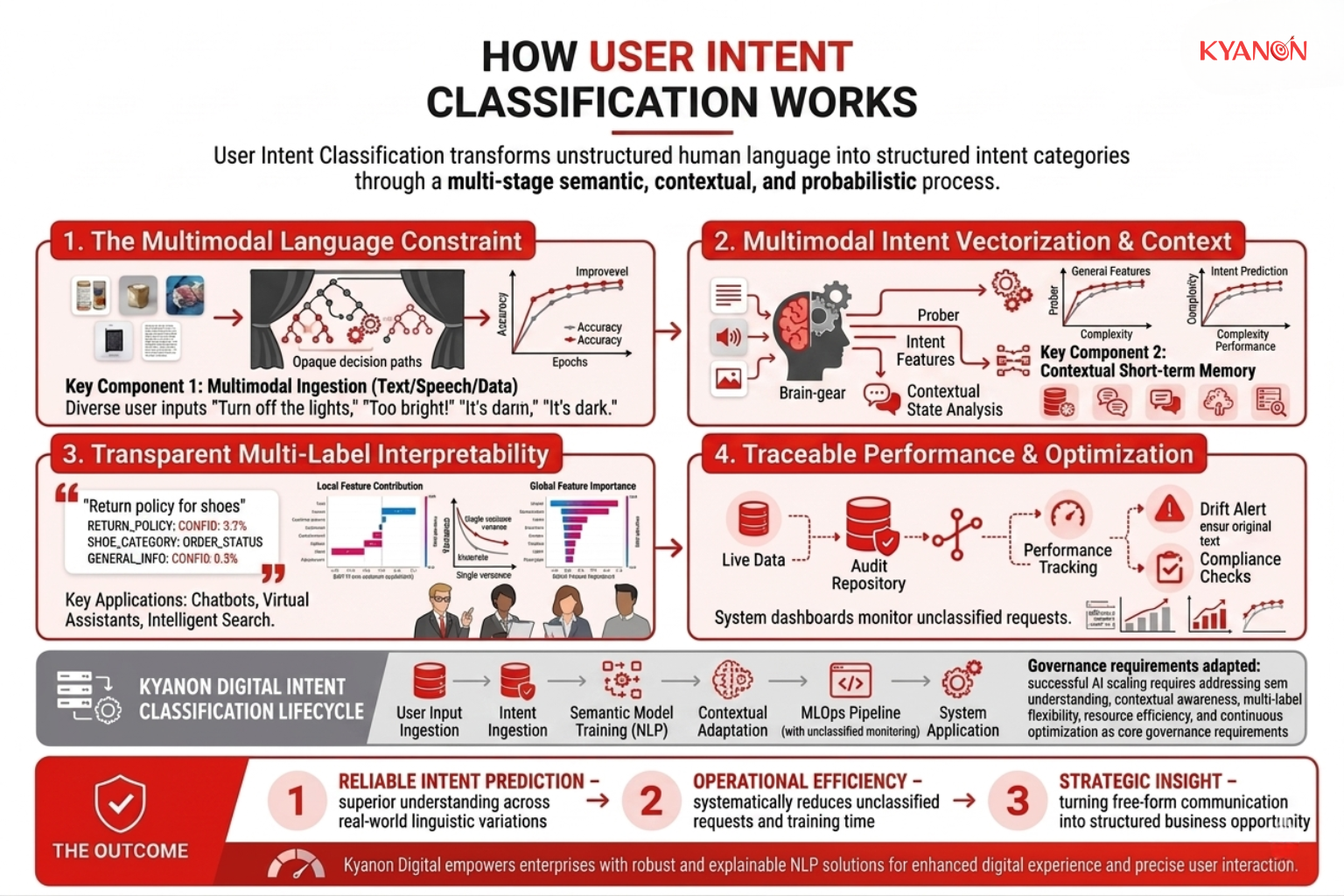
User Intent Classification transforms unstructured human language into structured intent categories through a multi-stage process that combines semantic understanding, contextual analysis, and probabilistic classification. Rather than relying on exact keyword matching, the system evaluates the meaning of a user’s message, interprets it within its conversational context, and maps it to one or more predefined intent labels.
Semantic Vectorization
The first stage converts raw text into numerical representations known as embeddings. Using machine learning models such as BERT, RoBERTa, or modern Large Language Model (LLM) encoders, the system maps words, phrases, and entire sentences into a high-dimensional mathematical space where similar meanings are positioned close together.
This semantic representation enables the model to understand intent beyond literal vocabulary. Different expressions that communicate the same objective are grouped within similar regions of the embedding space, allowing the system to recognize semantic equivalence despite variations in wording, slang, spelling, or sentence structure. Because embeddings capture contextual relationships between words, the model can infer meaning from the overall sentence rather than individual keywords.
Contextual State Analysis
After generating semantic representations, the classification engine evaluates the user’s message alongside contextual information from the current interaction. This contextual layer acts as a form of short-term memory, incorporating signals such as previous conversation turns, active page views, session history, location, or ongoing tasks.
By combining language understanding with environmental context, the system can resolve ambiguity that would otherwise be difficult to interpret. The same phrase may correspond to different intents depending on the user’s current situation, making contextual state analysis a critical component of accurate intent classification.
Multi-Label Output Routing
The final stage processes the semantic and contextual information through a classification model that evaluates the input against a predefined set of intent categories. Instead of producing a simple yes-or-no decision, the model generates a probability distribution that assigns confidence scores to potential intents.
Modern intent classification systems often support multi-label prediction, allowing a single user message to contain multiple intents simultaneously. The model identifies each relevant intent independently and ranks them according to confidence, enabling the system to accurately interpret compound requests while preserving the relationship between separate user objectives.

User Intent Classification vs. Keyword Matching
While both approaches are used to interpret user requests and trigger automated responses, User Intent Classification provides a significantly more advanced and flexible method for understanding human language. Instead of relying on exact keywords, it analyzes semantic meaning, contextual signals, and linguistic patterns to determine what a user is trying to accomplish. As a result, it can handle the variability and ambiguity that characterize real-world conversations, making it the foundation of modern conversational AI systems.
Dimension | User Intent Classification | Keyword Matching |
| Language Understanding | Interprets the underlying meaning of a message using machine learning and semantic representations. | Detects predefined words or phrases without understanding their meaning. |
Linguistic Flexibility | Handles synonyms, slang, paraphrasing, typos, and natural language variations without requiring explicit rules. | Requires exact or manually predefined keyword matches, making it sensitive to wording changes. |
| Semantic Inversion Handling | Understands sentence structure and intent, allowing it to distinguish between requests that contain similar keywords but opposite meanings. | Cannot differentiate between opposite meanings if the same keywords are present. |
Context Awareness | Incorporates conversation history, session state, user activity, and environmental context to improve intent prediction. | Processes each message independently and lacks awareness of previous interactions or user context. |
| Adaptability | Generalizes across thousands of unseen phrasing variations once an intent category is learned. | Requires ongoing manual updates whenever new wording patterns emerge. |
Scalability | Scales efficiently because one trained intent can cover a broad range of expressions with similar meaning. | Rule complexity increases rapidly as more keywords and exceptions are added. |
| Implementation Complexity | Requires training data, NLP models, and ongoing optimization. | Can be implemented quickly using simple keyword lists or regular expressions. |
Best Use Cases | Enterprise AI assistants, customer service automation, virtual agents, intelligent search, and complex multi-turn conversations. | Basic FAQ routing, deterministic command systems, and simple rule-based automation. |
For modern AI-driven applications, User Intent Classification is generally the preferred approach because it delivers greater accuracy, adaptability, and contextual understanding. Its ability to interpret meaning rather than simply match words enables conversational systems to support natural user interactions at enterprise scale, even when users express the same request in vastly different ways.
When to Consider User Intent Classification
Consider User Intent Classification if:
- Your customer support team spends over 30% of their time manually triaging and rerouting generic, front-line inquiries to the correct specialized department.
- Your digital platform regularly deploys new features, causing rigid keyword-based chatbots to fail because users immediately invent novel slang to describe the new capabilities.
- Your organization is implementing autonomous AI agents that require strictly defined, deterministic intents to execute secure backend API calls.
It may not be the right priority if:
- Your application features a highly constrained, linear user journey with fewer than five distinct actions, making simple button-based navigation vastly more efficient than natural language processing.
Why User Intent Classification Matters for Enterprise Support
As customer service shifts toward AI-driven self-service and conversational support, accurately understanding user intent has become a foundational requirement for enterprise support operations. User Intent Classification enables support systems to move beyond simple keyword detection and instead identify what customers are actually trying to accomplish, reducing misrouted requests, improving resolution accuracy, and creating a more seamless customer experience.
According to Gartner, 91% of customer service leaders report pressure from executive leadership to implement AI, with improving customer satisfaction, operational efficiency, and self-service success identified as their top priorities. As organizations increasingly redesign service models around AI-enabled customer interactions, the effectiveness of these systems depends heavily on their ability to accurately interpret customer requests across diverse language variations, intents, and conversational contexts. Even minor misunderstandings can directly impact resolution rates, customer satisfaction, and trust in automated service channels.

As enterprise support evolves toward conversational AI, self-service portals, and autonomous service agents, User Intent Classification serves as the intelligence layer that translates natural language into accurate actions. It enables support systems to scale efficiently while maintaining the contextual understanding required for high-quality customer experiences.
Common Misconceptions
A single customer message always maps to one specific intent category
Human communication is inherently messy and multi-layered. If a user states, “My account is locked, and I need a refund,” a rigid single-label classifier drops half the problem; modern enterprise systems must utilize multi-label classification to process primary and secondary intents simultaneously without breaking downstream automation.
Achieving 95% intent accuracy in testing guarantees a great user experience in production
Standard classification models suffer from massive out-of-distribution (OOD) blindspots, confidently forcing completely unrelated queries into the closest mathematical bucket. Confidently routing a frustrated user to the wrong automated workflow causes vastly more damage than establishing a strict confidence threshold that defaults to, “I do not understand, let me connect you to a human.”
How Kyanon Digital Applies User Intent Classification
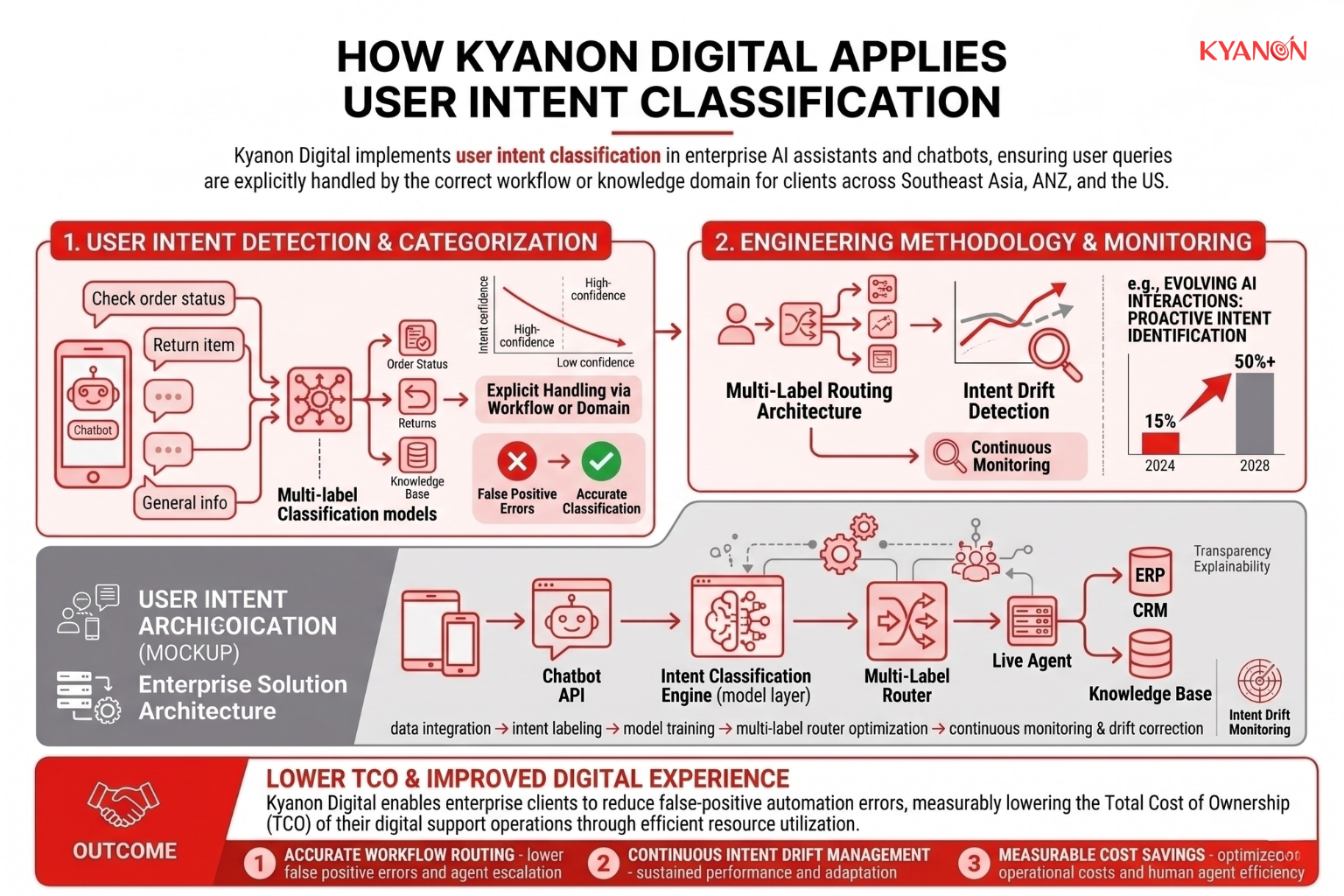
Kyanon Digital implements user intent classification in enterprise AI assistants and chatbots, ensuring user queries are explicitly handled by the correct workflow or knowledge domain. Our engineering methodology prioritizes multi-label routing architectures and continuous monitoring for intent drift, enabling enterprise clients across Southeast Asia, ANZ, and the US to reduce false-positive automation errors and measurably lower the Total Cost of Ownership (TCO) of their digital support operations.
→ Explore our Artificial Intelligence services.

 Create project brief with AI