
What is Natural Language Processing (NLP)?
Natural Language Processing (NLP) is a subfield of computer science and artificial intelligence (AI) that utilizes machine learning to allow computers to comprehend and communicate using human language. It works by combining computational linguistics, the rule-based modeling of human language with statistical, machine, and deep learning models to enable digital devices to recognize, understand, and generate both text and speech. Ultimately, NLP serves as the foundation for modern generative AI applications, powering everyday technologies like search engines, customer service chatbots, and digital voice assistants. (IBM)
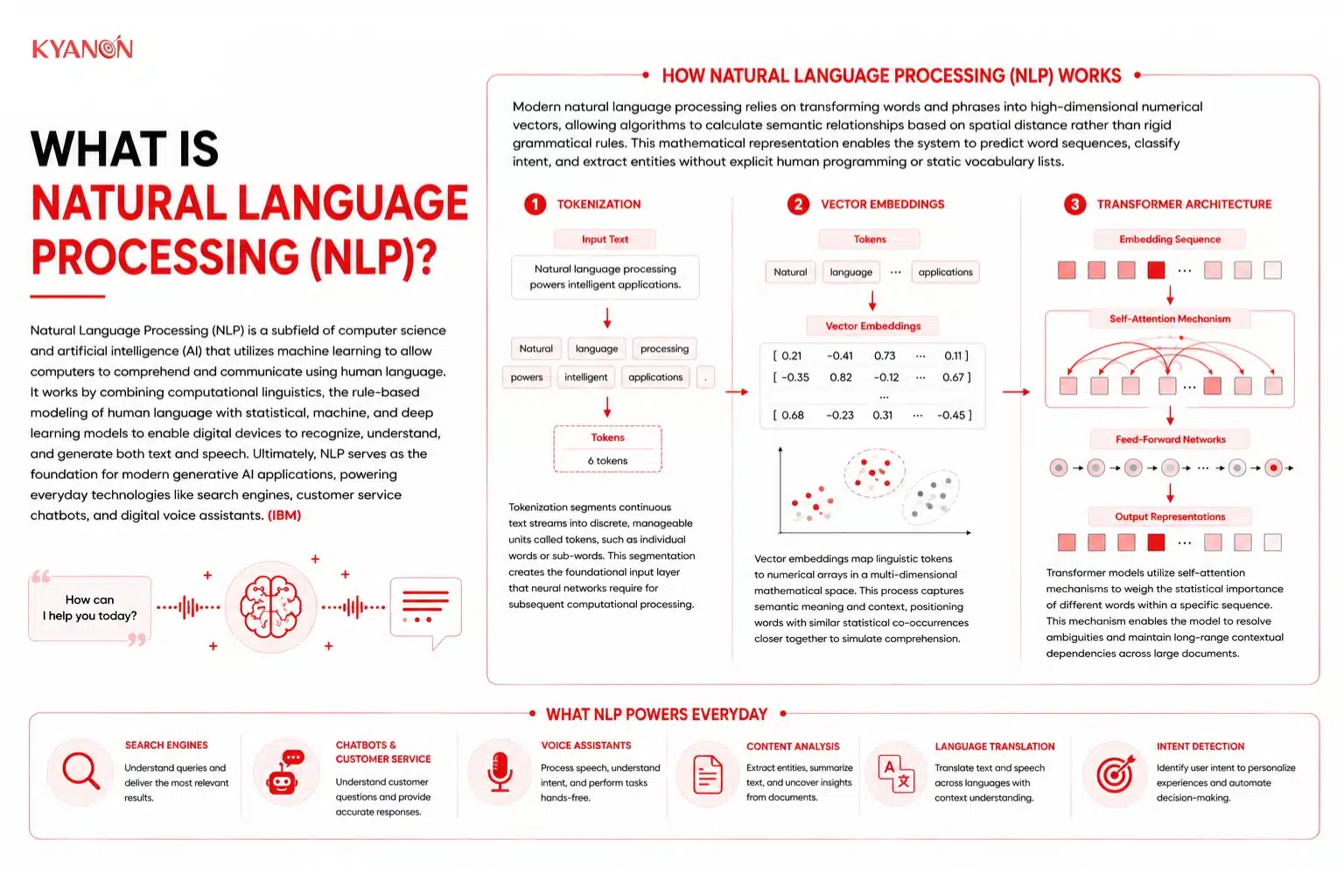
How Natural Language Processing (NLP) works
Modern natural language processing relies on transforming words and phrases into high-dimensional numerical vectors, allowing algorithms to calculate semantic relationships based on spatial distance rather than rigid grammatical rules. This mathematical representation enables the system to predict word sequences, classify intent, and extract entities without explicit human programming or static vocabulary lists.
Tokenization
Tokenization segments continuous text streams into discrete, manageable units called tokens, such as individual words or sub-words. This segmentation creates the foundational input layer that neural networks require for subsequent computational processing.
Vector Embeddings
Vector embeddings map linguistic tokens to numerical arrays in a multi-dimensional mathematical space. This process captures semantic meaning and context, positioning words with similar statistical co-occurrences closer together to simulate comprehension.
Transformer Architecture
Transformer models utilize self-attention mechanisms to weigh the statistical importance of different words within a specific sequence. This mechanism enables the model to resolve ambiguities and maintain long-range contextual dependencies across large documents.

Benefits of Natural Language Processing (NLP)
NLP makes it easier for humans to communicate and collaborate with machines, by allowing them to do so in the natural human language they use every day. This offers benefits across many industries and applications.
- Automation of repetitive tasks
- Improved data analysis
- Enhanced search
- Powerful content generation
Real-World Examples of Natural Language Processing (NLP)
Natural Language Processing (NLP) powers many of the AI-driven experiences people interact with every day. The following examples highlight how NLP is applied in real-world business and consumer scenarios:
- Search Engines: Autocompleting your queries and understanding your search intent even if you misspell words.
- Voice Assistants: Powering tools like Apple’s Siri or Amazon Alexa by converting your spoken soundwaves into text, processing the request, and generating a verbal answer.
- Email Filters: Analyzing the text patterns of incoming messages to automatically catch and divert spam or phishing attempts.
- Smart Autocorrect: Predicting the next word you want to type on your smartphone keyboard based on your past writing habits
Natural Language Processing (NLP) vs Rules-Based Text Parsing
Both approaches extract information from text, but they differ fundamentally in their handling of ambiguity and system scalability.
Dimension | Natural Language Processing (NLP) | Rules-Based Text Parsing |
| Contextual awareness | High (evaluates surrounding syntax) | None (evaluates exact strings) |
Adaptability to variations | High (interprets typos and synonyms) | Low (requires explicit programming for variations) |
| Setup complexity | High (requires model training/tuning) | Low (requires writing regex or if/then rules) |
Scaling across languages | Requires language-specific models | Requires entirely new rule sets |
| Primary use case | Intent classification, sentiment analysis | Log parsing, predictable string extraction |
When to consider Natural Language Processing (NLP)
Consider natural language processing (NLP) if:
- Your customer support teams are overwhelmed by high volumes of unstructured text inputs, requiring automated triage and intent classification before human routing.
- Your operations require extracting structured data points, such as compliance clauses or financial variables, from thousands of non-standardized PDF agreements.
- Your enterprise search infrastructure needs to retrieve internal documentation based on semantic intent rather than exact keyword matches.
It may not be the right priority if:
- Your data pipeline relies exclusively on processing highly structured, tabular data within rigid SQL environments where free-form text input is nonexistent.
Why Natural Language Processing (NLP) Matters for Enterprise Operations
Natural Language Processing (NLP) matters for enterprise operations because it scales the processing of unstructured text and voice data, which makes up roughly 80% to 90% of all corporate information
Without NLP, enterprises leave massive amounts of data locked away in emails, call logs, contracts, and support tickets, requiring expensive human labor to read and analyze manually. By embedding NLP into internal workflows, companies automate data entry, speed up decision-making, and lower operational overhead across major business units.
Common misconceptions
Our NLP model will understand the factual truth of the documents it reads, preventing false outputs
Reality: NLP systems calculate the statistical probability of word sequences; they possess no inherent understanding of objective truth or real-world facts. This reliance on statistical correlation over deductive logic is the root cause of algorithmic hallucinations in enterprise environments.
We can take a high-performing English NLP model and deploy it directly for our localized markets in Vietnam and Thailand
Reality: Deploying an English-optimized model in non-English contexts drastically degrades accuracy and fails to capture structural nuances. Distinct languages require specific tokenization algorithms, localized syntax mapping, and culturally relevant training datasets to function properly.
How Kyanon Digital Applies Natural Language Processing (NLP)
Kyanon Digital implements natural language processing (NLP) architectures to resolve complex data harmonization bottlenecks for enterprise clients across the APAC region. Our engineering teams deploy customized NLP models tailored for intelligent document processing, customer service automation, and localized enterprise search, focusing strictly on reducing total cost of ownership and accelerating data extraction workflows.
Explore our AI development services.

 Create project brief with AI