
What is JSON Mode (LLM)?
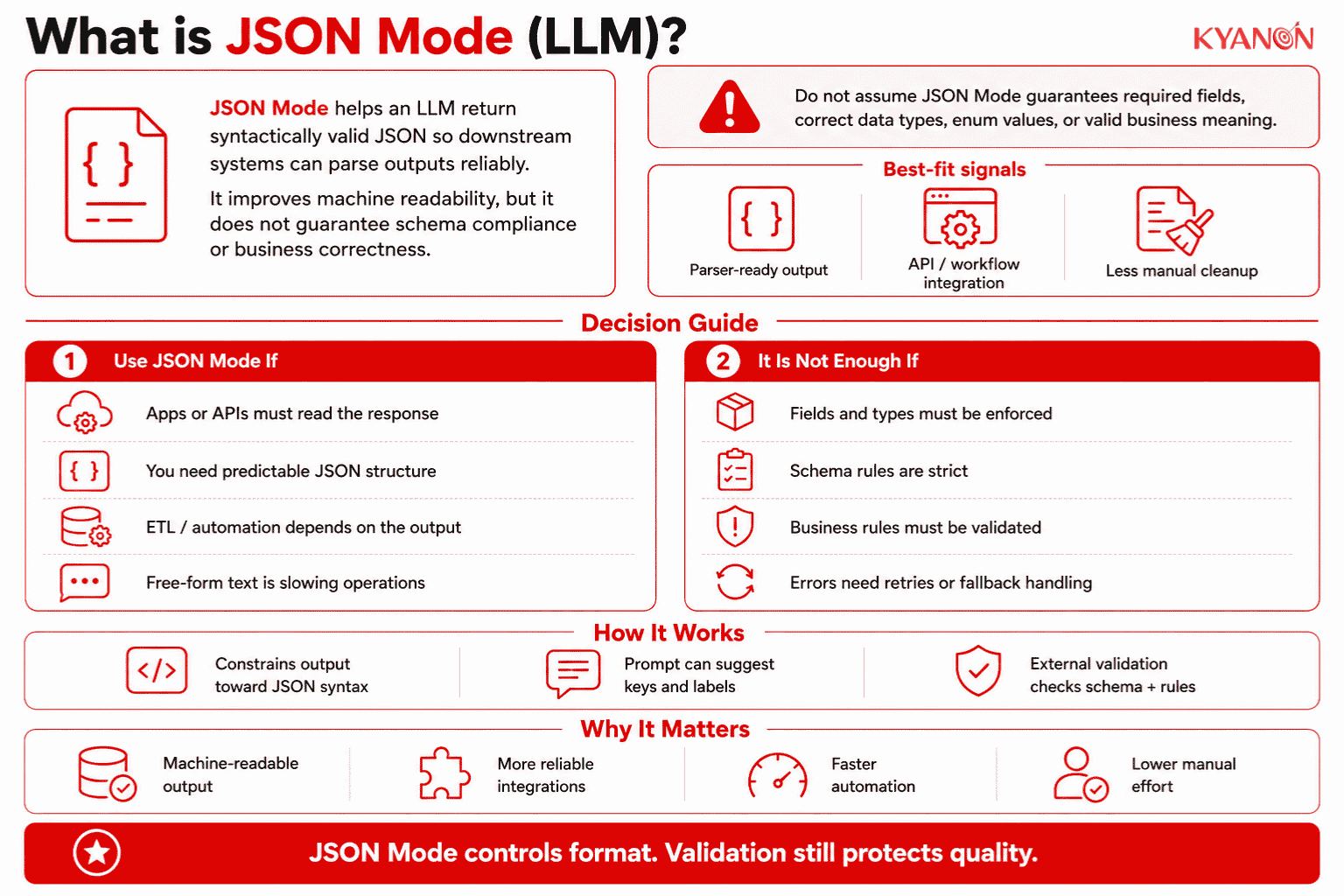
JSON Mode is an LLM output setting that instructs a language model to return syntactically valid JSON so its response can be parsed by downstream software systems. JSON Mode improves machine readability, but it does not guarantee that the output follows a specific schema, business rule, or data contract.
How JSON Mode (LLM) Works
JSON Mode works by constraining the model’s response format toward JSON syntax rather than free-form natural language. The model still generates tokens probabilistically, but the output channel is guided so the final response can be read by a JSON parser instead of requiring manual cleanup.
A JSON Mode response can be valid JSON while still being operationally wrong if required fields, data types, enum values, or business meanings do not match the consuming system.
JSON Syntax Constraint
The syntax constraint keeps the model output inside a JSON-readable structure, such as an object or array. This matters because downstream applications, APIs, ETL jobs, and orchestration workflows cannot reliably consume conversational text.
Prompt-Level Field Instruction
Teams usually define expected keys, labels, or formats inside the prompt. This can improve consistency, but prompt instructions alone do not create a strict contract because the model may still omit fields, change nesting, or return values in the wrong type.
External Validation Layer
A validation layer checks whether the returned JSON matches required fields, data types, allowed values, and business rules. In enterprise AI pipelines, JSON Mode should be treated as a formatting control, while schema validation and error handling remain separate production safeguards.

JSON Mode (LLM) vs Structured Outputs
Both JSON Mode and Structured Outputs make LLM responses easier for software systems to consume, but they differ in how strongly they enforce the output contract.
Dimension | JSON Mode (LLM) | Structured Outputs |
| Syntax validation | Valid JSON guaranteed | Valid JSON guaranteed |
Schema compliance | Best effort | Strictly enforced |
| Data type matching | Prone to type errors | Guaranteed type matching |
Upfront complexity | Low | High |
| Best for | Simple data extraction | Mission-critical integrations |
When to Consider JSON Mode (LLM)
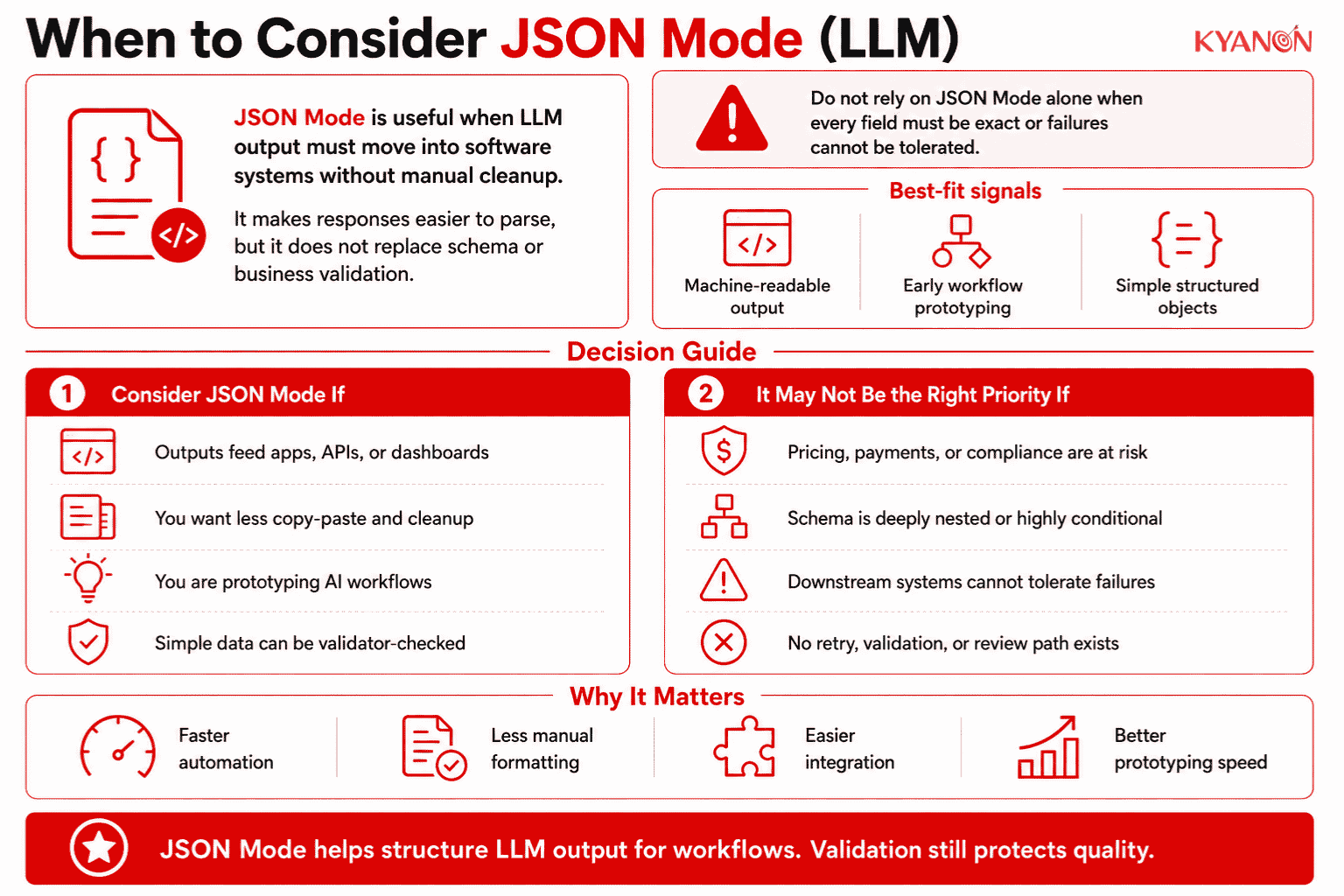
JSON Mode is most useful when a business workflow needs LLM output to move into software systems without manual copy-paste, markdown cleanup, or natural-language parsing.
Consider JSON Mode (LLM) if:
- Your team needs AI-generated outputs to feed dashboards, workflow tools, internal APIs, or automation scripts in a machine-readable format.
- You are building an early-stage enterprise AI workflow and need faster prototyping before investing in strict schema contracts.
- Your use case involves simple objects, shallow fields, or controlled internal data extraction where a validator can catch errors before production use.
It may not be the right priority if:
- Your workflow handles pricing, payments, compliance, customer identity, inventory, medical, legal, or financial decisions where every field must match a strict schema and business rule.
- Your expected output contains deeply nested objects, multiple conditional fields, or complex parent-child relationships that can increase failure risk.
- Your downstream system cannot tolerate retries, validation failures, or manual review queues.
Why JSON Mode (LLM) Matters for Enterprise AI Pipelines
JSON Mode matters for enterprise AI pipelines because structured, parseable output is the bridge between a generative model and the operational systems that execute business processes. The real value is not that the model “answers in JSON,” but that AI output can move safely into downstream systems with fewer post-processing hacks.
A regional e-commerce or retail enterprise using LLMs for product enrichment, customer service tagging, or order issue classification can use JSON Mode to make responses parseable, then apply schema validation before sending data into a PIM, CRM, OMS, or analytics platform. This approach reduces manual cleanup while keeping the final data contract under engineering governance.
Common Misconceptions
“JSON Mode ensures my data is schema-compliant.”
Reality: JSON Mode usually improves JSON syntax validity, but it does not guarantee that the model follows your required keys, data types, arrays, or enum values. For production workflows, CTOs should treat JSON mode as a formatting layer, not as a schema enforcement mechanism.
“If it is valid JSON, my program will not crash.”
Reality: A parser can accept JSON that is structurally valid but semantically wrong, such as a price returned as text, an invalid currency code, or a missing customer identifier. Enterprise systems need validation, fallback logic, monitoring, and error queues before LLM output is allowed to update business records.
“We can just ask the model to ‘return JSON’ in the prompt.”
Reality: Prompting alone often leaves room for conversational text, markdown fences, inconsistent field names, or partial structures. JSON Mode is a better baseline than plain prompting, but high-risk workflows should use structured outputs, function calling, or tool calling where schema adherence matters.
“JSON Mode is enough for complex nested data.”
Reality: Deeply nested JSON increases the chance of missing nodes, misplaced values, or inconsistent hierarchy. For enterprise use cases, flatter schemas are usually easier to validate, monitor, and maintain across downstream systems.
Technical Limitations of JSON Mode (LLM)
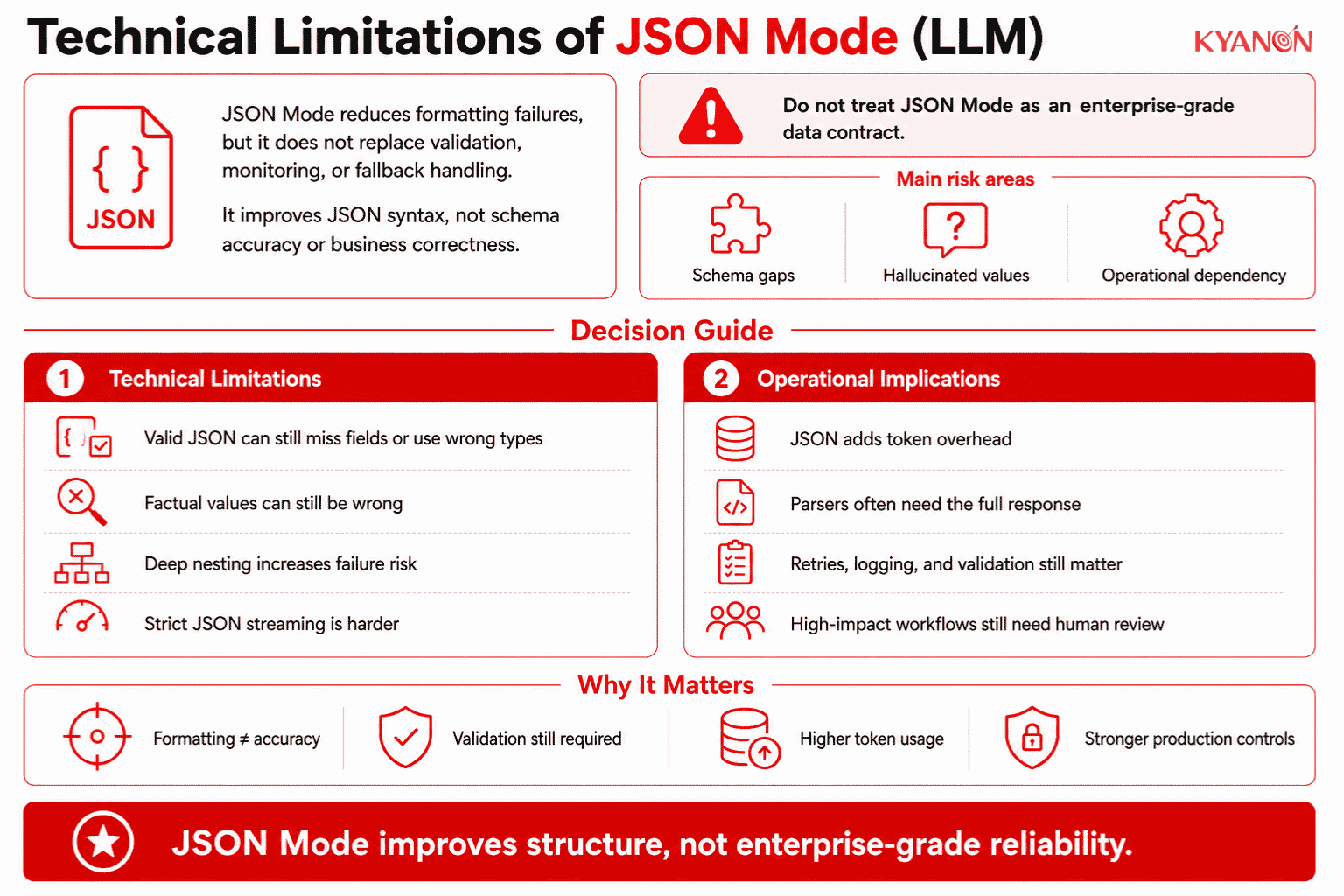
JSON Mode reduces formatting failures, but it does not remove the need for validation, monitoring, and fallback handling in enterprise AI systems.
- Schema gaps: JSON Mode can return valid JSON that still misses required fields, uses the wrong data type, or breaks a downstream business rule.
- Hallucinated values: JSON Mode controls format, not factual accuracy; the model can still produce incorrect names, prices, categories, or IDs inside valid JSON.
- Nested structure risk: Deeply nested JSON is harder for LLMs to maintain consistently, especially when parent-child relationships or conditional fields are involved.
- Streaming constraints: Some platform setups make strict JSON streaming harder because partial JSON cannot be parsed reliably until the full response is complete.
- Token overhead: JSON syntax uses repeated quotes, brackets, commas, and field names, which can increase token usage compared with shorter text formats.
- Operational dependency: Production teams still need schema validation, retry logic, logging, and human review for high-impact workflows.
For CTOs and IT directors, the key limitation is that JSON mode improves output formatting, but it does not create an enterprise-grade data contract by itself.
How Kyanon Digital Applies JSON Mode (LLM)
Kyanon Digital applies JSON Mode in enterprise AI pipelines where LLM outputs must feed downstream systems such as CRMs, product information management platforms, order systems, analytics layers, and workflow automation tools.
In practice, Kyanon Digital combines JSON Mode with schema validation, error handling, observability, and integration design so AI-generated output can support measurable outcomes such as faster time-to-market, lower post-processing effort, cleaner data handoff, and reduced total cost of ownership.
→ Explore our Generative AI Development services.

 Create project brief with AI