
What is JSON Schema Validation (AI Outputs)?
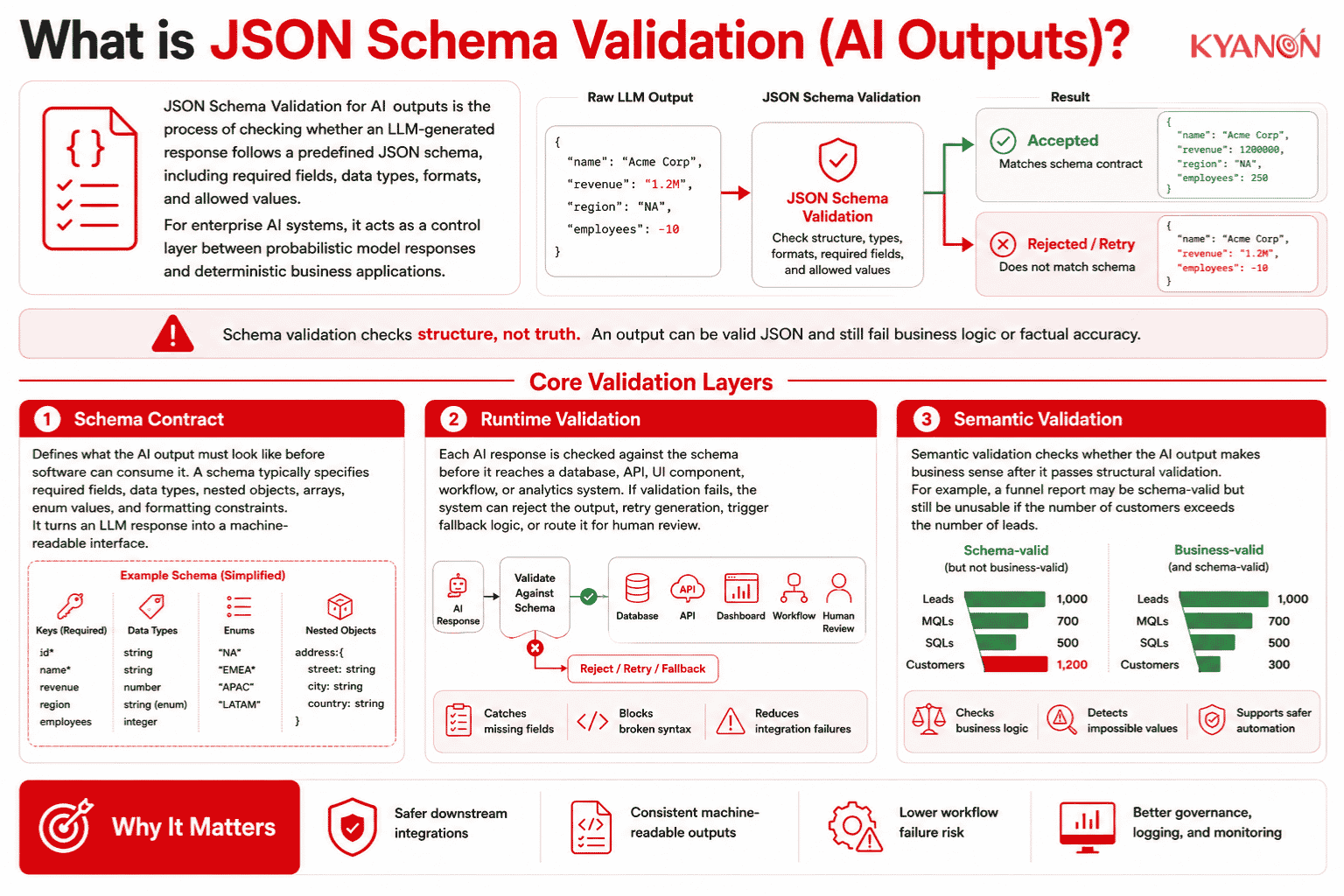
JSON schema validation for AI outputs is the process of verifying that an LLM-generated response adheres to a predefined JSON schema, including required fields, data types, formats, and allowed values.
For enterprise AI systems, JSON Schema validation acts as a control layer between probabilistic model responses and deterministic business applications.
How JSON Schema Validation (AI Outputs) Works
JSON schema validation works by comparing an AI-generated JSON response against a predefined contract before the response is accepted by an application, workflow, dashboard, or downstream system.
A JSON Schema can confirm that an AI response includes the right keys, valid data types, required fields, allowed enum values, and nested object structures, but it does not automatically confirm that the output is factually correct or business-logical.
Schema Contract
The schema contract defines what the AI output must look like before it can be consumed by software. It typically specifies required fields, data types, object nesting, enum values, arrays, and formatting constraints.
For CTOs and engineering leaders, the schema contract turns an LLM response from free-form text into a machine-readable interface.
Runtime Validation
Runtime validation checks each AI response against the schema before the response reaches a database, API, UI component, automation workflow, or analytics system. If the response fails validation, the system can reject it, retry the generation, trigger fallback logic, or route it for human review.
Runtime validation reduces integration failures caused by missing fields, broken syntax, unexpected values, or inconsistent response structures.
Semantic Validation
Semantic validation checks whether the AI output makes business sense after it passes structural validation. For example, a funnel report may pass JSON Schema validation but still be unusable if the number of customers exceeds the number of leads in the same funnel.

JSON Schema Validation (AI Outputs) vs Prompt Engineering
Both approaches attempt to control LLM formats but differ fundamentally in execution layer and system reliability.
Dimension | JSON Schema Validation (AI Outputs) | Prompt Engineering |
| Execution Layer | API / Inference Engine | Text Prompt |
Syntax Reliability | 100% Guaranteed | Variable / Probabilistic |
| Upfront Complexity | High | Low |
Conversational Filler | Zero Risk | High Risk |
| Best for | Production API pipelines | Prototyping and internal tools |
When to Consider JSON Schema Validation (AI Outputs)
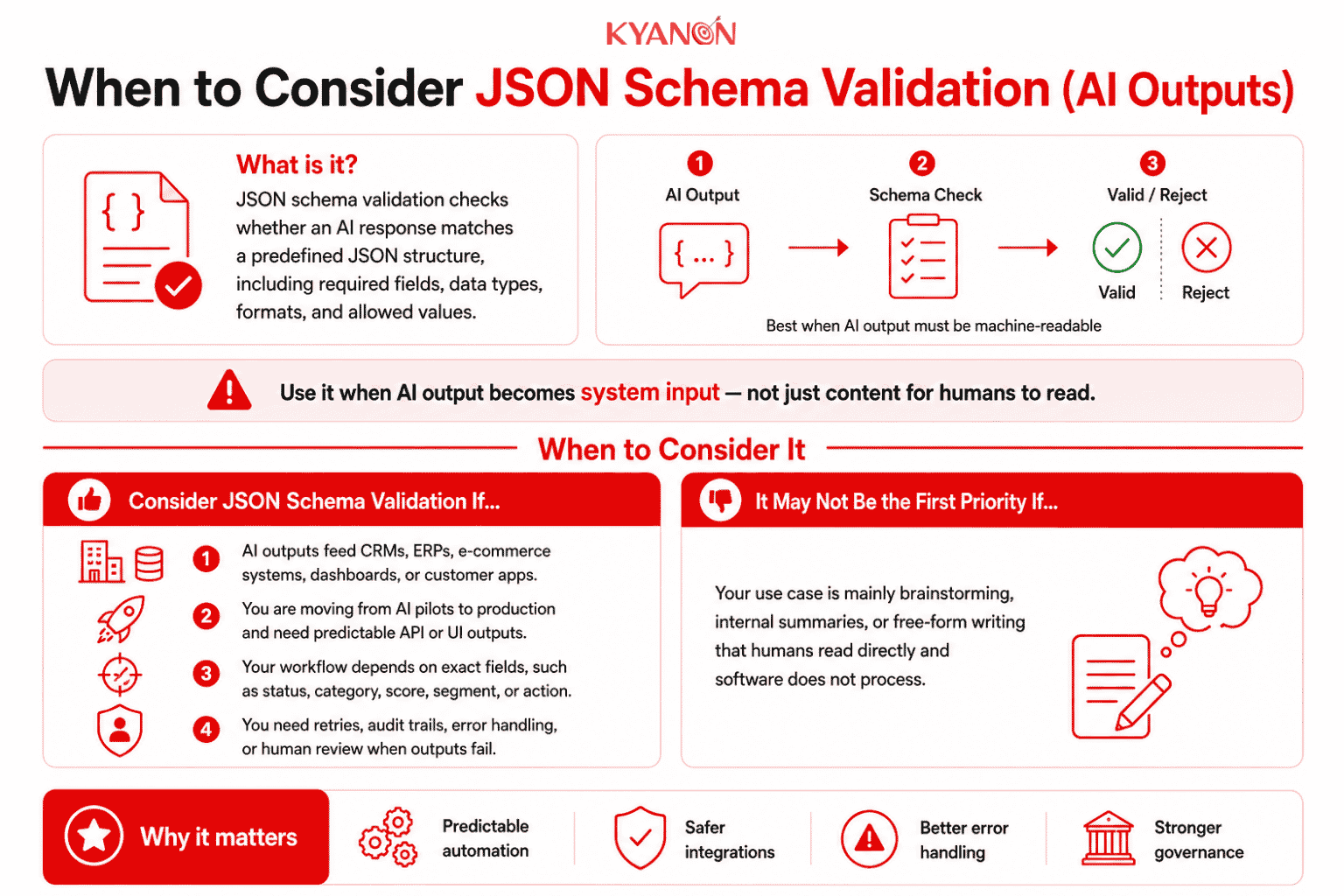
Consider JSON schema validation (AI outputs) if:
- Your AI outputs feed directly into business systems, such as CRMs, ERPs, e-commerce platforms, dashboards, approval workflows, or customer-facing applications.
- Your team is moving from AI pilots to production and needs predictable outputs for APIs, automation logic, or UI rendering.
- Your application depends on specific fields, such as order status, product category, risk score, customer segment, chart type, or recommended action.
- Your AI workflow must support error handling, audit trails, retries, or human review when outputs fail validation.
It may not be the right priority if:
- Your AI use case is limited to exploratory brainstorming, internal summarization, or free-form writing where outputs are read by humans and not processed by software.
For enterprise teams, JSON schema validation becomes important when an AI response is no longer just content but an input to a business process.
Why JSON Schema Validation (AI Outputs) Matters for Enterprise AI
JSON schema validation matters because enterprise AI systems often fail not when the model cannot generate an answer, but when the answer cannot be safely processed by downstream software.
OpenAI’s 2024 benchmark shows why schema enforcement has become important for production AI: The gap between valid-looking responses and schema-adherent responses can determine whether an AI feature can be integrated safely into real applications.
A retail or e-commerce enterprise using AI to generate product attributes, customer segments, campaign recommendations, or dashboard-ready chart data needs more than fluent text. It needs outputs that can be parsed, checked, logged, and passed into downstream systems without breaking workflows.
For example, an e-commerce team may ask an LLM to return a recommended product bundle in JSON format. If the response omits the SKU field, uses the wrong category value, or returns a discount outside the allowed range, schema validation can block the output before it reaches the storefront, promotion engine, or ERP integration.
Common Misconceptions
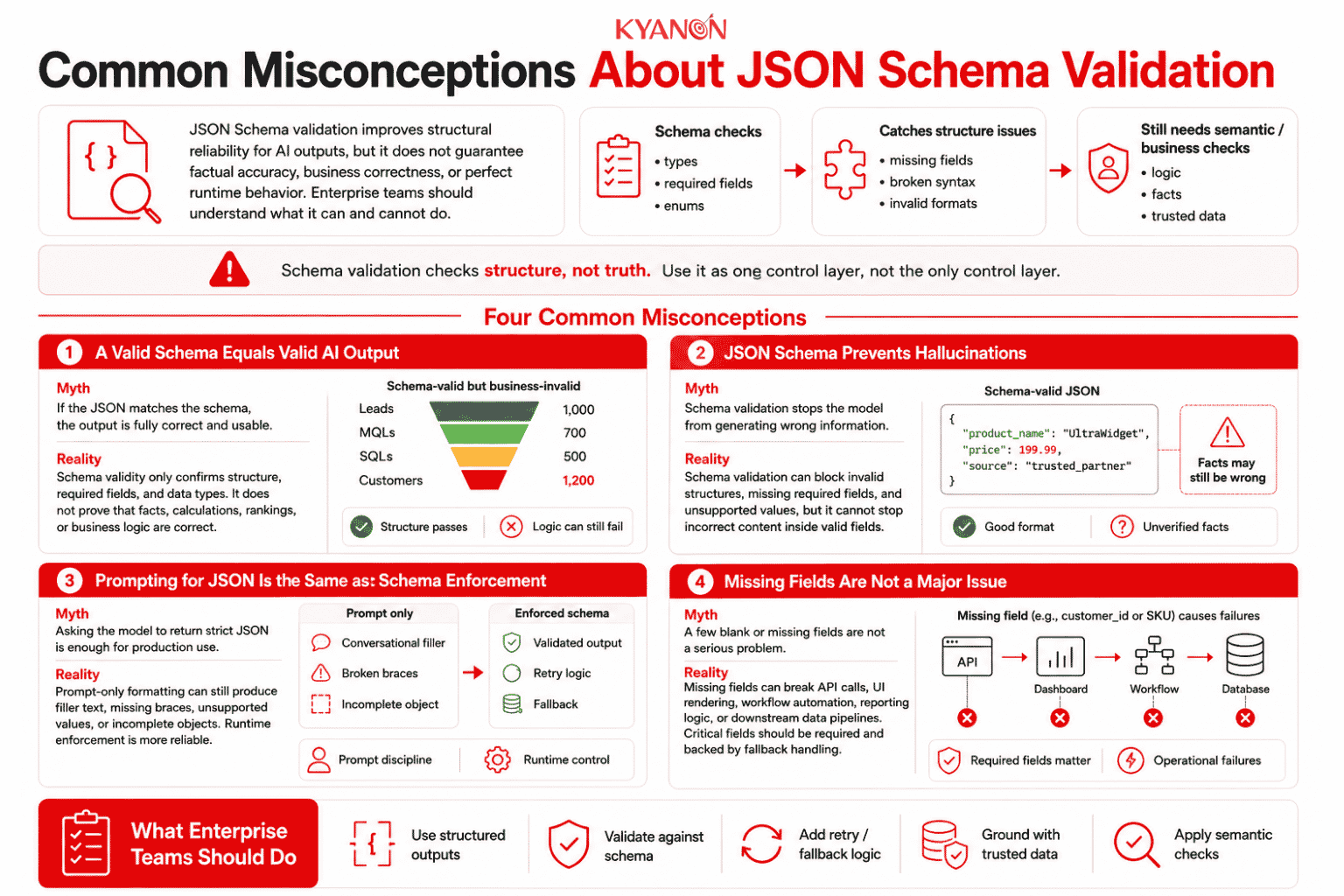
“A valid JSON Schema equals valid AI output.”
Reality: Valid JSON Schema only means the response matches the expected structure, types, and fields. It does not prove that the facts, calculations, rankings, or business logic are correct.
A funnel chart can pass schema validation while showing negative progression, impossible conversion rates, or customer numbers that exceed lead numbers.
“JSON Schema prevents hallucinations.”
Reality: JSON Schema can prevent invalid structures, missing required fields, and unsupported enum values, but it cannot stop the model from generating wrong information inside valid fields.
For enterprise use cases, schema validation should be combined with retrieval-augmented generation, trusted data sources, deterministic tools, and semantic checks.
“Prompting for JSON is the same as schema enforcement.”
Reality: Asking a model to “return strict JSON” is not the same as enforcing a schema at runtime. Prompt-only formatting can still produce conversational filler, missing braces, unsupported values, or incomplete objects.
Production AI systems should use structured output mechanisms, schema validation, retry logic, and fallback handling instead of relying only on prompt discipline.
“Missing fields are not a major issue.”
Reality: Missing fields can break API calls, UI rendering, workflow automation, reporting logic, or downstream data pipelines. For enterprise applications, every critical field should be marked as required and supported by fallback logic.
A missing customer ID, product SKU, payment status, or risk label can turn a successful AI response into an operational failure.
How Kyanon Digital Applies JSON Schema Validation (AI Outputs)
Kyanon Digital applies JSON Schema Validation in enterprise AI pipelines where LLM responses must be machine-readable, integration-safe, and usable by downstream systems. In AI, GenAI, commerce, data, and workflow automation projects, Kyanon Digital designs structured output contracts, validates model responses, adds semantic business rules, and connects validated outputs to APIs, dashboards, approval flows, and enterprise platforms across Vietnam, Singapore, Malaysia, Thailand, ANZ, the US, and Nordic Europe.
Kyanon Digital’s implementation approach focuses on making AI outputs usable in real business systems, not only generating responses that look correct.
→ Explore our Generative AI Development services.

 Create project brief with AI