
What is Knowledge Distillation?
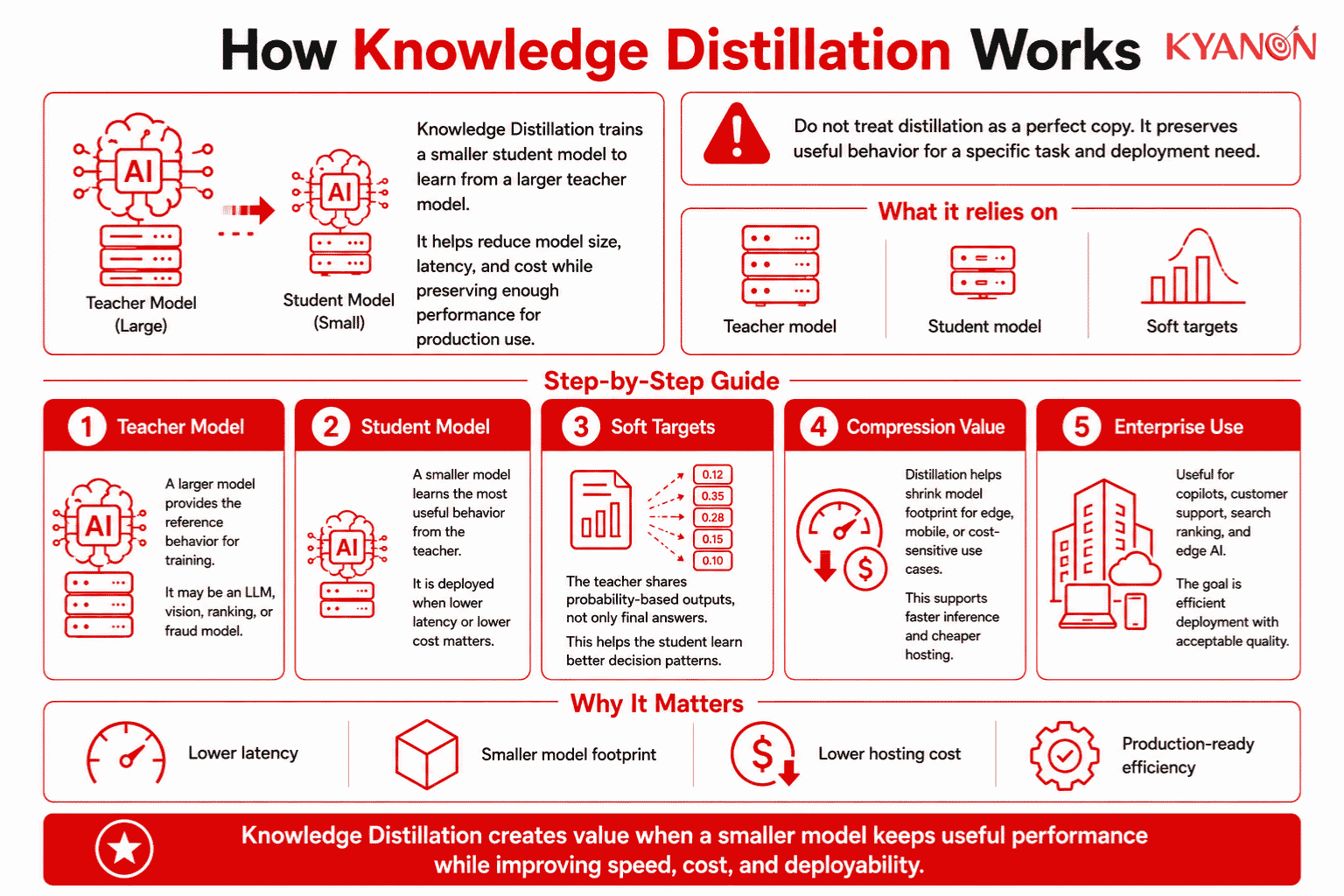
Knowledge Distillation is an AI model compression technique that trains a smaller student model to learn from the outputs, probability distributions, or internal representations of a larger teacher model.
The purpose of Knowledge Distillation is to reduce model size, latency, and hosting cost while preserving enough task performance for production use cases such as edge AI, mobile AI, customer support automation, search ranking, and enterprise copilots.
How Knowledge Distillation Works
Knowledge Distillation works by transferring learning signals from a teacher model to a smaller student model.
The student does not copy the teacher perfectly; it learns selected behavior that is useful for a defined task, deployment environment, and business constraint.
Teacher Model
The teacher model is the larger model that provides reference behavior for training.
In enterprise AI, the teacher model may be a large language model, vision model, recommendation model, fraud model, or search model.
Student Model
The student model is the smaller model trained to approximate the teacher’s useful behavior.
The student model is usually deployed when the business needs lower latency, lower infrastructure cost, or AI execution on edge devices.
Soft Targets
Soft targets are probability outputs from the teacher model.
Soft targets help the student model learn relationships between possible answers, not only the final correct label.

Three Main Knowledge Distillation Frameworks
Knowledge distillation can be applied through offline distillation, online distillation, or self-distillation, depending on when and how knowledge is transferred.
Framework | How it works | Best for |
Offline Distillation | A pre-trained teacher model is frozen, then a student model learns from its outputs. | Common enterprise model compression and cost reduction. |
| Online Distillation | Teacher and student models are trained at the same time and learn together. | Research-heavy or adaptive AI training setups. |
Self-Distillation | One model acts as both teacher and student across layers, stages, or checkpoints. | Improving model efficiency without relying on a separate teacher model. |
Offline Distillation
Offline distillation is the most common knowledge distillation approach for enterprise production.
The teacher model is already trained, and the student model learns from the teacher’s fixed outputs.
Online Distillation
Online distillation trains the teacher and student models at the same time.
This approach can improve collaboration between models, but it is usually more complex to manage in production pipelines.
Self-Distillation
Self-distillation uses one model to teach itself.
This can happen when deeper layers, later checkpoints, or stronger versions of the same model guide weaker parts of the model.
Knowledge Distillation vs Fine-Tuning
Knowledge distillation compresses model behavior into a smaller model, while fine-tuning adapts an existing model to a specific task or domain.
Dimension | Knowledge Distillation | Fine-Tuning |
| Main purpose | Reduce model size and inference cost | Improve task or domain performance |
Training signal | Teacher outputs, probabilities, or representations | Labeled data, examples, or instructions |
Output model | Usually a smaller student model | Usually the same model adapted to a use case |
| Best for | Cost reduction, latency reduction, edge AI | Domain adaptation, workflow alignment, tone control |
Infrastructure impact | Can reduce serving cost and memory use | May keep or increase serving cost |
| Main risk | Student loses teacher nuance or edge-case behavior | Model overfits or becomes poorly governed |
Common Applications of Knowledge Distillation
Knowledge distillation is commonly used when enterprises need AI models that are faster, cheaper, or easier to deploy than the original large model.
| Application | Business use case |
Natural Language Processing | Smaller language models for search, classification, support routing, summarization, and enterprise assistants. |
Computer Vision | Faster object detection, quality inspection, facial recognition, and video analytics on edge hardware. |
Generative AI | Compact domain-specific assistants for internal workflows, customer support, document processing, or local deployment. |
| E-commerce AI | Product classification, recommendation ranking, search relevance, catalog enrichment, and support automation. |
| Edge AI | AI deployment on devices with limited memory, compute, or network access. |
When to Consider Knowledge Distillation
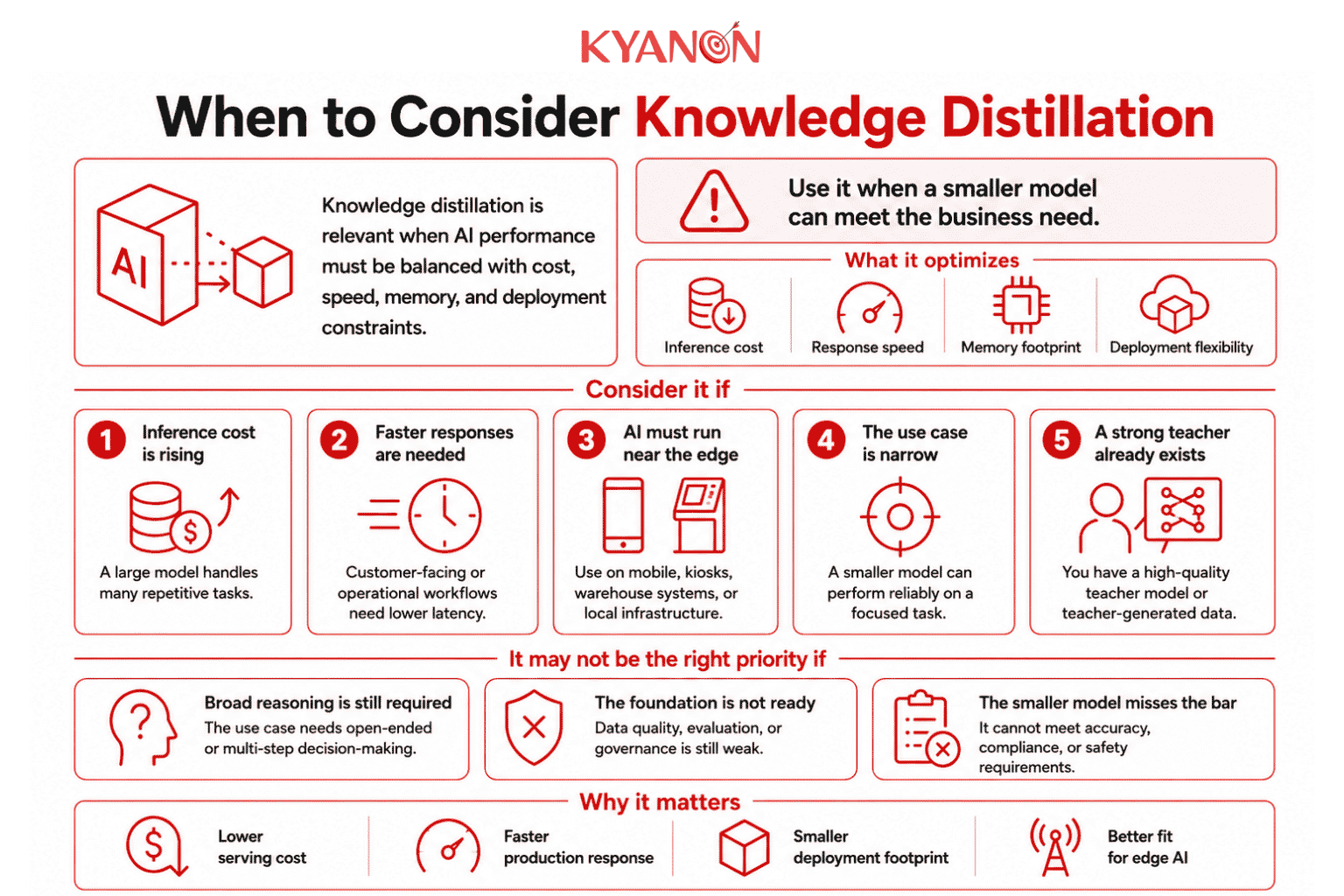
Knowledge distillation is relevant when AI performance must be balanced against cost, speed, memory, and deployment constraints.
Consider knowledge distillation if:
- Your AI inference cost is growing because a large model handles many repetitive tasks.
- Your AI system needs faster response times for customer-facing or operational workflows.
- Your business needs AI to run on edge devices, mobile devices, kiosks, warehouse systems, or local infrastructure.
- Your use case is narrow enough for a smaller model to perform reliably.
- Your team already has a high-quality teacher model or enough teacher-generated data.
It may not be the right priority if:
- Your use case still requires broad reasoning, open-ended analysis, or complex multi-step decision-making.
- Your data quality, evaluation process, or governance model is not ready.
- The smaller model cannot meet the minimum accuracy, compliance, or safety requirements.
Why Knowledge Distillation Matters for Enterprise AI
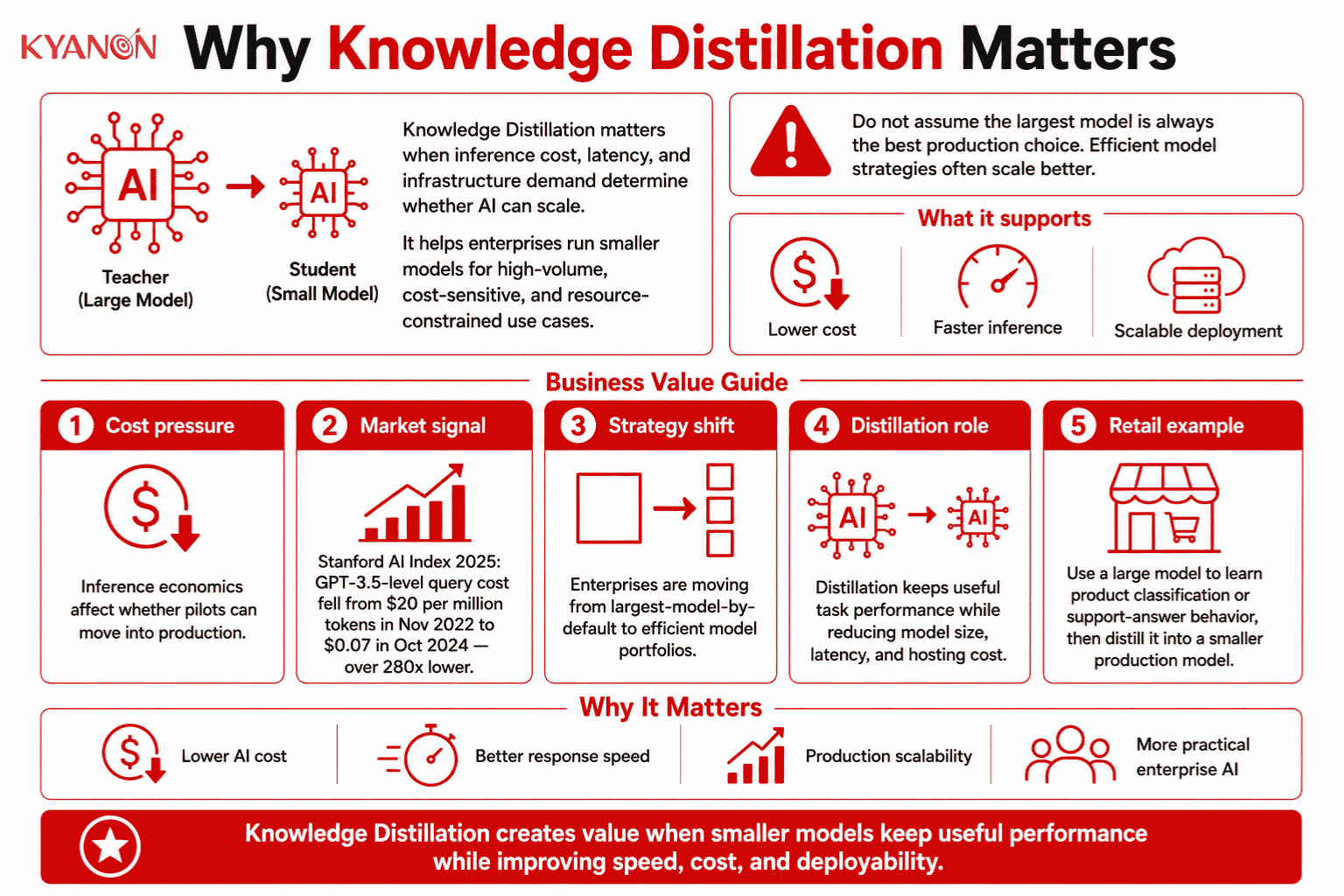
Knowledge distillation matters because AI inference cost, latency, and infrastructure demand often determine whether an AI pilot can scale into production.
For enterprise teams, knowledge distillation is a practical way to run smaller AI models for high-volume, cost-sensitive, or resource-constrained use cases.
According to the Stanford AI Index 2025, the cost of querying an AI model with GPT-3.5-level performance dropped from $20 per million tokens in November 2022 to $0.07 per million tokens by October 2024, a reduction of more than 280x.
This cost decline shows why enterprises are moving from the “largest model by default” to more efficient model strategies, including knowledge distillation, smaller models, caching, and inference optimization.
A retail enterprise, for example, can use a large teacher model to classify products, enrich catalog data, or generate support-answer behavior, then distill that behavior into a smaller model for faster and lower-cost production use.
Common Misconceptions
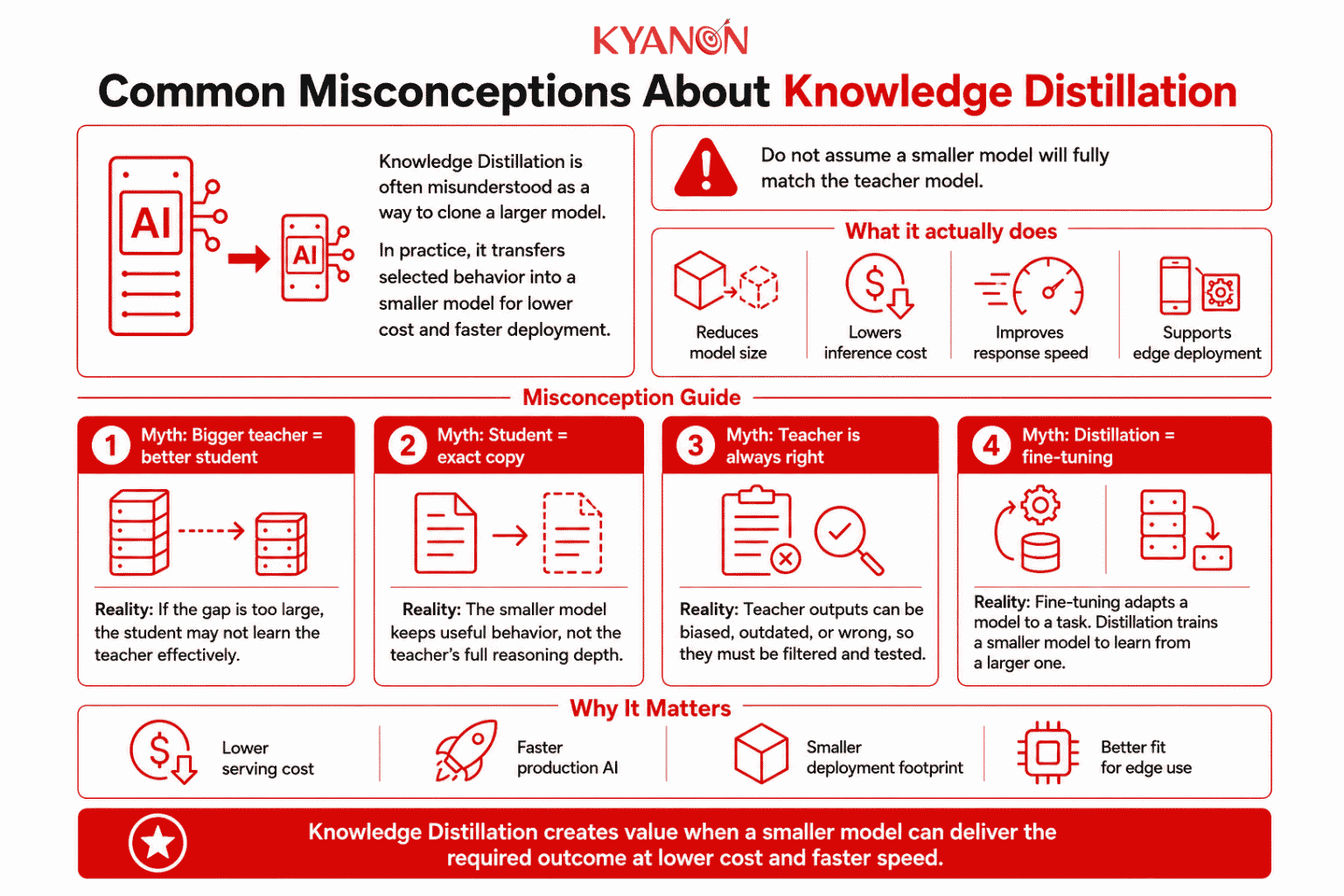
A common misconception is that knowledge distillation creates a smaller model that perfectly copies the teacher model.
In reality, knowledge distillation transfers selected behavior, not the full reasoning depth or exact internal logic of the teacher model.
“A larger teacher always creates a better student.”
Reality: A very large teacher can be too complex for a small student model to learn from effectively.
For CTOs, the right question is not “Which teacher is the biggest?” but “Which teacher provides learnable behavior for this business task?”
“The student model will behave exactly like the teacher.”
Reality: The student model usually loses some fine-grained behavior because it has fewer parameters and less capacity.
Knowledge distillation should be evaluated against business-specific acceptance criteria, not assumed to preserve every teacher’s capability.
“The teacher model is always correct.”
Reality: Teacher models can be biased, outdated, poorly calibrated, or wrong.
A production distillation pipeline should filter poor teacher outputs and test the student model against real business scenarios.
“Knowledge Distillation is the same as fine-tuning.”
Reality: Fine-tuning adapts a model to a task, while knowledge distillation trains a smaller model to learn from a larger model.
Both can be used together, but they solve different enterprise AI problems.
How Kyanon Digital Applies Knowledge Distillation
Kyanon Digital applies knowledge distillation when enterprise AI systems need lower inference cost, faster response time, or deployment in resource-constrained environments.
Kyanon Digital evaluates whether a large model should remain in the serving path, be distilled into a smaller model, or be combined with retrieval, caching, batching, fallback logic, and human review.
Typical implementation areas include:
- Distilling LLM behavior for repetitive enterprise workflows.
- Reducing AI hosting cost for high-volume classification, extraction, routing, and support automation.
- Deploying smaller models for edge environments in retail, logistics, manufacturing, and field operations.
- Combining distillation with RAG, model evaluation, guardrails, and monitoring for production AI reliability.
→ Explore our Kyanon Digital’s AI, GenAI & ML implementation services.

 Create project brief with AI