
What is a pre-trained model?
A pretrained model is a machine learning model that has been previously trained on a large dataset for a specific task (usually general-purpose) and can then be reused or fine-tuned for a different but related task. Pre-trained models save development teams time, data and computational resources compared to training a model from scratch. (IBM)
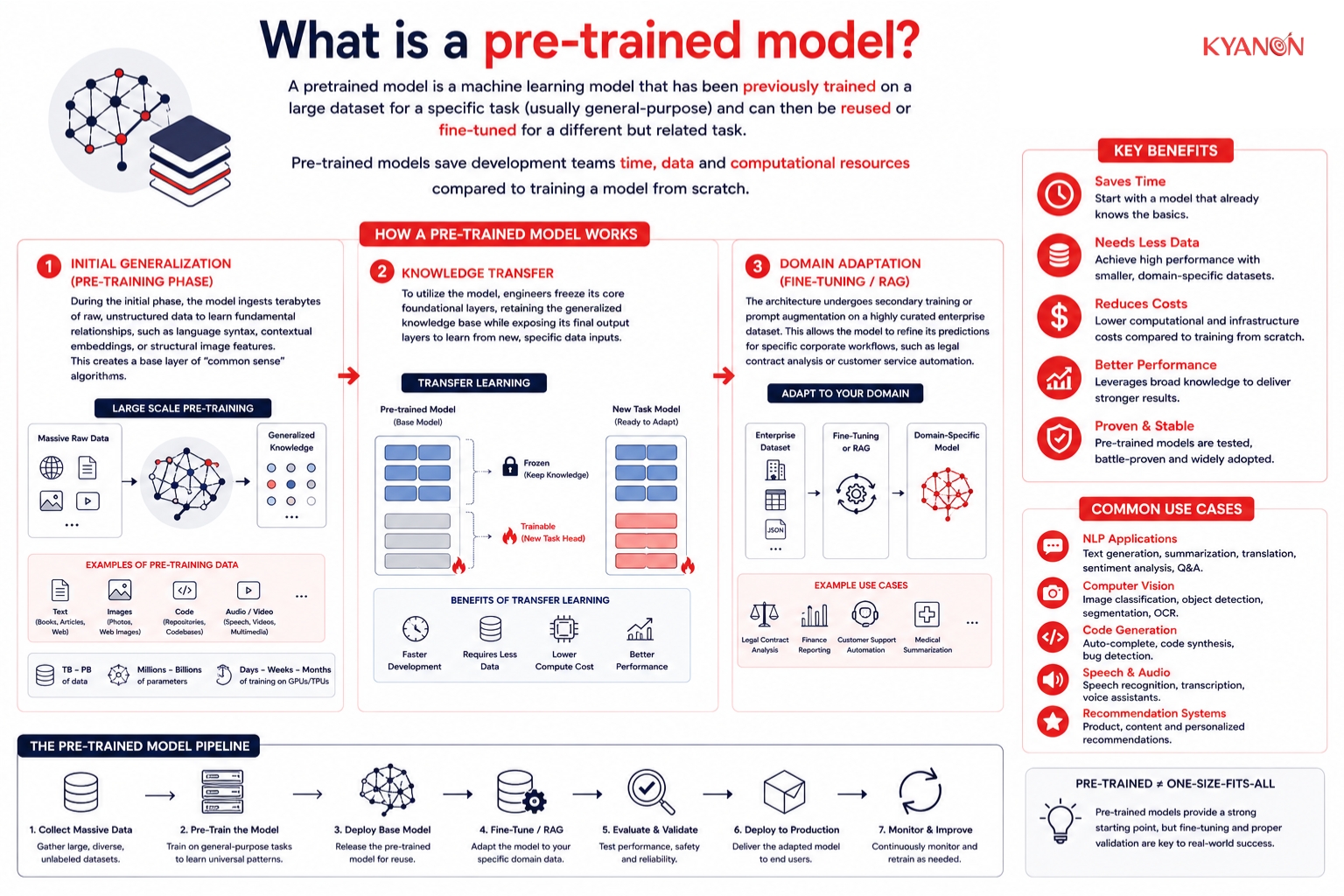
How a pre-trained model works
A pre-trained model functions by transferring generalized knowledge acquired during its initial compute-heavy training phase to a new, specialized domain through a process called transfer learning. Instead of initializing a neural network with random mathematical weights, the algorithm begins with optimized parameters, requiring only minor adjustments to adapt to enterprise-specific data.
Initial Generalization (Pre-training Phase)
During the initial phase, the model ingests terabytes of raw, unstructured data to learn fundamental relationships, such as language syntax, contextual embeddings, or structural image features. This creates a base layer of “common sense” algorithms.
Knowledge Transfer
To utilize the model, engineers freeze its core foundational layers, retaining the generalized knowledge base while exposing its final output layers to learn from new, specific data inputs.
Domain Adaptation (Fine-Tuning/RAG)
The architecture undergoes secondary training or prompt augmentation on a highly curated enterprise dataset. This allows the model to refine its predictions for specific corporate workflows, such as legal contract analysis or customer service automation.

Major enterprise benefits of a pre-trained model
- Drastic Cost & Compute Savings: Training an advanced AI model from scratch takes weeks of high-end GPU compute time. Pre-trained models bypass this financial hurdle entirely, allowing smaller startups to deploy world-class AI applications.
- Requires Far Less Data: Building a custom model from scratch requires millions of perfectly labeled data points. Fine-tuning a pre-trained model typically requires only a few hundred or thousand curated samples because the model already understands basic features (like shapes, colors, or grammar).
- Accelerated Time-to-Market: Engineering teams can download open-source pre-trained models from hubs like Hugging Face or deploy them directly through cloud market ecosystems like AWS Marketplace or IBM Watsonx NLP in a matter of hours.
Source: AWS, IBM
Pre-trained Model vs Trained-from-Scratch Model
Both approaches deliver predictive AI capabilities, but pre-trained models drastically reduce development timelines compared to algorithms trained from scratch.
Dimension | Pre-trained Model | Trained-from-Scratch Model |
| Time-to-market | Fast (days to weeks) | Slow (months to years) |
Upfront compute cost | Low to moderate | Exorbitantly high |
| Data volume required | Low (thousands of curated samples) | Massive (terabytes of raw data) |
Architecture flexibility | Constrained by original design | Complete architectural control |
| Risk of inherited bias | High (carries original training biases) | Controlled (determined by your dataset) |
When to consider a pre-trained model
Engineering teams should consider pre-trained models when they need to rapidly deploy AI capabilities but lack the extensive compute budgets required to train massive neural networks from scratch.
Consider a Pre-trained Model if:
- Your engineering team faces strict time-to-market deadlines and needs to deploy a functional AI capability in weeks rather than months.
- You are addressing standard NLP or computer vision tasks where broad, general internet knowledge serves as a strong foundation for your specific workflow.
- You possess a highly qualitative, accurately labeled dataset that is too small in volume to train a neural network from the ground up without severe overfitting.
It may not be the right priority if:
- Your organization operates in a highly regulated sector with completely proprietary data structures where inherited biases and open-source model weights violate strict compliance and transparency policies.
Why pre-trained models matter for enterprise technology
A pre-trained model enables developers to build AI solutions faster by leveraging models that have already learned general patterns from large datasets and then adapting them to specific tasks through techniques such as fine-tuning. This approach reduces the need for extensive data, computing resources, and training time while improving reliability, since the models have already been tested and validated in real-world scenarios. Pre-trained models power a wide range of applications, including NLP, generative AI, object detection, and image classification, making advanced AI capabilities more accessible to organizations of all sizes. (IBM)
Common Misconceptions
IT Directors and Engineering VPs often misinterpret the legal and operational realities of off-the-shelf algorithms, leading to unexpected scaling costs and licensing breaches.
Open-source pre-trained models are entirely free to use commercially
Reality: Many pre-trained models carry restrictive open-source licenses that strictly govern or limit commercial applications and monetization. Just because a pre-trained model’s weights are public on platforms like Hugging Face does not mean it is legally cleared for corporate use; some licenses explicitly ban usage for training competing models or require royalty payments if your user base scales past a certain threshold.
You can easily run any pre-trained model on standard business infrastructure
Reality: Pre-trained models, especially modern Large Language Models (LLMs) frequently require massive hardware footprints and multi-GPU cloud instances just for basic inference. While training a model from scratch is what costs millions, simply hosting and serving an unoptimized 70-billion parameter pre-trained model in production still demands specialized compute. Enterprises must use model compression techniques like quantization or formats like ONNX to make them cost-effective.
How Kyanon Digital applies pre-trained models
Kyanon Digital adapts pre-trained models into production-grade enterprise AI systems using advanced transfer learning and model compression techniques. Serving enterprise clients across Vietnam, Singapore, Thailand, ANZ, and Nordic Europe, our data engineering teams leverage these foundational architectures as the starting point for most AI engagements, bypassing the prohibitive costs of training from scratch. By implementing strict output validation layers and optimizing inference for cross-platform environments via ONNX, we ensure our clients achieve measurable improvements in conversion rates, lower their TCO, and drastically accelerate their time-to-market.
Explore our Generative AI Development Services.

 Create project brief with AI