
What is Orchestration (AI)?
According to IBM Think, AI orchestration is the strategic coordination and management of artificial intelligence models, systems, and integrations. It is an end-to-end framework that governs how the distinct pieces of an AI estate, including machine learning models, autonomous AI agents, data stores, computing resources, and enterprise data pipelines, interact seamlessly.
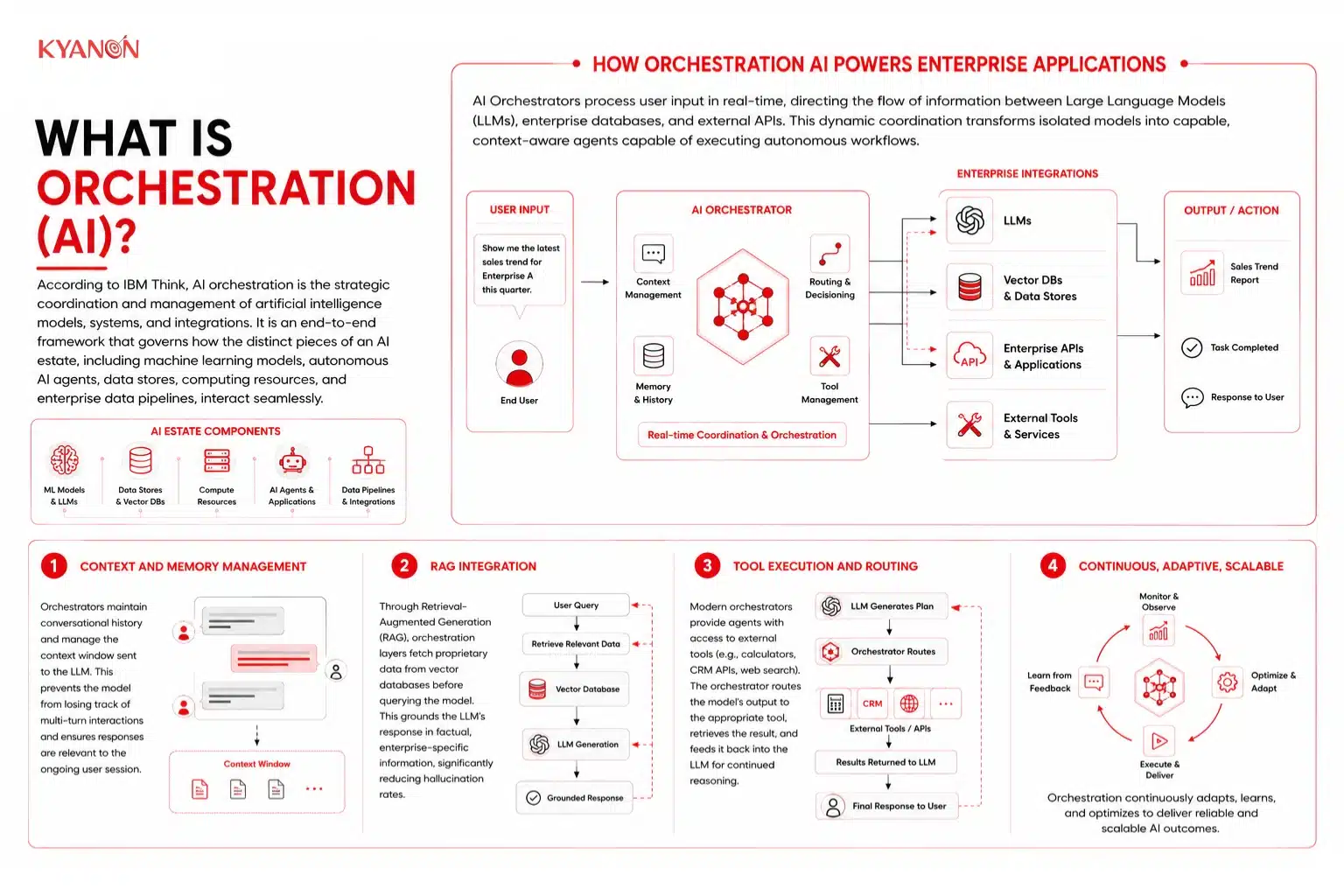
How Orchestration AI powers enterprise applications
AI Orchestrators process user input in real-time, directing the flow of information between Large Language Models (LLMs), enterprise databases, and external APIs. This dynamic coordination transforms isolated models into capable, context-aware agents capable of executing autonomous workflows.
Context and Memory Management
Orchestrators maintain conversational history and manage the context window sent to the LLM. This prevents the model from losing track of multi-turn interactions and ensures responses are relevant to the ongoing user session.
RAG Integration
Through Retrieval-Augmented Generation (RAG), orchestration layers fetch proprietary data from vector databases before querying the model. This grounds the LLM’s response in factual, enterprise-specific information, significantly reducing hallucination rates.
Tool Execution and Routing
Modern orchestrators provide agents with access to external tools (e.g., calculators, CRM APIs, web search). The orchestrator routes the model’s output to the appropriate tool, retrieves the result, and feeds it back into the LLM for continued reasoning.

Orchestration (AI) vs. MLOps Pipelines
While both are essential for enterprise AI, they operate at completely different layers of the technology stack.
Dimension | Orchestration (AI) | MLOps Pipeline |
| Execution Timing | Real-time (during user interaction) | Scheduled/Batch (during training) |
Primary Output | Application responses/actions | Trained model files/artifacts |
| Core Function | Managing LLM workflows & tools | Managing data prep & model training |
Examples | LangChain, LlamaIndex, Semantic Kernel | Kubeflow, MLflow, Vertex AI Training |
| Focus | Application logic and state | Infrastructure and reproducibility |
Why Orchestration (AI) Matters for B2B Systems
As Large Language Models (LLMs) and generative AI continue to mature, organizations rely on advanced LLM orchestration techniques to deploy highly capable chatbots and context-aware business applications. Unifying these decoupled components under a centralized orchestration layer provides three primary business benefits (IBM):
- Scalability: Seamlessly expanding AI workloads without manual pipeline reconfiguration.
- Efficiency & Responsiveness: Speeding up the organization’s execution time and system stability.
- Effectiveness: Ensuring that autonomous components work as a unified system to solve real-world problems accurately.
Common Misconceptions
Engineering leaders often misinterpret the scope and autonomy of orchestration frameworks, leading to architectural missteps during production deployment.
Orchestration (AI) handles all the infrastructure automatically.
Reality: Orchestration (AI) frameworks manage the logical workflow, not the underlying compute or scaling. An orchestrator can chain five different model calls together, but it won’t manage the GPU provisioning, API rate limits, load balancing, or token cost optimizations. Engineers still need traditional cloud infrastructure and API gateways to make orchestrated AI applications production-ready.
AI orchestration is just a fancy term for basic automation
The Reality: Linear automation handles individual steps, but orchestration coordinates end-to-end journeys.
The underlying AI model executes tools itself
The Reality: Language models do not press buttons or run API calls.
How Kyanon Digital Implements Orchestration (AI)
Kyanon Digital architects custom Orchestration (AI) layers for enterprise clients in Singapore, ANZ, and Nordic Europe. Our implementation teams leverage frameworks like LangChain to build multi-agent systems tailored to complex B2B workflows. We focus on integrating Retrieval-Augmented Generation (RAG) and robust tool routing, ensuring high conversion rates and measurable reductions in manual processing time, while securely connecting AI models to your existing corporate data.
Explore our AI services:

 Create project brief with AI