
What is an order management system (OMS)
An Order Management System (OMS) is software that manages the lifecycle of a customer order by tracking the data and processes involved in order entry, inventory, fulfillment, delivery, and after-sales service. IBM explains that an OMS also provides visibility to both the business and the customer, including inventory availability and order status.
In omnichannel commerce, an OMS acts as a coordination layer between sales channels, inventory locations, fulfillment operations, and enterprise systems so orders can move through one controlled lifecycle.
Under IBM’s order-management model, that lifecycle can begin before the order is placed, with inventory availability and inventory promising, and continue through fulfillment, service, exchanges, and returns.
How an order management system (OMS) works
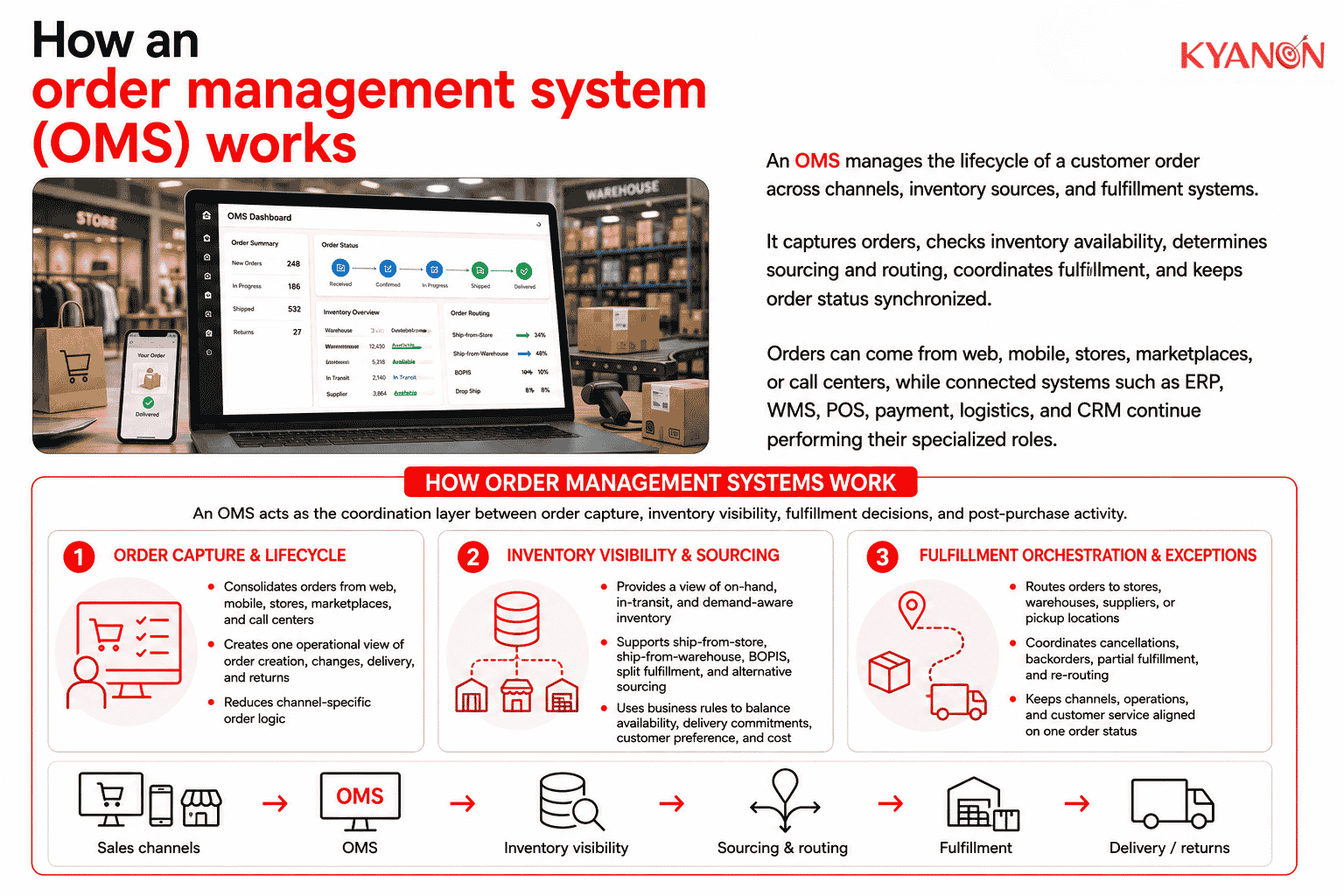
An OMS works by capturing orders from customer channels, checking available inventory, determining how orders should be fulfilled, coordinating execution, and keeping order status synchronized throughout the lifecycle. IBM identifies inventory availability, order capture, verification, inventory promising, fulfillment, and service as core stages of the order-management process.
A typical omnichannel flow is:
Sales channel → inventory availability → order capture → sourcing and routing → fulfillment → delivery or pickup → changes or returns → status update
Orders can originate from channels including web, mobile, call centers, stores, and marketplaces, while fulfillment can involve warehouses, distribution centers, stores, or pickup locations.
The OMS coordinates these decisions while systems such as ERP, WMS, POS, payment, logistics, and CRM continue performing their specialized functions.
Key functions of an OMS
The core functions of an OMS are to centralize orders, provide inventory visibility, determine fulfillment options, maintain order status, and manage changes and post-purchase activity across channels. IBM’s OMS framework covers order entry, inventory management, fulfillment, after-sales service, real-time inventory, fulfillment optimization, and customer visibility.
| Function | What the OMS does | Business relevance |
Centralized order management | Consolidates orders from web, mobile, stores, marketplaces, and other channels | Creates one view of the customer order lifecycle |
| Inventory visibility | Provides a consolidated view of available, in-transit, and demanded inventory | Supports more accurate availability and order promising |
Sourcing and routing | Determines suitable fulfillment locations using inventory and business rules | Balances availability, delivery commitments, customer preference, and cost |
| Fulfillment coordination | Routes approved orders to warehouses, stores, suppliers, or other execution points | Supports ship-from-warehouse, ship-from-store, pickup, and other fulfillment models |
Customer order visibility | Maintains order and delivery status as fulfillment progresses | Gives service teams and customers access to current order information |
| Changes and returns | Coordinates cancellations, exchanges, returns, and other after-sales processes | Keeps post-purchase activity connected to the original order |
IBM specifically notes that fulfillment optimization can consider where customers want orders delivered, time-to-delivery, and cost, so routing should not be reduced to simply selecting the nearest warehouse.
Order capture and lifecycle management
Centralized order lifecycle management gives the organization one operational view of orders created across multiple customer channels.
An OMS can consolidate orders originating from eCommerce, mobile, stores, marketplaces, call centers, and other sources, then track them through verification, fulfillment, modification, delivery, and post-purchase activity. IBM identifies web, mobile, call centers, stores, and marketplaces among the channels through which an order may originate.
This reduces the need for each channel to maintain independent order-processing logic.
Inventory visibility and order sourcing
Inventory visibility allows an OMS to determine whether inventory is available and which location or resource should fulfill an order.
IBM describes real-time inventory as providing a single view of stock, including inventory on hand, in transit, and current demand. Its distributed order management model then uses this information to route orders to appropriate fulfillment destinations or resources.
This supports use cases such as:
- Ship-from-warehouse
- Ship-from-store
- Buy online, pick up in store (BOPIS)
- Split fulfillment
- Alternative sourcing
- Distributed inventory allocation
Fulfillment orchestration and exceptions
Fulfillment orchestration applies order and inventory rules across fulfillment locations while maintaining one consistent order state for channels, operations, and customer service.
IBM describes distributed order management as a core OMS capability that routes orders toward suitable fulfillment destinations and resources. Its fulfillment optimization capabilities can also account for customer preferences, delivery time, and fulfillment cost.
The OMS can therefore coordinate cancellations, partial fulfillment, backorders, returns, or re-routing when the original fulfillment plan changes.

Order management system (OMS) vs. WMS vs. ERP
An OMS manages the customer order across channels and fulfillment locations, a WMS manages the physical execution of work inside warehouses, and an ERP manages broader enterprise processes and records across functions such as finance, procurement, supply chain, and human resources.
IBM defines ERP as software for managing and integrating organization-wide functions and workflows, while Oracle defines WMS around inventory visibility and fulfillment operations within distribution and warehouse environments.
Dimension | OMS | WMS | ERP |
Primary purpose | Orchestrate customer orders | Execute warehouse operations | Manage enterprise processes |
| Primary object | Customer order | Inventory and warehouse tasks | Enterprise transactions and resources |
Operational scope | Across channels and fulfillment locations | Within warehouses and distribution centers | Across finance, procurement, supply chain, HR and other functions |
| Inventory role | Determines availability and sourcing for orders | Controls physical inventory movement and storage | Maintains inventory and financial records |
Fulfillment role | Decides where and how an order should be fulfilled | Executes receiving, picking, packing and shipping | Records and supports wider operational transactions |
| Omnichannel role | Coordinates web, app, store, marketplace and service orders | Executes warehouse portions of fulfillment | Provides enterprise systems of record and back-office processes |
Returns role | Coordinates the customer return or exchange lifecycle | Executes physical receipt and disposition of returned goods | Records financial and inventory adjustments |
| Typical integrations | Commerce, POS, WMS, ERP, CRM, payment, 3PL | OMS, ERP, automation, transportation systems | OMS, WMS, CRM, procurement and financial systems |
A practical distinction is:
OMS decides how the customer order should move. WMS executes the warehouse work required to fulfill it. ERP records and coordinates the wider business consequences of the transaction.
These boundaries can overlap because individual software suites may include OMS, WMS, or ERP capabilities in the same platform. The architecture decision should therefore be based on which system owns each business decision and record, not simply the product category printed on the software license.
When to consider an order management system (OMS)
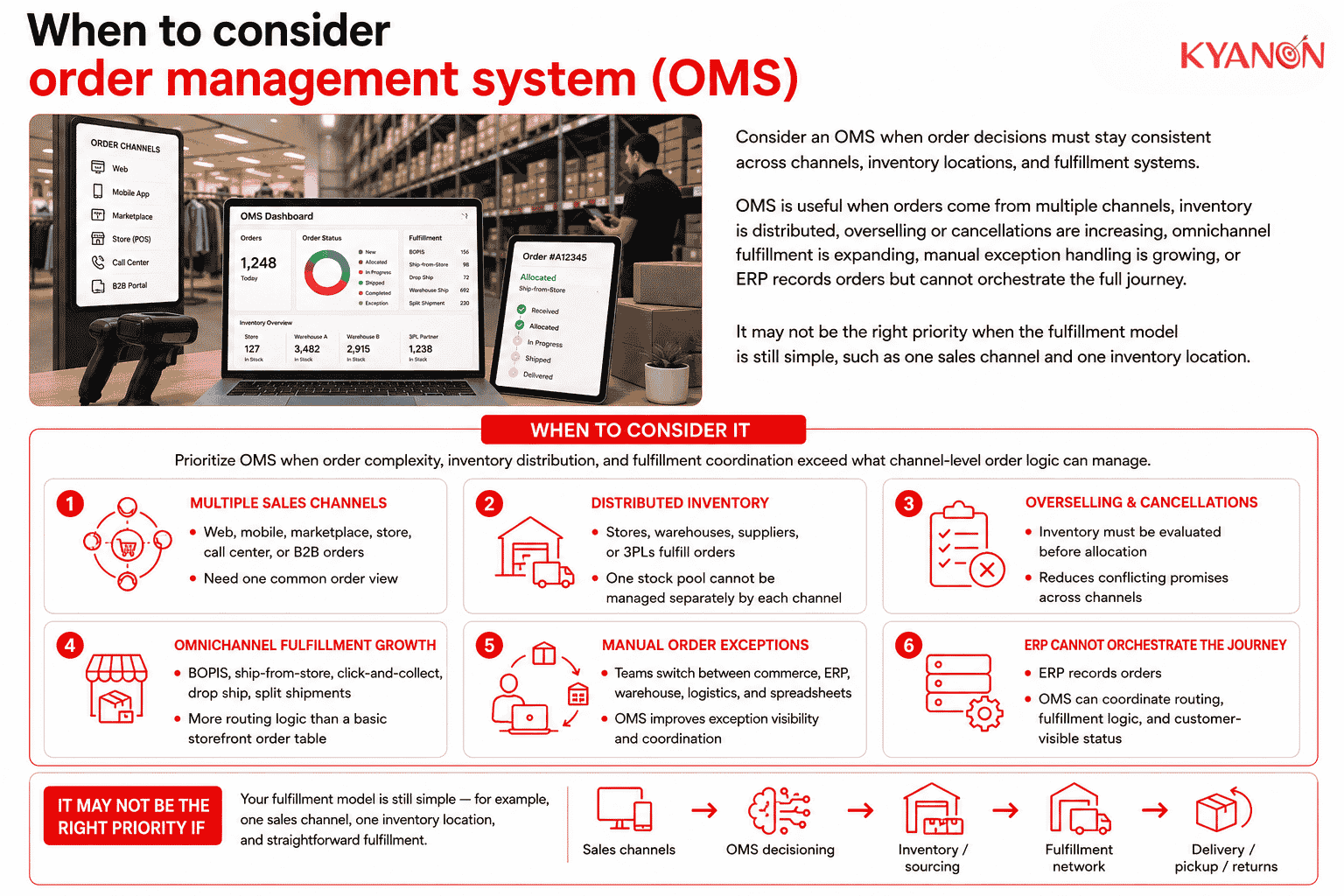
An OMS becomes relevant when order fulfillment decisions must remain consistent across multiple channels, inventory locations, or execution systems.
Consider an order management system (OMS) if
- Orders come from multiple channels. Website, mobile, marketplace, store, call center, or B2B orders require a common order view rather than separate channel-specific processes.
- Inventory is distributed across several locations. Stores, warehouses, suppliers, and 3PLs need to participate in fulfillment without each channel maintaining its own stock assumptions.
- Overselling and cancellations are becoming operational problems. Available inventory needs to be evaluated before allocation so one stock pool is not independently promised by several channels.
- Omnichannel fulfillment is expanding. BOPIS, click-and-collect, ship-from-store, drop shipping, split shipments, and return-anywhere models require more routing logic than a basic eCommerce order table.
- Order exceptions require manual coordination. Customer service or operations teams repeatedly switch between commerce, ERP, warehouse, logistics, and spreadsheet records to understand one order.
- Your ERP records orders but cannot orchestrate the required customer journey. A specialized OMS can sit between channels and execution systems rather than requiring ERP customization for every fulfillment rule.
It may not be the right priority if:
- Your fulfillment model is still simple. A business operating one sales channel, one inventory location, and straightforward fulfillment may be adequately served by the order-management capabilities already included in its commerce or ERP platform.
Business size alone does not determine whether an OMS is required; order and fulfillment complexity is the more useful qualification criterion.
Why the order management system (OMS) matters for Retail and eCommerce
An OMS matters in omnichannel retail because the same customer order may depend on inventory, sourcing, fulfillment, service, and return decisions distributed across several physical and digital systems.
Without centralized coordination, a website may promise inventory already committed by a store, a service agent may not see a marketplace order, or a return may be processed independently from the original fulfillment record.
An OMS creates a common control point for these order decisions while allowing specialized systems such as WMS, ERP, POS, and logistics platforms to continue executing their respective functions.
The National Retail Federation and Happy Returns reported in 2025 that total U.S. retail returns were projected to reach $849.9 billion, with an estimated 19.3% of online sales being returned. That figure does not measure OMS ROI, but it illustrates the scale of post-purchase order activity that retail architectures must manage alongside outbound fulfillment.
World Market provides a practical example of the operating model. The retailer uses IBM Sterling Order Management with inventory-visibility, call-center, and engagement capabilities to support omnichannel order fulfillment.
The business case for an OMS is therefore not simply processing more orders; it is maintaining one controllable order lifecycle as channels, fulfillment options, inventory locations, and exception volumes increase.
Common misconceptions about order management system (OMS)
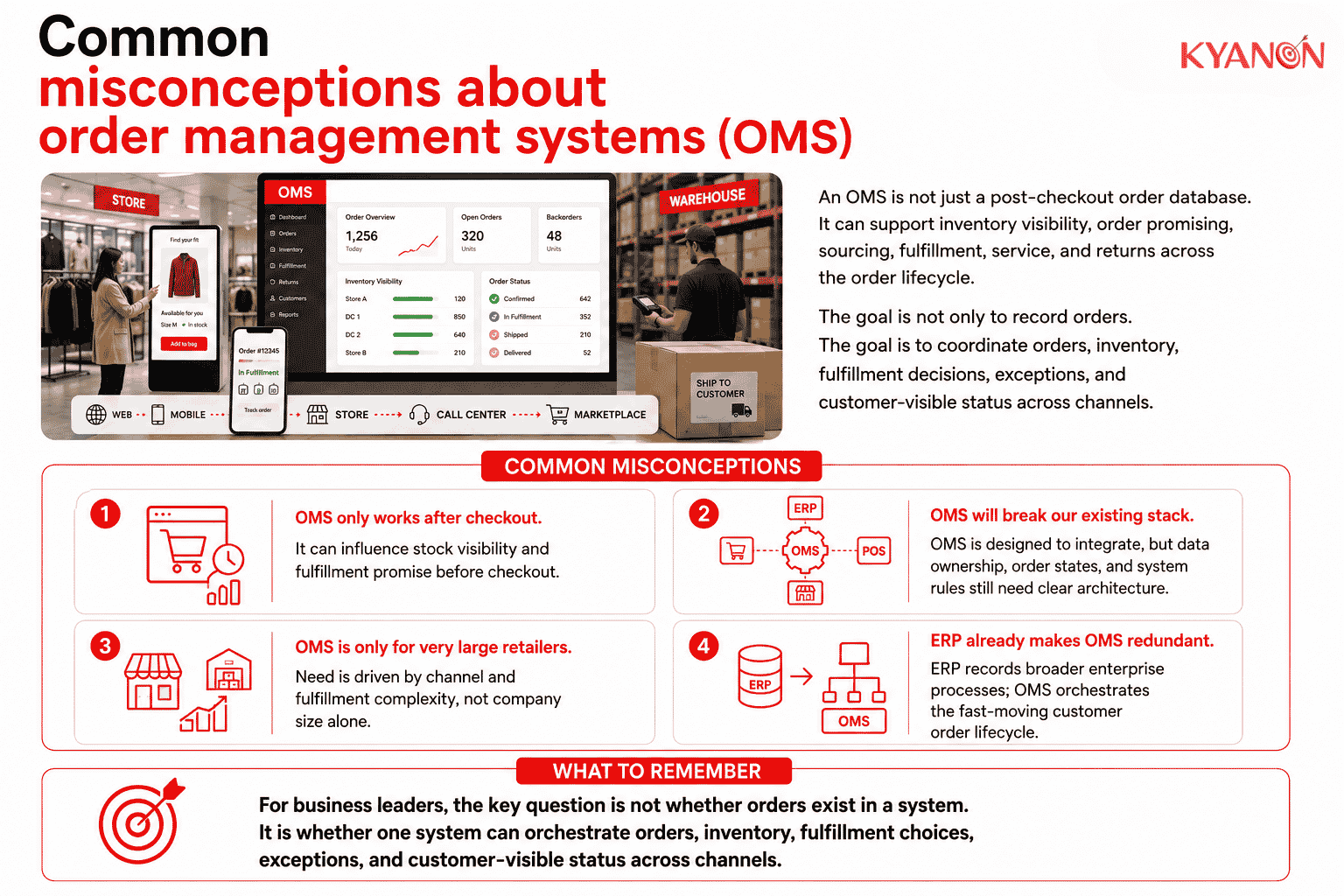
The most important misconception about an OMS is that it is simply a post-checkout order database; modern order management can participate in inventory availability, order promising, sourcing, fulfillment, service, and returns across the customer journey. IBM’s current OMS portfolio includes real-time inventory, BOPIS, ship-from-store, warehouse integration, and omnichannel fulfillment capabilities.
“An OMS only starts working after the customer places the order.”
Reality: Order creation is only one part of modern order management. Inventory visibility and order-promising capabilities can inform what inventory is available and what fulfillment promise can be presented before checkout.
For a Head of eCommerce, this means the OMS can influence whether an item is sellable and how it can be fulfilled, not only what happens after payment.
“Adding an OMS will break the ERP, POS, and commerce platform we already have.”
Reality: A specialized OMS is normally designed to exchange data with existing enterprise applications rather than replace every surrounding system. Current OMS platforms support APIs, services, connectors, events, and integrations with commerce and fulfillment applications.
However, API availability does not make integration automatically simple. Data ownership, inventory definitions, order states, failure handling, and system-of-record responsibilities still need explicit architectural decisions.
“OMS is only for very large retailers.”
Reality: An OMS should be justified by operational complexity rather than company size. A growing retailer or wholesaler can reach the point where multiple channels, stock locations, fulfillment options, or manual order exceptions require centralized orchestration even before it reaches enterprise scale.
The reverse is also true: a larger business with a simple order model may not need a separate OMS if its existing commerce or ERP capabilities meet the required workflows.
“Our ERP already manages orders, so an OMS would be redundant.”
Reality: ERP and OMS functionality can overlap, and some ERP suites include order-management modules. But ERP is designed around a much broader range of enterprise processes, while an OMS concentrates on the fast-moving customer order and fulfillment lifecycle.
For a CTO or IT director, the architecture question is not “Do we already have an order table?” It is “Can our current system orchestrate orders, inventory, fulfillment choices, exceptions, and customer-visible status across every required channel?”
How Kyanon Digital applies order management system (OMS)
Kyanon Digital integrates OMS as a central coordination hub within omnichannel eCommerce architectures, connecting customer-facing order channels with inventory, fulfillment, and enterprise systems.
In this model, the OMS can receive orders from eCommerce, marketplaces, stores, or other channels and coordinate with systems such as ERP, WMS, POS, payment, CRM, loyalty, inventory, analytics, and fulfillment platforms. Kyanon Digital’s Digital Commerce offering explicitly includes integration between commerce platforms and these enterprise systems.
The implementation focus is on defining where order logic belongs: inventory visibility, sourcing rules, order routing, fulfillment states, exception handling, and synchronization with downstream systems. Keeping those decisions centralized reduces the need to reproduce order logic separately in each storefront or channel.
→ Explore Kyanon Digital’s Digital Commerce services for connected omnichannel operations or Enterprise Software Development services for broader application modernization and enterprise-system integration.

 Create project brief with AI