
What is order splitting?
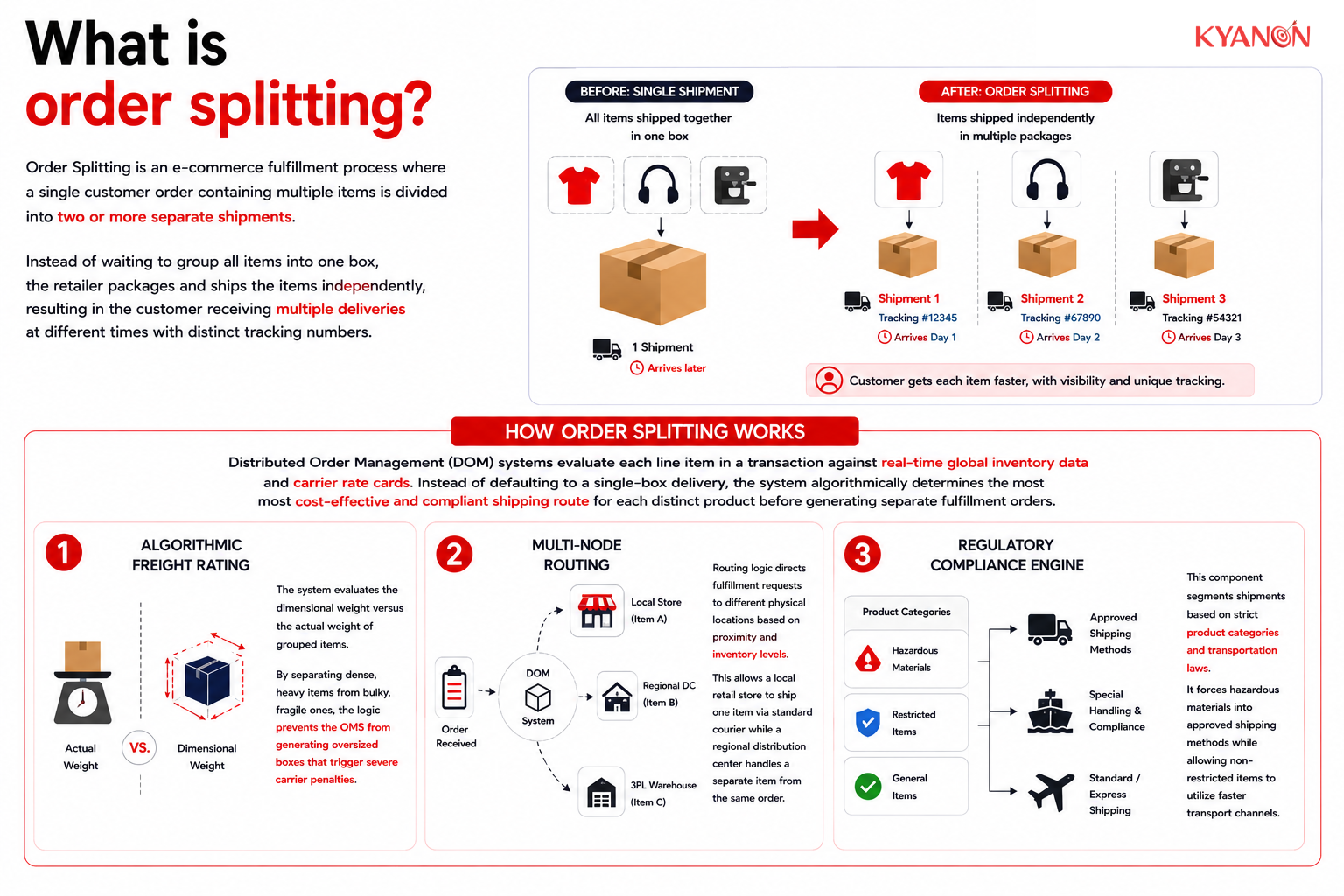
Order splitting is an e-commerce fulfillment process where a single customer order containing multiple items is divided into two or more separate shipments. Instead of waiting to group all items into one box, the retailer packages and ships the items independently, resulting in the customer receiving multiple deliveries at different times with distinct tracking numbers.
How order splitting works
Distributed Order Management (DOM) systems evaluate each line item in a transaction against real-time global inventory data and carrier rate cards. Instead of defaulting to a single-box delivery, the system algorithmically determines the most cost-effective and compliant shipping route for each distinct product before generating separate fulfillment orders.
Algorithmic freight rating
The system evaluates the dimensional weight versus the actual weight of grouped items. By separating dense, heavy items from bulky, fragile ones, the logic prevents the OMS from generating oversized boxes that trigger severe carrier penalties.
Multi-node routing
Routing logic directs fulfillment requests to different physical locations based on proximity and inventory levels. This allows a local retail store to ship one item via standard courier while a regional distribution center handles a separate item from the same order.
Regulatory compliance engine
This component segments shipments based on strict product categories and transportation laws. It forces hazardous materials into approved shipping methods while allowing non-restricted items to utilize faster transport channels.

Impact on Retailers vs. Customers
Perspective | Pros | Cons |
| For the Retailer |
|
|
For the Customer |
|
|
Order Splitting vs Single-Box Fulfillment
Both approaches aim to complete the customer transaction, but differ significantly in logistics flexibility, carrier compliance, and shipping cost optimization.
Dimension | Order Splitting | Single-Box Fulfillment |
| Shipping cost model | Optimized (Avoids dimensional penalties) | High (Prone to dimensional weight fees) |
Inventory utilization | Global (Draws from multiple nodes) | Restrictive (Requires all items in one node) |
| Carrier compliance | Dynamic (Adapts to hazardous materials) | Static (Limited by the most restricted item) |
Fulfillment speed | Variable (In-stock items ship immediately) | Delayed (Waits for backordered items) |
| Upfront logic complexity | High (Requires DOM/OMS routing rules) | Low (Basic warehouse picking) |
When to consider order splitting
Evaluating order splitting requires assessing your multi-node fulfillment capabilities and analyzing historical carrier penalty fees.
Consider order splitting if:
- Your enterprise consistently incurs dimensional weight penalties from carriers for packing small, heavy items with large, fragile goods.
- Your customers experience delayed deliveries because multi-item orders are held back waiting for a single backordered SKU to arrive at the primary warehouse.
- You operate a network of physical retail stores and regional distribution centers that need to act as independent fulfillment nodes for a single transaction.
It may not be the right priority if:
- Your product catalog consists entirely of uniformly sized, non-hazardous items fulfilled exclusively from a single micro-fulfillment center.
Why order splitting matters for retail logistics
Order splitting is a critical operational lever in retail logistics because it directly impacts inventory asset utilization, delivery speed, and gross margins. At scale, holding back an entire shipment because a single item is unavailable ties up capital, clogs warehouse packing stations, and introduces steep logistics risks.
Implementing automated order splitting allows retailers to balance warehouse workloads, meet tight customer delivery windows, and optimize carrier transportation costs.
Common misconceptions
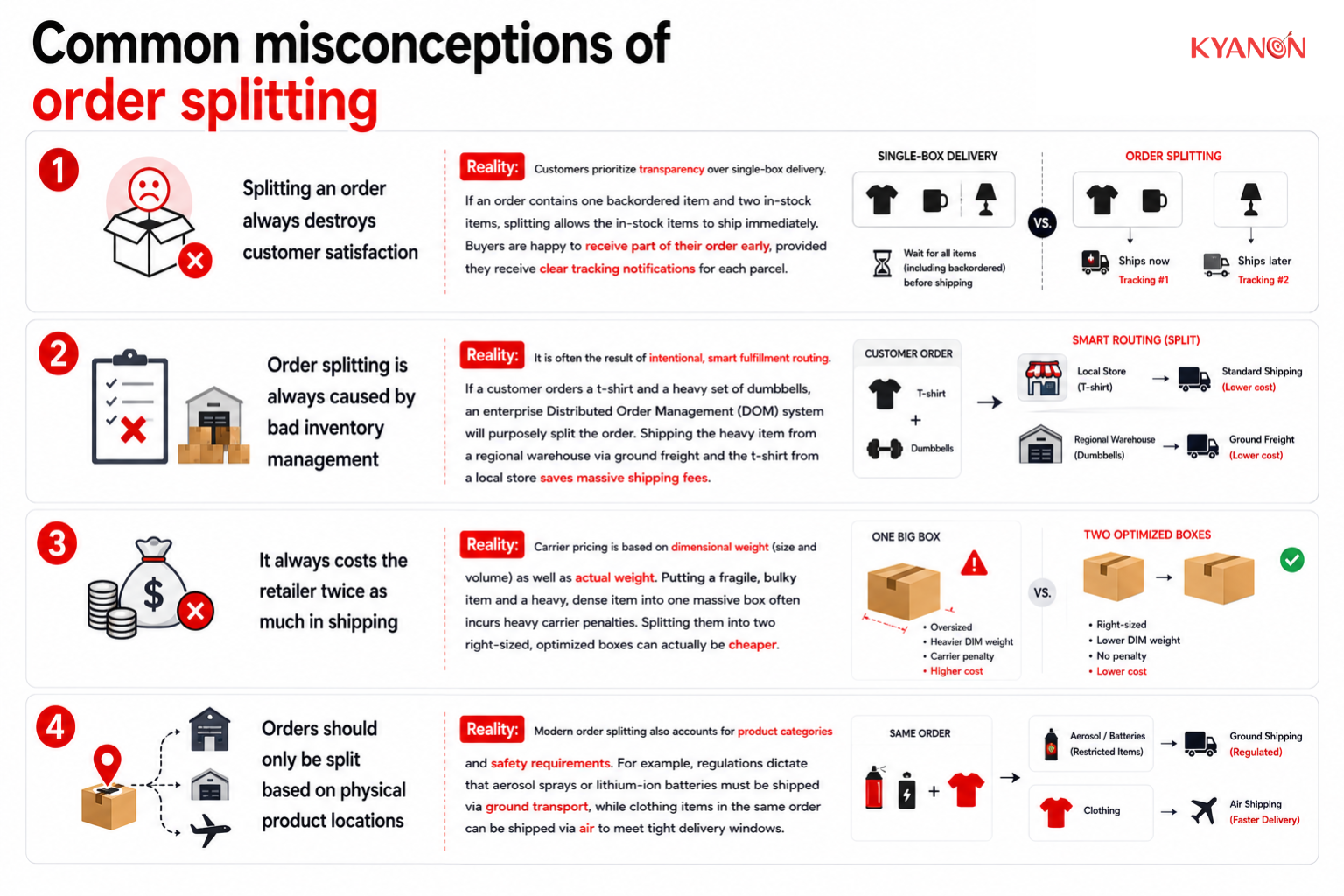
Splitting an order always destroys customer satisfaction
Reality: Customers prioritize transparency over single-box delivery. If an order contains one backordered item and two in-stock items, splitting allows the in-stock items to ship immediately. Buyers are happy to receive part of their order early, provided they receive clear tracking notifications for each parcel.
Order splitting is always caused by bad inventory management
Reality: It is often the result of intentional, smart fulfillment routing. If a customer orders a t-shirt and a heavy set of dumbbells, an enterprise Distributed Order Management (DOM) system will purposely split the order. Shipping the heavy item from a regional warehouse via ground freight and the t-shirt from a local store saves massive shipping fees.
It always costs the retailer twice as much in shipping
Reality: Carrier pricing is based on dimensional weight (size and volume) as well as actual weight. Putting a fragile, bulky item and a heavy, dense item into one massive box often incurs heavy carrier penalties. Splitting them into two right-sized, optimized boxes can actually be cheaper.
Orders should only be split based on physical product locations
Reality: Modern order splitting also accounts for product categories and safety requirements. For example, regulations dictate that aerosol sprays or lithium-ion batteries must be shipped via ground transport, while clothing items in the same order can be shipped via air to meet tight delivery windows.
How Kyanon Digital applies order splitting
Kyanon Digital implements complex order splitting logic within Distributed Order Management (DOM) and OMS architectures for multi-location retailers. Our approach maps real-time global inventory directly to carrier APIs, ensuring enterprise clients across Vietnam, Singapore, and ANZ automatically route multi-item transactions to minimize dimensional weight penalties and accelerate delivery to the end consumer.
Explore our services:

 Create project brief with AI