
What is Pre-Order Management?
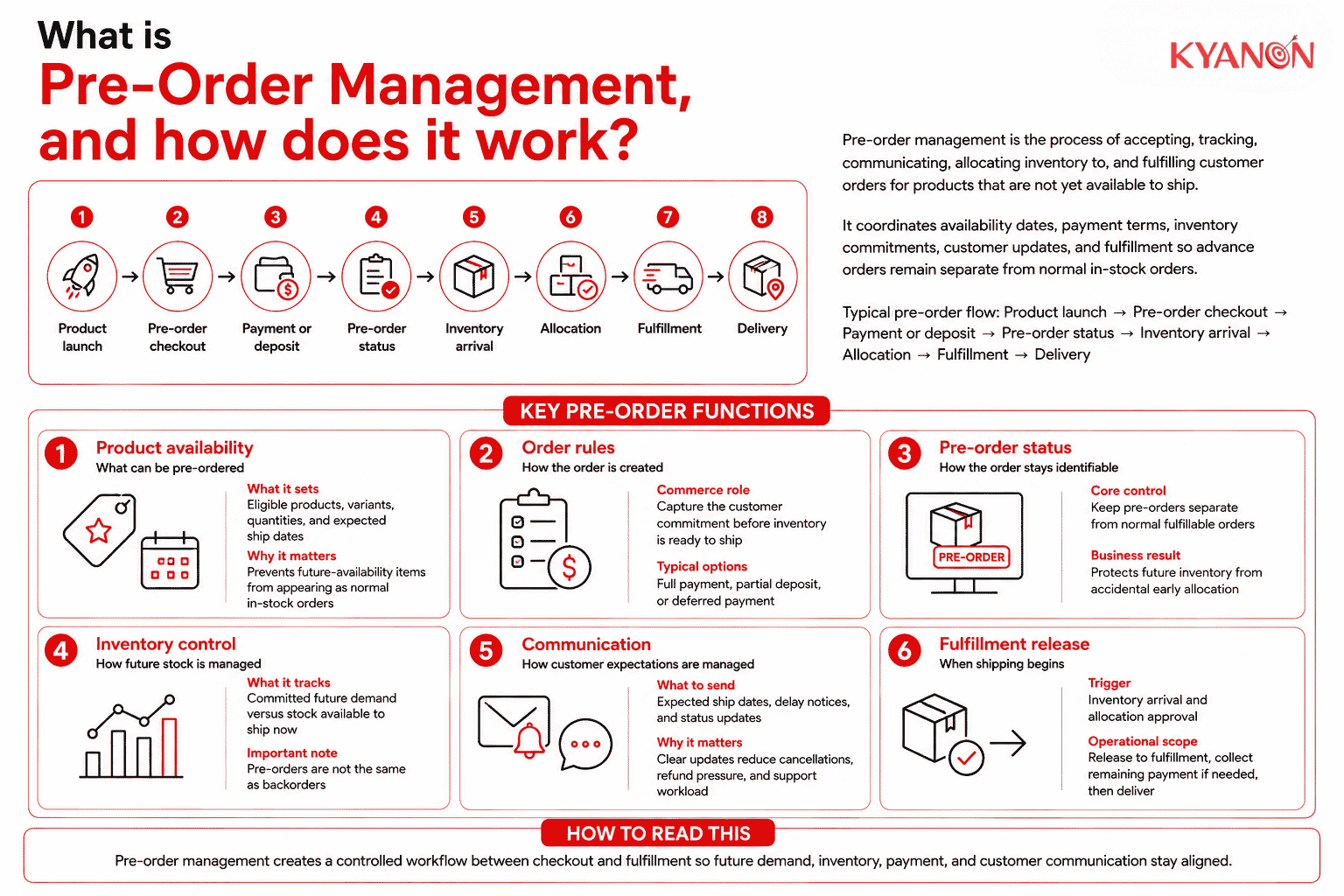
Pre-order management is the process of accepting, tracking, communicating, allocating inventory to, and fulfilling customer orders for products that are not yet available to ship. It coordinates availability dates, payment terms, inventory commitments, customer updates, and fulfillment so advance orders remain separate from normal in-stock orders.
Shopify defines pre-orders as orders for products that are out of stock or not yet available and supports full, partial, or no payment when the customer orders.
How Pre-Order Management works
Pre-order management creates a controlled order state between checkout and fulfillment for products that cannot yet be shipped. The workflow records the customer’s commitment, connects it to expected inventory, applies the selected payment rule, communicates the expected availability date, and releases the order for fulfillment when stock becomes available.
A typical pre-order flow is:
Product launch → Pre-order checkout → Payment or deposit → Pre-order status → Inventory arrival → Allocation → Fulfillment → Delivery
Product availability and order rules
The commerce platform must identify which products or variants can be pre-ordered, how many units can be committed, and when the product is expected to ship. Shopify supports pre-order products before they are available and requires pre-order information to be displayed during the customer journey.
These rules prevent the storefront from presenting a future-availability product as normal immediately fulfillable inventory.
Inventory and order-state control
Pre-orders must remain identifiable until the inventory required to fulfill them becomes available. The order workflow therefore needs to distinguish committed future demand from stock that can be allocated and shipped immediately.
This distinction matters because pre-orders and backorders represent different inventory conditions: Adobe Commerce defines backorders as orders accepted when on-hand quantity has reached zero, while pre-orders can be created for products that have not yet been released or restocked.
Payment, communication, and fulfillment release
Pre-order payment can be collected in full, partially, or deferred, depending on the commerce model and supported payment configuration.
The workflow must also manage expected ship dates, delay notifications, remaining-payment collection, cancellation, and the eventual transition into normal fulfillment. For U.S. transactions covered by the FTC Mail, Internet, or Telephone Order Merchandise Rule, sellers that cannot meet the promised shipment date must obtain consent to the delay or provide the required refund.

Pre-Order Management vs. Backorder Management
Pre-order management handles planned sales before a product is released or available, while backorder management handles demand for an existing product after immediately available inventory has been depleted.
| Dimension | Pre-Order Management |
Backorder Management |
|
Product status |
Upcoming, unreleased, or planned restock | Existing product temporarily unavailable |
| Demand timing | Demand is captured before availability |
Demand continues after available stock reaches zero |
|
Typical use case |
Product launches, limited releases, incoming inventory | Temporary stockouts and replenishment gaps |
| Customer expectation | Customer knowingly orders for future fulfillment |
Customer waits for an existing product to return to stock |
|
Inventory logic |
Future inventory is committed before release | Negative or future salable quantity may be accepted |
| Payment model | Full, partial, deposit, or deferred payment may apply |
Usually follows the existing order payment model |
|
Fulfillment trigger |
Product release or planned inventory arrival | Inventory replenishment |
| Main operational risk | Launch delays, supplier changes, overcommitment |
Replenishment delay and accumulated unfulfilled demand |
The distinction should remain visible across storefront messaging, inventory reporting, customer service, and fulfillment rather than treating both order types as a generic out-of-stock sale.
When to consider Pre-Order Management
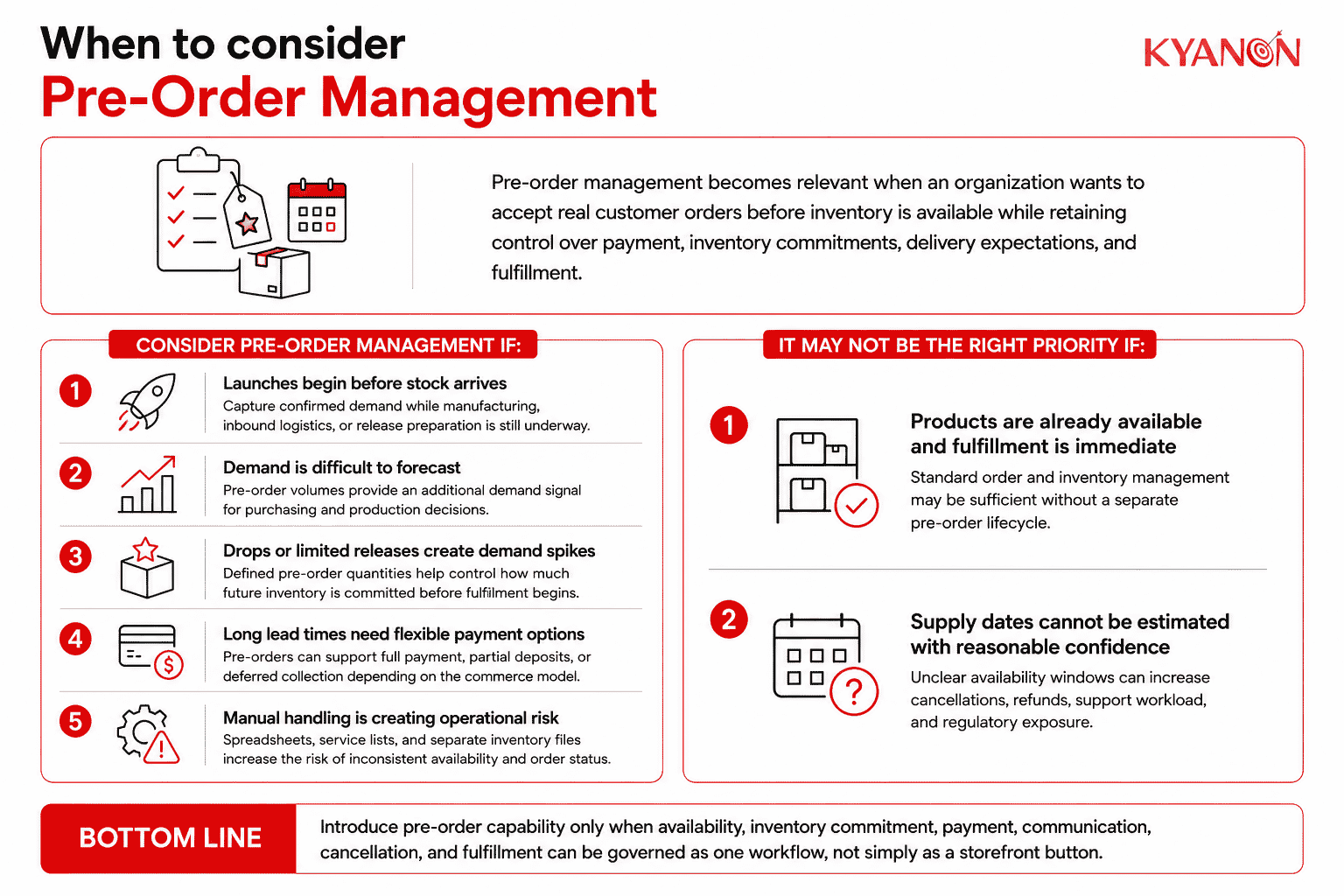
Pre-order management becomes relevant when an organization wants to accept real customer orders before inventory is available while retaining control over payment, inventory commitments, delivery expectations, and fulfillment.
Consider pre-order management if:
- You launch products before inventory reaches the warehouse. Pre-orders can capture confirmed demand while manufacturing, inbound logistics, or release preparation is still underway.
- New-product demand is difficult to forecast. Pre-order volumes provide an additional demand signal that can inform purchasing and production decisions, although they should not replace broader forecasting. Shopify specifically identifies demand forecasting as a pre-order use case.
- Product drops or limited releases create concentrated demand. A defined pre-order quantity can control how much future inventory is committed before fulfillment begins.
- Customers need different payment options for long lead times. Depending on the platform, pre-orders can support full payment, partial deposits, or deferred collection.
- Pre-order volumes are becoming difficult to manage manually. Separate spreadsheets, customer-service lists, inventory files, and warehouse instructions increase the risk of inconsistent availability and order status.
It may not be the right priority if:
- Products are already available, and fulfillment is immediate. Standard order and inventory management may be sufficient without introducing a separate pre-order lifecycle.
- Supply dates cannot be estimated with reasonable confidence. Accepting orders without a defensible availability window can increase cancellations, refunds, support workload, and regulatory exposure.
Pre-order capability should therefore be introduced when the organization can govern availability, inventory commitment, payment, communication, cancellation, and fulfillment as one workflow, not simply add a “Pre-order” button.
Why Pre-Order Management matters for eCommerce
Pre-order management matters because a customer can commit to a purchase weeks or months before fulfillment, making delivery expectations and post-purchase communication part of the conversion and retention experience.
The operational issue is larger than inventory forecasting. A pre-order creates a liability to maintain accurate order status, communicate changes, protect future inventory, collect or refund payment correctly, and eventually release the order into fulfillment.
Pre-orders extend the delivery commitment further into the future. Shopify reported in 2026 that SURI had 5,000 pre-orders and later had to inform thousands of customers that deliveries would arrive weeks later than expected. Because the company had prepared customer-service systems and proactive messaging before launch, SURI’s co-founder reported that the delay resulted in no refunds.
For eCommerce leaders, pre-order performance should therefore be measured through pre-order conversion, committed quantity, cancellation rate, fulfillment-date accuracy, refund rate, support volume, and eventual sell-through, rather than pre-order revenue alone.
Common misconceptions about Pre-Order Management
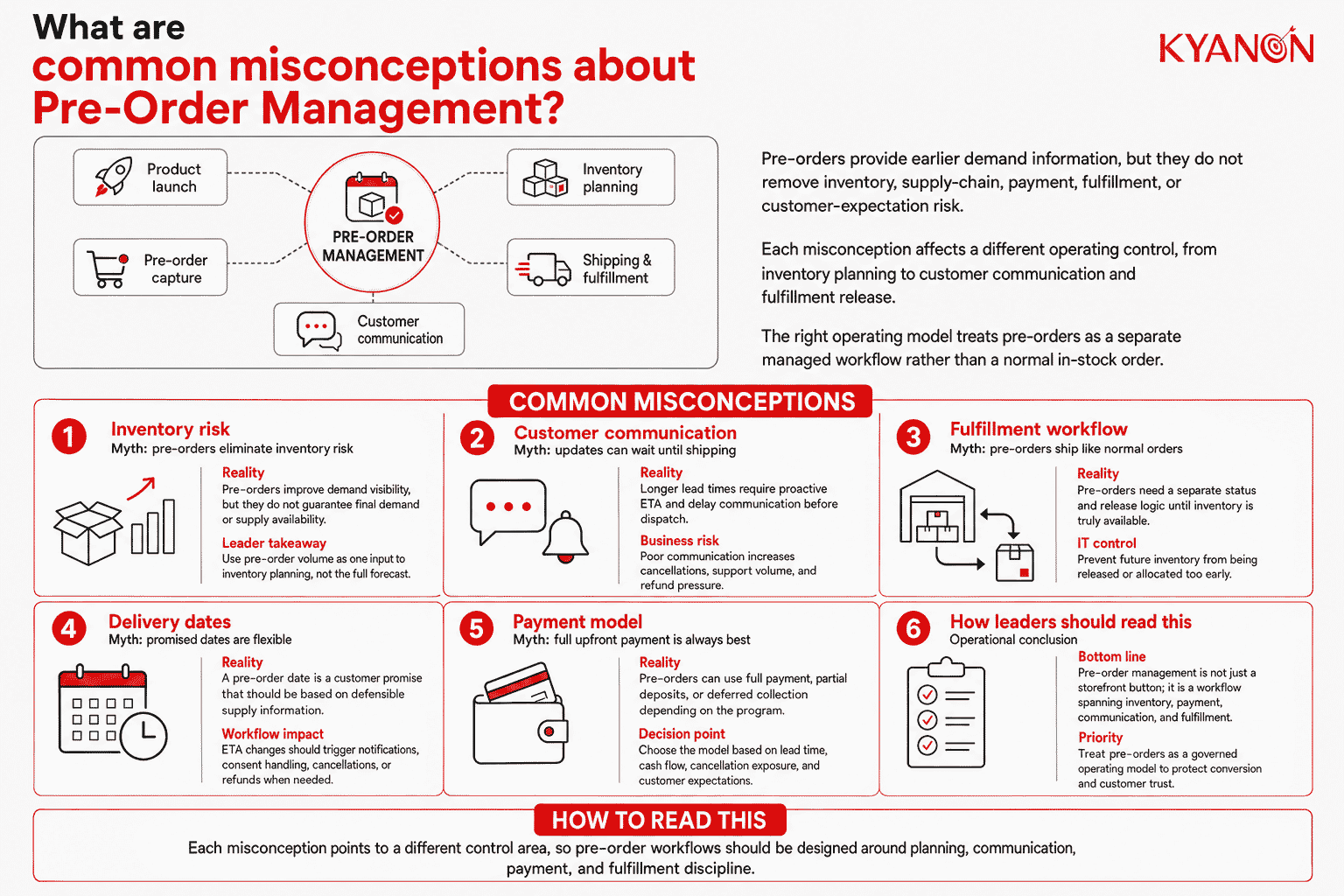
Pre-orders provide earlier demand information, but they do not remove inventory, supply-chain, payment, fulfillment, or customer-expectation risk.
“Pre-orders eliminate our inventory risk.”
Reality: Pre-orders provide a stronger demand signal because customers have expressed purchase intent, but they do not guarantee final demand or supply availability. Supplier delays, cancellations, manufacturing constraints, allocation errors, and demand outside the pre-order window can still create shortages or excess inventory.
For a Head of eCommerce or operations leader, pre-order volume should be an input into inventory planning, not the complete forecast.
“Once customers pre-order, we only need to contact them when the product ships.”
Reality: The longer the gap between purchase and fulfillment, the more important timeline communication becomes. Shopify recommends communicating estimated dates and updates throughout the pre-order journey rather than waiting until dispatch.
For U.S. orders covered by the FTC rule, missed shipment promises can also trigger specific delay-notification, consent, cancellation, and refund obligations.
“Pre-orders can go through the same fulfillment workflow as normal orders.”
Reality: A pre-order represents demand for inventory that is not yet ready for normal fulfillment. The commerce and order-management workflow should therefore preserve a distinct status or rule until the relevant inventory becomes available.
Shopify’s own merchant example describes the operational challenge of accepting a pre-order without withdrawing stock at the time of sale, illustrating why advance orders require different inventory treatment.
For IT leaders, the critical control is preventing future inventory from being released, promised, or routed incorrectly before the intended fulfillment event.
“The delivery date is only an estimate, so changing it does not materially affect the workflow.”
Reality: A pre-order date is a customer promise that should be based on defensible supply and fulfillment information. In the United States, the FTC requires sellers covered by its rule to have a reasonable basis for stated shipment timing and to take specific action when that timing cannot be met.
The architecture should therefore treat ETA changes as an operational event that can trigger customer notification, consent, cancellation, refund, or revised fulfillment logic.
“Collecting the full price upfront is always the best pre-order model.”
Reality: There is no single payment model that is optimal for every pre-order program. Shopify supports full, partial, or no payment at the time of pre-order, demonstrating that payment structure can vary with lead time, cash flow requirements, product value, cancellation exposure, and customer expectations.
Partial deposits can reduce the customer’s initial commitment, but businesses should not assume they will automatically increase conversion without testing the model against payment costs, cancellation behavior, refund operations, and cash-flow requirements.
How Kyanon Digital applies Pre-Order Management
Kyanon Digital builds pre-order workflows as part of connected eCommerce architecture, linking the customer-facing purchase journey with payment, inventory, order management, fulfillment, and customer communication.
For product-launch use cases, the implementation can include pre-order eligibility and quantity rules, future availability dates, full or partial payment logic, order-state management, inventory reservation, customer notifications, cancellation and refund flows, and controlled release into fulfillment.
This approach aligns with Kyanon Digital’s broader commerce architecture, which connects storefronts with payments, inventory visibility, OMS, WMS, order routing, delivery, and other enterprise systems.
The objective is not simply to accept an order before stock exists. It is to ensure that commercial commitments made during the launch remain synchronized with inventory availability and operational execution, reducing manual reconciliation and protecting the customer promise.
→ Explore Kyanon Digital’s Digital Commerce services for eCommerce platforms, orders, inventory, fulfillment, and enterprise-system integration.

 Create project brief with AI