
What is Q-Learning?
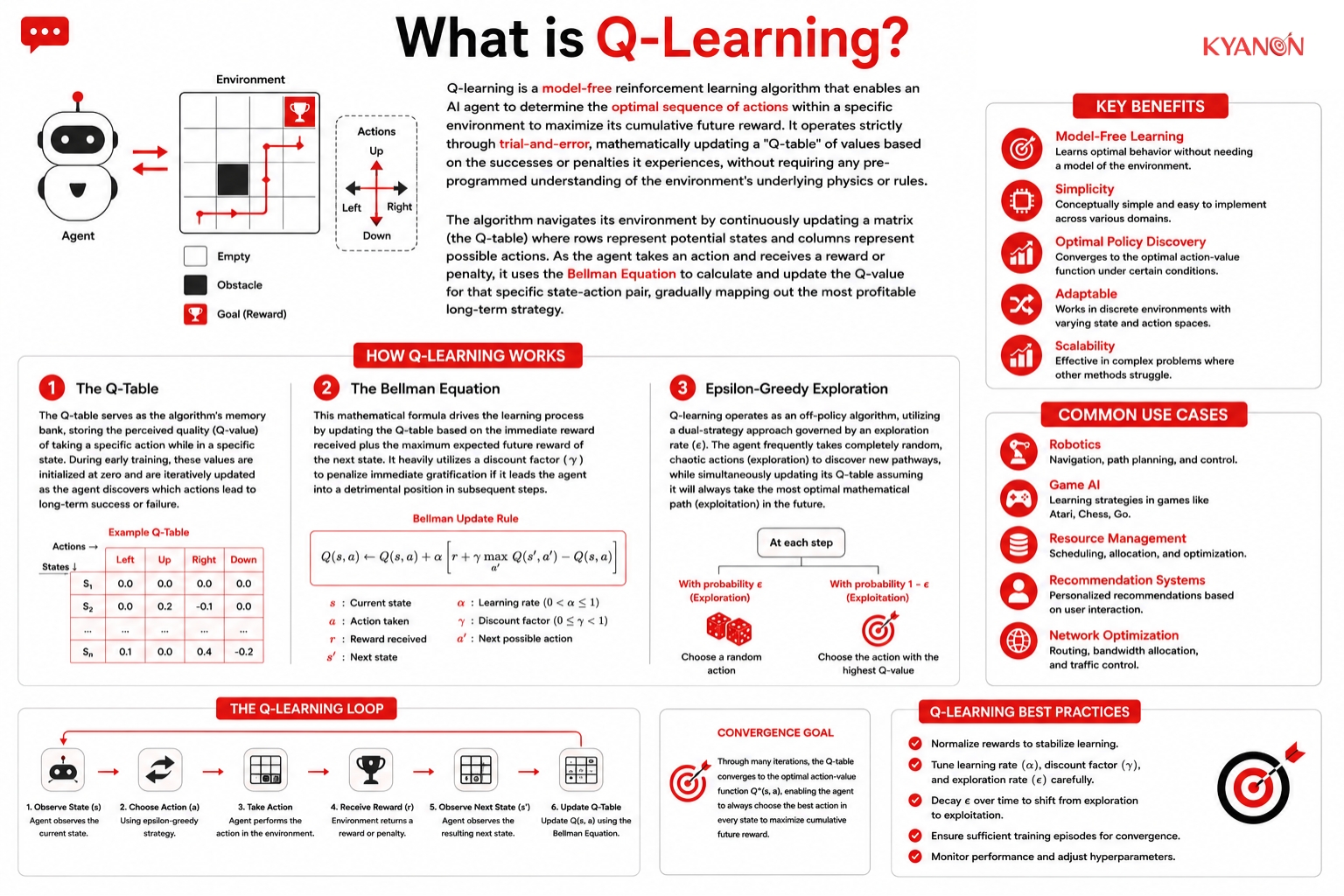
Q-learning is a model-free reinforcement learning algorithm that enables an AI agent to determine the optimal sequence of actions within a specific environment to maximize its cumulative future reward. It operates strictly through trial-and-error, mathematically updating a “Q-table” of values based on the successes or penalties it experiences, without requiring any pre-programmed understanding of the environment’s underlying physics or rules.
How Q-Learning works
The algorithm navigates its environment by continuously updating a matrix (the Q-table) where rows represent potential states and columns represent possible actions. As the agent takes an action and receives a reward or penalty, it uses the Bellman Equation to calculate and update the Q-value for that specific state-action pair, gradually mapping out the most profitable long-term strategy.
The Q-Table
The Q-table serves as the algorithm’s memory bank, storing the perceived quality (Q-value) of taking a specific action while in a specific state. During early training, these values are initialized at zero and are iteratively updated as the agent discovers which actions lead to long-term success or failure.
The Bellman Equation
This mathematical formula drives the learning process by updating the Q-table based on the immediate reward received plus the maximum expected future reward of the next state. It heavily utilizes a discount factor ($ \gamma $) to penalize immediate gratification if it leads the agent into a detrimental position in subsequent steps.
Epsilon-Greedy Exploration
Q-learning operates as an off-policy algorithm, utilizing a dual-strategy approach governed by an exploration rate ($\epsilon$). The agent frequently takes completely random, chaotic actions (exploration) to discover new pathways, while simultaneously updating its Q-table assuming it will always take the most optimal mathematical path (exploitation) in the future.

Q-Learning vs Deep Q-Networks (DQN)
While traditional Q-learning relies on an explicit matrix, Deep Q-Networks adapt the algorithm for highly complex or infinite environments by replacing the table with a neural network.
|
Dimension |
Q-Learning (Tabular) | Deep Q-Networks (DQN) |
| State Storage Method | Explicit matrix/table |
Neural network approximation |
|
Environment Suitability |
Small, finite state spaces | Large, continuous state spaces |
| Memory Consumption | Scales exponentially with states |
Fixed by the neural network size |
|
Training Stability |
Highly stable and guaranteed to converge | Prone to instability without target networks |
| Enterprise Use Case | Basic inventory reorder triggers |
Autonomous navigation, dynamic pricing |
When to consider Q-Learning
Consider Q-Learning if:
- Your enterprise needs to optimize a closed-loop system with clearly defined, finite states and actions, such as routing logic within a small-scale warehouse grid.
- You are developing a dynamic pricing engine where the algorithm can cleanly categorize inventory levels and competitor prices into a discrete, manageable table.
- Your engineering team requires an optimization algorithm that guarantees mathematical convergence to the absolute optimal policy given sufficient training time in a controlled environment.
It may not be the right priority if:
- Your application involves continuous, infinite variables—such as real-time GPS coordinates for autonomous vehicles—which would trigger the “Curse of Dimensionality” and instantly overwhelm a tabular Q-learning system.
Why Q-Learning matters for enterprise optimization
Q-Learning matters for enterprise optimization because it provides autonomous, trial-and-error learning that discovers optimal, long-term strategies without needing predefined models. It excels in dynamic, unpredictable environments, like supply chains and financial markets, by continuously learning from feedback to maximize profitability and efficiency.
For large-scale businesses, traditional, rule-based optimization methods can quickly break down when faced with an overwhelming number of variables and changing constraints. Q-Learning addresses these challenges through several key advantages:
- Dynamic adaptation to market changes
- Solving complex, sequential decisions
- “Model-free” learning
- Advanced real-world enterprise applications: supply chain & inventory management, dynamic pricing, budget allocation
Common misconceptions
Engineering leaders frequently misunderstand the mathematical constraints and internal logic of reinforcement learning, leading to architectural failures in complex deployments.
Q-learning is a ‘model-based’ algorithm because it builds a strategy
Reality: Q-learning is strictly model-free. In reinforcement learning, a “model” refers to whether the AI inherently understands the physical rules and probability transitions of its environment. Q-learning has zero knowledge of how the world works; it is purely a trial-and-error algorithm that blindly tests actions, experiences a reward or penalty, and updates its table via the Bellman Equation without ever mapping the environment’s underlying physics.
If an action yields a high immediate reward, the Q-value increases drastically
Reality: Q-learning heavily discounts immediate gratification in favor of long-term utility. The update formula relies on a discount factor ($\gamma$); if an action provides a massive reward today but traps the agent in a dead-end on the very next step, the mathematical discount factor heavily penalizes that initial choice.
Q-learning values are mathematically unbiased and perfectly accurate
Reality: Standard Q-learning suffers heavily from overestimation bias. Because the Bellman update rule uses a max function to target the highest expected future reward, it consistently overestimates action values. If statistical noise accidentally makes a poor choice appear lucrative once, the max operator locks onto it, causing the algorithm to develop false optimism. Advanced production systems utilize Double Q-Learning to split the calculation and untangle action selection from evaluation.
How Kyanon Digital applies Q-Learning
Kyanon Digital references Q-learning concepts in enterprise AI engagements involving dynamic optimization, such as pricing, scheduling, and resource allocation across Southeast Asia, ANZ, and Nordic Europe. Our data engineering teams implement advanced reinforcement learning architectures, graduating from tabular Q-learning to Deep Q-Networks (DQNs) when clients face complex, high-dimensional environments. By carefully tuning discount factors and exploration rates, we build autonomous systems that proactively maximize long-term business value, ensuring measurable improvements in operational efficiency and conversion rates.
Explore our Machine Learning Services.

 Create project brief with AI