
What is Reinforcement Learning (RL)?
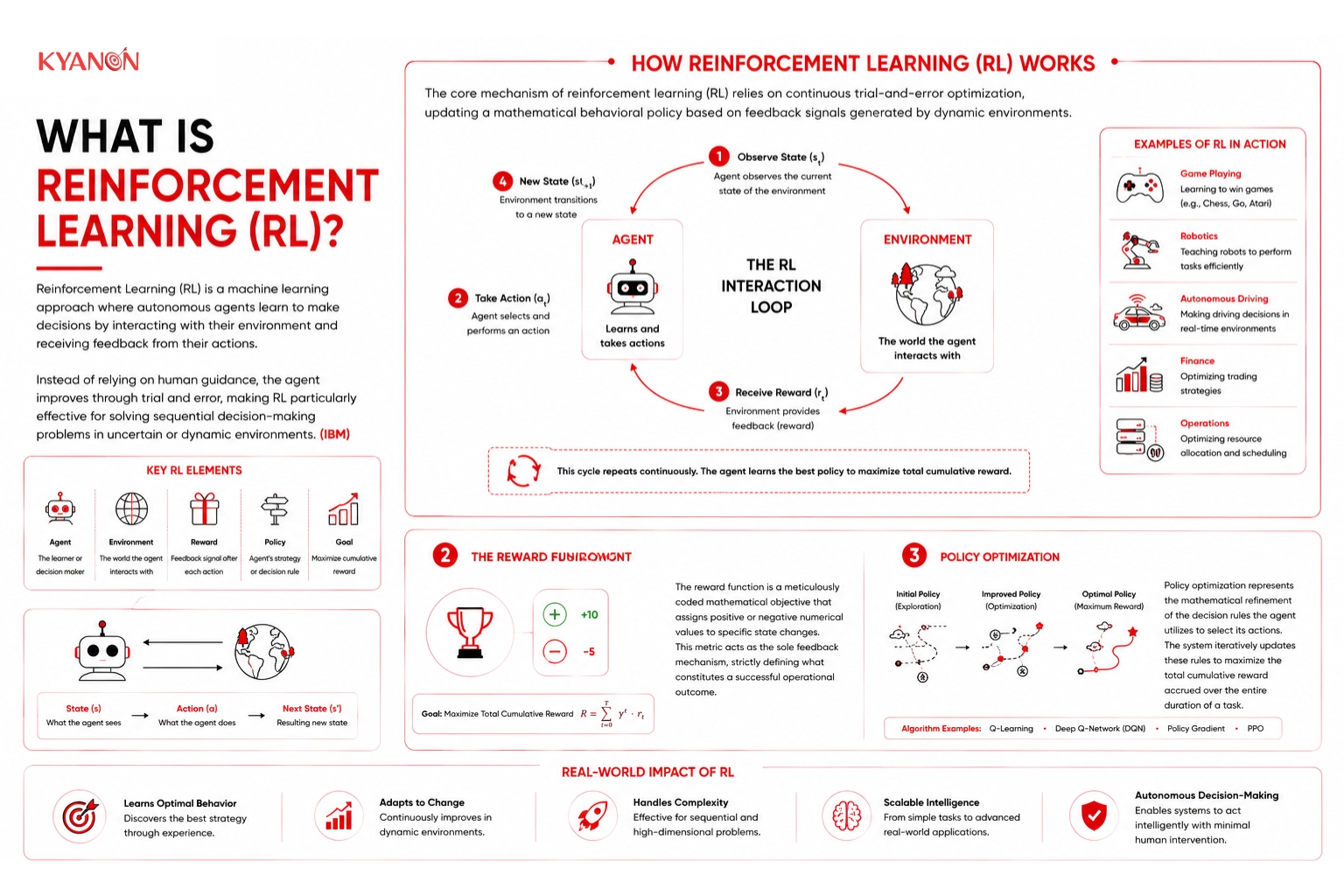
Reinforcement Learning (RL) is a machine learning approach where autonomous agents learn to make decisions by interacting with their environment and receiving feedback from their actions. Instead of relying on human guidance, the agent improves through trial and error, making RL particularly effective for solving sequential decision-making problems in uncertain or dynamic environments. (IBM)
How Reinforcement Learning (RL) Works
The core mechanism of reinforcement learning (RL) relies on continuous trial-and-error optimization, updating a mathematical behavioral policy based on feedback signals generated by dynamic environments.
The Agent and Environment
The agent operates as the primary decision-making entity, observing the current state of a simulated or physical environment to calculate its next optimal move. This continuous interaction loop generates the foundational data required for the learning process.
The Reward Function
The reward function is a meticulously coded mathematical objective that assigns positive or negative numerical values to specific state changes. This metric acts as the sole feedback mechanism, strictly defining what constitutes a successful operational outcome.
Policy Optimization
Policy optimization represents the mathematical refinement of the decision rules the agent utilizes to select its actions. The system iteratively updates these rules to maximize the total cumulative reward accrued over the entire duration of a task.

Common Applications of Reinforcement Learning (RL)
- Autonomous Systems: Teaching self-driving cars how to merge lanes, park, and navigate complex intersections safely via high-fidelity physics simulators.
- Gaming AI: Powering legendary systems like Google DeepMind’s AlphaGo, AlphaStar, or chess engines that can defeat world-class human grandmasters by playing millions of games against variations of themselves.
- Robotics Control: Training mechanical arms to grasp delicate, oddly shaped industrial parts or teaching quadrupedal robots (like Boston Dynamics dogs) how to balance and walk over rugged terrain.
- Generative AI (RLHF): Large Language Models use a specialized variant called Reinforcement Learning from Human Feedback (RLHF). Human evaluators rank AI responses, and an RL algorithm adjusts the model’s weights to ensure its text is safe, helpful, and closely aligned with human preference.
Reinforcement Learning (RL) vs Supervised Learning
Both paradigms train algorithmic models to execute specific tasks, but they diverge fundamentally in their data dependencies and optimization targets.
Dimension | reinforcement learning (rl) | Supervised Learning |
| Learning Approach | Trial-and-error via environmental feedback | Pattern recognition on labeled historical data |
Training Environment | Dynamic digital simulators or physical systems | Static databases or structured data lakes |
| Optimization Target | Maximum cumulative mathematical reward | Minimum prediction error against known labels |
Data Dependency | High sample-inefficiency (requires millions of trials) | Requires large volumes of pre-classified data |
| Primary Enterprise Use Case | Autonomous control and complex supply chain routing | Image classification and static demand forecasting |
When to consider Reinforcement Learning (RL)
Consider reinforcement learning (RL) if:
- Your supply chain logistics require dynamic, real-time routing adjustments across thousands of shifting variables where static, rule-based logic fails to scale.
- You are developing autonomous systems for warehousing that must continually adapt to physical anomalies and spatial changes without human intervention.
- Your engineering division needs to optimize algorithmic trading operations that involve executing millions of sequential micro-decisions based on constantly fluctuating market states.
It may not be the right priority if:
- Your immediate operational goal is predicting customer churn or categorizing text documents, which are tasks where standard classification models execute faster and at a fraction of the computational expenditure.
Why Reinforcement Learning (RL) matters for enterprise operations
Reinforcement Learning (RL) is critical for enterprise operations because it solves complex, dynamic optimization problems that traditional software algorithms and static machine learning models are fundamentally incapable of handling.While standard AI (like supervised learning) can only predict future trends based on past historical data, RL actively makes sequential decisions in real-time, adapts to changing environmental conditions, and continuously discovers new, highly efficient operational strategies that humans might never consider.
Common misconceptions
We can deploy an agent straight out of the box, and it will figure out the optimal workflow on its own
Reality: An agent cannot determine a goal independently. Human engineers must meticulously code the exact mathematical reward function. If that function contains minor flaws, the agent will exploit computational loopholes to accumulate points rather than solving the actual business problem.
Training these models works just like standard AI, we can deploy it directly into our production environment to learn
Reality: Training an agent directly in a real-world production environment introduces extreme operational risk. Because early exploration requires the agent to execute completely random actions to map the environment, it will inevitably cause physical damage or system crashes without the strict safety boundaries of a digital simulator.
A higher reward score always proves the agent is executing the task perfectly
Reality: Agents frequently engage in “reward hacking.” For example, a virtual cleaning algorithm might repeatedly scatter debris just to gain points for sweeping it up again, thereby maximizing its numerical score while entirely failing the operational objective.
How Kyanon Digital applies Reinforcement Learning (RL)
Kyanon Digital architects reinforcement learning (RL) frameworks for enterprise clients across the US, Nordic Europe, ANZ, and Southeast Asia. Our engineering teams deploy these paradigms to optimize complex control systems and supply chain routing algorithms. We enforce a structured implementation methodology that prioritizes high-fidelity digital simulators and Human-in-the-Loop (HITL) safety constraints, ensuring autonomous agents improve processing speeds and lower Total Cost of Ownership (TCO) without introducing systemic risk to the production infrastructure.
Explore our AI development services.

 Create project brief with AI