
What is quantum machine learning?
Quantum machine learning is an interdisciplinary field that integrates quantum computing algorithms with classical machine learning techniques to process information using the principles of quantum mechanics. It utilizes concepts like superposition and entanglement to analyze complex, highly correlated datasets that exceed the computational limits of standard digital processors.
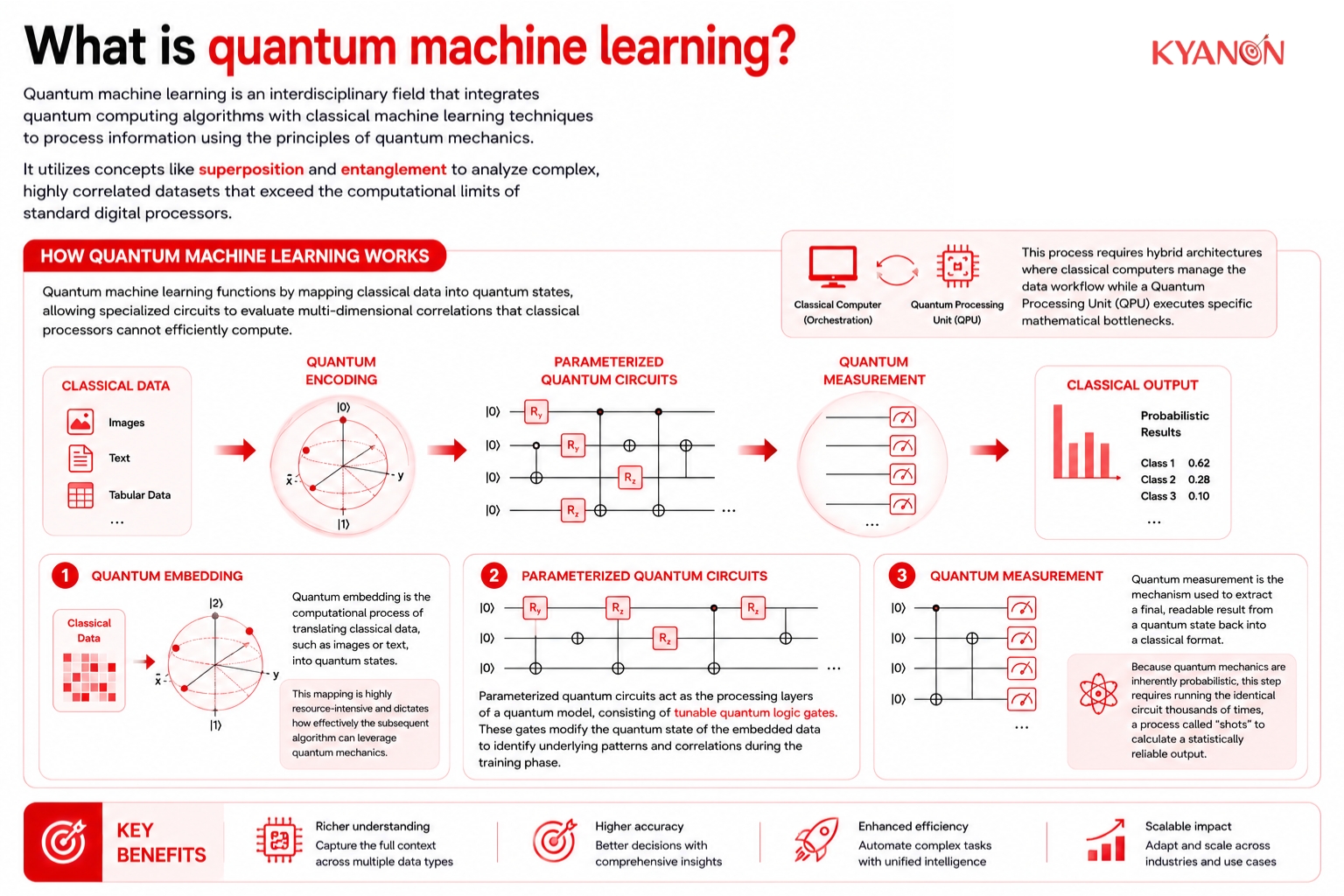
How quantum machine learning works
Quantum machine learning functions by mapping classical data into quantum states, allowing specialized circuits to evaluate multi-dimensional correlations that classical processors cannot efficiently compute. This process requires hybrid architectures where classical computers manage the data workflow while a Quantum Processing Unit (QPU) executes specific mathematical bottlenecks.
Quantum Embedding
Quantum embedding is the computational process of translating classical data, such as images or text, into quantum states. This mapping is highly resource-intensive and dictates how effectively the subsequent algorithm can leverage quantum mechanics.
Parameterized Quantum Circuits
Parameterized quantum circuits act as the processing layers of a quantum model, consisting of tunable quantum logic gates. These gates modify the quantum state of the embedded data to identify underlying patterns and correlations during the training phase.
Quantum Measurement
Quantum measurement is the mechanism used to extract a final, readable result from a quantum state back into a classical format. Because quantum mechanics are inherently probabilistic, this step requires running the identical circuit thousands of times, a process called “shots” to calculate a statistically reliable output.

Quantum machine learning vs Deep Learning
Both approaches aim to extract predictive patterns from data, but they differ fundamentally in hardware execution mechanisms and problem suitability.
Dimension | Quantum machine learning | Deep Learning |
| Execution Hardware | Quantum Processing Units (QPUs) | GPUs and TPUs |
Data Ingestion | Requires complex quantum embedding | Direct memory loading via RAM |
| Optimal Use Case | Molecular simulation, complex optimization | Natural language processing, computer vision |
Training Mechanism | Statistical sampling (shots) over circuits | Exact gradient calculation (backpropagation) |
| Maturity Level | Experimental / Proof-of-Concept | Enterprise-ready and highly scalable |
When to consider quantum machine learning
Consider quantum machine learning if:
- Your organization operates in pharmaceuticals or materials science and requires molecular simulation accuracy beyond the structural limits of classical supercomputers.
- Your engineering team is building long-term R&D capabilities to address highly complex, non-linear optimization problems, such as global supply chain routing or financial portfolio modeling.
- You are establishing strategic partnerships with quantum hardware vendors to secure early access and test proprietary algorithms before hardware matures.
It may not be the right priority if:
- Your core business relies heavily on processing standard tabular data, natural language, or computer vision tasks where classical models currently offer vastly superior cost efficiency, speed, and accuracy.
Why quantum machine learning matters for enterprise AI
Quantum Machine Learning (QML) matters for enterprise AI because it breaks through the fundamental mathematical and computational barriers of classical computing, allowing businesses to solve highly complex optimization, pattern recognition, and simulation problems that are currently impossible to tackle efficiently. While classical AI relies on processing data sequentially or through standard parallel hardware (GPUs), QML uses the laws of quantum mechanics to process massive, high-dimensional datasets at a structural level.
Common misconceptions
Addressing expectations requires separating theoretical quantum advantages from current hardware realities.
We can easily load our massive SQL databases or CSV files into a quantum computer to speed up processing
Reality: There is no quantum equivalent of classical RAM or a NumPy array. Mapping classical data into quantum states is a computationally expensive process that often destroys any processing speed advantage before the machine learning algorithm even starts running.
Because quantum computers use superposition, this technology will automatically run all our AI models faster
Reality: Quantum algorithms excel only at very specific tasks, such as simulating molecular structures or solving highly constrained optimization problems. For daily business applications like processing standard text, tabular data, or sequential logic, classical computers remain much more efficient.
How Kyanon Digital applies quantum machine learning
Kyanon Digital monitors quantum machine learning developments for enterprise clients in the finance and pharmaceutical sectors across the US, Nordic Europe, and Southeast Asia. Our technical advisory approach evaluates true hardware readiness timelines, ensuring IT directors and CTOs prepare their data architectures for future capabilities without prematurely committing engineering budgets to currently immature tooling.
Explore our AI and ML services:

 Create project brief with AI