
What is sentiment analysis?
Sentiment analysis, or opinion mining, is the process of analyzing large volumes of text to determine whether the expressed emotional tone is positive, negative, or neutral. While the massive influx of customer data from diverse sources, such as emails, tweets, surveys, customer service chats, and reviews, presents a major operational challenge, extracting meaningful insights from this text is essential for guiding business decisions. Ultimately, implementing automated sentiment analysis systems enables companies to deeply understand their audience, deliver stronger customer experiences, and successfully improve their brand reputation. (IBM)
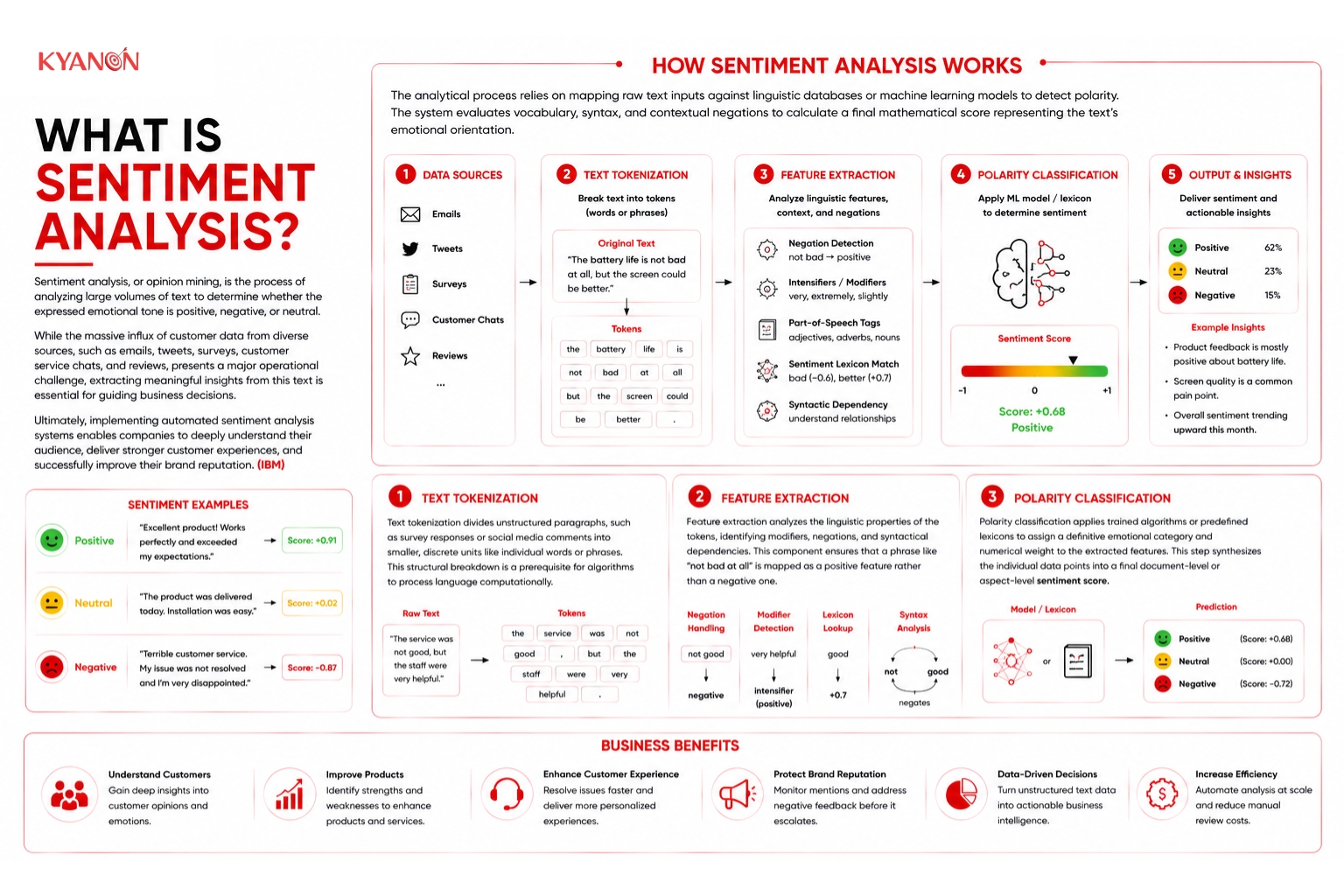
How sentiment analysis works
The analytical process relies on mapping raw text inputs against linguistic databases or machine learning models to detect polarity. The system evaluates vocabulary, syntax, and contextual negations to calculate a final mathematical score representing the text’s emotional orientation.
Text Tokenization
Text tokenization divides unstructured paragraphs, such as survey responses or social media comments into smaller, discrete units like individual words or phrases. This structural breakdown is a prerequisite for algorithms to process language computationally.
Feature Extraction
Feature extraction analyzes the linguistic properties of the tokens, identifying modifiers, negations, and syntactical dependencies. This component ensures that a phrase like “not bad at all” is mapped as a positive feature rather than a negative one.
Polarity Classification
Polarity classification applies trained algorithms or predefined lexicons to assign a definitive emotional category and numerical weight to the extracted features. This step synthesizes the individual data points into a final document-level or aspect-level sentiment score.

Sentiment Analysis vs Intent Recognition
Both methodologies utilize natural language processing to extract meaning from text, but they focus on entirely different dimensions of user communication.
Dimension | Sentiment analysis | Intent Recognition |
| Core Objective | Identifies the emotional tone of the text | Identifies the functional goal of the user |
Output Example | “Negative” or “-0.8 score” | “Password Reset” or “Refund Request” |
| Primary Use Case | Brand monitoring and customer feedback | Chatbot routing and automated support workflows |
Handling Sarcasm | Highly susceptible to misclassification | Less affected, focuses on underlying action |
| Business Value | Measures customer satisfaction and brand health | Reduces support ticket resolution time |
When to consider sentiment analysis
Consider sentiment analysis if:
- Your customer service center receives thousands of unstructured survey responses monthly, making manual categorization and review impossible.
- Your e-commerce platform needs to automatically prioritize and escalate highly negative product reviews for immediate customer recovery workflows.
- Your marketing department requires quantitative data to measure public reaction to a newly launched product line across multiple digital channels.
It may not be the right priority if:
- Your primary user feedback mechanism relies entirely on structured, numerical metrics like a rigid 1-to-5 star rating system without any free-text comment fields.
Why sentiment analysis matters for retail and E-commerce
Sentiment analysis is critical for retail and e-commerce because it transforms unstructured public text, like product reviews, social media rants, and support tickets into real-time, actionable business intelligence. In a digital marketplace where brand loyalty is highly volatile, enterprises cannot wait for quarterly sales reports to find out if a product is failing. Sentiment analysis acts as an automated, early-warning system that flags customer frustration and surface product flaws at scale.
Common Misconceptions
We can just plug in a pre-trained model and it will instantly understand our customers’ sarcasm and specific complaints
Reality: Sarcasm is the ultimate enemy of sentiment algorithms, as users often employ highly positive words to express extreme frustration. Furthermore, a standard document-level model only provides a blanket score; it cannot tell you what the user is reacting to unless you implement advanced Aspect-Based Sentiment Analysis to separate feedback about the product’s price from its quality.
If the dashboard shows a ‘neutral’ score, it means our customers just don’t care about the feature
Reality: Neutral classifications frequently act as a garbage bin for text the model failed to understand. Alternatively, a neutral score often masks a review containing a mix of extreme positive and extreme negative statements that mathematically cancel each other out to zero, hiding critical user feedback.
How Kyanon Digital Applies sentiment analysis
Kyanon Digital integrates sentiment analysis within customer experience and analytics platforms for enterprise retail, e-commerce, and banking clients across the US, ANZ, and Southeast Asia. Our data engineering teams deploy aspect-based natural language processing pipelines to parse complex, domain-specific customer feedback. This implementation strategy ensures IT directors and Heads of E-commerce can convert unstructured text into actionable insights, directly reducing churn and optimizing the Total Cost of Ownership (TCO) for their analytics infrastructure.
Explore our Machine Learning services.

 Create project brief with AI