
What is a Token (LLM)?
A token is the fundamental computational unit of data, representing a word, syllable, or character that a large language model processes, generates, and uses to calculate API billing costs. Algorithms slice raw human language into these discrete numerical sequences before execution, allowing artificial neural networks to mathematically process textual information.
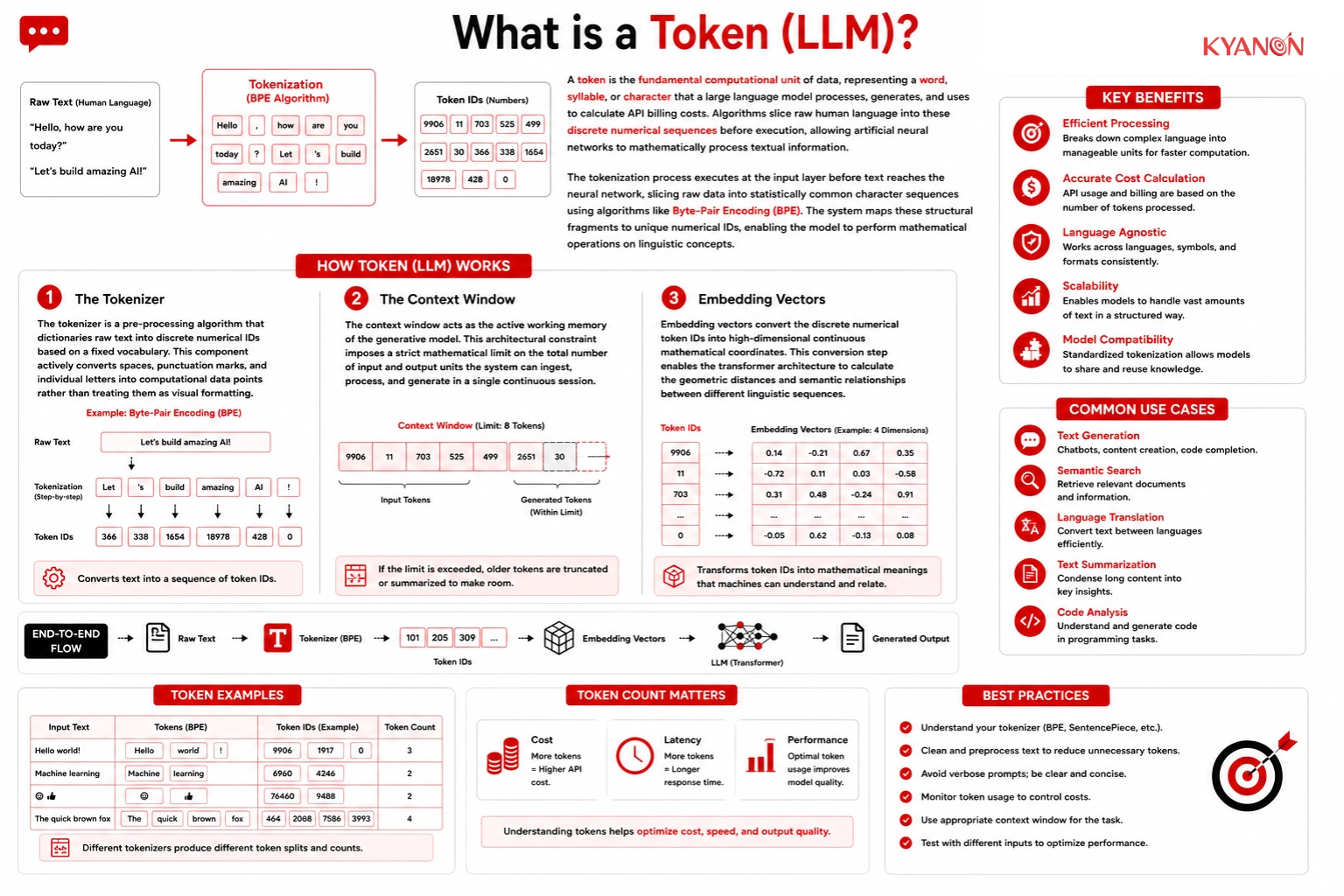
How Token (LLM) works
The tokenization process executes at the input layer before text reaches the neural network, slicing raw data into statistically common character sequences using algorithms like Byte-Pair Encoding (BPE). The system maps these structural fragments to unique numerical IDs, enabling the model to perform mathematical operations on linguistic concepts.
The Tokenizer
The tokenizer is a pre-processing algorithm that dictionaries raw text into discrete numerical IDs based on a fixed vocabulary. This component actively converts spaces, punctuation marks, and individual letters into computational data points rather than treating them as visual formatting.
The Context Window
The context window acts as the active working memory of the generative model. This architectural constraint imposes a strict mathematical limit on the total number of input and output units the system can ingest, process, and generate in a single continuous session.
Embedding Vectors
Embedding vectors convert the discrete numerical token IDs into high-dimensional continuous mathematical coordinates. This conversion step enables the transformer architecture to calculate the geometric distances and semantic relationships between different linguistic sequences.

Token (LLM) vs Word (Human Language)
While humans perceive text as complete words and sentences, machine learning architectures parse data through strict statistical fragmentation.
Dimension | Token (LLM) | Word (Human Language) |
| Processing mechanism | Mapped via statistical byte-pair encoding | Interpreted via grammatical rules |
Cost implication | Directly drives cloud compute and API billing | No direct computational cost per word |
| Cross-lingual parity | Non-Latin scripts require significantly more units | Independent of computational architecture |
Spatial formatting | Treats whitespace and punctuation as distinct units | Treats whitespace purely as visual separation |
| System limitations | Strictly capped by the context window limit | Limited only by external storage or human memory |
When to consider Token (LLM) Optimization
Consider Token (LLM) optimization if:
- Your engineering team is deploying long-context Retrieval-Augmented Generation (RAG) pipelines and experiencing compounding API costs due to processing massive document histories.
- Your customer service chatbots frequently fail to execute logic tasks because multi-turn conversational histories are silently exceeding the model’s maximum context window limit.
- You are scaling an AI application into non-English markets (such as Thailand or Vietnam) and noting disproportionately high latency and compute expenses compared to the English baseline.
It may not be the right priority if:
- Your application architecture relies exclusively on fixed, zero-shot classification prompts that consume a negligible, highly predictable computational footprint.
Why Token (LLM) Optimization Matters for Enterprise AI
Understanding token mechanics is mandatory for engineers managing AI budgets and performance metrics:
- Context Window Limits: Every LLM has a strict structural boundary called a context window (e.g., 128,000 tokens). This is a shared pool that must simultaneously hold your system prompt, your conversation history, your current question, and the final answer. Exceeding this limit causes the model to “forget” the beginning of the conversation.
- API Billing and Pricing: Cloud AI vendors (like OpenAI, Anthropic, or Google) bill enterprises strictly based on token volume, usually priced “per 1 million tokens.” Input tokens (prompts) are typically much cheaper than output tokens (the AI’s response).
- Speed Metrics (TPS): The speed of an LLM is measured in Tokens Per Second (TPS). Optimizing your prompts to use fewer tokens directly reduces user latency.
Common misconceptions
Tokens map cleanly across different languages, so our cost per user will be the same in Thailand as it is in the US
Reality: Tokenizers are heavily optimized for English text. A single English word is typically mapped as one unit, but translating that exact same word into languages with non-Latin scripts, such as Thai or Chinese, breaks it into four to six distinct units. This structural discrepancy makes non-English AI processing significantly slower and more expensive.
Our enterprise model has a 128k context window, which means we can upload exactly 128,000 words of documentation into the prompt
Reality: Because of sub-word splitting, capitalization rules, and punctuation formatting, a context window holds significantly fewer words than its numerical capacity. Furthermore, this limit is a shared pool; it must simultaneously accommodate your system instructions, the entire user conversation history, and the final output response generated by the model.
We are only billed for the outputs the AI generates when answering our customers
Reality: Cloud AI providers bill for both input processing and output generation. In long conversational chat sessions, the architecture re-bills you for the entire accumulating conversation history with every single new message the user submits, causing operational costs to compound rapidly over time.
How Kyanon Digital optimizes Token (LLM) Usage
Kyanon Digital helps enterprise clients optimize token (llm) usage across generative AI applications in the US, Nordic Europe, ANZ, and Southeast Asia. Our data engineering teams implement prompt compression techniques and advanced retrieval routing architectures to ensure language models receive only the exact required context. This targeted approach prevents context window overflow and strictly manages API payload sizes, directly lowering the Total Cost of Ownership (TCO) for enterprise AI integrations without degrading response accuracy.
Explore our Generative AI Development services.

 Create project brief with AI