
What is the Total Cost of Ownership (TCO)?
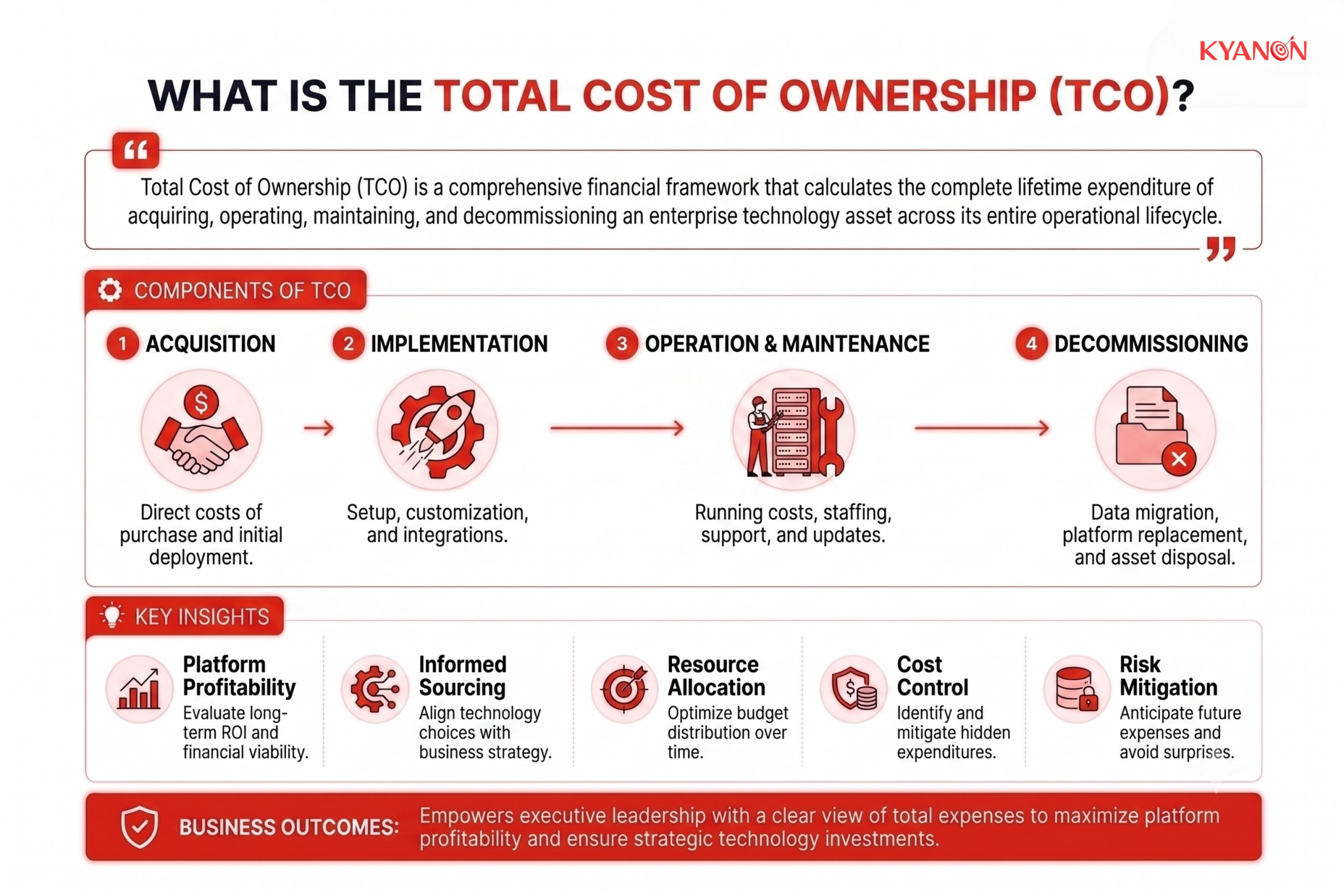
Total Cost of Ownership (TCO) is a comprehensive financial framework that calculates the complete lifetime expenditure of acquiring, operating, maintaining, and decommissioning an enterprise technology asset across its entire operational lifecycle. By factoring in direct implementation fees alongside indirect operational costs, administrative overhead, and future transition expenses, TCO provides executive leadership with a clear view of platform profitability.
How Total Cost of Ownership (TCO) Works
Evaluating Total Cost of Ownership (TCO) requires assessing both capital expenditure (CapEx) and operational expenditure (OpEx) across the entire technology lifecycle. Rather than focusing solely on acquisition costs, a comprehensive TCO analysis captures the full financial impact of implementing, operating, maintaining, and eventually replacing an enterprise solution.
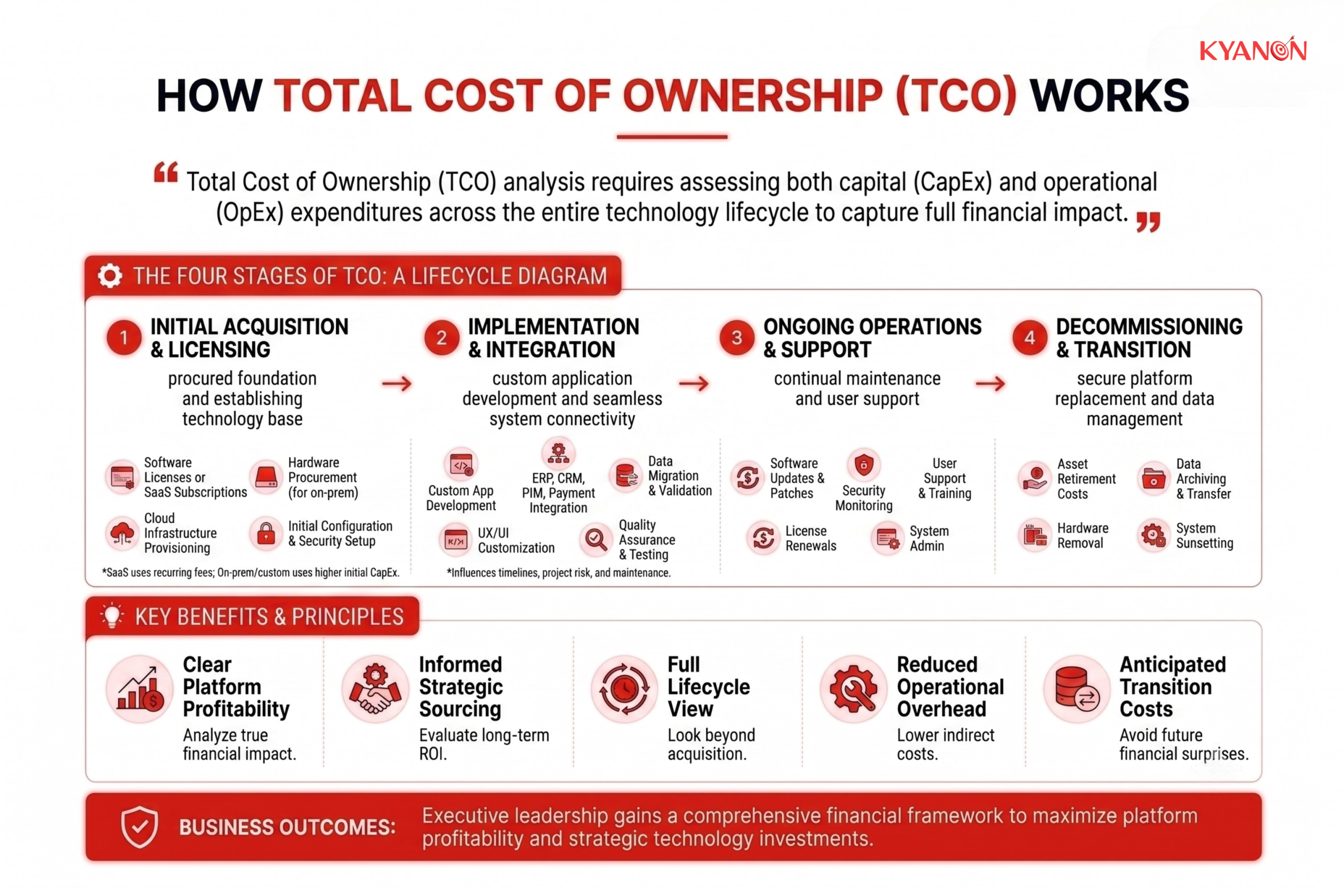
Initial Acquisition & Licensing
This stage accounts for the upfront investment required to procure and establish the technology foundation.
Typical cost components include:
- Software licensing or SaaS subscriptions
- Cloud infrastructure provisioning
- Hardware procurement for on-premises deployments
- Initial environment configuration and security setup
The cost structure varies by deployment model. SaaS platforms typically incur recurring subscription fees based on users or transaction volume, while custom-built and on-premises solutions require higher initial capital investment in software licenses and infrastructure.
Custom Integration & Deployment
Implementation extends beyond software acquisition and often represents a significant share of total ownership costs. Enterprise platforms must integrate seamlessly with existing business systems while meeting operational and compliance requirements.
Key cost drivers include:
- Custom application development
- Integration with ERP, CRM, PIM, payment gateways, and other enterprise systems
- Data migration and validation
- UX/UI customization
- Quality assurance, security testing, and production deployment
The complexity of these activities directly influences implementation timelines, project risk, and future maintenance requirements.

Comparative Analysis: Total Cost of Ownership (TCO) vs. Total Cost of Acquisition (TCA)
While Total Cost of Acquisition accounts strictly for initial purchase expenses prior to go-live, Total Cost of Ownership tracks long-term operational and strategic expenditures across the platform’s multi-year lifespan.
Dimension | Total Cost of Acquisition (TCA) | Total Cost of Ownership (TCO) |
| Financial Scope | Capital expenditure (CapEx) up to go-live | Complete CapEx and Operational Expenditure (OpEx) lifecycle |
Time Horizon | Short-term (procurement through deployment) | Multi-year (3 to 5+ years operational lifespan) |
| Hidden Cost Factors | Excludes operational downtime, upgrades, and support | Accounts for API usage, infrastructure drift, maintenance, and training |
Vendor Selection Focus | Evaluates upfront sticker price and setup fees | Evaluates long-term efficiency, scalability costs, and exit friction |
| Strategic Impact | Protects initial procurement budgets | Safeguards long-term corporate operating margins |
When to Consider Total Cost of Ownership (TCO)
Consider Total Cost of Ownership (TCO) modeling if:
- Your enterprise is evaluating a platform migration between monolithic, SaaS, headless, or composable commerce architectures and needs a clear financial projection.
- Post-launch operational expenditures, cloud infrastructure bills, or third-party integration maintenance regularly exceed initial baseline budgets.
- Executive leadership requires an objective financial baseline to evaluate vendor RFP proposals beyond listed sticker pricing.
It may not be the right priority if:
- You are building a short-term, low-budget MVP designed for rapid market validation with a planned lifespan under 12 months.
Why Total Cost of Ownership (TCO) Matters for Enterprise Commerce
For enterprise commerce leaders, technology decisions extend far beyond implementation costs. Total Cost of Ownership (TCO) provides a lifecycle view of technology investments by accounting for acquisition, integration, operations, maintenance, and future modernization. This enables CTOs and engineering leaders to evaluate platform architecture based on long-term operational efficiency, scalability, and business value, not just initial deployment costs.
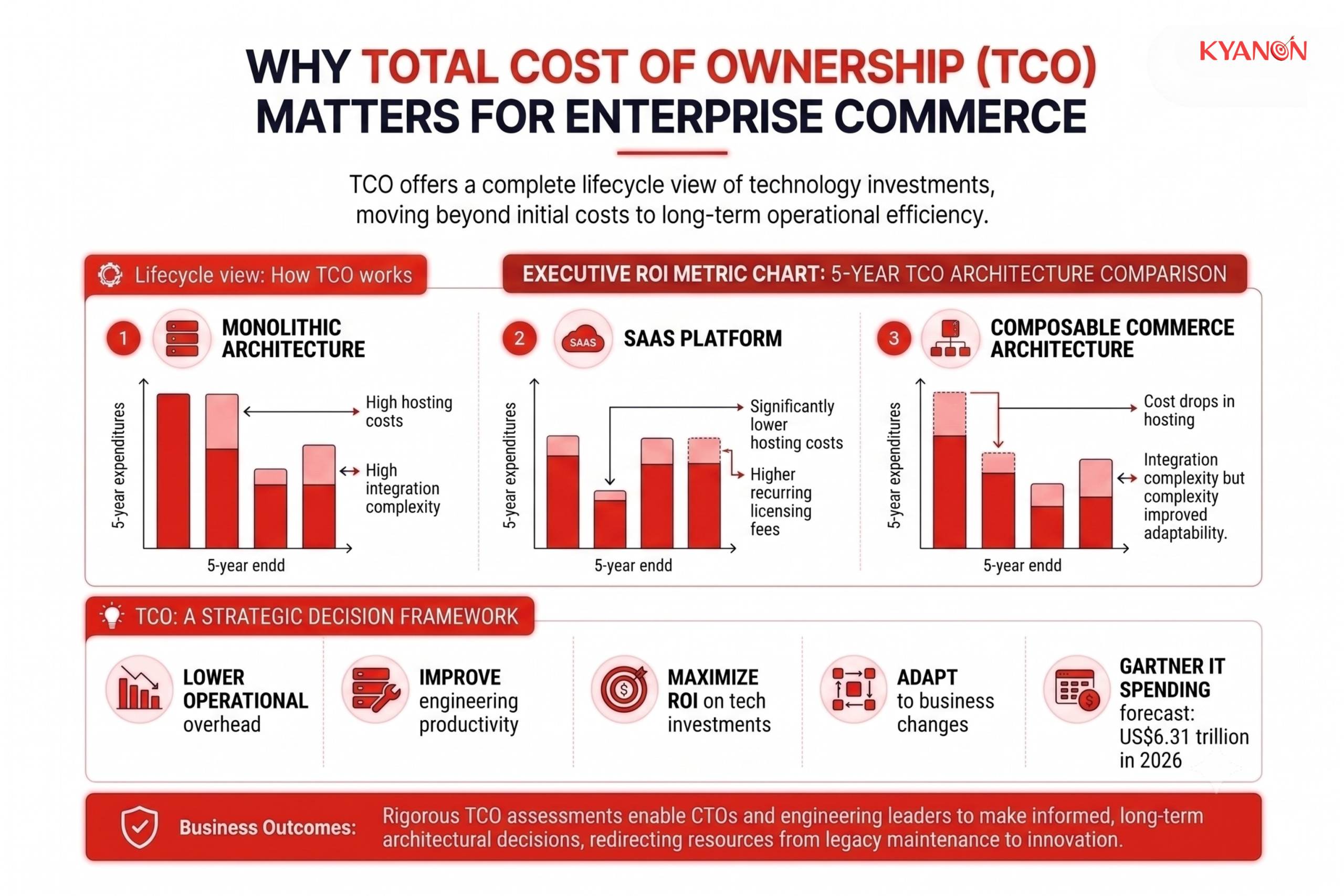
As technology budgets continue to grow, maximizing the return on every investment has become increasingly critical. Gartner forecasts worldwide IT spending will reach US$6.31 trillion in 2026, driven by continued investment in AI infrastructure, software, and cloud services. At the same time, Gartner’s research shows that only 28% of AI initiatives in infrastructure and operations fully achieve their expected ROI, highlighting the importance of building scalable, cost-efficient technology foundations before expanding digital capabilities.
A rigorous TCO assessment helps organizations identify the long-term impact of architectural decisions. Modern, modular platforms reduce operational complexity, improve engineering productivity, and lower ongoing maintenance overhead, allowing technology teams to redirect resources from sustaining legacy systems toward innovation. Rather than serving as a financial reporting exercise, TCO becomes a strategic decision framework for prioritizing modernization initiatives, improving technology ROI, and ensuring enterprise commerce platforms remain adaptable as business requirements evolve.
Common Misconceptions
The Purchase Price Represents the Complete TCO
The initial purchase price rarely reflects the full financial impact of an enterprise platform. Selecting platforms strictly based on low initial sticker prices can lead to significant budget overruns. Research from McKinsey & Company shows that 25% to 40% of large-scale technology programs exceed their initial budgets or schedules by more than 50%.
TCO is a One-Time Procurement Calculation
Treating TCO as a static metric calculated solely during procurement leads to inaccurate financial planning. TCO shifts over time due to inflation, changing usage patterns, cloud scaling fees, and operational bottlenecks. Continuous TCO monitoring is required to maintain accurate budget oversight post-launch.
Indirect Costs Do Not Belong in TCO Calculations
Excluding non-invoice costs distorts financial accuracy. Operational variables such as platform downtime, administrative overhead, developer training curves, and lost conversions caused by slow performance directly affect profitability and must be factored into comprehensive TCO frameworks.
TCO Ends Once the Platform is Fully Implemented
Financial obligations extend beyond operational launch. Decommissioning legacy systems, migrating historical data, paying contract termination penalties, ensuring data compliance scrubbing, and retiring hardware carry significant costs that must be budgeted during initial planning to mitigate vendor lock-in.
Total Cost of Ownership is Identical to Total Cost of Acquisition
Total Cost of Acquisition (TCA) tracks spending only up to the official go-live date. TCO encompasses the entire operational lifecycle, including years of post-launch optimization, continuous feature development, cloud scaling, and technical support. Relying solely on TCA results in overwhelmed OpEx budgets after launch.
SaaS Architecture Eliminates TCO Concerns
Transitioning to cloud-based Software-as-a-Service (SaaS) shifts maintenance to vendors but introduces variable hidden costs. API usage fees, data egress charges, seat license scaling, and premium vendor support tiers can create cloud spend inflation that matches or exceeds traditional hardware cycles if unmonitored.
How Kyanon Digital Applies Total Cost of Ownership (TCO)
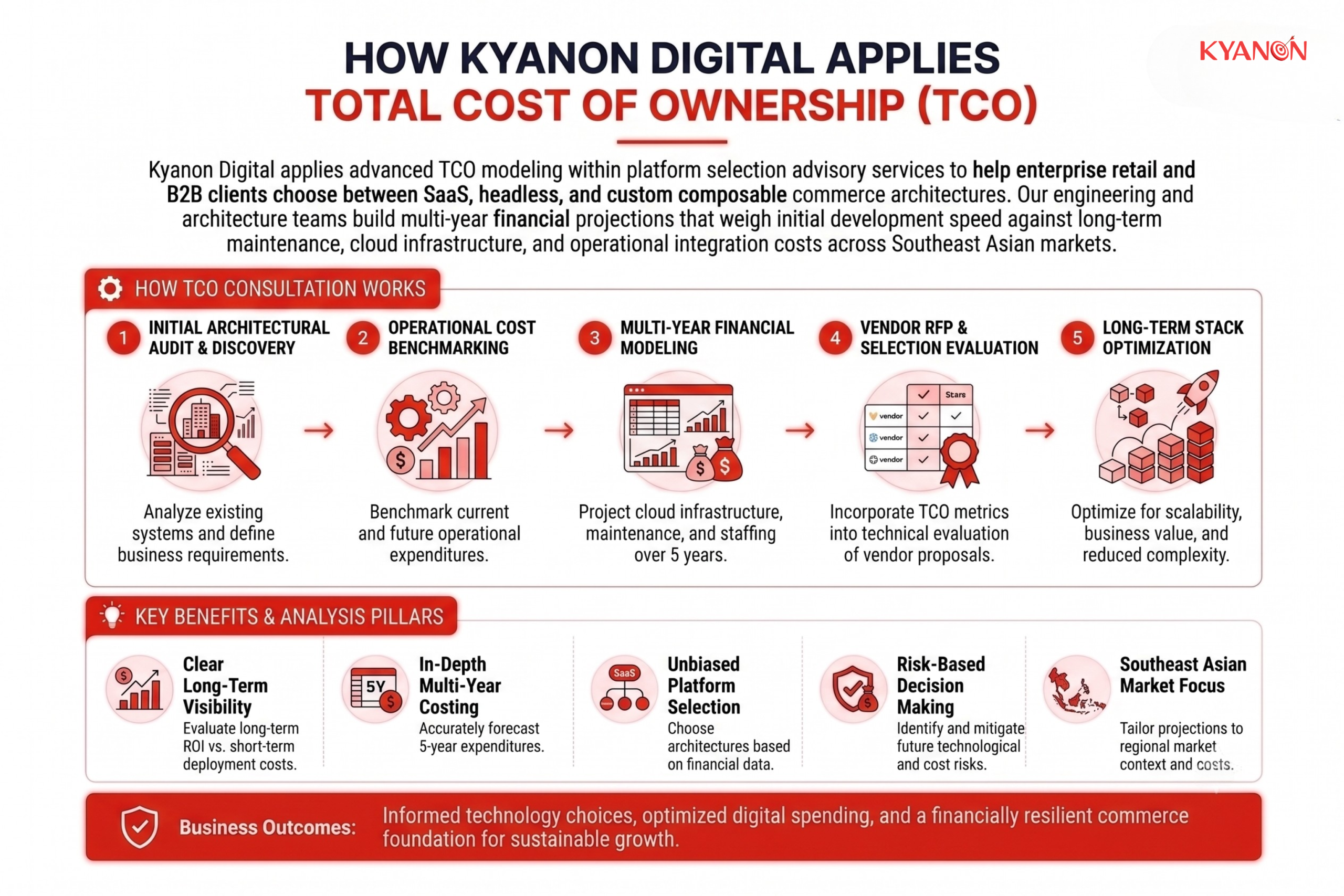
Kyanon Digital applies advanced TCO modeling within platform selection advisory services to help enterprise retail and B2B clients choose between SaaS, headless, and custom composable commerce architectures. Our engineering and architecture teams build multi-year financial projections that weigh initial development speed against long-term maintenance, cloud infrastructure, and operational integration costs across Southeast Asian markets.
Explore our services:

 Create project brief with AI