
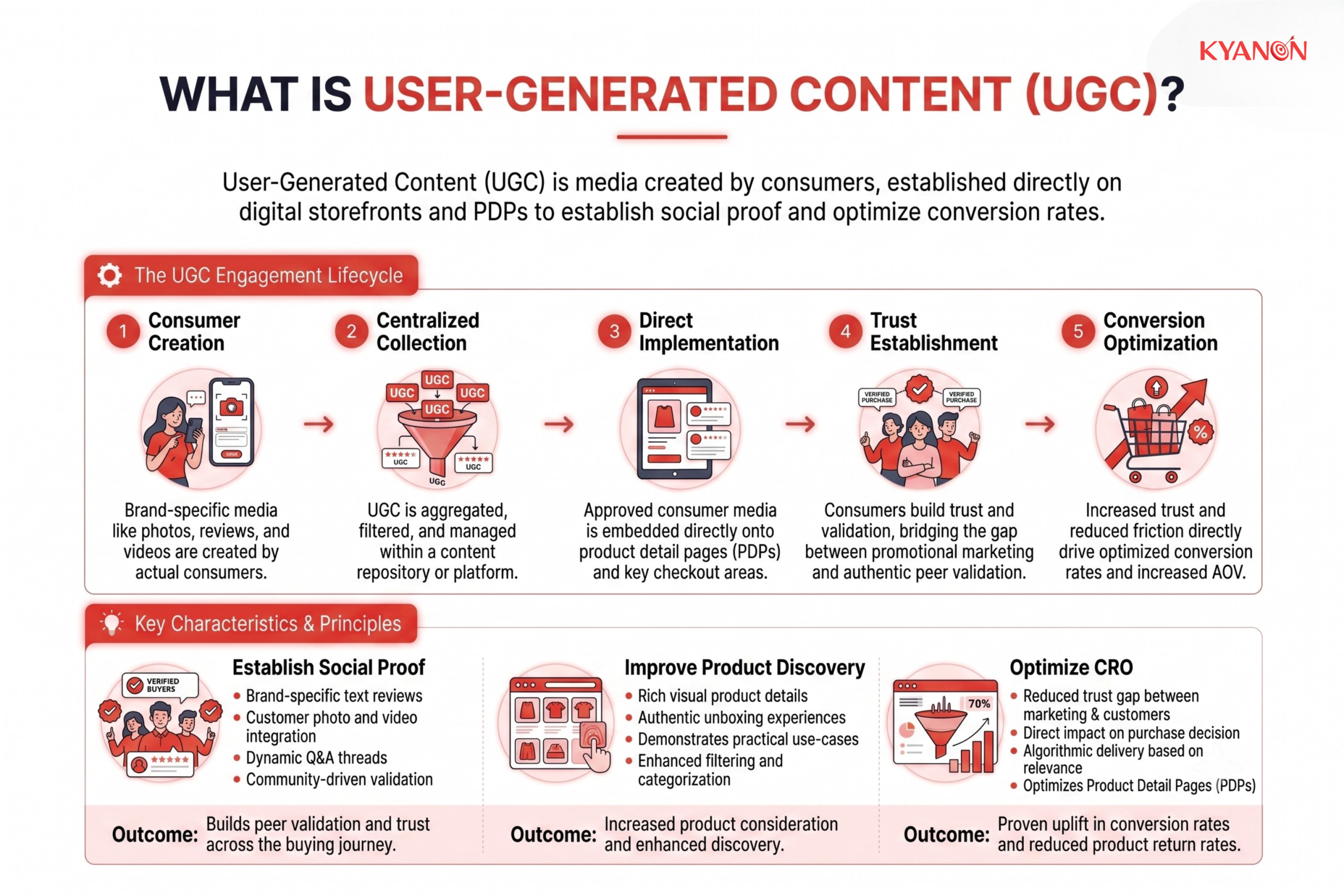
What is User-Generated Content (UGC)?
User-Generated Content (UGC) refers to brand-specific media, such as text reviews, customer photos, unboxing videos, and Q&A threads, created by consumers rather than brands to establish social proof and optimize conversion rates. Embedded directly into digital storefronts and Product Detail Pages (PDPs), UGC bridges the trust gap between promotional marketing and authentic peer validation.
How User-Generated Content (UGC) Works
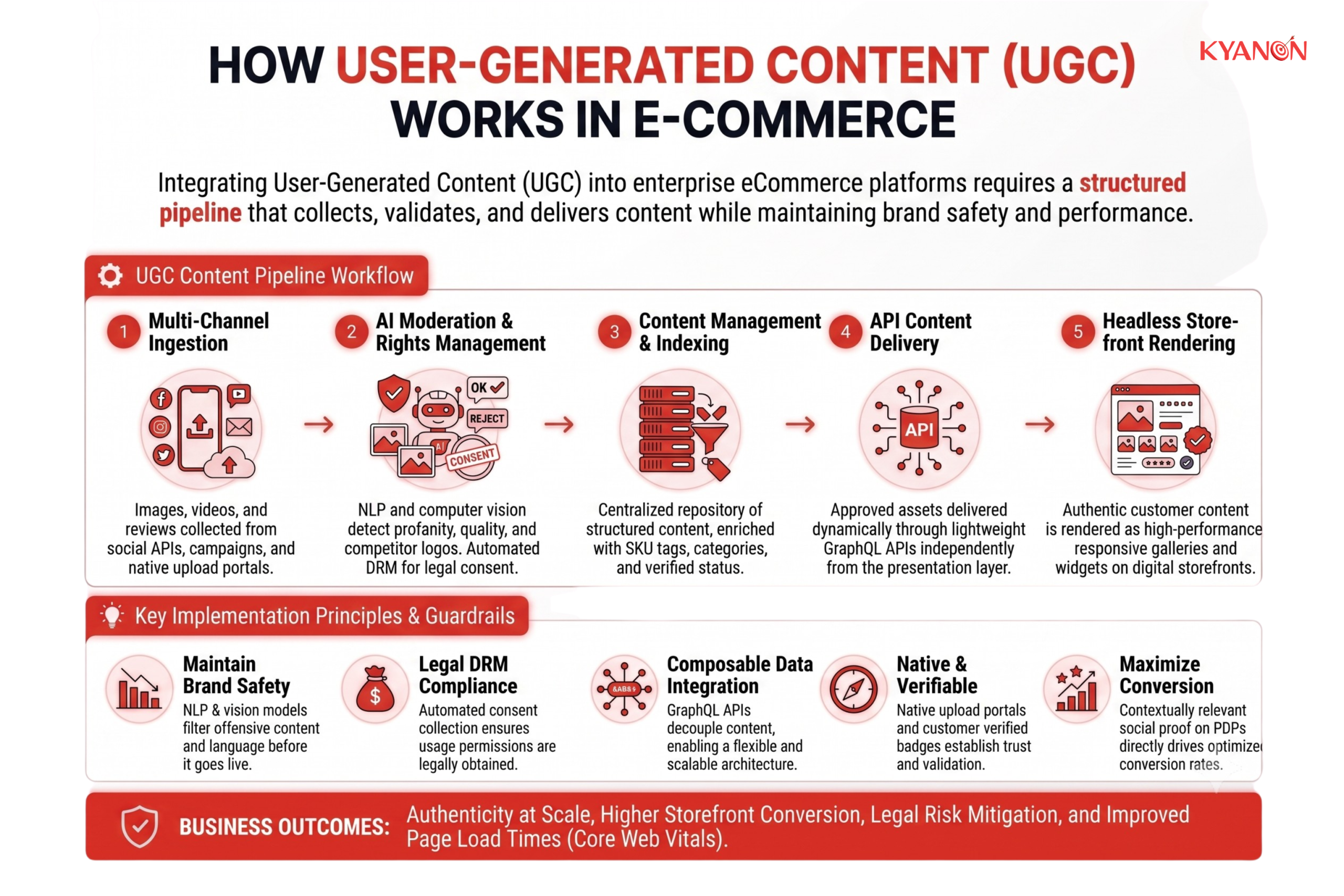
Integrating User-Generated Content (UGC) into enterprise eCommerce platforms requires more than simply embedding customer reviews or social media posts. Modern commerce platforms rely on a structured pipeline that collects, validates, enriches, and delivers customer-generated content while maintaining brand safety, legal compliance, and storefront performance at scale.
Multi-Channel Ingestion & Content Discovery
The first stage focuses on aggregating customer-generated content from multiple digital touchpoints. Images, videos, ratings, and reviews are collected through social media APIs, post-purchase campaigns, and native upload portals before being consolidated into a centralized repository, typically within a Product Information Management (PIM) platform or dedicated UGC database.
Content sources include:
- Social platforms through REST and GraphQL APIs
- Post-purchase email and review requests
- Native web and mobile upload portals
- Customer ratings and written reviews
Outcome: A centralized repository of structured visual and textual content ready for moderation.
Automated Moderation & Digital Rights Management
Before content is published, automated moderation workflows evaluate every submission for quality, compliance, and legal eligibility. Natural Language Processing (NLP) and computer vision models identify inappropriate language, offensive imagery, low-quality assets, duplicate submissions, and unauthorized brand references.
In parallel, Digital Rights Management (DRM) workflows automate consent collection and usage permissions, ensuring customer-generated assets can be legally displayed across commercial channels.
Automated validation covers:
- Content safety and profanity detection
- Image quality assessment
- Competitor logo recognition
- Duplicate content detection
- Rights and consent management
Outcome: Brand-safe, legally approved content ready for customer-facing channels.
Dynamic Indexing & Headless PDP Rendering
Approved assets are enriched with structured metadata, including product-level Stock Keeping Unit (SKU) tags, categories, and customer verification status. This indexing enables commerce platforms to retrieve the most relevant content for each product dynamically.
Headless storefronts access approved UGC through lightweight GraphQL APIs, rendering responsive photo galleries, video widgets, and verified buyer reviews directly on Product Detail Pages (PDPs). Because content is delivered independently from the presentation layer, retailers can enrich the shopping experience without compromising page speed or Core Web Vitals.
Key capabilities:
- SKU-based content indexing
- GraphQL-powered content delivery
- Responsive media galleries and review widgets
- High-performance rendering optimized for Core Web Vitals
Outcome: Authentic customer content is delivered seamlessly across digital storefronts while maintaining scalability and site performance.

Comparative Analysis: User-Generated Content (UGC) vs. Studio Product Photography
Studio brand assets provide controlled product presentation, whereas User-Generated Content delivers authentic visual validation directly from real-world usage environments.
Dimension | Studio Product Photography | User-Generated Content (UGC) |
| Deployment Speed | Slow (requires staging, shoots, editing) | Fast (continuous automated ingestion) |
Vendor Lock-In | High dependence on production agencies | Low (community and creator powered) |
| Upfront Complexity | High CapEx per asset production run | Low to moderate platform integration |
Best For | Baseline catalog launches & branding | CRO, social proof, and PDP engagement |
| Cost Model | Capital Expenditure (CapEx per campaign) | Operational Expenditure (OpEx platform/creators) |
When to Consider User-Generated Content (UGC)
Consider User-Generated Content (UGC) if:
- High traffic on Product Detail Pages (PDPs) is yielding low conversion rates due to consumer hesitation over product fit, material, or real-world appearance.
- High customer acquisition costs (CAC) require scalable, authentic creative assets to refresh paid acquisition campaigns and social channels continuously.
- Product return rates are escalating due to discrepancies between studio imagery and actual customer expectations upon delivery.
It may not be the right priority if:
- Your business operates in a highly regulated B2B industry with strict legal restrictions on public customer testimonials and unverified media usage.
Why User-Generated Content (UGC) Matters for E-Commerce
User-Generated Content (UGC) has become a strategic asset for eCommerce because it addresses one of the most significant barriers to online purchasing: consumer trust. While professionally produced product images and marketing messages remain important, they often cannot provide the authenticity that shoppers seek when evaluating products. Customer-generated photos, videos, and reviews offer credible, real-world validation that helps prospective buyers assess product quality, appearance, and overall satisfaction before making a purchase.
As online buying journeys become increasingly research-driven, authentic customer content plays a critical role in reducing purchase uncertainty and strengthening buyer confidence. Integrating UGC across Product Detail Pages (PDPs) and digital storefronts enables retailers to create more engaging shopping experiences while supporting key commercial objectives, including higher conversion rates, stronger customer engagement, and increased revenue per session.
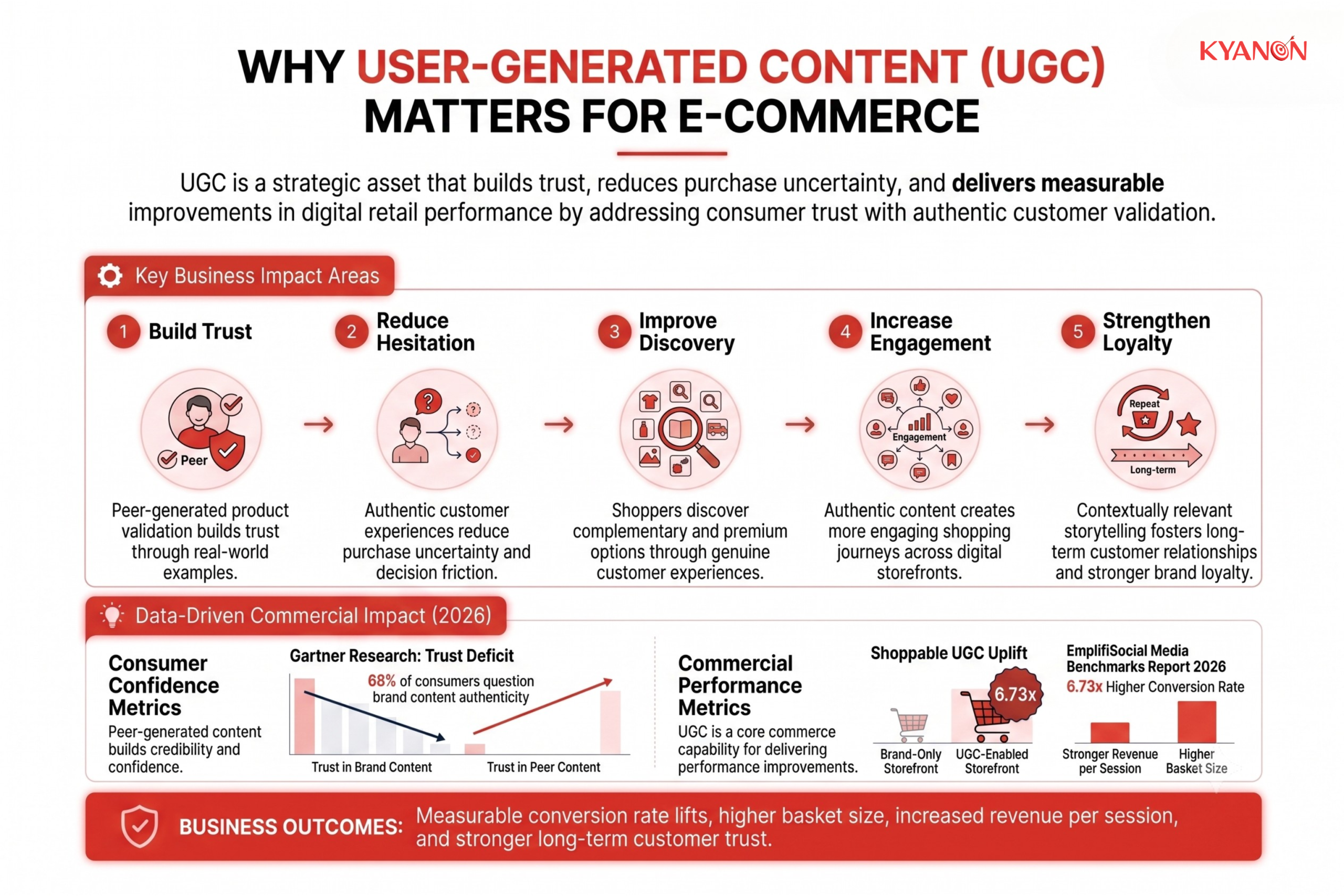
The business value of UGC extends beyond social proof. By incorporating authentic customer experiences throughout the shopping journey, retailers can:
- Build trust through peer-generated product validation
- Reduce purchase hesitation and decision friction
- Improve product discovery with real-world usage examples
- Increase customer engagement across digital storefronts
- Drive higher conversion rates and stronger long-term loyalty
Industry research reinforces the growing importance of authentic customer content. According to Gartner, 68% of consumers frequently question the authenticity of brand-created online content, making peer-generated photos, videos, and reviews an increasingly influential factor in purchase decisions. As a result, retailers that incorporate authentic customer storytelling and advocacy are better positioned to establish credibility and foster consumer confidence during product evaluation.
The commercial impact is equally compelling. According to the Emplifi Social Media Benchmarks Report 2026, eCommerce storefronts that actively integrate customer-generated media and verified reviews achieve 6.73× higher conversion rates than those relying solely on brand-created content. These findings demonstrate that UGC is no longer simply a marketing enhancement, it has become a core commerce capability that strengthens customer trust while delivering measurable improvements in digital retail performance.
Common Misconceptions
UGC is Always Low Quality
Many modern creators utilize professional cameras, lighting equipment, and mobile editing software. User-created content frequently matches the technical fidelity of studio assets while retaining visual authenticity.
Consumers Trust All UGC Implicitly
Digital shoppers identify overly scripted or forced product endorsements quickly. Maintaining genuine customer feedback—including constructive criticism—is necessary to protect long-term consumer trust.
UGC Only Works for Gen Z Audiences
Consumers across all age demographics consult verified purchaser reviews, customer photographs, and peer feedback to validate buying decisions prior to checkout.
UGC is Completely Free
High-performing creators charge creation fees to produce structured, high-resolution media. Managing an enterprise UGC program requires ongoing investment in creator payouts, licensing management, and platform infrastructure.
Brands Lose All Brand Control
Merchants pre-approve creator briefs, campaign guidelines, and media assets prior to public deployment. Automated moderation tools and approval workflows ensure all published assets align with corporate brand guidelines.
UGC Requires Viral Video Formats
Text reviews, photo testimonials, community Q&As, and star rating widgets represent critical forms of user content. Static feedback formats often deliver higher conversion impact on product pages than complex video formats.
UGC Replaces Professional Production
User media supplements polished studio campaigns by providing authentic, top-of-funnel organic content and real-world product context. It operates alongside core studio photography rather than replacing high-tier brand creative.
More Content Always Means More Sales
Irrelevant or unmoderated customer posts dilute product detail pages and can negatively impact brand prestige. Strategic curation of high-value, product-specific media generates better conversion outcomes than high volumes of uncurated content.
UGC is a Set-It-and-Forget-It Tactic
Sustaining a community content strategy requires continuous moderation, rights clearance management, creator relationship maintenance, and regular performance analysis.
How Kyanon Digital Applies User-Generated Content (UGC)
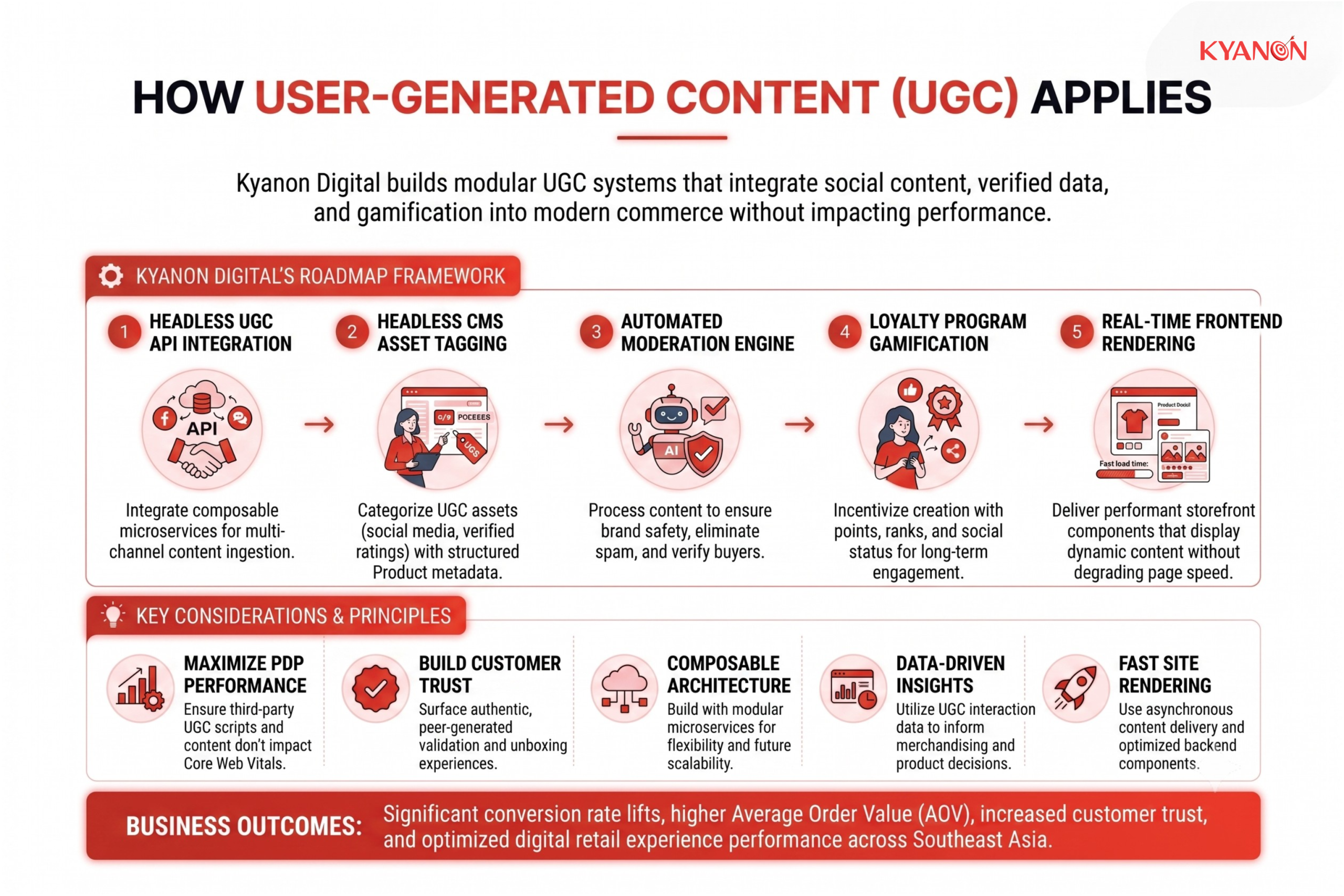
Kyanon Digital integrates UGC systems directly into modern e-commerce Product Detail Pages (PDPs) and customer loyalty architectures for enterprise retail clients across Southeast Asia. Our engineering teams implement composable APIs and modular storefront components to ingest, moderate, and render shoppable social media galleries, verified buyer ratings, and community forums without degrading core page load speed or site performance.
Explore our services:

 Create project brief with AI