
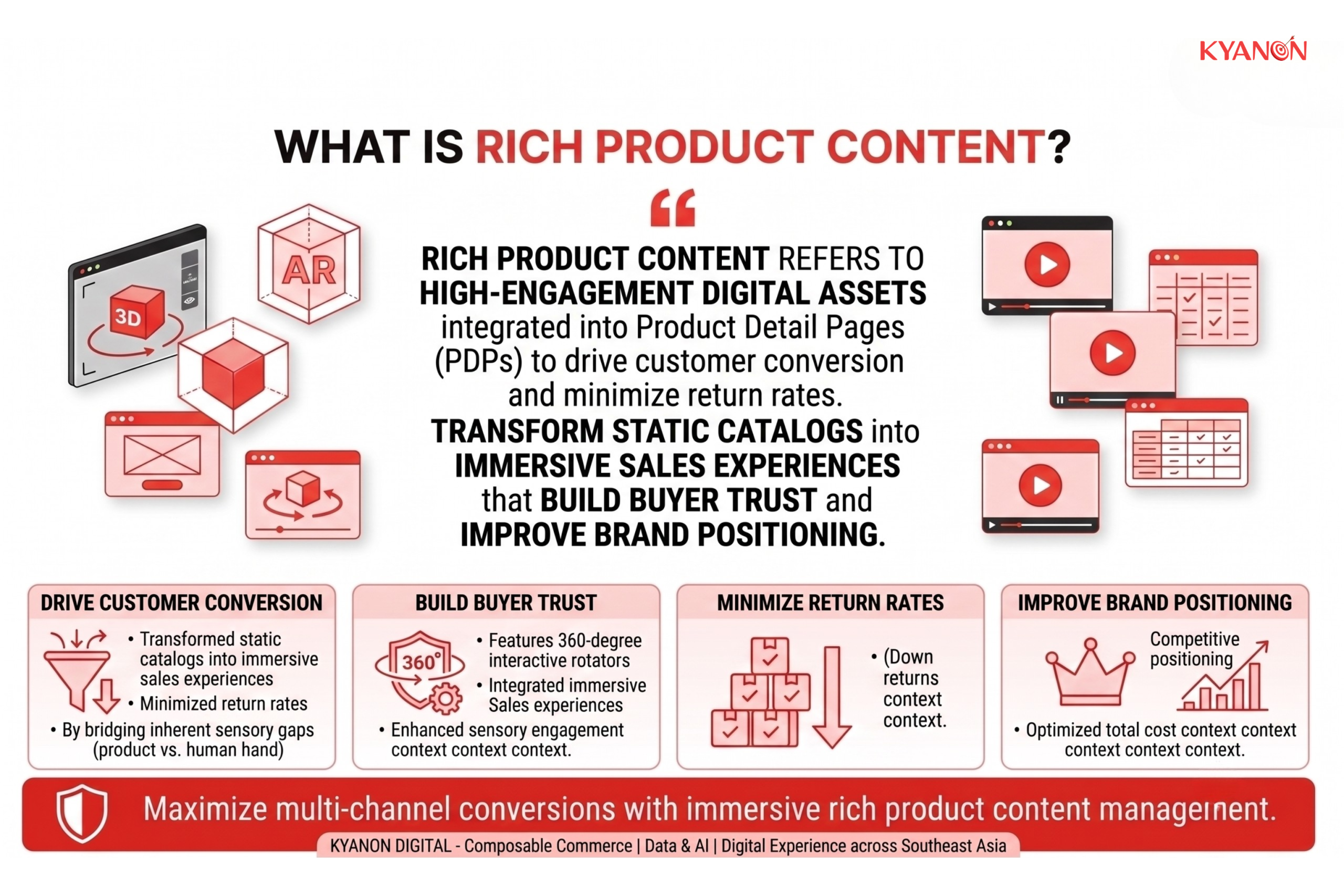
What is Rich Product Content?
Rich product content refers to high-engagement digital assets, such as 360-degree interactive rotators, 3D models, augmented reality (AR) previews, feature videos, and structured comparison matrices, integrated into Product Detail Pages (PDPs) to drive customer conversion and minimize return rates. By bridging the sensory gap inherent in digital commerce, it transforms static catalogs into immersive sales experiences that build buyer trust and improve brand positioning.
How Rich Product Content Works
Modern rich product content platforms separate content management from presentation using API-first, headless architectures. Instead of embedding images, videos, and 3D assets directly into the storefront, enterprises centralize these assets within Digital Asset Management (DAM) or Product Information Management (PIM) systems. Content is then optimized, delivered through edge networks, and rendered dynamically across web, mobile, and emerging commerce channels.
This architecture enables retailers to deliver immersive product experiences while maintaining fast page performance, consistent branding, and centralized content governance.
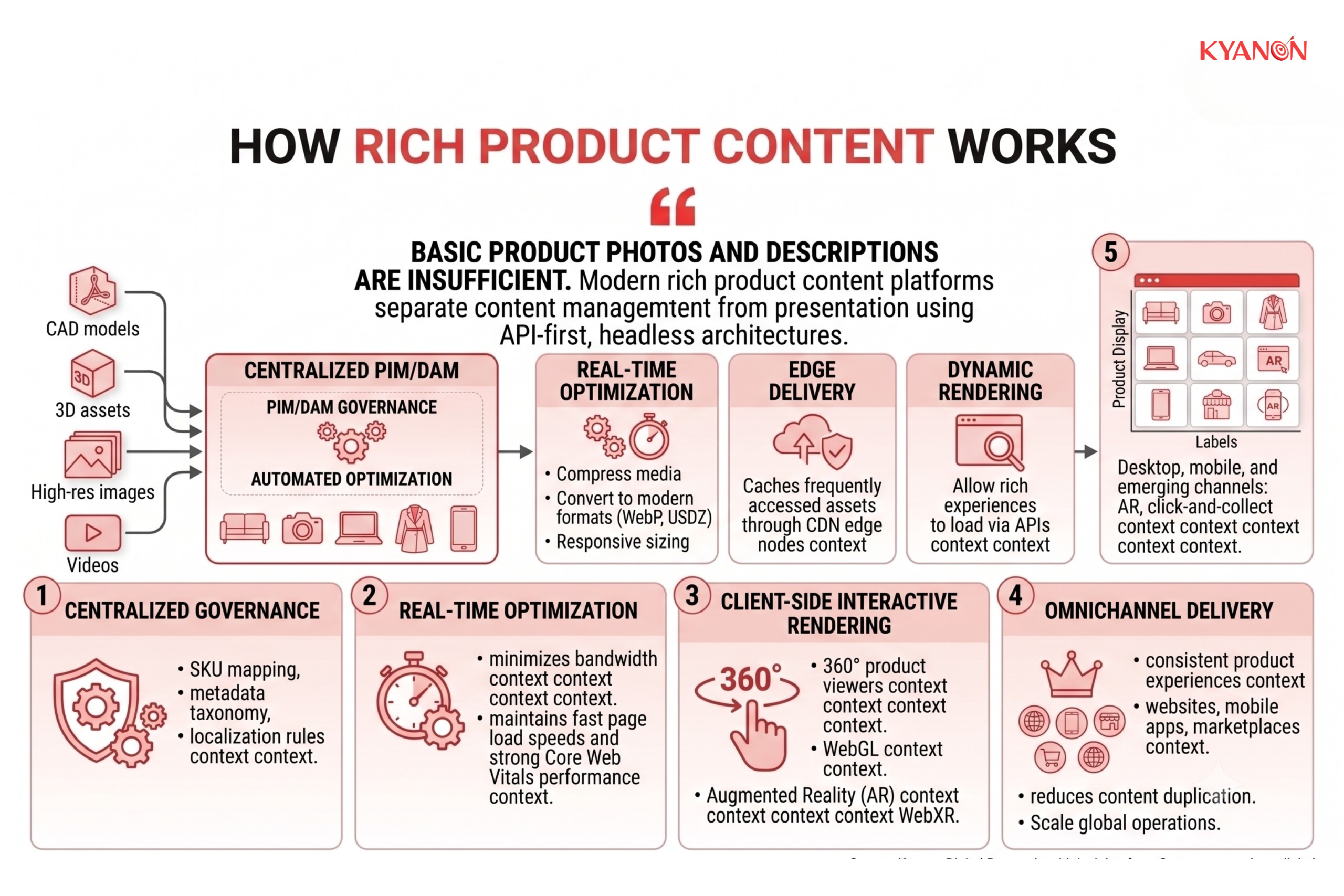
Centralized Asset Governance
Rich product assets are managed through a single repository that serves as the source of truth for every digital channel.
Typical content includes:
- High-resolution product photography
- 360° product spins and 3D models
- CAD files and spatial assets
- Product videos and interactive media
- Technical documentation and marketing content
The platform automatically applies:
- SKU and product catalog mapping
- Metadata tagging and taxonomy
- Localization and regional content rules
- Version control and approval workflows
This centralized governance ensures every customer channel presents accurate, up-to-date, and brand-consistent product information.
Real-Time Media Optimization
When a shopper opens a Product Detail Page (PDP), the storefront doesn’t retrieve raw media files. Instead, requests are processed through edge infrastructure that automatically optimizes assets based on the shopper’s device, browser, and network conditions.
The platform dynamically:
- Compresses high-resolution media without compromising visual quality
- Converts assets into modern formats such as WebP, AVIF, USDZ, or glTF/GLB
- Delivers responsive image sizes for different screen resolutions
- Caches frequently accessed assets through CDN edge nodes
This real-time processing minimizes bandwidth consumption while maintaining fast page load speeds and strong Core Web Vitals performance.
Client-Side Interactive Rendering
The headless storefront receives optimized asset URLs and rendering instructions through APIs, allowing rich experiences to load without affecting overall site performance.
Interactive capabilities typically include:
- 360° product viewers powered by WebGL for rotation, zoom, and detailed inspection
- Augmented Reality (AR) experiences using WebXR, Apple Quick Look, or Android Scene Viewer for in-environment product visualization
- Interactive product videos with clickable hotspots that display product information or enable add-to-cart actions directly within the video
- Dynamic media galleries that adapt to different devices and customer interactions
By rendering these experiences on the client side, retailers can offer immersive product exploration while preserving a responsive browsing experience.
Omnichannel Content Delivery
Because rich product content is managed independently of the storefront, the same assets can be published consistently across multiple customer touchpoints.
This enables organizations to:
- Deliver consistent product experiences across websites, mobile apps, marketplaces, and in-store kiosks
- Launch new campaigns or product updates without modifying frontend code
- Reduce content duplication across regional storefronts
- Scale global commerce operations while maintaining centralized governance

Comparative Analysis: Rich Product Content vs. Traditional Static PDPs
| Operational Dimension | Traditional Static PDPs | Rich Product Content (AR/3D/Interactive) |
| Customer Engagement | Passive viewing of 2D images and standard text blocks. | Active interaction via 360-degree spins, spatial placement, and dynamic media. |
| Return Rate Impact | Higher return rates caused by buyer expectations mismatching reality. | Lower return rates driven by accurate dimensional spatial understanding. |
| Page Load Performance | Fast raw load, but unoptimized high-res images can stall latency. | Optimized asset delivery via edge CDNs maintaining low core web vitals. |
| Search Engine Visibility | Dependent solely on indexing static body copy and metadata text. | Enhanced indexing through schema markups, image alt tags, and dynamic session dwell time. |
| Omnichannel Scalability | Requires manual image cropping and updating across distinct web targets. | Centralized PIM/DAM sync automatically updating multiple sales channels via APIs. |
Why Rich Product Content Matters
In competitive e-commerce environments, basic product photos and generic descriptions are insufficient to capture conversion intent. Modern buyers demand visual proof, clear dimensions, and interactive spatial context before making purchasing decisions, particularly across high-value retail categories like furniture, electronics, and fashion.
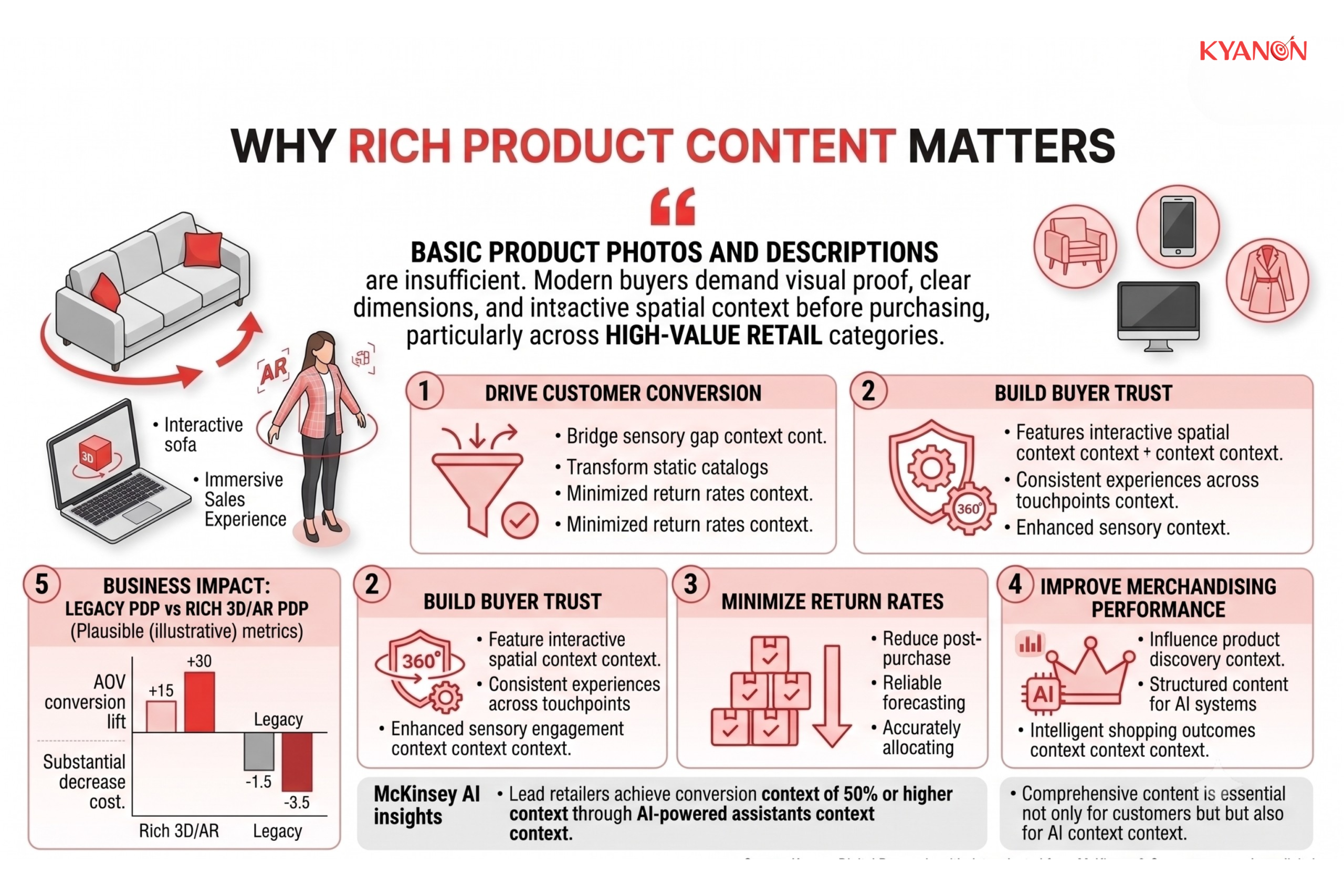
Enterprise investments in rich Product Detail Pages (PDPs) improve more than customer engagement, they strengthen merchandising performance, increase purchase confidence, and reduce post-purchase friction. As digital commerce becomes increasingly AI-driven, high-quality product content is also becoming a strategic asset that influences how products are discovered, evaluated, and recommended.
According to McKinsey, e-commerce is projected to continue growing at 5–7% annually, while 38% of European consumers already use GenAI to research products and inform purchasing decisions. McKinsey also reports that leading retailers achieve conversion rates of 50% or higher through AI-powered shopping assistants, demonstrating how richer product information and intelligent digital experiences can significantly improve purchase outcomes. As AI increasingly mediates the shopping journey, structured, comprehensive product content becomes essential not only for customers but also for the AI systems that help them discover, compare, and select products.
Common Misconceptions
Only for Big Companies
Many believe small and mid-market online stores do not need rich details like 360-degree views or videos. However, modern shoppers look for clear specifications and visual transparency regardless of business size. Scalable headless CMS platforms and cloud-based DAM tools now make high-end asset integration accessible for growing brands without requiring massive custom infrastructure budgets.
Just an Organization Tool
Some believe enhanced content only keeps asset files tidy inside administrative backends. In reality, structured rich content directly drives search engine visibility through detailed schema indexing, increases consumer dwell time, builds immediate buyer trust, and directly increases PDP conversion rates.
Text is Enough
A common myth is that heavy blocks of keyword-stuffed copy equal good content, ignoring that modern buyers demand visual, interactive formats. Text alone fails to convey scale, texture, or real-world utility, whereas integrated video, infographics, and 3D visualizers communicate key value propositions within seconds.
Too Hard to Update
Businesses often assume maintaining rich media across large product catalogs takes too long and creates severe operational overhead. Modern headless CMS setups and automated PIM workflows streamline updates across multiple global sales channels simultaneously, allowing central teams to push media updates globally with a single click.
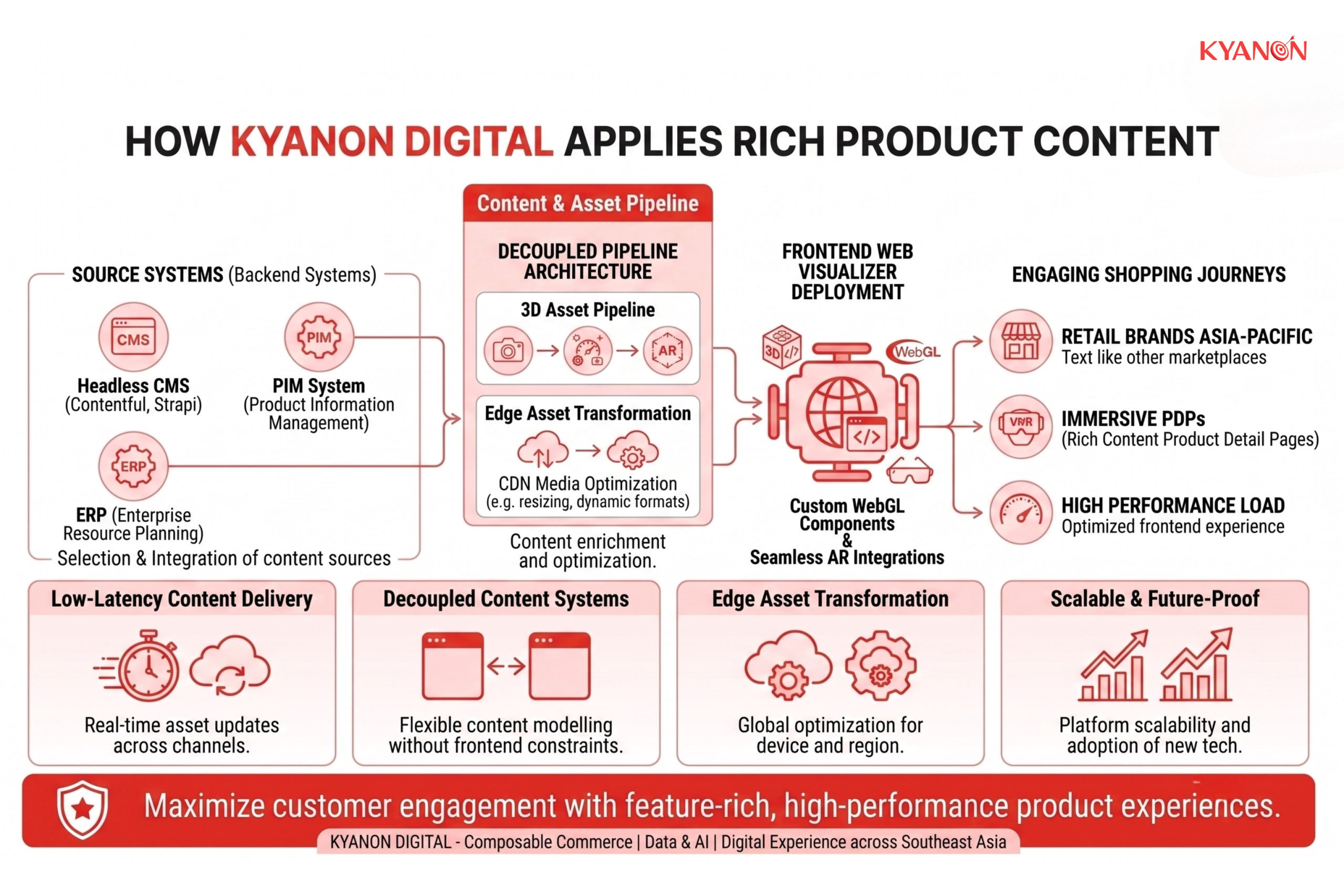
How Kyanon Digital Applies Rich Product Content
Kyanon Digital builds rich content PDPs using headless CMS architectures and seamless AR integrations for retail brands across Asia-Pacific. Our software engineering teams combine decoupled content systems, edge asset transformation pipelines, and custom WebGL components to create engaging shopping journeys without sacrificing platform scalability or loading performance.
Explore our services:

 Create project brief with AI