
What is xCommerce Framework?
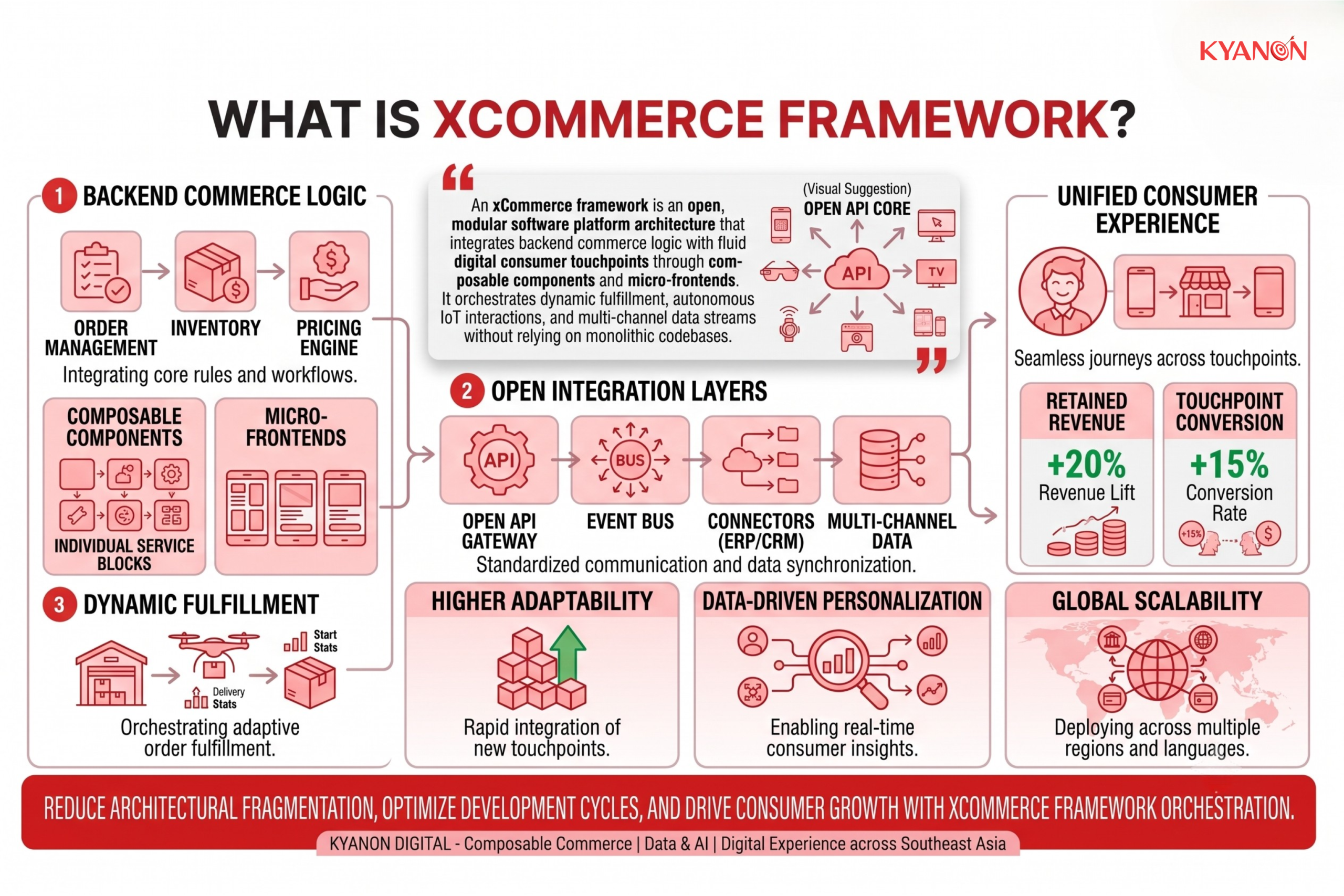
An xCommerce framework is an open, modular software platform architecture that integrates backend commerce logic with fluid digital consumer touchpoints through composable components and micro-frontends. It orchestrates dynamic fulfillment, autonomous IoT interactions, and multi-channel data streams without relying on monolithic codebases.
How xCommerce Framework Works
An xCommerce framework provides a composable architecture that decouples core commerce capabilities from customer-facing experiences. Instead of embedding business logic within individual websites or applications, the framework exposes services through standardized APIs, allowing inventory, pricing, orders, promotions, and fulfillment data to flow seamlessly across multiple digital and physical channels. This modular approach enables organizations to evolve their commerce ecosystem continuously without disrupting core operations.
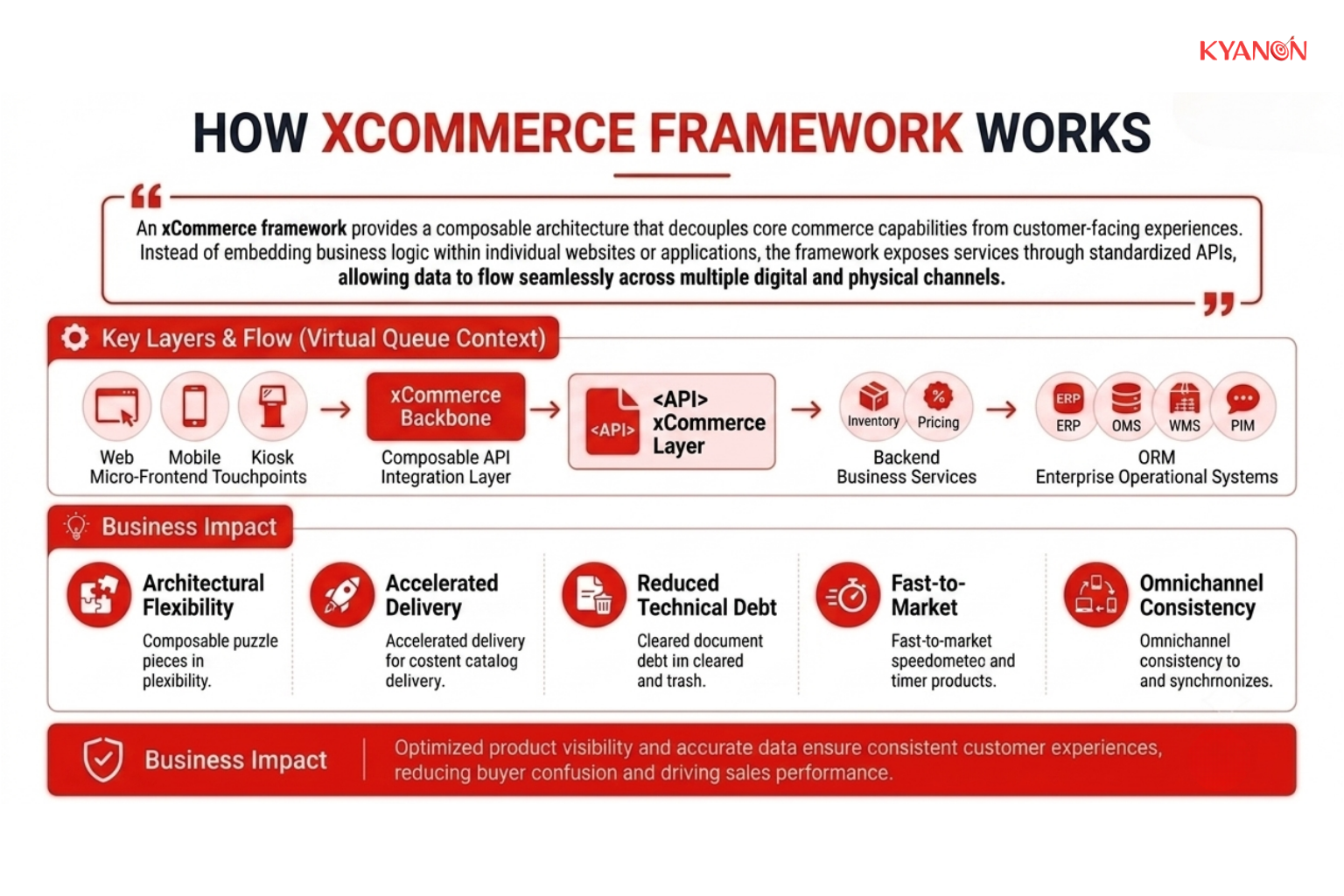
Composable API Integration Layer
The composable API layer serves as the integration backbone of the xCommerce framework, enabling independent business services to communicate while remaining loosely coupled. Rather than relying on tightly integrated, monolithic applications, organizations can assemble best-of-breed solutions that work together through standardized APIs.
Key capabilities include:
- Connecting order management, catalog, inventory, pricing, promotions, and payment services
- Integrating ERP, CRM, WMS, PIM, and third-party business applications
- Exposing reusable APIs for web, mobile, marketplace, and partner ecosystems
- Supporting rapid deployment of new commerce capabilities without modifying core backend systems
Business value: Faster system integration, greater architectural flexibility, reduced technical debt, and accelerated delivery of new digital commerce initiatives.
Micro-Frontend Touchpoint Orchestration
Customer experiences are delivered through independently deployable micro-frontends, allowing development teams to build, update, and scale each interface without affecting the rest of the digital ecosystem. This architecture enables organizations to tailor experiences for different customer journeys while maintaining consistent business logic across every channel.
Development teams can independently:
- Launch new storefronts or regional websites
- Customize experiences for mobile apps, kiosks, and POS systems
- Support social commerce, marketplaces, and emerging digital channels
- Release interface updates with shorter development and deployment cycles
Business impact: Greater agility, faster time-to-market, improved customer experience consistency, and the ability to innovate across multiple touchpoints simultaneously.
Real-Time Backend Mechanics Engine
Behind every customer interaction, the xCommerce framework orchestrates real-time communication between frontend experiences and enterprise operational systems. The architecture continuously synchronizes business data to ensure every channel operates from a single, accurate source of truth.
The orchestration engine typically manages:
Business Function | Example |
| Inventory availability | Real-time stock synchronization across warehouses and channels |
Order orchestration | Intelligent routing based on inventory and fulfillment capacity |
| Pricing and promotions | Dynamic, localized, and channel-specific pricing |
Compliance | Tax calculation, international customs, and regulatory requirements |
| Fulfillment | Warehouse execution, shipping, and delivery coordination |
By connecting customer interactions directly to ERP, OMS, WMS, PIM, CRM, and other enterprise platforms, the framework continuously synchronizes inventory availability, pricing, customer information, and fulfillment status across all active channels. This real-time orchestration minimizes operational latency, reduces data inconsistencies, and enables organizations to deliver accurate, consistent, and scalable commerce experiences regardless of where customers choose to engage.

Comparative Analysis: xCommerce Framework vs. Monolithic Omnichannel
An xCommerce framework delivers extensible, API-driven flexibility across non-traditional touchpoints, whereas traditional monolithic omnichannel setups bind digital channels to rigid, unified vendor platforms.
Dimension | xCommerce Framework | Monolithic Omnichannel Platform |
| System Architecture | Decoupled composable blocks and micro-services | Single tightly coupled code structure |
Channel Integration | Dynamic, open API access for any IoT/social interface | Pre-defined, native web and mobile store templates |
| Backend Connectivity | Direct, real-time sync with global ERP, DOM, and WMS | Batch updates via centralized platform database |
Deployment Agility | Independent micro-frontend deployments | Full application regression testing and deploy cycles |
| Vendor Lock-in | Low; individual services can be swapped out | High; fully tied to platform vendor ecosystem |
Why xCommerce Framework Matters
An xCommerce framework provides the architectural foundation for modern digital commerce by separating customer-facing experiences from core enterprise systems. This composable approach enables organizations to enhance individual commerce capabilities, such as storefronts, search, checkout, and personalization, without re-architecting underlying ERP, OMS, WMS, or CRM platforms. As a result, enterprises can reduce long-term total cost of ownership (TCO), accelerate the delivery of new digital capabilities, and continuously modernize their commerce ecosystem while preserving existing technology investments.
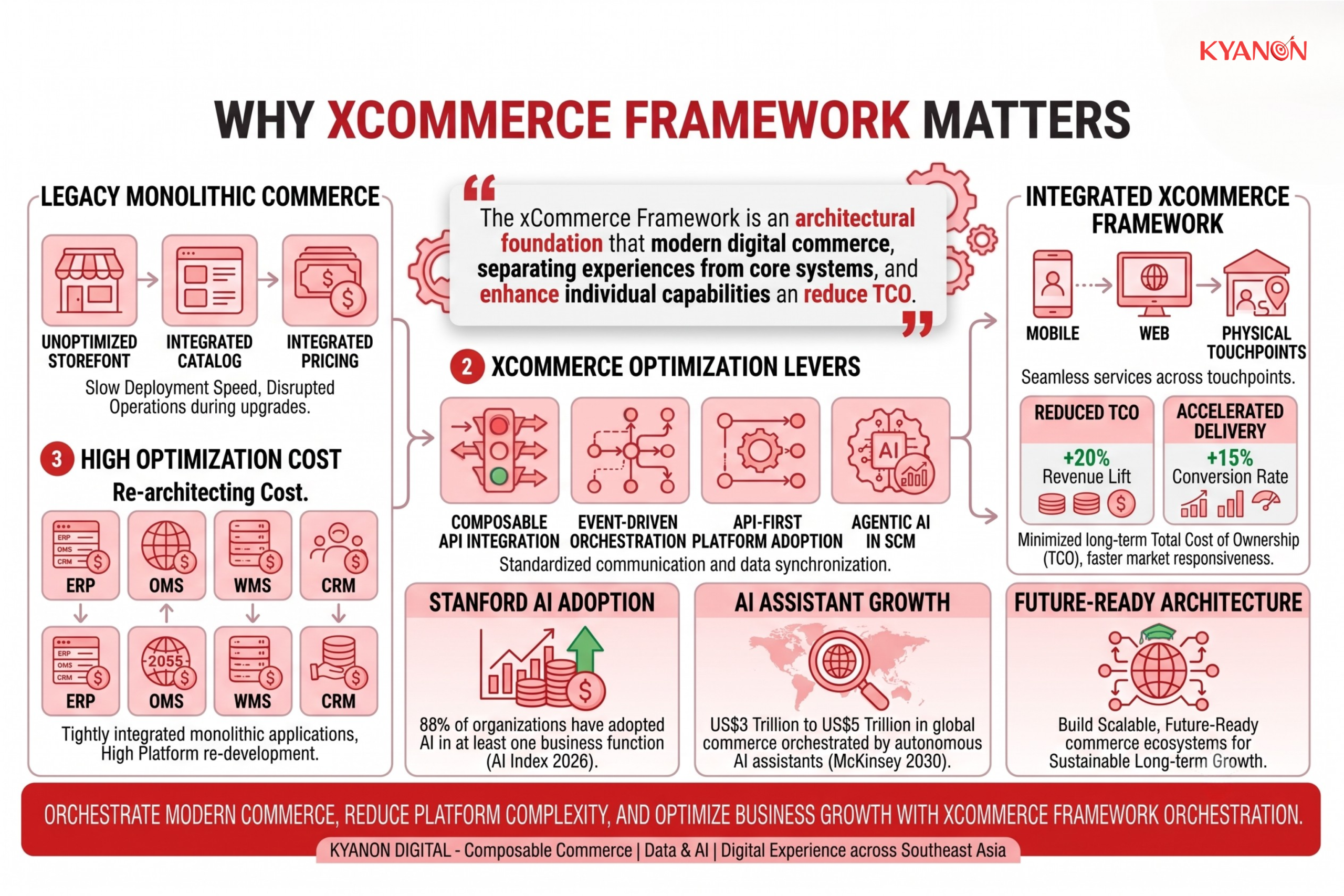
The strategic importance of xCommerce continues to grow as enterprises expand across global markets, digital channels, and increasingly sophisticated customer touchpoints. Modern commerce operations require agile architectures capable of supporting cross-border transactions, localized pricing and fulfillment, real-time inventory synchronization, and consistent customer experiences across websites, mobile applications, marketplaces, social commerce, and emerging AI-powered interfaces. Achieving this level of operational agility depends on an architecture that can evolve continuously without disrupting core business systems.
Industry research reinforces this shift toward modular, API-driven commerce. The Stanford AI Index Report 2026 found that 88% of organizations have adopted AI in at least one business function, highlighting the rapid integration of intelligent technologies into enterprise operations. Meanwhile, McKinsey estimates that autonomous AI shopping assistants could orchestrate US$3 trillion to US$5 trillion in global commerce by 2030, signaling a fundamental transformation in how consumers discover products, evaluate options, and complete purchases. These developments are driving enterprises to adopt flexible commerce architectures capable of integrating AI-driven services, new digital channels, and evolving customer journeys without requiring extensive platform redevelopment.
As digital commerce becomes increasingly intelligent and interconnected, an xCommerce framework evolves beyond a technology architecture into a strategic business capability. By combining composable services, API-first integration, and real-time orchestration, it enables organizations to innovate more rapidly, respond to changing market demands with greater agility, and build scalable, future-ready commerce ecosystems that support sustainable long-term growth.
Common Misconceptions
It is Just an Omnibus Word for Multichannel or Omnichannel
Omnichannel focuses on a business-centric view of connecting fixed data streams like standard websites and retail store mobile applications. The xCommerce framework is an open architecture structured around the fluid digital lifestyle of consumers, incorporating autonomous commerce, IoT touchpoints, and social discovery phases that extend beyond traditional channel boundaries.
It Requires a Monolithic Software Platform
Organizations do not need to purchase a heavy, all-in-one software suite to adopt this architecture. An xCommerce framework relies on an adaptable architecture blueprint that functions independently of specific platform software, utilizing composable blocks, APIs, and micro-frontends to connect existing enterprise engines like Shopify or custom legacy systems to the broader network.
It Only Solves Front-End and Customer-Facing Problems
The framework extends far beyond storefront layout modifications and unified shopping cart software. A true xCommerce architecture integrates complex backend supply chain mechanics directly with sales tools, linking real-time operational variables—such as international customs compliance, predictive purchasing, dynamic localized forecasting, and logistics—to active customer touchpoints.
The Goal is Purely Digital Automation
The framework optimizes physical retail environments and human workflows rather than phasing out personal interactions. In environments like enterprise in-store tablet setups, sales associates utilize the framework to launch micro-sites directly on the retail floor, bridging physical stockouts with global inventory access while strengthening direct consumer relationships.
How Kyanon Digital Applies xCommerce Framework
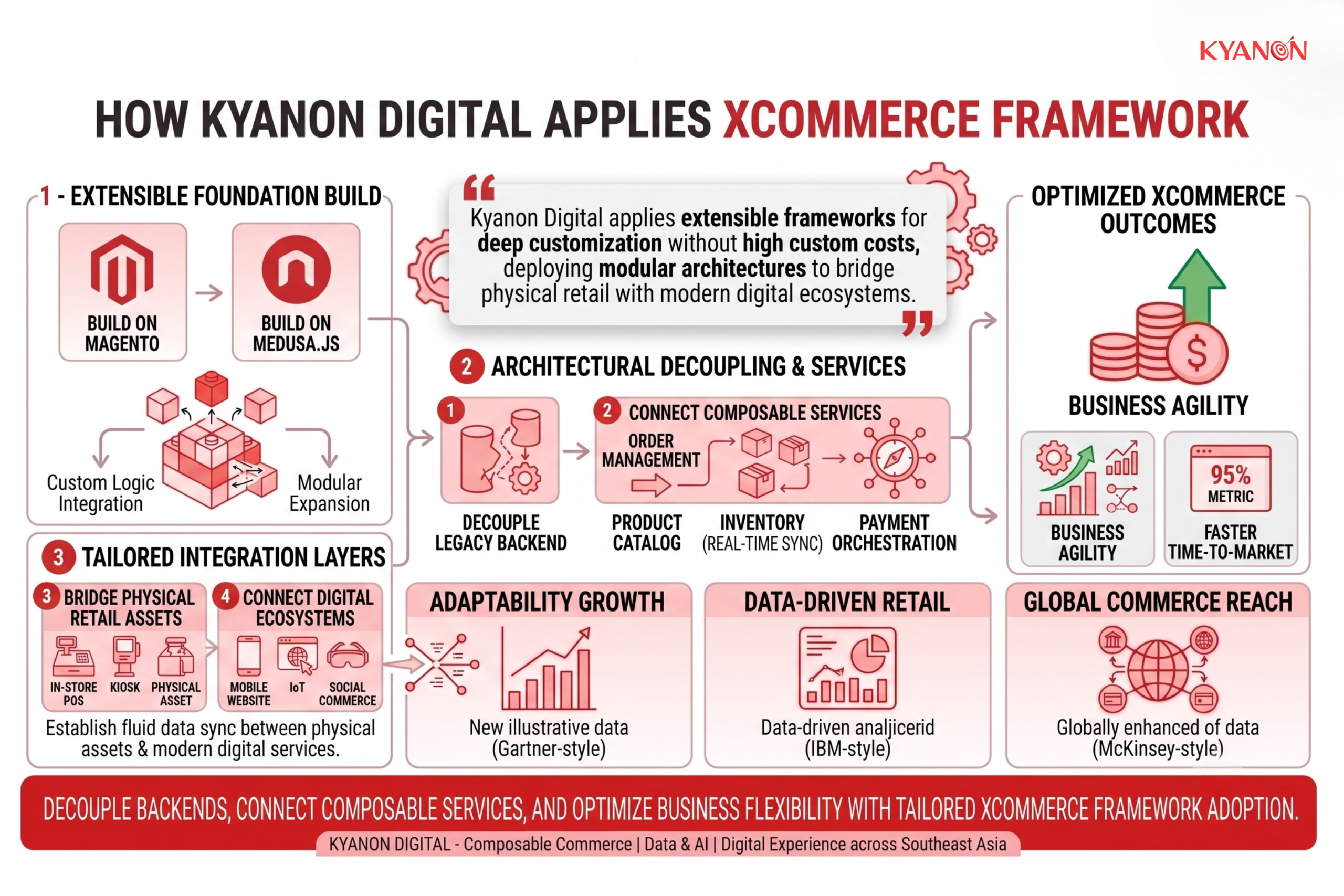
Kyanon Digital builds on extensible commerce frameworks (such as Magento and Medusa.js) for clients requiring deep customization without incurring the expense of full custom development. By deploying modular architectures and tailored integration layers, Kyanon Digital bridges physical retail assets with modern digital ecosystems.
Explore our services:

 Create project brief with AI